
Equipment
Flashback arrestors for acetylene, oxygen and fuel-gas systems
A flashback arrestor stops a flame travelling back up the hose into the cylinder. KIGL builds regulator-mount and torch-mount units to EN ISO 5175-1, combining a non-return valve, a sintered flame-arresting element, a thermal cut-off valve and an inlet filter. Suitable for acetylene, oxygen, propane, hydrogen and other fuel gases.
₹2,100 – ₹35,000 per unit Indicative. Your quotation is the figure that counts — price moves with quantity, cylinder size, contract term and delivery.
- EN ISO 5175-1
- Governing standard
- Non-return valve
- Protective elements
- Acetylene
- Gases covered
- Regulator outlet and torch inlet
- Mounting positions
- No
- Requires an SDS?
What a flashback actually is
Under the wrong conditions the flame at the torch tip stops sitting where it should and travels back up the hose. If it reaches the cylinder, an acetylene cylinder can undergo internal decomposition, and that is a rupture, not a fire.
The conditions that cause it are ordinary, not exotic: a nozzle drawing more gas than the cylinder can safely deliver, incorrect pressure settings, a blocked or damaged tip, or oxygen finding its way into the fuel line. Which is why protection is fitted as standard rather than added after an incident.
What our arrestors do
Four mechanisms in one body:
Non-return valve — stops gas flowing backwards, which is how oxygen gets into a fuel line and creates a combustible mixture inside the hose.
Sintered flame arrestor — a porous metal element that quenches an advancing flame front by removing heat faster than the flame can sustain itself.
Thermal cut-off valve — shuts off gas flow if the device gets hot, covering the case where a flame stabilises against the arrestor rather than passing through it.
Inlet filter — keeps particulate out of the mechanism, on regulator-mount units.
All four to EN ISO 5175-1, the international standard for safety devices in oxy-fuel gas welding equipment.
Fitting
Fit at both positions on both lines — regulator outlet and torch inlet, fuel gas and oxygen. The regulator unit protects the cylinder; the torch unit protects the hose run between them. Protecting only one end leaves the hose exposed, and the hose is where the flame travels.
Match the device to the gas. Fuel-gas and oxygen units are not interchangeable.
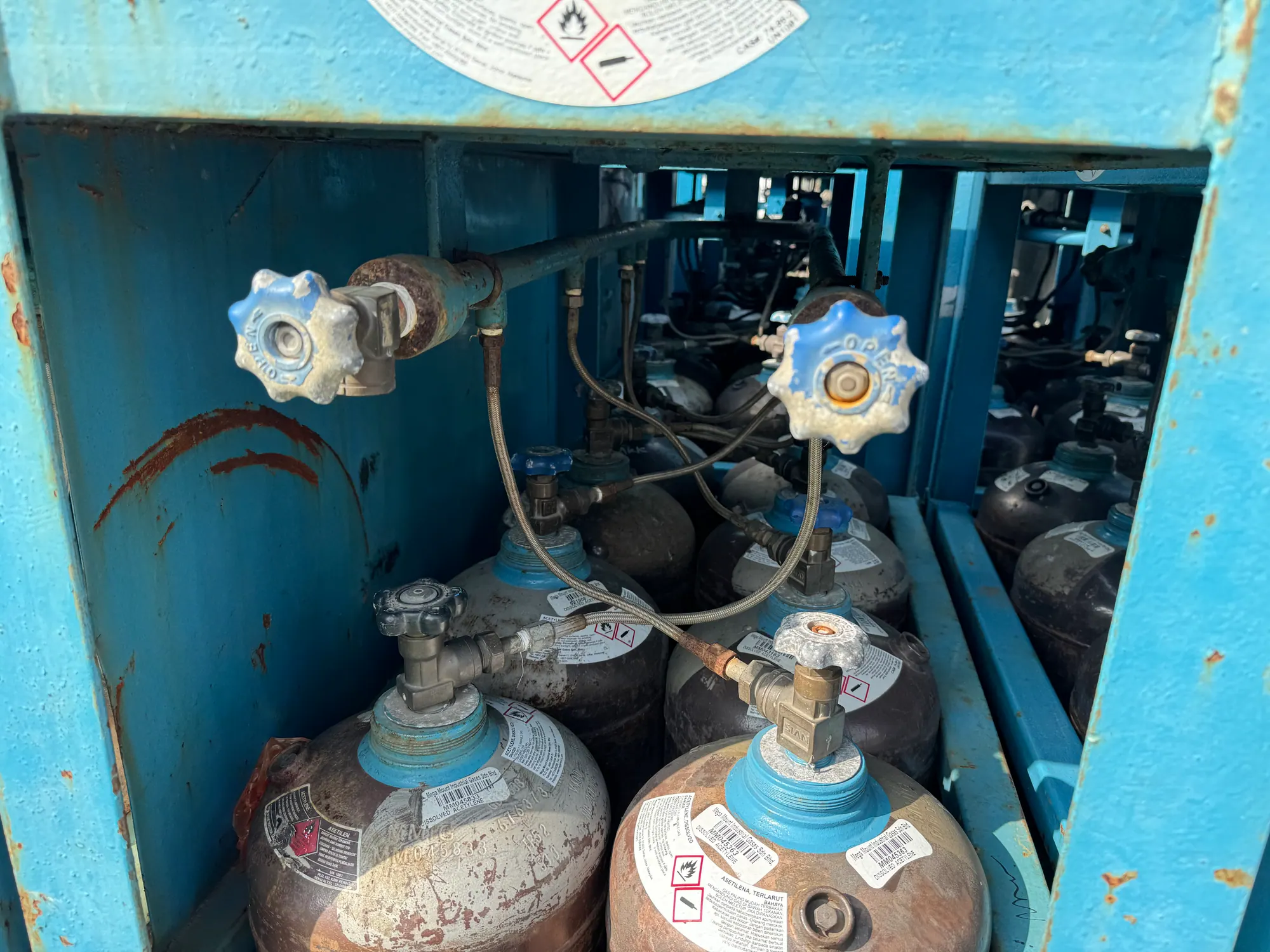
An acetylene cylinder cascade, manifolded to a single regulated take-off
Guwahati works · agent network
Replacement
After any flashback, replace the device. It has absorbed a flame front and cannot be assumed intact. Also replace if the thermal cut-off has operated, if the element is contaminated, or at the manufacturer’s stated interval.
An arrestor is cheap. The cylinder it protects, and the person standing next to it, are not.
Safe handling
We are asked for an “MSDS for flashback arrestors” often enough that it deserves a plain answer.
A safety data sheet describes the hazards of a chemical substance or mixture. A flashback arrestor is an article — a manufactured device, and articles are outside the scope of GHS safety data sheets. No manufacturer anywhere issues a genuine SDS for one, and a document claiming to be one should be treated with suspicion.
What belongs in your safety file instead:
Documentation — and why there is no MSDS
- the technical datasheet — gas service, flow capacity, working pressure, thread specification;
- the declaration of conformity to EN ISO 5175-1;
- the installation and inspection instructions.
Why KIGL
Why buy from a gas manufacturer
We make acetylene, we build the plants that produce it, and we fill cylinders every day. Flashback protection is not a catalogue line we resell. It protects our own product in our own customers' hands, and we have been dealing with the consequences of getting it right since 1947.
Specification
Flashback arrestors — full specification
| Property | Value | Basis |
|---|---|---|
| Governing standard | EN ISO 5175-1 | — |
| Protective elements | Non-return valve, sintered flame arrestor, thermal cut-off, inlet filter | KIGL product specification |
| Gases covered | Acetylene, oxygen, propane, propylene, ethylene, methane, hydrogen | KIGL product specification |
| Mounting positions | Regulator outlet and torch inlet | EN ISO 5175-1 recommended practice |
| Requires an SDS? | No — an arrestor is an article, not a chemical | GHS scope |
| Standard | EN ISO 5175-1 | Type test |
| Non-return (check) valve | Fitted | EN ISO 5175-1 |
| Flame arresting element | Sintered metal | EN ISO 5175-1 |
| Thermal cut-off valve | Fitted — shuts gas flow on temperature rise | EN ISO 5175-1 |
| Inlet filter | Fitted on regulator-mount units | KIGL specification |
| Body material | Brass | — |
Questions
Flashback arrestors — frequently asked questions
Do you have an MSDS for your flashback arrestors?
No, and none is required. A safety data sheet describes a chemical substance or mixture. A flashback arrestor is an article — a manufactured device — so it falls outside the scope of GHS safety data sheets. What you need for your safety file is the technical datasheet and the declaration of conformity to EN ISO 5175-1, both of which we supply. If a purchasing system is demanding an "MSDS" for arrestors, send us the request and we will provide the correct documentation in a form your auditor will accept.
Where should flashback arrestors be fitted?
For the highest level of protection, fit them at both ends: at the regulator outlet and at the torch inlet, on both the fuel gas and the oxygen lines. The regulator unit protects the cylinder; the torch unit protects the hose. Fitting only one leaves a length of hose unprotected.
What is the difference between a non-return valve and a flashback arrestor?
A non-return valve only prevents reverse gas flow. A flashback arrestor does that and also stops a flame front, using a sintered element to quench it, plus a thermal cut-off that shuts off gas if the device heats up. A non-return valve on its own is not flashback protection.
How often should arrestors be replaced?
Replace after any flashback event, without exception, and inspect at the intervals given in the manufacturer’s instructions. A device that has arrested a flame has done its job once and must not be relied on again. They should also be replaced if the thermal cut-off has operated or the element is contaminated.
Can I use the same arrestor for oxygen and acetylene?
No. Fuel-gas and oxygen arrestors are different devices with different thread forms, and oxygen units are prepared for oxygen service. Fitting the wrong one is dangerous. Our units are marked for their gas.
Why did my arrestor stop gas flow when there was no flashback?
Usually the thermal cut-off responding to heat, or the non-return valve seating because of a pressure imbalance — often from drawing more gas than the cylinder can safely deliver. Over-draw is the common cause. Check your withdrawal rate against the cylinder rating before assuming the device has failed.
Read next
Enquiries
Request a quotation for flashback arrestors
State the gas or equipment, the quantity or capacity, and your location. KIGL will confirm the grade, the cylinder or plant size, and whether the location can be served from Noonmati, or through our agent network.