Gases
Argon gas for TIG and MIG welding, heat treatment and laboratory use
Argon is the standard shielding gas for TIG and MIG welding because it is completely inert and heavier than air, so it blankets the weld pool rather than drifting off it. KIGL supplies argon to IS 5760 in welding grade at ≥99.99 % and higher purity on request, in cylinders and cascades.
₹220 – ₹250 per Nm³ Indicative. Your quotation is the figure that counts — price moves with quantity, cylinder size, contract term and delivery.
- IS 5760
- Specification
- ≥99.99 % Ar
- Purity, welding grade
- Peacock blue
- Cylinder colour
- EN ISO 14175
- Shielding gas standard
- UN 1006
- UN number
Why argon is the default shielding gas
Two properties, and both matter.
It is a noble gas — genuinely inert, with no reaction with molten metal at any welding temperature. And it is heavier than air, at about 1.38 times the density, so it settles over the weld pool and stays there instead of drifting away.
Nitrogen is cheaper and unreactive at room temperature, but it dissociates in the arc and can form nitrides that embrittle the weld. Helium works and gives a hotter arc, but costs far more and is lighter than air so it needs higher flow. Argon is the practical answer for most work, which is why it dominates.
KIGL supplies argon to IS 5760 in welding grade at ≥99.99 %, with higher purity on request.
Argon applications in industry
TIG welding
The standard shielding gas across steel, stainless, aluminium and reactive metals.
MIG welding
Pure argon for aluminium; argon-CO₂ or argon-oxygen mixtures for carbon and stainless steel, where a little active gas improves arc stability and penetration.
Root purging
Displacing air from the underside of a weld to prevent oxidation, particularly on stainless steel pipework.
Heat treatment
Annealing, brazing and hot isostatic pressing under a protective atmosphere.
Laboratory use
Carrier gas in gas chromatography, and the plasma source in ICP-MS.
Metal production
Argon stirring and degassing in steel and non-ferrous processing.
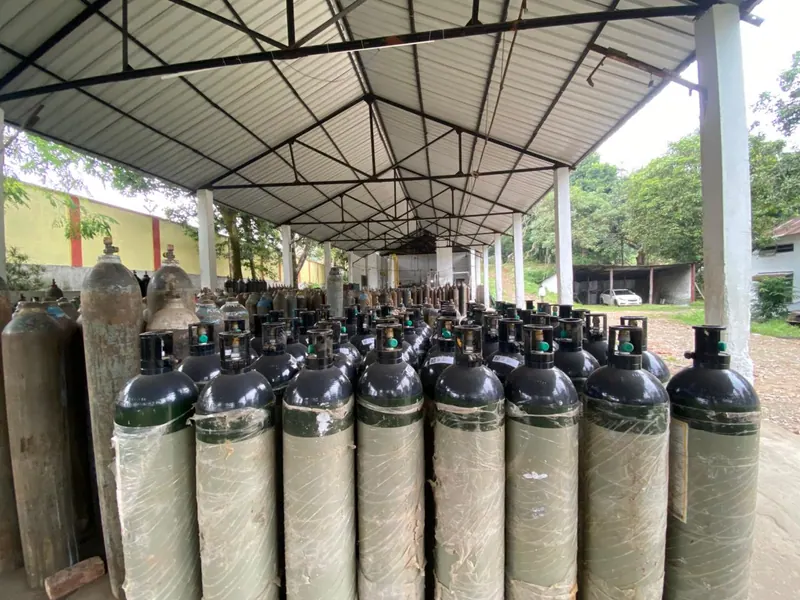
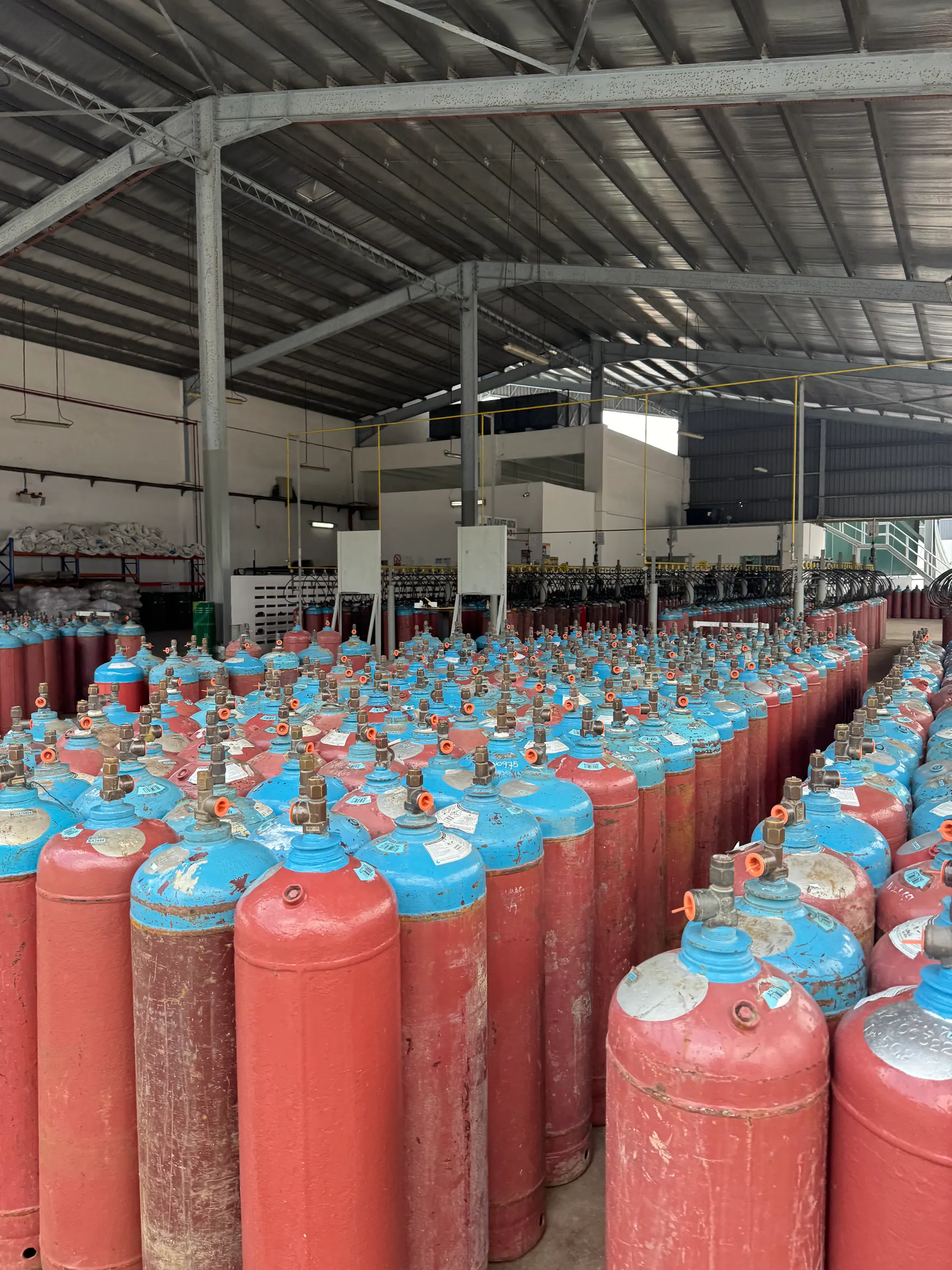
Filled industrial gas cylinders, ranked upright in the yard for despatch
Guwahati works · agent network
Getting the shielding right
Most argon-related weld defects are not gas quality problems. They are shielding problems.
More flow is not better shielding
Excessive flow becomes turbulent at the nozzle and actively draws air into the shield. If a weld looks grey or sooty, reduce flow before increasing it.
Draughts destroy shielding
A fan or an open shutter across the work will contaminate the weld regardless of gas purity.
Check the delivery path
A cracked hose, a worn gas lens or a loose fitting lets air in downstream of everything you paid for.
Purge properly at the start of a run and after any cylinder change.
Safety
Argon is inert, non-toxic and non-flammable — and an asphyxiant that gives no warning.
Because it is heavier than air, argon collects in pits, trenches, tank bottoms and confined spaces and stays there. This is the specific hazard that kills welders: an argon-filled pit looks exactly like an empty pit. Someone entering loses consciousness within a breath or two, with no smell, no irritation and no sense of breathlessness.
Monitor oxygen before entering any low-lying or confined space where argon has been used. Never rely on ventilation clearing it by itself.
Full detail is in our argon safety data sheet.
Argon cylinder sizes and supply across India
Cylinders and cascades from Guwahati, and through a network of agents, with exchange and refill programmes, and mixtures specified against your material and process rather than sold from a standard list.
Why KIGL
Why buy argon from KIGL
We have filled industrial gas in Assam since 1947, under PESO licence, to the Indian Standards our own people helped draft. Argon is a gas where the grade is decided by the work rather than by the price list. Tell us the parent metal, the thickness and the transfer mode, and we will specify against the weld. If a cheaper grade will hold it, we will say so.
Specification
Argon gas — full specification
| Property | Value | Basis |
|---|---|---|
| Specification | IS 5760 | Bureau of Indian Standards |
| Purity, welding grade | ≥99.99 % (O₂ ≤50 ppm, H₂O ≤20 ppm) | IS 5760 |
| Cylinder colour | Peacock blue | IS 4379 |
| Shielding gas standard | EN ISO 14175 | — |
| UN number | UN 1006 (compressed) | ADR 2025 |
| Proportion of atmosphere | 0.93 % | Literature |
| Chemical symbol | Ar | — |
| Purity, high-purity grade | ≥99.999 % (O₂ ≤5 ppm, H₂O ≤5 ppm) | On request |
| Relative vapour density (air = 1) | ≈1.38 — heavier than air | Literature |
| Supply form | Cylinders and cascades | — |
Documents
Argon gas — safety and technical documentation
Questions
Argon gas — frequently asked questions
Why is argon better than nitrogen as a shielding gas?
Argon is a noble gas and genuinely inert under welding conditions. Nitrogen, despite being unreactive at room temperature, dissociates in the arc and can form nitrides in the weld metal, causing porosity and embrittlement in steels. Argon is also heavier than air, so it blankets the pool instead of drifting away.
Do I need pure argon or an argon mixture?
Pure argon for TIG on most materials, and for MIG on aluminium. For MIG on carbon and stainless steel an argon-CO₂ or argon-oxygen mixture usually gives better arc stability and penetration. Tell us the material, thickness and process and we will specify it rather than guess.
What purity do I need?
Welding grade at ≥99.99 % covers most fabrication. Reactive metals — titanium, zirconium — and analytical instrumentation need higher purity, because residual oxygen and moisture at even a few ppm cause discolouration or affect results. Aerospace and nuclear work often specifies higher grade for that reason.
Why does my TIG weld look grey or sooty?
Usually atmospheric contamination of the shield: gas flow too low, flow too high causing turbulence that pulls air in, a damaged gas lens, a leaking hose, or a draught across the work. Counter-intuitively, increasing flow is often the wrong fix — turbulence draws in more air than it excludes.
Do you supply liquid argon?
Not currently. We supply liquid oxygen and liquid nitrogen; argon is cylinder and cascade supply. If you have a bulk argon requirement, talk to us and we will tell you honestly whether we can serve it.
Why is argon cylinder colour peacock blue?
IS 4379 colour coding. As always, confirm against the stamped markings and label rather than colour alone — customer-owned and traded cylinders in circulation do not always follow the code.
Read next
Enquiries
Request a quotation for argon gas
State the gas or equipment, the quantity or capacity, and your location. KIGL will confirm the grade, the cylinder or plant size, and whether the location can be served from Noonmati, or through our agent network.