
Equipment
KIGL-FBA-HP — the hose-mounted flashback arrestor for welding and cutting sets
The KIGL-FBA-HP is the hose-mounted model in the KIGL-FBA range, built to IS 11006 : 2011 for welding and cutting sets. It fits 5.0 to 10.0 mm hose on 1/4 in or 3/8 in BSP threads, left or right hand, and holds 20.0 bar on air or oxygen and 1.5 bar on acetylene.
Written and checked by KIGL technical staff
- 20.0 bar
- Air or oxygen maximum
- 5.0 bar
- LPG maximum
- 1.5 bar
- Acetylene maximum
- 5.0 to 10.0 mm bore
- Hose sizes
- 1/4 in and 3/8 in BSP
- Outlet threads
On this page 7 sections
Where the KIGL-FBA-HP sits on a welding set #
The KIGL-FBA-HP is the hose-mounted model in the KIGL-FBA range, and it is the only one of the four that a welder handles. It screws directly onto welding and cutting hose, serving fuel gases, oxygen and air, and it stops a flashback before the flame can travel back along the hose to the regulator and the cylinder.
It is specified against the hose rather than against a pipe, which is why the two numbers that matter on an order are the hose bore in millimetres and the hand of the thread. A set takes four units: one at each regulator outlet and one at each torch inlet, on both lines.
What a flashback is, how the sintered element quenches it and how IS 11006 classifies the device are covered on the range page, flash back arrestors. This page covers the -HP alone.
Hose sizes and outlet threads #
| Hose bore, inlet and outlet | Outlet thread |
|---|---|
| 5.0 / 6.0 mm | ¼″ BSP, left or right hand |
| 8.0 / 9.0 / 10.0 mm | ⅜″ BSP, left or right hand |
Left hand is fuel gas and right hand is oxygen. That difference is not a convention but a physical interlock, and it is the reason a fuel-gas body cannot be fitted to an oxygen line by mistake. Other thread forms, materials and surface finishes are made to order.
KIGL-FBA-HP, filled and despatched from KIGL's own works.
Guwahati works · agent network
Maximum working pressure, gas by gas #
| Gas | Maximum working pressure |
|---|---|
| Air / oxygen | 20.0 bar |
| LPG | 5.0 bar |
| Acetylene | 1.5 bar |
| Natural gas | 0.6 bar |
Those are device maxima, not working points. A welding set draws acetylene at a small fraction of 1.5 bar, and an arrestor is sized on its flow curve at the pressure actually used: a regulator-outlet device measured on air at 20 °C passes about 1.4 Nm³/h at 0.1 bar, 12.8 at 0.9 bar and 19.5 at 1.5 bar. A large cutting nozzle at the end of a long hose with four devices in series is the commonest flow complaint on a set, and it is a stacking problem rather than a cylinder problem. The measured tables are in flashback arrestor pressure drop and flow capacity.
The -HP holds 20.0 bar on oxygen where the pipeline KIGL-FBA-PM holds 25.0 bar, so a manifold header running above 20 bar takes the -PM rather than this model. Where the fuel gas is LPG, natural gas or hydrogen running beside oxygen at equal or higher pressure, the body specified is the KIGL-FBA-NRV, which holds 16.0 bar on those gases and is sized by nominal bore from DN6 to DN150 rather than by hose.
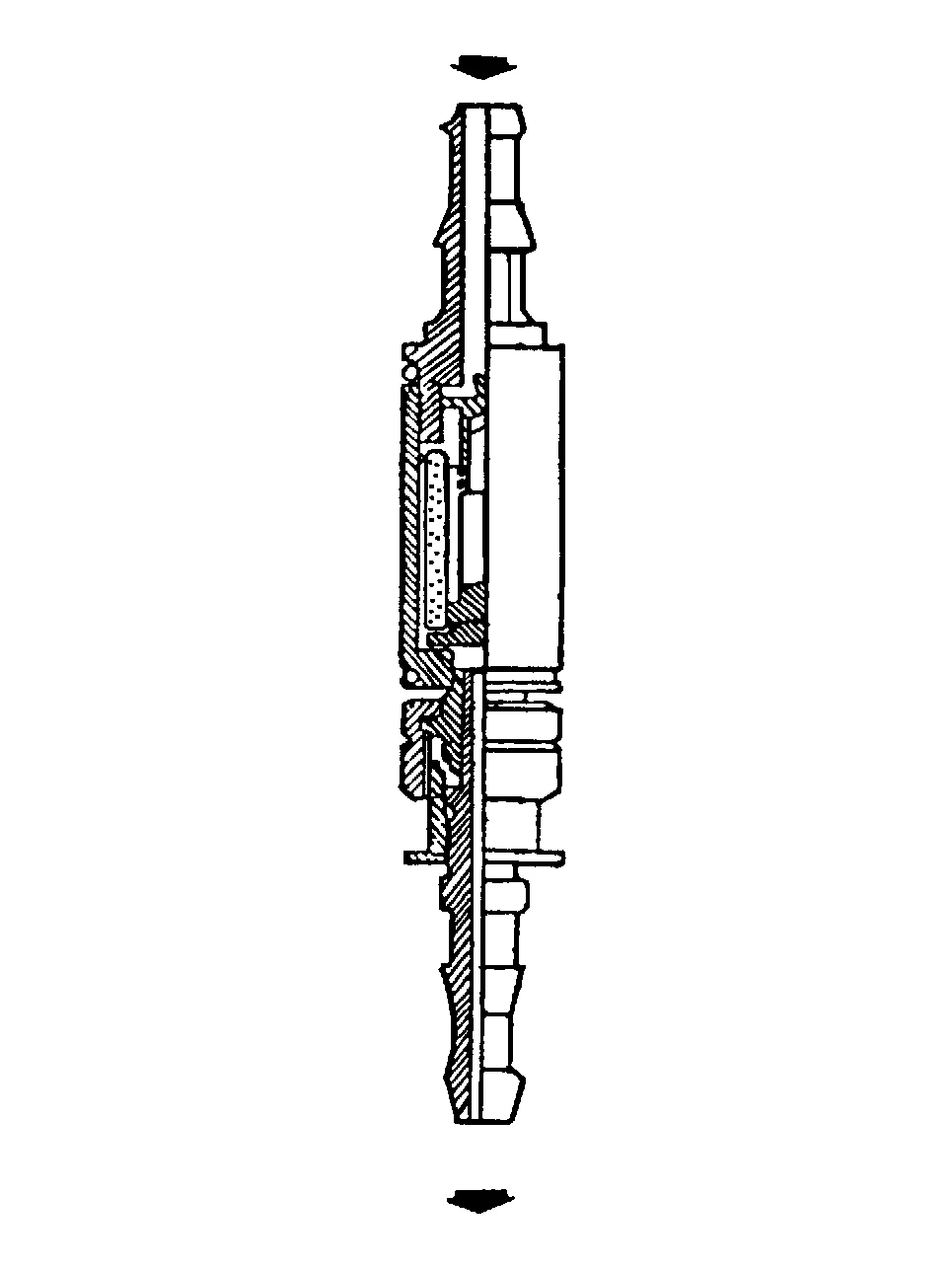
The two safety elements in an -HP body #
-
Non-return valve
This blocks reverse gas flow, which is how oxygen reaches a fuel hose and forms a combustible mixture inside it. Backfeed through a torch with unequal line pressures is the ordinary cause.
-
Flame-arrestor block
This quenches an advancing flame front by taking heat out of the reaction zone faster than the reaction can produce it, and it is what makes the device an arrestor rather than a check valve.
-
The pair together, not either alone
A non-return valve on its own is not flashback protection, because it does nothing to a flame front; a quenching element on its own does nothing to the pressure wave that runs ahead of the flame. The distinction is set out in non-return valve vs flashback arrestor.
Key points
Fitting and replacing a hose-mounted arrestor #
- Count four units per set, not one A device at each regulator outlet and each torch inlet, on the fuel-gas line and on the oxygen line. Protecting one end leaves the hose exposed.
- Match the bore before the thread A 1/4 in BSP body on a 10 mm hose is a throttle on a line already carrying two pressure drops.
- Replace after any flashback, without exception The device has absorbed a flame front and cannot be assumed intact. Soot or discolouration at the outlet condemns it on its own.
- Never test with oxygen, and never return an air-service unit to oxygen duty The annual check is an external leak test at working pressure, a reverse-flow test with dry oil-free nitrogen at 1 to 2 bar applied to the outlet, and a flow check on a calibrated bench.
- Treat an untraceable unit as spent An arrestor that cannot be tied to a known installation is treated as having arrested a flame, because the only evidence of a flashback may be inside the element.
Every unit is tested for gas tightness and gas return before dispatch, and should be tested again at least once a year by a qualified person. The full schedule and the IS 11006 test clauses behind it are in flashback arrestor testing and replacement.
Specification
KIGL-FBA-HP — full specification
| Property | Value | Basis |
|---|---|---|
| Air or oxygen maximum | 20.0 bar | Maximum working pressure, KIGL-FBA technical specification |
| LPG maximum | 5.0 bar | Maximum working pressure, KIGL-FBA technical specification |
| Acetylene maximum | 1.5 bar | Maximum working pressure, KIGL-FBA technical specification |
| Hose sizes | 5.0 to 10.0 mm bore | Inlet and outlet, KIGL-FBA technical specification |
| Outlet threads | 1/4 in and 3/8 in BSP, left or right hand | KIGL-FBA technical specification |
| Safety elements | Non-return valve and flame-arrestor block | KIGL-FBA technical specification |
| Governing standard | IS 11006 : 2011 | International equivalent EN ISO 5175-1 |
| Natural gas maximum | 0.6 bar | Maximum working pressure, KIGL-FBA technical specification |
| Mounting positions | Regulator outlet and torch inlet | EN ISO 5175-1 recommended practice |
Questions
KIGL-FBA-HP — frequently asked questions
Which thread goes with which hose bore on the KIGL-FBA-HP?
A 5.0 or 6.0 mm hose takes a 1/4 in BSP outlet, and an 8.0, 9.0 or 10.0 mm hose takes a 3/8 in BSP outlet. Both are offered left hand for fuel gas and right hand for oxygen, so an order states the bore in millimetres and the hand of the thread.
How many KIGL-FBA-HP units does one welding set need?
Four, counted per line and per end rather than per set. Full protection is a device at the regulator outlet and a device at the torch inlet, on the fuel-gas line and on the oxygen line. Fitting only one end leaves the length of hose between them unprotected, and the hose is where the flame travels.
Why is the acetylene rating only 1.5 bar when the oxygen rating is 20.0 bar?
Because the gas, not the device, sets the limit. Free acetylene decomposes without an oxidant once compressed, so Indian practice holds it near atmospheric pressure. The same body holds 20.0 bar on air or oxygen. An arrestor advertised for acetylene at 10 bar is describing a system that should not exist.
Does the KIGL-FBA-HP have a temperature cut-off?
The published elements for this model are a non-return valve and a flame-arrestor block. The temperature-activated cut-off is published on the pipeline and manifold [KIGL-FBA-PM](/kigl-fba-pm-pipeline-flashback-arrestor). Confirm the device configuration with KIGL before writing a cut-off into a work instruction, because IS 11006 recognises five configurations and a quotation should say which one it offers.
My torch starves at settings that used to work. Is the arrestor the cause?
Often, and in two ways. Two devices in series on one line are two pressure drops rather than one, so a long hose with four arrestors on it can starve a large tip that a short hose fed properly. The second cause is a fouling element: pressure drop rises as the pores load, and a creeping drop is the earliest warning an arrestor gives. The measured tables are in [pressure drop and flow capacity](/guides/flashback-arrestor-pressure-drop-and-flow-capacity).
Can one KIGL-FBA-HP be moved between the fuel-gas and the oxygen line?
No. The two are different devices with different thread hands, and a unit prepared for oxygen service is never returned to fuel-gas or compressed-air duty. KIGL units are marked for their gas, and a device whose marking cannot be read cannot be fitted to a known line.
References
Bureau of Indian Standards.
- IS 11006:2011, First RevisionFlash back arrestor (flame arrestor) — Specification (2011)
- The Kamrup Industrial Gases Limited. (2026). Company information and manufacturer's data [Company statement].
Read next
Enquiries
Request a quotation for KIGL-FBA-HP
State the gas or equipment, the quantity or capacity, and your location. KIGL will confirm the grade, the cylinder or plant size, and whether the location can be served from Noonmati, or through the agent network.