
Equipment
Acetylene cylinder filling plants — manifold, arrestors, weighing and the filling hall
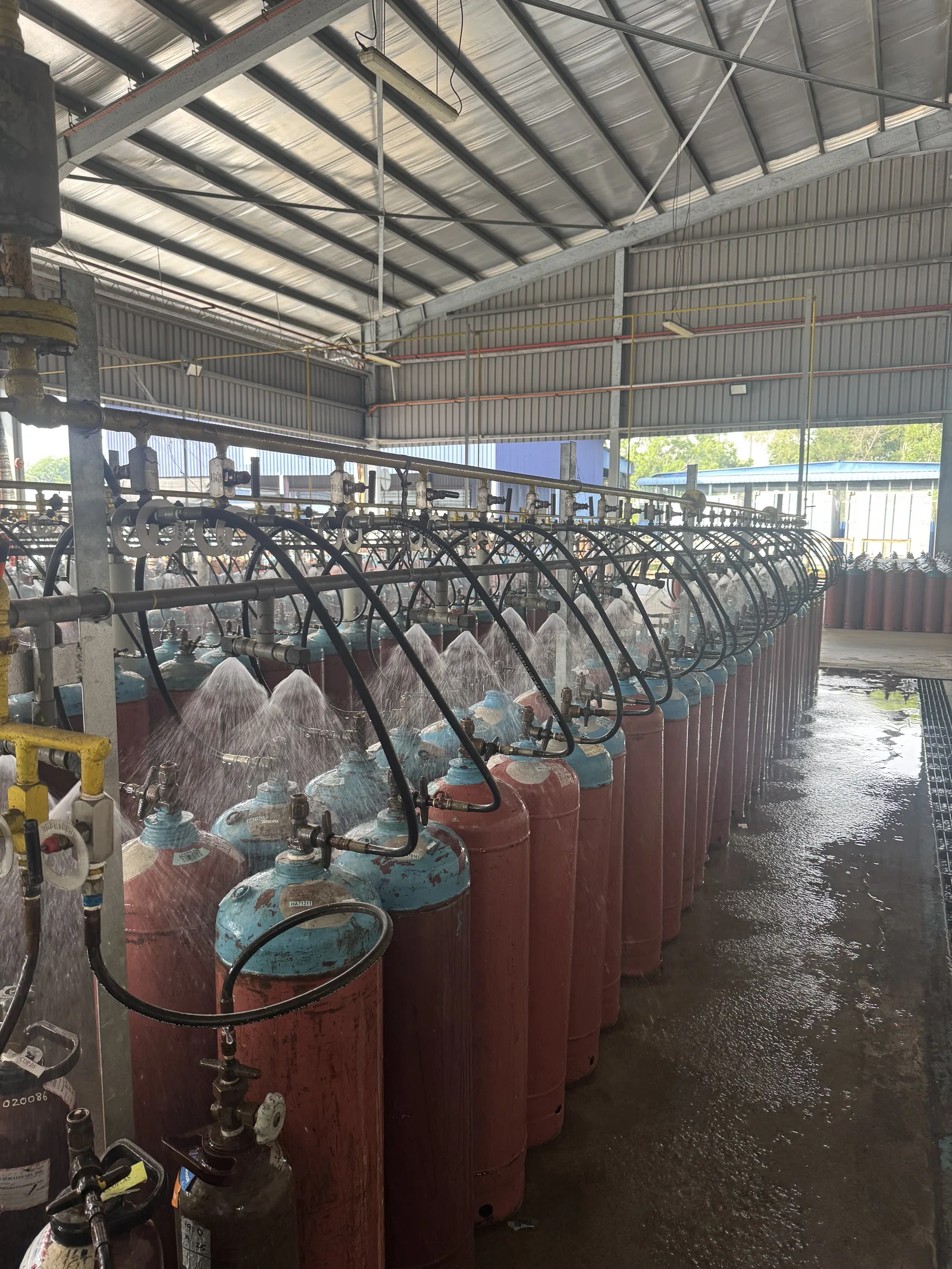
An acetylene cylinder filling plant is the manifold and hall where compressed gas enters acetone-charged cylinders. KIGL builds it with the manifold held at 12 to 14 kg/cm²g, three flame arrestors with non-return valves in series on each manifold, weigh-based fill checks, and a water deluge over the bay.
Written and checked by KIGL technical staff · Reviewed by Devendra Kumar Garg, Founder and Chairman
- 12 to 14 kg/cm²g
- Manifold working pressure
- Three flame arrestors with non-return valves
- Arrestors per manifold
- DN 25 not exceeded where possible
- Manifold pipe bore
- Cylinders and manifold cooled while filling
- Cooling during filling
- Weight
- Fill check method
On this page 10 sections
What a filling plant actually is #
A dissolved acetylene cylinder is not filled the way an oxygen cylinder is filled. It is not a pressure vessel being charged to a pressure. It is a sponge of porous mass soaked in acetone, and acetylene is being dissolved into that acetone under pressure.
Everything unusual about a filling plant follows from that. The fill is checked by weight. The manifold runs at a modest pressure. The cylinders are cooled while they fill. And the pipework is deliberately as narrow as the duty allows.
The pressure stack #
Four pressures sit in a line on the high-pressure side of the plant, and they must be read together:
| Point | Setting | Source |
|---|---|---|
| Compressor high-pressure switch | 24 kg/cm²g | Compressor operation manual |
| Back-pressure regulator after HP drier | 14 to 17 kg/cm²g | IS 15190 (Part 2) cl 5.3.1 |
| Charging manifold | 12 to 14 kg/cm²g | KIGL-DA operating manual |
| Cylinder, maximum | 16 kgf/cm² at 15 °C | Gas Cylinders Rules 2016, Rule 37 |
A plant where these four figures do not descend in order has had one of them adjusted, and the adjustment is almost always upward and almost always to make gas faster.
Three arrestors in series #
The filling side carries the strictest flame-arrestor requirement on the whole plant. IS 15190 (Part 2):2002 cl 8.6 asks for three flame arrestors with non-return valves, in series, on each charging or discharging manifold — not one, and not one per cylinder in place of the manifold set.
The reason is where this equipment sits. A decomposition in the generator is contained by a vessel at under 1 kg/cm²g. A decomposition on the charging rack is in gas at fourteen times that pressure, surrounded by cylinders. Protection here is layered because a single device failing has nowhere benign to fail to.
Individual cylinder connections carry their own arrestors in addition. KIGL's own range of bodies for this duty is on flash back arrestors.
Narrow pipe is the other defence #
Acetylene will not sustain a decomposition in a pipe below a certain bore, and the filling side is designed around that fact rather than around flow convenience.
- IS 15190 (Part 2) cl 6.4: DN 25 not exceeded where possible, DN 40 never.
- The C.P.I. code for the high-pressure part of a dissolved acetylene plant: pipe bore not above 21 mm for charging racks and 15 mm for individual connections, in seamless drawn, heat-treated mild steel able to withstand more than ten times the maximum compression pressure.
The measured basis for all of this — why bore matters more than wall thickness — is set out in pipe diameter and detonation.
Acetylene cylinder filling plants, filled and despatched from KIGL's own works.
Guwahati works · agent network
Weighing, and why pressure is not the check #
The fill record for each cylinder gives its serial number, stencil weight, actual weight, gauge pressure, residual gas, acetone added, full and net weight, and normal cubic metres. Pressure is on that list, but it is not the acceptance figure. Weight is.
A dissolved acetylene cylinder at a given pressure may hold very different quantities of gas, depending on its temperature, how much acetone it holds, and how much gas was left in it when it arrived. A cylinder weighed before and after is the only measurement that answers the question. The arithmetic is on checking contents by weight.
Acetone loss is the quiet problem here. Acetone leaves with the gas over a cylinder's life, and a cylinder short of acetone will not take its rated charge. That is why acetone added is a recorded field rather than an occasional top-up.
The hall #
The filling bay itself is regulated space, not just covered space. A KIGL filling hall is laid out to the Gas Cylinders Rules, with a water deluge over the filling bay, flammable cylinders separated from oxidising cylinders, and the storage shed held at its own distances.
Form F requires at least 3 m clear distance all round the shed with industrial fencing not less than 2 m high, flammable-gas cylinders separated from oxidising-gas cylinders by at least 1 m or a fire-resisting partition, and at least two portable foam or chemical extinguishers of 10 kg each.
Licensing #
Filling is licensed separately from generation. Rule 43 of the Gas Cylinders Rules 2016 requires a licence to fill, and Rule 44 a licence to possess. Rule 37 governs the dissolved acetylene cylinder itself. The full document list for both the Form C application and the licence grant is on the PESO licence guide.
Supply, spares and commissioning #
KIGL builds the filling manifold and hall as part of a complete KIGL-DA plant, and also supplies a manifold on its own for plants of other makes. A manifold bought separately is sized from the drawings of the installation rather than from a catalogue, because the number of filling points follows the cylinder throughput and the space in the bay. The pressure stack is the other fixed point. The manifold works at 12 to 14 kg/cm²g, and three flame arrestors with non-return valves sit in series on it. That is the requirement of IS 15190 (Part 2):2002 cl 8.6.
To quote for a filling manifold alone, KIGL needs the cylinders being filled and the number filled per shift. It also needs the layout of the filling bay, the pressure the high-pressure side is set at today, and the process flow drawing or schematic. The licence held for the site matters as well, because filling is licensed separately under Rule 43 of the Gas Cylinders Rules 2016.
A filling plant is licensed as a filling plant, and the licence describes the bay as built. Replace a manifold, move a bay or change the number of filling positions and the amended drawing goes back through PESO for approval before anything is commissioned. KIGL does not commission against an unamended licence, so the paperwork and the order run together rather than one after the other. The forms, and the order they are filed in, are in the PESO licence guide.
Erection and commissioning are supervised, not taken over. KIGL supervises the installation and trains your operators on the bay they will actually work, while the civil work, the utilities and the labour remain the buyer's.
Specification
Acetylene cylinder filling plants — full specification
| Property | Value | Basis |
|---|---|---|
| Manifold working pressure | 12 to 14 kg/cm2 gauge, held by a back-pressure valve | KIGL-DA series operating manual |
| Arrestors per manifold | Three flame arrestors with non-return valves, in series | IS 15190 (Part 2):2002, cl 8.6 |
| Manifold pipe bore | DN 25 not exceeded where possible, and DN 40 never | IS 15190 (Part 2):2002, cl 6.4 |
| Cooling during filling | Cylinders and manifold cooled while filling | IS 15190 (Part 2):2002, cl 8.10 |
| Fill check method | Weight, because cylinder pressure does not show contents | KIGL-DA series operating manual |
| Maximum cylinder pressure | Not above 16 kgf/cm2 at 15 degrees Celsius | Gas Cylinders Rules 2016, Rule 37 |
| High-pressure pipe bore limit | 21 mm charging racks, 15 mm individual connections | C.P.I., Safety in the Production and Use of Acetylene, 1968 |
| High-pressure pipe bore | 21 mm on charging racks and 15 mm on individual connections | C.P.I., Safety in the Production and Use of Acetylene, 1968 |
| Built for plant sizes | KIGL-DA-25, DA-50 and DA-100, and other makes sized from drawings | KIGL plant range |
Questions
Acetylene cylinder filling plants — frequently asked questions
Why is an acetylene cylinder filled by weight rather than by pressure?
Because the pressure in a dissolved acetylene cylinder tells you almost nothing about how much gas is in it. The acetylene is dissolved in acetone held in a porous mass, so the pressure reflects temperature and the acetone's saturation far more than the quantity present. The only reliable measure is weight. See [cylinder pressure does not show contents](/guides/acetylene-cylinder-pressure-does-not-show-contents).
What pressure does the charging manifold run at?
12 to 14 kg/cm²g, held by a back-pressure valve. The compressor's own high-pressure switch is set at 24 kg/cm²g, well above it, and IS 15190 (Part 2) requires a back-pressure regulator after the high-pressure drier holding 14 to 17 kg/cm² gauge. The manifold sits at the bottom of that stack, and a plant where the three figures disagree has had one of them moved.
How many flame arrestors does a filling manifold need?
Three, in series, with non-return valves, on each charging or discharging manifold. That is IS 15190 (Part 2):2002 cl 8.6, and it is the single strictest arrestor requirement anywhere on an acetylene plant. The high-pressure side is where a decomposition would do the most damage, so the protection is layered rather than single.
Why is the pipe bore on the filling side so small?
Because a narrow pipe will not sustain a decomposition. IS 15190 (Part 2) cl 6.4 asks that DN 25 not be exceeded where possible and DN 40 never, and the C.P.I. code goes further for the high-pressure part: 21 mm on charging racks and 15 mm on individual connections. The physics is in [pipe diameter and detonation](/guides/acetylene-pipe-diameter-and-detonation).
What is the one-seventh rule and does it apply to filling?
The one-seventh rule limits continuous withdrawal to about one-seventh of a cylinder's contents per hour, so the acetone is not carried out with the gas. It governs withdrawal rather than filling, but it sizes the manifold on a filling plant too, because the same manifold is used to discharge cylinders. See [the one-seventh rule](/guides/acetylene-cylinder-withdrawal-rate-one-seventh-rule).
Why are the cylinders cooled during filling?
Because dissolving acetylene into acetone releases heat, and a warm cylinder accepts less gas and finishes at a higher pressure. IS 15190 (Part 2) cl 8.10 requires cooling of the cylinders and manifold during filling. In Indian summer conditions this stops being a refinement and becomes the difference between a correct fill and a rejected one.
What licence does a filling plant need?
A licence to fill under Rule 43 of the Gas Cylinders Rules 2016, and storage approval under Form F. Rule 37 governs the dissolved acetylene cylinder itself — porosity 75 to 92 percent, acetone to IS 170, valves with not more than 70 percent copper, and pressure not above 16 kgf/cm² at 15 °C. The [PESO licence guide](/guides/peso-licence-for-an-acetylene-plant-step-by-step) lists the files.
Does KIGL build filling plants separately from generation plants?
Yes. A filling plant is useful on its own where gas is bought in or generated elsewhere, and the manifold, arrestors, weighing and hall layout are the same either way. KIGL also sizes filling manifolds for existing plants from drawings.
References
Bureau of Indian Standards.
- IS 15190:2002Acetylene pipelines (2002)
Government of India.
- G.S.R. 1081(E)Gas Cylinders Rules, 2016 (2016) Petroleum and Explosives Safety Organisation.
- The Kamrup Industrial Gases Limited. (2026). Company information and manufacturer's data [Company statement].
Read next
Enquiries
Request a quotation for acetylene cylinder filling plants
State the gas or equipment, the quantity or capacity, and your location. KIGL will confirm the grade, the cylinder or plant size, and whether the location can be served from Noonmati, or through the agent network.