
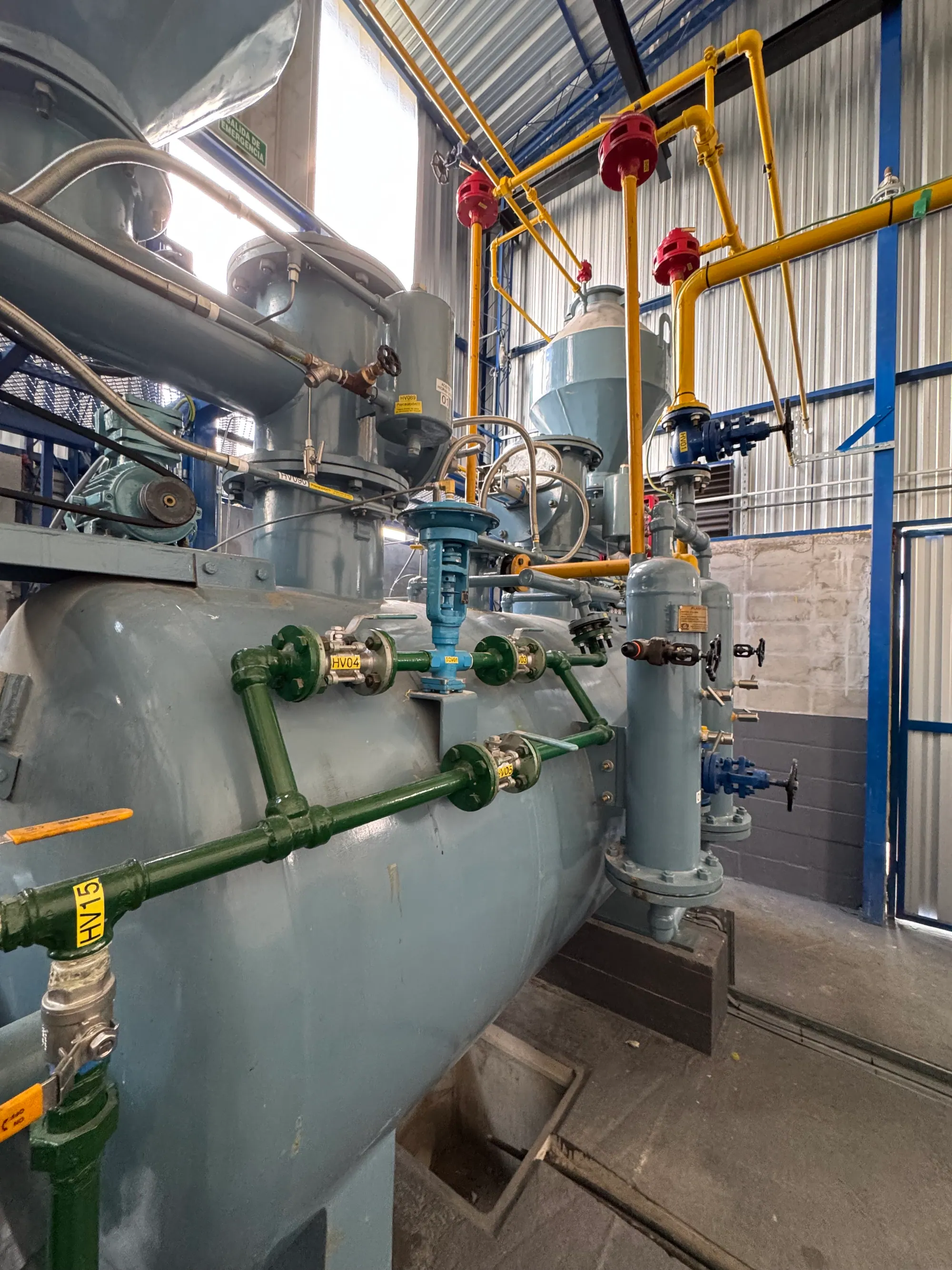
Equipment
Industrial oxygen pipelines — where cleanliness is the whole design
An industrial oxygen pipeline distributes oxygen from a central cascade to cutting, welding and process points. Its entire design is about cleanliness: hydrocarbon contamination can ignite from the heat of compression alone, with no spark. 1 oily fingerprint is a genuine ignition source.
₹500 – ₹1,200 per installed sq ft Installation only — pipe, fittings, valves and manifolds are charged separately. Indicative. Your quotation is the figure that counts — price moves with quantity, cylinder size, contract term and delivery.
- Hydrocarbons igniting from heat of compression
- The governing hazard
- Degreased and oxygen-clean throughout
- Cleanliness requirement
- Oil
- Never permitted
- Open slowly
- Valve operation
- IS 7285
- Cylinder standard at source
The one thing this system is designed around
Oxygen does not burn. It makes everything else burn, and in a pressurised line it can start that fire with no spark and no flame anywhere near it.
The mechanism is adiabatic compression. Open a valve quickly against a closed downstream, and the gas compressing into that dead space heats sharply. If there is any hydrocarbon present — a film of oil, a smear of grease, solvent residue, ordinary PTFE tape — that heat is enough. The resulting fire then burns the metal of the fitting.
Everything below follows from that.
Safe handling
It means every wetted component has been degreased to a specification and kept free of hydrocarbon since. It does not mean the pipe looks clean.
That distinction is the whole game, because contamination is invisible:
What "oxygen-clean" means
- A fitting wiped with a rag that has been near a machine tool is contaminated.
- A fitting installed by someone with oily gloves is contaminated.
- A valve lubricated “just to free it up” is contaminated, permanently.
- Ordinary PTFE tape is a hydrocarbon. Use only sealants rated for oxygen, and use them sparingly.
None of these leaves a mark you can see at handover.
The operating rules
Open valves slowly. Always, and especially into a closed or dead-ended section.
Never use oxygen for anything but its purpose. Not to blow down a bench, not to ventilate a space, not to drive tools. Oxygen enrichment in a confined space makes ordinary clothing burn fiercely and very hard to extinguish, and people have died from a habit that felt harmless.
Never lubricate anything in the system.
Keep oxygen equipment segregated. Once a regulator has been used on another service or handled with contaminated hands, it is no longer oxygen-clean, and it cannot be made clean by wiping.
"It has been fine for years"
This is the argument we hear most, and it is the weakest one in the industry.
An oxygen system that has not caught fire has not demonstrated that it is clean. It has demonstrated that the pressure and flow conditions needed to ignite whatever is in it have not yet coincided. Contamination accumulates; the trigger is an event, not a date. The two facts together are why these fires are always described afterwards as sudden.
Have the line surveyed instead.
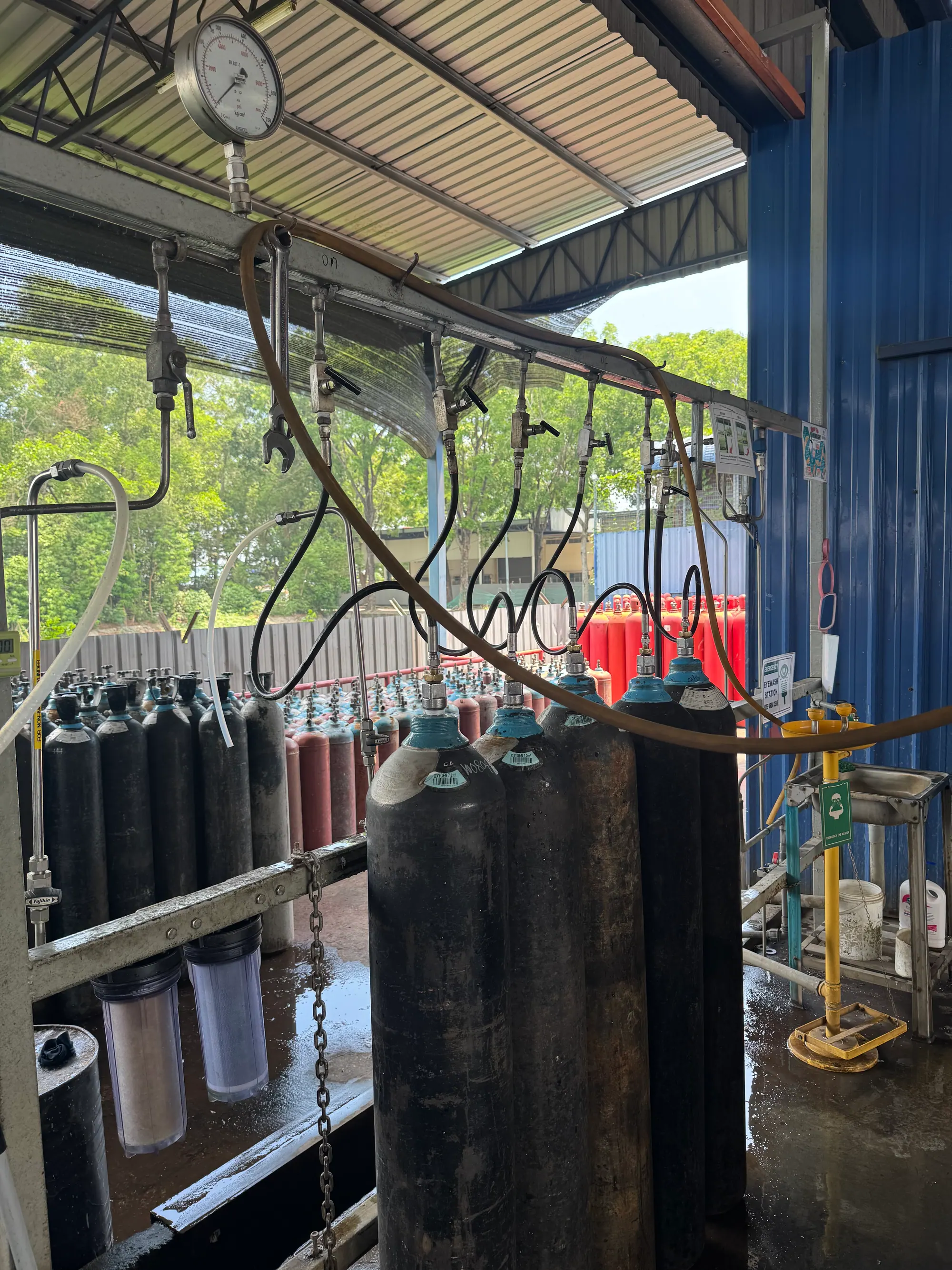
The cylinder filling manifold — one header, one gauge, many cylinders
Guwahati works · agent network
Arrestors on the oxygen line too
A flashback can propagate into the oxygen line, and a flame travelling back toward a cascade of oxygen cylinders is not the lesser case. Two devices per line, both lines — regulator and torch. See flashback arrestors.
Oxygen pipelines — design, installation and commissioning
We size the cascade against measured consumption, supply industrial oxygen to IS 309 from our own filling works, and install and maintain the pipework. We also survey existing lines — which, on an oxygen system that has been extended over the years by whoever was available, is usually the first thing worth doing. Contact us.
How we work on a pipeline
Two routes, and the choice is yours. We design and install: survey, drawings, materials, installation, testing and commissioning, with the system handed over complete. Or we supply and supervise: we provide the design, the pipework and the components, and our engineer supervises while your own contractor installs. The second is often the faster route on a live site where a contractor is already mobilised, and it costs less; the first leaves one company accountable for the whole system.
Why KIGL
Why bring the oxygen line to us
We have filled oxygen under PESO licence since 1947. Oxygen pipework is unforgiving in a particular way: the hazard is never the gas itself but what the gas does to everything it touches, and a line cleaned properly for oxygen service can be ruined by a single pressure test with shop air. We clean, test and certify to that standard, and we survey existing lines, which on a system extended over the years by whoever was available is usually the first thing worth doing.
Specification
Industrial oxygen pipelines — full specification
| Property | Value | Basis |
|---|---|---|
| The governing hazard | Hydrocarbons igniting from heat of compression — no spark required | KIGL technical |
| Cleanliness requirement | Degreased and oxygen-clean throughout, and kept that way | KIGL practice |
| Never permitted | Oil, grease, solvent residue, or PTFE tape not rated for oxygen | KIGL practice |
| Valve operation | Open slowly — rapid opening causes adiabatic compression downstream | KIGL practice |
| Cylinder standard at source | IS 7285 (Part 1):2018, valved to IS 3224:2021 | BIS MED-16 compendium |
| Gas | Industrial oxygen to IS 309 | Bureau of Indian Standards |
| Source | Cylinder cascade | Sized against measured consumption |
| Cleanliness | Degreased, oxygen-clean | KIGL practice |
| Prohibited | Oil, grease, hydrocarbon residue, non-oxygen-rated sealants | KIGL practice |
| Flame arrestors | Required on the oxygen line as well as the fuel line | IS 11006:2011 / KIGL practice |
Documents
Industrial oxygen pipelines — safety and technical documentation
Questions
Industrial oxygen pipelines — frequently asked questions
Oxygen does not burn — why is an oxygen line a fire risk?
Because oxygen does not burn, it makes everything else burn, and it does so at a violence with no everyday equivalent. In a high-pressure oxygen system, hydrocarbon contamination can ignite from the heat of compression alone — no spark, no external flame. Once started, the fire consumes the metal of the fitting itself.
What does "oxygen-clean" actually mean?
That every component in contact with the gas has been degreased to a specification and kept free of hydrocarbon since. It is not a description of how the pipe looks. A visually spotless fitting handled with oily gloves is not oxygen-clean, and nothing about its appearance will tell you.
Why must valves be opened slowly?
Opening a valve quickly against a closed downstream compresses the gas suddenly, and that compression raises its temperature sharply. If there is anything combustible in the line, that is the ignition. Slow opening is not politeness towards the equipment — it is the control for a specific ignition mechanism.
Can I use ordinary PTFE tape on oxygen fittings?
Not unless it is rated for oxygen service. This is one of the most common site-level mistakes, because the tape is universal in every other pipe-fitting job and nobody thinks of it as a hydrocarbon. Use only sealants specified for oxygen, and use them sparingly.
The line has been like this for years without a problem. Is it safe?
Years without an event is not evidence of safety in an oxygen system — it is evidence that the ignition conditions have not yet coincided. Contamination accumulates, and the trigger is a particular pressure and flow event rather than the passage of time. Have it surveyed.
Do oxygen lines need flashback arrestors too?
Yes. A flashback can propagate into the oxygen line, and an oxygen line carrying a flame back towards a cascade is not the lesser case. Fit arrestors at the regulator and the torch on both lines.
Read next
Enquiries
Request a quotation for industrial oxygen pipelines
State the gas or equipment, the quantity or capacity, and your location. KIGL will confirm the grade, the cylinder or plant size, and whether the location can be served from Noonmati, or through our agent network.