
Guide
Flashback arrestor pressure drop and flow capacity: how IS 11006 rates flow and why fine elements cost pressure
Flashback arrestor pressure drop is the price of quenching: the finer the element, the more pressure it takes to push gas through. IS 11006:2011 cl 10.6 rates flow in m³/h at maximum operating pressure with a 10 % pressure drop across it, so a 1.5 bar acetylene unit is rated at a 0.15 bar loss.
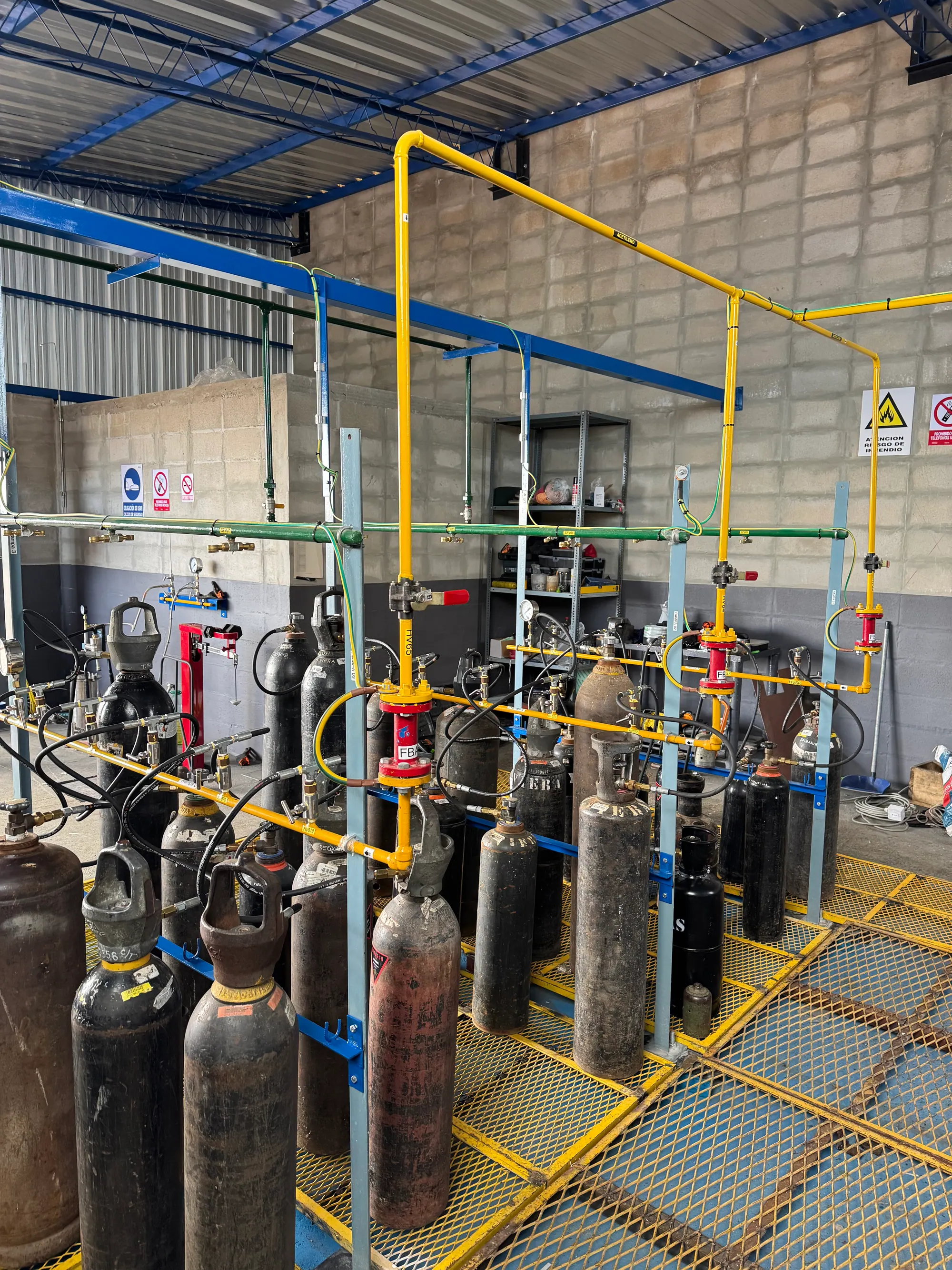
- How rated flow is defined
- Flow in m³/h at maximum operating pressure with a pressure drop of 10 % of that pressure
- Flow curve the maker must measure
- At 0.25
- Air-to-acetylene flow factor
- 1.04
- Distribution pipe capacity
- 1
- Dry arrestors on low-pressure systems
- Pressure loss means they cannot as a rule be used in low-pressure installations
Every flashback arrestor costs pressure. The element stops a flame by forcing gas through passages too fine for a flame to survive, and the same fineness resists the normal flow of gas. IS 11006:2011 handles the trade-off by rating an arrestor's flow at the point where the drop across it reaches 10 % of its maximum operating pressure, so a buyer can compare devices on a common basis. This page explains that rating, how the main element types compare, and why stacked, undersized or fouled devices starve the torch or pipeline they protect.
Why does every arrestor cost pressure?
Quenching is a heat-transfer duty. A flame dies when the walls around it take heat away faster than the reaction can replace it, which means small passages and a very large internal surface. For an oxyacetylene flame the passages must be finer than about 0.12–0.16 mm at 1 atm (two independent extrapolations, as compiled by S. A. Miller, 1965); for the decomposition flame of pure acetylene the quenching diameter measured by Cummings, Hall and Straker in 1962 was 0.6 cm at 2.02 atm absolute. Gas flowing through such a mass loses pressure by friction, and the loss rises with flow. The designer's job is to give the gas as much flow area as possible while keeping every individual passage below quenching size. The guide to how an arrestor works covers the quenching physics in detail.
The trade-off is old and well recorded. Tightly packed plugs of fine powder suppress a detonation reliably but resist flow so strongly that they suit only places where little gas moves, such as the connection to a pressure gauge (as compiled by S. A. Miller, 1965). Where the main flow passes, designers moved to sintered metal and, on large low-pressure lines, to packed towers.
How does IS 11006 define flow capacity?
IS 11006:2011 sets four requirements that together define what a buyer should be shown:
| Clause | Requirement | What it means in practice |
|---|---|---|
| 10.6 | Rated flow is the flow in m³/h at maximum operating pressure with a pressure drop of 10 % of that pressure | A 1.5 bar acetylene device is rated at about 0.15 bar loss |
| 11.9 | Flow and pressure drop measured at 0.25, 0.5, 0.75 and 1.0 of maximum operating pressure; five samples; spread between samples no more than 10 % | The maker holds a four-point curve, not just a single number |
| 11.2 | Flow measured to ±10 %, pressure to ±3 %, all pressures in bar gauge | Small differences between two catalogues may be inside test error |
| 13 | Instructions must give gas-flow characteristics and an installation method that keeps total pressure drop as low as possible | Stacking devices is a design decision, not a free choice |
Two consequences follow. First, an arrestor run below its maximum operating pressure passes less than its rated flow, so a device rated at 1.5 bar but used behind a regulator set to 0.7 bar must be judged on the 0.5 point of its curve, not the headline figure. Second, a flow figure quoted without its pressure and pressure-drop basis cannot be compared with an IS 11006 rating at all.
Flow is normally measured on air or nitrogen, as IS 11006 cl 11.3 requires, and converted. Witt and Wilhelmsen/Unitor, two unrelated manufacturers, publish the same conversion factors: 1.04 for acetylene, 0.80 for propane, 0.95 for oxygen and 3.75 for hydrogen.
How do the element types compare?
| Element | Typical duty | Pressure drop | Source |
|---|---|---|---|
| Compressed fine-powder plug | Gauge and instrument connections | High | as compiled by S. A. Miller (1965) |
| Sintered metal (hollow cylinders or discs) | Regulator outlet, torch inlet, manifold and plant lines | Moderate | Stephenson, BP 363,628 (1930); IS 11006:2011 cl 6 |
| Compressed steel wool, 2.5 cm at 75 % porosity | Small-bore high-pressure pipe, 20–25 atm | Moderate | as compiled by S. A. Miller (1965) |
| Granular packing (C.P.I. 1931 pattern) | Points of use on dissolved acetylene supply | Limited, but too high for low-pressure systems | C.P.I., Paris 1968 |
| Hydraulic water seal | Generator outlet, low-pressure mains | Low to moderate; set by water depth | C.P.I., Paris 1968; IS 11006:2011 |
| Packed tower of Raschig rings | Pipes of 15–60 cm at 0.03–1.5 atm gauge | Low | Schmidt and Haberl, 1955–56 |
The C.P.I. described the dry granular arrestor as offering "only limited resistance" to gas flow, then drew the practical line: the loss is enough that dry arrestors "cannot as a rule be used in low-pressure installations" and belong on medium- and high-pressure systems, normally with dry gas from dissolved acetylene cylinders (C.P.I., Safety in the Production and Use of Acetylene, Paris 1968). The same code barred them from generator gas unless the acetylene is absolutely dry, because moisture attacks the packing. That is why a carbide generator outlet carries a wet seal; see wet flashback arrestors.
A wet seal has its own flow limit. The C.P.I. required any hydraulic device to stay effective at a delivery of about 30 % above normal, and warned that over-drawing a low-pressure hydraulic valve can pull its water into the torch line. Its identification plate must state both the maximum working pressure and the rated maximum delivery.
How much flow does a real arrestor pass?
Manufacturers publish very different figures, and the pressure is usually the reason. One manufacturer's air-flow table for a regulator-outlet device (Wilhelmsen/Unitor W-66 S manual, air at 20 °C) shows how strongly flow depends on inlet pressure:
| Inlet pressure, bar | Air flow, Nm³/h | Approximate acetylene equivalent (× 1.04), Nm³/h |
|---|---|---|
| 0.1 | 1.4 | 1.5 |
| 0.9 | 12.8 | 13.3 |
| 1.5 | 19.5 | 20.3 |
| 10.0 | 108.0 | not applicable; acetylene is not used at this pressure |
The acetylene column is an illustration, not a rating. It shows why acetylene devices look heavily derated: another maker rates its regulator-outlet unit at 10 m³/h on acetylene against 95 m³/h on oxygen, mainly because acetylene is held to 1.5 bar. IS 14814:2023 cl 7.2.1 sets the free-state acetylene limit lower still, at 0.612 atm, or 1.021 atm with PESO clearance, so most acetylene arrestors in India work well below their marked maximum. Size them on the curve at the pressure you actually use. The regulator and working pressures guide covers typical settings.
What happens when devices are stacked in series?
Losses add. A typical portable set has an arrestor at the regulator outlet and another at the torch inlet; a pipeline adds devices at the source, the branch and the point of use. IS 15190 (Part 1):2002 cl 4.12.1.2 calls for arrestors at the outlet of the gas source, the entrance and exit of any gasholder, each booster exit, each branch from main header to shop sub-header and the entry to each consuming unit. IS 15190 (Part 2):2002 cl 8.6 requires three flame arrestors with non-return valves in series on every cylinder charging or discharging manifold.
The standards anticipate the cost. IS 11006 cl 13 makes the manufacturer state an installation method that keeps total pressure drop low, and IS 15190 (Part 1) cl 4.12.1.5 says that where one unit cannot carry the flow, several are to be installed in parallel between common inlet and outlet headers. Parallel units are the correct answer to a flow shortfall; a larger-bore single device with coarser passages is not, because coarser passages may no longer quench.
Does pipe size matter as much as the arrestor?
Often more. The British Acetylene Association's 1962 code found that piping of 1–3 inches (2–8 cm) is adequate for up to 100 m³/h even over runs of hundreds of metres at the legally permitted pressures. IS 15190 (Part 2):2002 cl 6.4 avoids high-pressure pipe above DN 25 where possible and forbids anything above DN 40, recommending multiple DN 25 lines for more flow, sized at 2–4 m/s under cl 6.4.1. Small pipe is safer as well as adequate: the C.P.I. recorded that in 100 mm pipe a detonation is to be feared above 0.6 kg/cm². The pipe diameter and detonation guide explains why.
Why does pressure drop rise in service?
Because the element is a filter whether or not it was designed as one. Pipe scale, rust, carbide dust and thread debris collect on it, carbon from earlier flashbacks plugs it, and water from wet gas can block it entirely (Wilhelmsen/Unitor W-66 S manual). Every major manufacturer fits an inlet filter for this reason. A device that met its curve when new may starve the same torch years later, and a starved torch backfires more readily. Wilhelmsen/Unitor lists insufficient flow capacity among the causes of flashback, and the American Welding Society notes that arrestors reduce the gas volume available at the tip. The annual flow check described in testing and replacement exists to catch this.
Rules that matter
Rules to apply
- Ask for the IS 11006 cl 11.9 flow curve and read it at your working pressure, not the maximum.
- Convert air ratings to acetylene with the factor 1.04, and compare devices only at the same pressure.
- Add the losses of every device in series; where one unit cannot carry the flow, install units in parallel.
- Never solve a flow shortage with a coarser element or by removing a device.
- Use dry arrestors on dry cylinder gas and medium-pressure systems; use a wet seal at a low-pressure generator outlet.
- Keep distribution pipe small; it carries more than most people expect.
- Recheck flow annually and after any flashback. See KIGL flash-back arrestors for the range.
Flashback arrestor pressure drop — frequently asked questions
What is the pressure drop of a flashback arrestor?
It depends on the element and the flow, which is why IS 11006:2011 does not fix a single figure. Instead, cl 10.6 defines rated flow as the flow at which the drop across the device is 10 % of its maximum operating pressure. For an acetylene arrestor rated at 1.5 bar, that means about 0.15 bar lost at rated flow. Above rated flow the loss rises steeply.
How do I size a flashback arrestor for flow?
Start from the peak flow of the torch, burner or branch, in m³/h of acetylene. Ask the supplier for the IS 11006 cl 11.9 flow curve at your actual working pressure, not the maximum, and pick a device whose flow at that pressure sits comfortably above your peak. If you have two devices in series, add their losses. Never size by hose or thread size.
How do I convert an air flow rating to acetylene?
Multiply the air flow by 1.04. Two unrelated manufacturers, Witt and Wilhelmsen/Unitor, publish identical factor sets: 1.04 for acetylene, 0.80 for propane, 0.95 for oxygen and 3.75 for hydrogen. The factor follows roughly from the square root of the density ratio, so acetylene, slightly lighter than air, passes slightly more volume than air at the same pressure drop.
Why is an acetylene arrestor rated for so much less flow than an oxygen one?
Mainly because of pressure, not the gas. Flow through a porous element rises with the pressure driving it, and acetylene arrestors are normally limited to 1.5 bar while oxygen devices run to 10 bar or more. One maker rates the same regulator-outlet unit at 10 m³/h on acetylene and 95 m³/h on oxygen. Compare devices at the same pressure, never across gases.
Can I use a dry flashback arrestor on an acetylene generator?
Generally not on the low-pressure side. The C.P.I. warned in 1968 that dry arrestors lose enough pressure that they cannot as a rule be used in low-pressure installations, and that they must not be used on generator gas unless it is absolutely dry, because moisture attacks the packing. Generator outlets use a wet hydraulic seal, which IS 11006:2011 recognises as a separate wet type.
What happens if a flashback arrestor is too small?
The torch is starved. Gas velocity at the nozzle falls, the flame burns closer to the tip and backfires become more likely, which is the event the arrestor was bought to contain. Wilhelmsen/Unitor lists insufficient flow capacity among the causes of flashback, and the American Welding Society notes that these devices reduce the gas volume available at the tip.
Does a flashback arrestor's pressure drop change over time?
Yes, it rises. Dirt, pipe scale, carbide dust and carbon from earlier flashbacks lodge in the element and narrow its passages; water from wet gas can block it outright. A device that met its flow curve when new may starve the same torch years later. That is why the annual check recommended by manufacturers and regulators includes a flow test on a bench.
References
- American Welding Society, Safety and Health Fact Sheet No. 28, Flashback arrestors
- Bureau of Indian Standards. (2002). (Part 1 and Part 2):2002 Acetylene Pipelines — Code of Practice (IS 15190:2002).
- Bureau of Indian Standards. (2011). Flash Back Arrestor (Flame Arrestor) — Specification, Bureau of Indian Standards (full text) (IS 11006:2011, First Revision).
- International Organization for Standardization. (2017). Gas welding equipment — Safety devices — Part 1: Devices incorporating a flame (flashback) arrestor (ISO 5175-1:2017).
Enquiries
Request a quotation
State the gas or equipment, the quantity or capacity, and your location. KIGL will confirm the grade, the cylinder or plant size, and whether the location can be served from Noonmati, or through the agent network.