
Gases
Nitrogen gas to IS 1747, for purging, blanketing and inerting
Nitrogen is the standard inert gas for purging, blanketing and inerting, because it displaces oxygen and moisture without reacting. KIGL fills nitrogen to IS 1747 at ≥99.5 % purity into high-pressure cylinders and cascades, with higher purity grades on request. Cylinder supply from KIGL's own filling works. Manufacturing since 1947.
By Mithillessh Garg, Director (Gas Supply)
₹50 – ₹65 per Nm³ Indicative. Your quotation is the figure that counts — price moves with quantity, cylinder size, contract term and delivery.
What nitrogen does
Nitrogen is 78 % of the air around you and it does essentially nothing — which is exactly why it is useful. Where oxygen or moisture would spoil a product, corrode a surface, or turn a vapour space into an explosion hazard, nitrogen takes their place and stays unreactive.
KIGL fills nitrogen to IS 1747 at ≥99.5 %, in high-pressure cylinders and cascades built to IS 7285.
Nitrogen applications in industry
Purging and inerting
Displacing air from vessels, pipework and equipment before maintenance or start-up. On acetylene systems, nitrogen purging is mandatory — purging with air can create an explosive atmosphere inside the equipment being cleaned.
Blanketing
Holding an inert vapour space above a flammable or oxygen-sensitive liquid in storage tanks and reactors.
Pressure transfer
Moving liquids without introducing oxygen or moisture.
Laser cutting
High-pressure nitrogen assist gas gives clean, oxidation-free edges on stainless steel and aluminium.
Electronics and heat treatment
Providing a controlled, non-oxidising atmosphere.
Root purging
Backing purge on stainless steel welds to prevent oxidation on the underside.
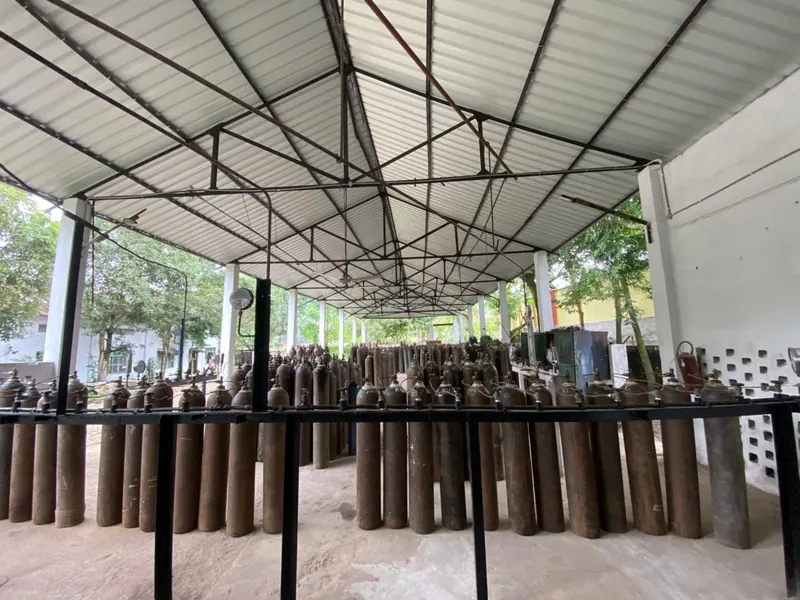
Cylinder storage hall, stock segregated by gas as the standards require
Guwahati works · agent network
Which nitrogen purity your process needs
More purity costs more and is not always better. The question is what the residual oxygen does to your process, not what number looks safest on a purchase order.
| Purity | Residual oxygen | Typically used for |
|---|---|---|
| 99.5 % (IS 1747, KIGL standard fill) | up to 0.5 % | Purging, inerting, blanketing, pressure transfer, tyre inflation |
| 99.9 % | about 0.1 % | General heat treatment, laser cutting of mild steel, food packaging |
| 99.99 % and above | about 100 ppm | Bright annealing, stainless and aluminium laser cutting, electronics |
| 99.999 % | about 10 ppm | Analytical carrier gas, semiconductor and specialty work |
Two cases where the extra purity genuinely pays. Laser cutting stainless and aluminium: residual oxygen shows as discolouration on the cut edge, so the edge quality tells you the gas grade. Bright annealing: oxygen at a few hundred parts per million is enough to dull the surface the process exists to produce. For everything else on the list above, the standard fill does the job and the difference is money.
If you need a grade above the standard fill, say what the process is and what fault you are seeing, and KIGL will specify against that rather than supply the highest number.
Cylinder, cascade or your own nitrogen plant
Three ways to get nitrogen, and the right one is set by how much you use and how steadily.
Cylinders suit intermittent use, maintenance purging and small workshops. No capital, no licensing, and you pay per cubic metre.
Cascades, a manifolded bank of cylinders, suit a continuous draw that a single cylinder cannot sustain. KIGL sizes these against the measured draw-off rate rather than the monthly total, because a bank sized on consumption alone will still run short at peak.
On-site generation suits a steady, high-volume demand. A PSA nitrogen plant separates nitrogen from compressed air on site and removes the cylinder logistics entirely, at the cost of capital, power and maintenance. The crossover is a calculation, not an opinion, and the guide on cylinders or on-site generation sets out the arithmetic. For choosing the purity a PSA plant should be specified to, see choosing PSA nitrogen purity — a plant specified a nine too high costs considerably more to run for no benefit.
Safe handling
Nitrogen is not toxic, not flammable and not corrosive. It kills by displacing oxygen, silently and with no warning.
There is no smell, no irritation and no sensation of breathlessness — the urge to breathe is triggered by carbon dioxide build-up, not oxygen shortage, so someone entering a nitrogen-filled space can lose consciousness without ever feeling short of breath. Fatalities happen in tanks, pits and small unventilated rooms after purging.
Rules that are not optional:
The hazard nobody expects
- Monitor oxygen before and during any confined-space entry after a nitrogen purge.
- Never enter a purged vessel on the assumption it has cleared.
- Ventilate work areas where nitrogen is discharged.
- Never use nitrogen to blow down clothing or clear a workspace.
Full detail is in the nitrogen safety data sheet.
Nitrogen cylinder sizes and supply across India
Compressed nitrogen in cylinders and cascades from Guwahati, and through a network of agents, with exchange and refill programmes and cascades sized to measured consumption.
Liquid nitrogen — also available, for cryopreservation, food freezing, cold-fitting and users vaporising on site. Liquid nitrogen comes from KIGL's air separation plant, and compressed nitrogen is filled in cylinders at KIGL's own filling plants. State the consumption when planning supply security.
Safe handling
KIGL fills nitrogen at its own PESO-licensed Guwahati works and delivers by its own vehicles within that radius. Beyond it, supply runs through appointed agents across Uttar Pradesh, Madhya Pradesh, West Bengal, Assam, Odisha and other states, because compressed gas is heavy and freight decides the economics.
For a buyer comparing suppliers, three questions separate them, and none is the rate per cubic metre on its own:
Nitrogen gas supplier in India — how supply actually works
- What water capacity is the cylinder? A rate only compares if the cylinders match. Ask in litres.
- Deposit or daily holding? Cylinders sitting on your site between jobs are where a cheap rate turns dear.
- What purity is committed, against which standard? KIGL's is IS 1747 at ≥99.5 %, stated on the label.
Indicative pricing and the full list of what moves a gas quotation are on the industrial gas prices guide.
Why KIGL
Why buy nitrogen from KIGL
KIGL has filled nitrogen since 1947 at its own works in Guwahati, and supplies through a network of agents across Uttar Pradesh, Madhya Pradesh, West Bengal, Assam, Odisha and other states. The family has served on the Bureau of Indian Standards committees that write the Indian standards for gas cylinders and valves.
Nitrogen is the gas nobody thinks about until a confined space goes quiet. What comes with it here is unglamorous and worth paying for: the same purity in every cylinder, the IS 4379 livery painted where the standard says it goes, and a label that matches what is inside it.
Specification
Nitrogen gas — full specification
| Property | Value | Basis |
|---|---|---|
| Specification | IS 1747 (Compressed Nitrogen) | Bureau of Indian Standards |
| Purity, industrial | ≥99.5 % N₂ | KIGL product specification |
| Cylinder standard | IS 7285 | Bureau of Indian Standards |
| Cylinder colour | French grey body, black band | IS 4379 |
| UN number | UN 1066 | ADR 2025 |
| Shielding gas standard | EN ISO 14175 | — |
| Chemical formula | N₂ | — |
| Purity, industrial grade | ≥99.5 % v/v (O₂ ≤5000 ppm) — IS 1747 N 2.5 grade | — |
| Purity, high-purity grade | ≥99.9 % v/v (O₂ ≤1000 ppm) | On request |
| Supply form | High-pressure cylinders and cascades | — |
| Proportion of atmosphere | 78 % | Composition of dry air, U.S. Standard Atmosphere (1976) |
Documents
Nitrogen gas — safety and technical documentation
Questions
Nitrogen gas — frequently asked questions
Why is nitrogen used for purging rather than compressed air?
Air is 21 % oxygen, so purging a flammable system with air can create exactly the explosive mixture you are trying to remove. Nitrogen is inert, displaces both oxygen and moisture, and leaves an atmosphere that will not support combustion. On acetylene equipment nitrogen purging is mandatory, never air.
Is nitrogen dangerous if it is inert?
Yes — as an asphyxiant. Nitrogen is not toxic and gives no warning, which is precisely the danger. It displaces oxygen, and a nitrogen-filled vessel or pit can render someone unconscious in a breath or two with no smell or irritation to warn them. Confined-space entry after nitrogen purging requires oxygen monitoring without exception.
What purity do I need for laser cutting?
Laser cutting of stainless steel and aluminium generally needs higher purity than general industrial grade, because residual oxygen causes edge oxidation and discolouration. State the material, thickness and machine and KIGL will confirm the grade rather than guess.
Does KIGL supply liquid nitrogen?
Yes. Liquid nitrogen is available alongside the cylinder range, for cooling, freezing, cryopreservation and high-volume gas users who vaporise on site. Liquid nitrogen comes from KIGL's air separation plant, and compressed nitrogen is filled at KIGL's own filling plants. State the consumption and KIGL will confirm what it can commit to.
Can nitrogen be used as a welding shielding gas?
In specific cases, and usually as part of a mixture rather than alone — EN ISO 14175 covers its classification. For most TIG and MIG work [argon](/argon-gas) or an argon mixture is correct. Nitrogen is also used for backing and root purging on stainless steel.
Why does my nitrogen cylinder have a black band?
IS 4379 colour coding: french grey body with a black band identifies nitrogen. Always confirm against the stamped markings and label rather than colour alone, especially with customer-owned or traded cylinders.
References
- Bureau of Indian Standards. (2021). Identification of the contents of industrial gas cylinders (IS 4379:2021, Second Revision).
- Bureau of Indian Standards. (2023). Nitrogen, compressed gas and liquid — Specification (IS 1747:2023, Second Revision).
- National Oceanic and Atmospheric Administration, National Aeronautics and Space Administration, & United States Air Force. (1976). U.S. Standard Atmosphere, 1976.
- The Kamrup Industrial Gases Limited. (2026). Company information and manufacturer's data [Company statement].
Read next
Enquiries
Request a quotation for nitrogen gas
State the gas or equipment, the quantity or capacity, and your location. KIGL will confirm the grade, the cylinder or plant size, and whether the location can be served from Noonmati, or through the agent network.