
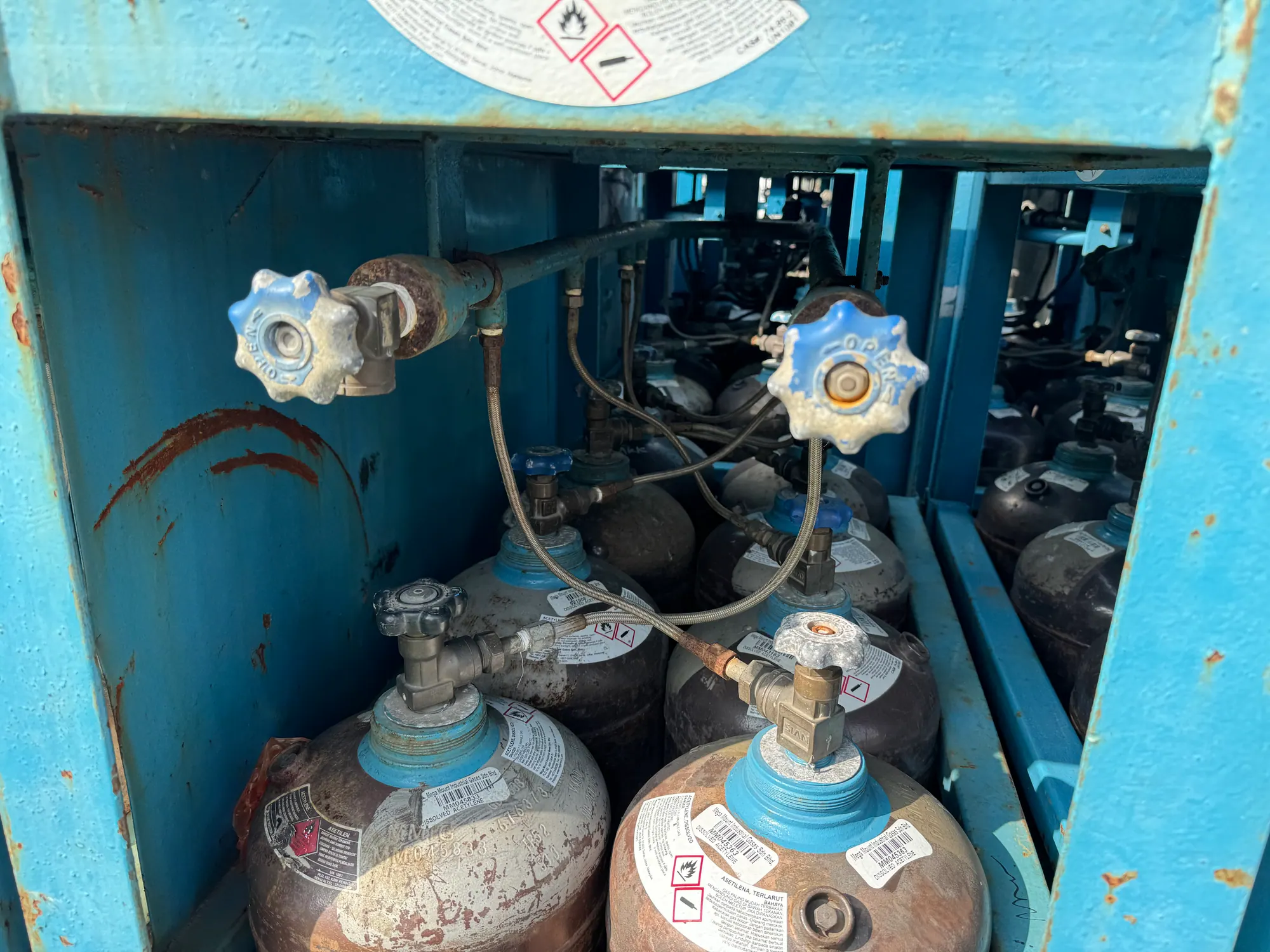
Equipment
Acetylene pipelines — low pressure, no copper, arrestors at both ends
An acetylene pipeline distributes dissolved acetylene from a central cascade to cutting and welding points. Three rules govern it: no copper anywhere in contact with the gas, low pressure, and a cascade sized so that 2 or more cylinders share the draw-off rather than one being over-drawn.
₹500 – ₹1,200 per installed sq ft Installation only — pipe, fittings, valves and manifolds are charged separately. Indicative. Your quotation is the figure that counts — price moves with quantity, cylinder size, contract term and delivery.
- Copper and high-copper alloys
- Prohibited material
- Low
- Pressure
- Limited per cylinder; exceeding it pulls acetone out with the gas
- Draw-off
- IS 11006:2011
- Flame arrestors
- IS 7312 dissolved acetylene cylinders
- Source cylinders
Acetylene pipeline design: three governing rules
No copper. Low pressure. Do not over-draw.
Acetylene reticulation is not difficult, but it is unforgiving of ordinary pipe-fitting habits, and each of these three rules is broken routinely by contractors who are competent at everything else.
Why acetylene pipelines must contain no copper
Acetylene reacts with copper to form copper acetylides, which are explosive and shock-sensitive. That rules out copper pipe, copper fittings, and high-copper brasses anywhere in contact with the gas.
This is the most commonly violated rule in the field, and the reason is mundane: brass fittings are the default in every other pipe-fitting job on a site. A fitter who has never worked on acetylene will reach for one without a thought, and the installation will look completely correct.
For the same reason, KIGL surveys an existing line before extending it. An extension in the correct material, joined to an original in the wrong one, is still a system with copper in it.
Acetylene pipeline pressure limits
Acetylene decomposes explosively under pressure with no oxidant present at all. Not “when it leaks and meets air”, but on its own, if compressed.
That is why the gas is dissolved in acetone in the first place, why an acetylene plant generates at a fraction of a bar, and why an acetylene pipeline is a low-pressure system in a workshop full of high-pressure ones. Any proposal to raise line pressure to improve flow at the far end is solving the wrong problem. The answer is pipe sizing and cascade capacity, not pressure.
Sizing an acetylene cylinder cascade by draw-off rate
Withdrawing acetylene too quickly from a cylinder pulls acetone out of the porous mass along with the gas. That starves the cylinder, destabilises the flame, contaminates the pipeline, and degrades the cylinder permanently.
So the cascade is sized by peak simultaneous draw, not by monthly consumption. A works that uses a modest total volume but occasionally runs six torches at once needs a larger cascade than the consumption figure suggests. This is the calculation most often got wrong, and the symptom — an unstable flame at the far bench — gets blamed on the gas.
Cylinders stay upright, always. Lying one down lets liquid acetone reach the valve and go straight into the line.
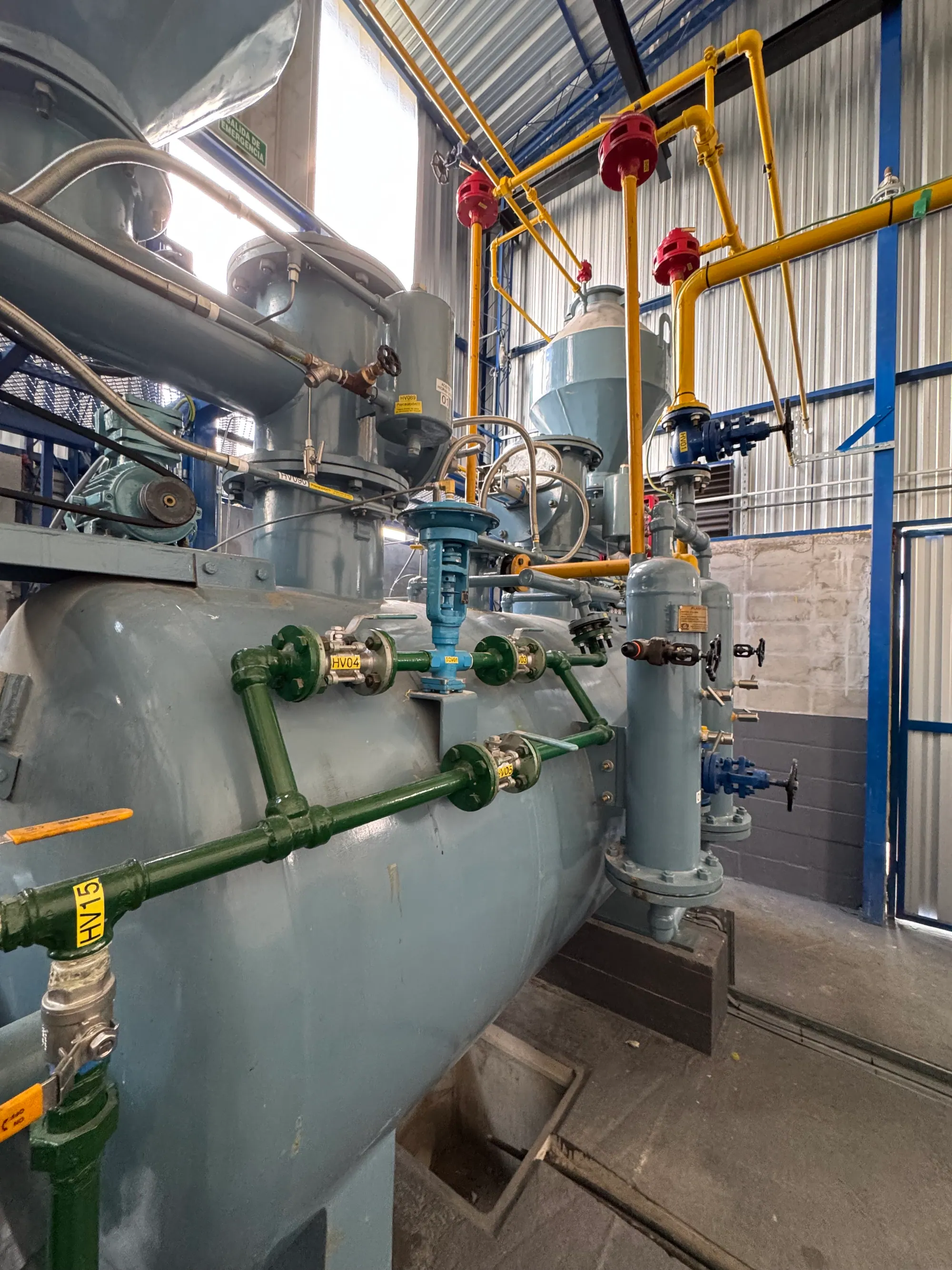
Process pipework and valve manifold on a KIGL-built industrial gas plant
Guwahati works · agent network
Flashback arrestor placement on an acetylene pipeline
At the regulator and at the torch, on acetylene and on oxygen.
A single device at the manifold protects nothing downstream of itself, and a flashback does not start at the manifold; it starts at the torch and travels back. See flashback arrestors and the standards behind them.
Acetylene pipeline design, installation and commissioning
We fill dissolved acetylene to IS 308 at our own works, we build the plants that generate it, and we manufacture the arrestors that protect the line. Cascade sizing, installation, and survey of existing systems: contact us.
For the opposite discipline on the same job, see oxygen pipelines.
How we work on a pipeline
Two routes, and the choice is yours. We design and install: survey, drawings, materials, installation, testing and commissioning, with the system handed over complete. Or we supply and supervise: we provide the design, the pipework and the components, and our engineer supervises while your own contractor installs. The second is often the faster route on a live site where a contractor is already mobilised, and it costs less; the first leaves one company accountable for the whole system.
Why KIGL
Why bring the acetylene line to us
We fill the acetylene, we build the generators that make it, and members of the family have served on the Bureau of Indian Standards committees behind the acetylene standards. An acetylene line is the one gas system where the safe answer runs against the instinct: narrower bore rather than wider, lower pressure rather than higher, and no copper anywhere near it. We have been designing to those rules since 1947, and we would far rather talk you out of a bad layout at the drawing stage than inspect it afterwards.
Specification
Acetylene pipelines — full specification
| Property | Value | Basis |
|---|---|---|
| Prohibited material | Copper and high-copper alloys — acetylene forms explosive acetylides | KIGL technical |
| Pressure | Low — acetylene decomposes explosively under pressure with no oxidant present | GHS H230 / KIGL technical |
| Draw-off | Limited per cylinder; exceeding it pulls acetone out with the gas | KIGL technical |
| Flame arrestors | IS 11006:2011 — regulator and torch | Bureau of Indian Standards |
| Source cylinders | IS 7312 dissolved acetylene cylinders, upright, always | Bureau of Indian Standards |
| Gas | Dissolved acetylene to IS 308 | Bureau of Indian Standards |
| Source | Cylinder cascade, cylinders upright | IS 7312 |
| Prohibited materials | Copper, high-copper alloys (brass above the permitted copper content) | Forms explosive copper acetylides |
| Prohibited contaminants | Oil and grease | KIGL practice |
| Cylinder orientation | Upright at all times | Prevents acetone carry-over |
Documents
Acetylene pipelines — safety and technical documentation
Questions
Acetylene pipelines — frequently asked questions
Why can there be no copper in an acetylene line?
Acetylene reacts with copper to form copper acetylides, which are explosive and shock-sensitive. This rules out copper pipe, copper fittings and high-copper brasses anywhere in contact with the gas. It is the single most commonly violated rule in acetylene reticulation, because brass fittings are the default in every other pipe-fitting job on site.
Why does an acetylene line run at such low pressure?
Because acetylene decomposes explosively under pressure without needing any oxidant at all. It is not a fuel that becomes dangerous when it meets air — it is a molecule that comes apart on its own if compressed. Every part of an acetylene system, from the generator to the pipeline, is designed around keeping it below that threshold.
How many cylinders does the cascade need?
Enough that no single cylinder is over-drawn. Draw-off from an acetylene cylinder is limited, because withdrawing too fast pulls acetone out of the porous mass along with the gas — which starves the cylinder, destabilises the flame and contaminates downstream equipment. Cascade size is set by your peak simultaneous draw, not by your total consumption.
What happens if acetone gets into the pipeline?
It contaminates the line and everything downstream of it, the flame becomes unstable, and the cylinder that lost the acetone is degraded. It is a maintenance problem and a safety problem at once, and it is almost always caused by over-draw or by a cylinder that was lying down.
Do the cylinders really have to stay upright?
Yes, in storage, transport and use. Lying a cylinder down lets liquid acetone reach the valve, and it is then drawn straight into your pipeline. A cylinder that has been horizontal must stand upright for at least an hour before it is connected.
Where do the arrestors go on a reticulated system?
At the regulator and at the torch, on the acetylene line and the oxygen line — two devices per line. One device at the manifold does not protect the system; a flashback does not begin at the manifold, and everything downstream of a single arrestor is unprotected.
Read next
Enquiries
Request a quotation for acetylene pipelines
State the gas or equipment, the quantity or capacity, and your location. KIGL will confirm the grade, the cylinder or plant size, and whether the location can be served from Noonmati, or through our agent network.