
Guide
Bursting discs vs flashback arrestors: why a relief disc cannot stop an acetylene detonation
A bursting disc cannot replace a flashback arrestor in acetylene service. In tests by Miller and Penny (1960), a vessel fitted with a 5 cm disc set at 32 atm still reached 50–150 atm, because a detonation outruns the disc. Arrestors quench the flame; discs only relieve slower pressure rises and residual pulses.
- Disc rating against measured peak
- Disc set at 32 atm; peaks of 50 and 70 atm from 10 atm absolute
- Deflagration pressure rise
- About 11 times initial
- Detonation pressure rise
- 20
- Arrestor plus disc
- A packed tower quenched detonations but passed a pulse above 10 atm; a 10 atm disc upstream cut it to about 3.5 atm gauge
- Indian arrestor casing strength
- Ten times maximum working pressure or 60 bar
A bursting disc and a flashback arrestor are both called safety devices, and both sit on acetylene lines, but they do different jobs and one cannot stand in for the other. A disc relieves pressure after it has risen. An arrestor stops a flame from travelling. Against an acetylene detonation, which moves faster than any disc can open, only the arrestor works. The test data show this plainly, and they also show where discs are genuinely useful.
What happened when a disc was tested
The key measurements are by Miller and Penny, presented at the Institution of Chemical Engineers Symposium on Chemical Process Hazards, Manchester, 1960. A vessel 38 cm long and 11.5 cm in diameter was fitted at one end with a 5 cm bursting disc set to operate at 32 atm. That is a large disc for so small a vessel. Acetylene was exploded inside it, and the pressure near the disc was recorded.
| How the explosion started | Initial 10 atm absolute | Initial 20 atm absolute |
|---|---|---|
| Fused platinum wire at the far end of the vessel | 50 atm | 130 atm |
| Explosion led in at mid-wall through a 1.2 cm pipe | 70 atm | 150 atm |
In every case the pressure went well past the disc's 32 atm rating, to between 1.6 and 4.7 times the set pressure. The worst case was the one most like a real plant: an explosion arriving from a connecting pipe. As compiled by S. A. Miller (1965), the operation of a bursting disc had no retarding effect on a detonation, and its protective value was not great in deflagrations either.
Why a disc cannot keep up
A disc opens on a timescale set by its own inertia, the gas it must accelerate through the vent, and the vent area. A detonation front in acetylene travels at roughly 1,800–2,000 m/s in measured tests compiled by S. A. Miller (1965), with a sudden step in pressure at the front. By the time the disc has opened, the front has passed through the vessel and the peak has arrived.
The pressures involved are large. Deflagration raises pressure about 11 times; Miller and Penny measured 11.1 ± 0.6 in 16 runs in a 30 × 5 cm tube at 9–10 atm absolute. Detonation reaches 20–24 times in the front, two to two and a half times more on reflection, and 40–50 times the initial pressure as the destructive effect in a long tube. With cascading the rise can exceed 100 or 200 times, and Kogarko and colleagues (Khim. Prom., 1962) measured about 300 times at the end of 20 cm pipe. Carver, Smith and Webster (IChemE Symposium Series No. 33, 1972) measured more than 320 times in 12.7 mm tube, a lower bound, read from a disc that only just failed. The dead legs page explains how those extremes arise.
What an arrestor does instead
An arrestor works on the flame, not on the pressure. Fine passages present a large surface to the flame front and take heat out of it faster than the decomposition can supply it. For acetylene the passages must be very fine: the quenching diameter of the decomposition flame is about 0.6 cm at 2 atm absolute (Cummings, Hall and Straker, 1962), and detonation has been seen in tubes as narrow as 3 mm at 10 atm. The mechanism is set out on how a flashback arrestor works.
That changes the design case for everything downstream. A vessel that can only ever see a deflagration started inside it needs a test pressure of about 11 times its working pressure. A vessel that a detonation can enter through a pipe would need 40–50 times or more, which is not a practical design. The two conditions in the literature compiled by S. A. Miller (1965) are that no detonation can pass into a vessel through any connecting pipe, which requires arrestors, and that the vessel itself is too short for a deflagration inside it to become a detonation. IS 15190 (Part 1):2002 expresses the same thinking in its pipeline classes: Class 2 pipe is designed with a deflagration factor of 11, Class 3 with factors of 20 for undisturbed detonation and 35 where reflection must be resisted.
Rules that matter
Discs have real value where the pressure rise is slow enough for venting to keep up, or where the job is to cut a residual pulse rather than to stop a flame.
Where are bursting discs genuinely useful?
- Liquid-phase reactors Where acetylene reacts in a liquid, a runaway may build without becoming immediately explosive, and heat may drive acetylene out of solution. The compilation by S. A. Miller (1965) notes that a disc can limit that process and may prevent it from building to a gas-phase explosion.
- Dissolved acetylene cylinders The same compilation records that bursting discs are of proven value in DA cylinders, where decomposition in the acetone solution is slow because it is limited by the rate at which heat releases gas from solution. Indian cylinders use fusible plugs for the same function, to IS 13497:2017, with a yield temperature of 98–104 °C under IS 3224:2021 clause 7.1.5 (fusible plugs).
- Upstream of a packed-tower arrestor After the 1954 Hüls incident, Schmidt and Haberl (Tech. Überwachung, 1955; Chem. Ing. Tech., 1956) tested a 25 cm tower with 1.2 m of 2.5 cm Raschig rings against detonations from 180 m of 8 cm pipe at 3 atm gauge. The tower quenched every one, but the gas in the pipe had been heated to about 2,800 °C and raised to 72 atm, and a pulse of more than 10 atm still passed the tower. A bursting disc set at 10 atm on a tee near the tower inlet cut that pulse to about 3.5 atm gauge. Arrestor and disc together did what neither did alone (packed-tower arrestors).
- Pressure gauges IS 15190 (Part 2):2002 clause 7.1 calls for safety-pattern gauges with a blow-out disc, so that a failed element vents away from the operator.
Two further points from the literature help with disc specification. In 104 trials compiled by S. A. Miller (1965), breaking steel tubes holding acetylene at 10–20 atm did not ignite the escaping gas, so the act of bursting is not normally an ignition source. And the Italian rules in the same compilation required disc discharge to be fast enough to halve the pressure in the affected part in ten seconds or less.
Relief valves on arrestors are for process upsets
The same logic applies to the relief valve on a hydraulic arrestor or a back-pressure valve. The compilation by S. A. Miller (1965) describes the user-end hydraulic back-pressure valve and states that its relief valve is there to prevent pressure build-up from causes other than explosion and cannot relieve explosion pressures. The C.P.I. (Safety in the Production and Use of Acetylene, Paris 1968) adds that submerged non-return valves fitted with bursting discs must still be strong enough to withstand a flashback, allowing for the disc. In other words, the body must survive without help from the disc.
IS 11006:2011 follows the same principle for Indian arrestors. Clause 4.1 requires the casing to withstand ten times the maximum working pressure or 60 bar, whichever is higher, for at least 5 minutes, and clause 8 requires any safety valve or bursting disc that is fitted to be of full-flow design. The strength is in the casing; the relief device is supplementary. Testing is covered under flashback arrestor standards.
Rules that matter
Rules to apply
- Fit flashback arrestors, with non-return valves, wherever a flame could travel between sections of plant. IS 15190 (Part 2):2002 clause 8.6 requires three in series on each cylinder charging or discharge manifold.
- Do not substitute a bursting disc or relief valve for an arrestor on any line where detonation is possible.
- Use discs where pressure rises slowly enough to vent, on gauge backs, and upstream of large-bore arrestors to cut the residual pulse.
- Specify arrestor and vessel bodies to survive the event on their own strength, as IS 11006:2011 clause 4.1 and the C.P.I. both require.
- Route disc and relief outlets to a safe place at height, and inspect them after any event.
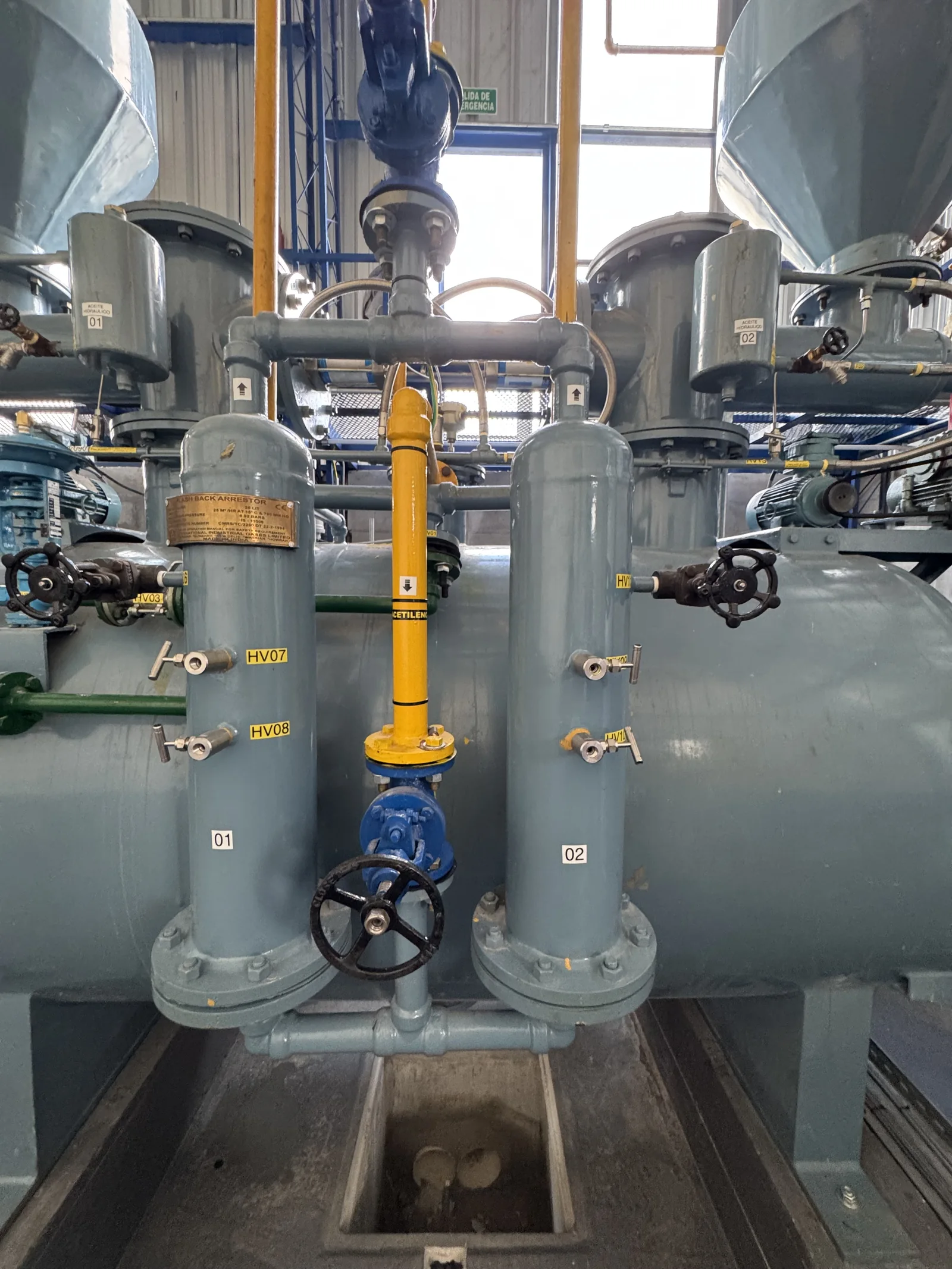
KIGL manufactures flashback arrestors for generator outlets, pipelines and cylinder manifolds; the KIGL plant operation manual places wet arrestors at the generator outlet and small arrestors with uni-flow valves on each charging pigtail.
Bursting discs vs flashback arrestors — frequently asked questions
Can a bursting disc protect an acetylene line from detonation?
No. A detonation front travels at about 1,800–2,000 m/s and the peak pressure arrives before a disc can open and vent. In the Miller and Penny tests of 1960 a disc set at 32 atm on a small vessel did not prevent peaks of 50 to 150 atm. The compilation by S. A. Miller (1965) adds that discs give limited protection even in deflagrations.
What is the difference between a bursting disc and a flashback arrestor?
A bursting disc is a pressure relief device: a thin membrane that breaks at a set pressure and vents gas. A flashback arrestor is a flame-quenching device: fine passages remove heat from the flame front so it cannot pass. One limits pressure after the event; the other stops the event travelling. In acetylene service only the arrestor stops a detonation.
Where are bursting discs useful in acetylene systems?
In liquid-phase reactors, where a reaction may accelerate slowly enough for a disc to relieve it; in dissolved acetylene cylinders where national practice uses them; on pressure gauge backs; and upstream of a packed-tower arrestor, where a disc cut the pulse passing the tower from over 10 atm to about 3.5 atm gauge.
Why does a vessel with a flashback arrestor not need to resist detonation?
Because the arrestor stops a detonation entering through the pipe. Provided the vessel is too short for an internal deflagration to become a detonation, the only explosion it must survive is a deflagration started inside it. That needs a test pressure of about 11 times working pressure. Without arrestors the design case becomes 40–50 times, or more with cascading, which is impractical. The arrestor changes the design case.
Do Indian acetylene cylinders use bursting discs?
Indian DA cylinders use fusible plugs to IS 13497:2017, which yield at about 98–104 °C under IS 3224:2021. Bursting discs appear in Indian practice mainly on cylinder valves for liquefiable gases such as carbon dioxide and nitrous oxide, and on the blow-out backs of acetylene pressure gauges, required by IS 15190 (Part 2):2002 clause 7.1.
Does gas escaping through a burst disc ignite?
Not usually from the act of bursting. In 104 trials compiled by S. A. Miller (1965), steel tubes holding acetylene at 10–20 atm were broken without igniting the escaping gas. The released gas is still a fire hazard outside, so disc outlets should discharge at height to a safe place, as for any acetylene relief.
References
- Bureau of Indian Standards. (2002). (Part 1 and Part 2):2002 Acetylene Pipelines — Code of Practice (IS 15190:2002).
- Bureau of Indian Standards. (2011). Flash Back Arrestor (Flame Arrestor) — Specification (IS 11006:2011, First Revision).
- Carver, Smith and Webster, The Explosive Decomposition of Acetylene in Pipelines, IChemE Symposium Series No. 33 (1972) https://www.icheme.org/media/10611/iv-paper-08.pdf
- European Industrial Gases Association. (2022). Code of Practice: Acetylene (EIGA Doc 123/22). https://www.eiga.eu/uploads/documents/DOC123.pdf
Enquiries
Request a quotation
State the gas or equipment, the quantity or capacity, and your location. KIGL will confirm the grade, the cylinder or plant size, and whether the location can be served from Noonmati, or through the agent network.