
Guide
What causes a flashback and what a flashback arrestor actually does
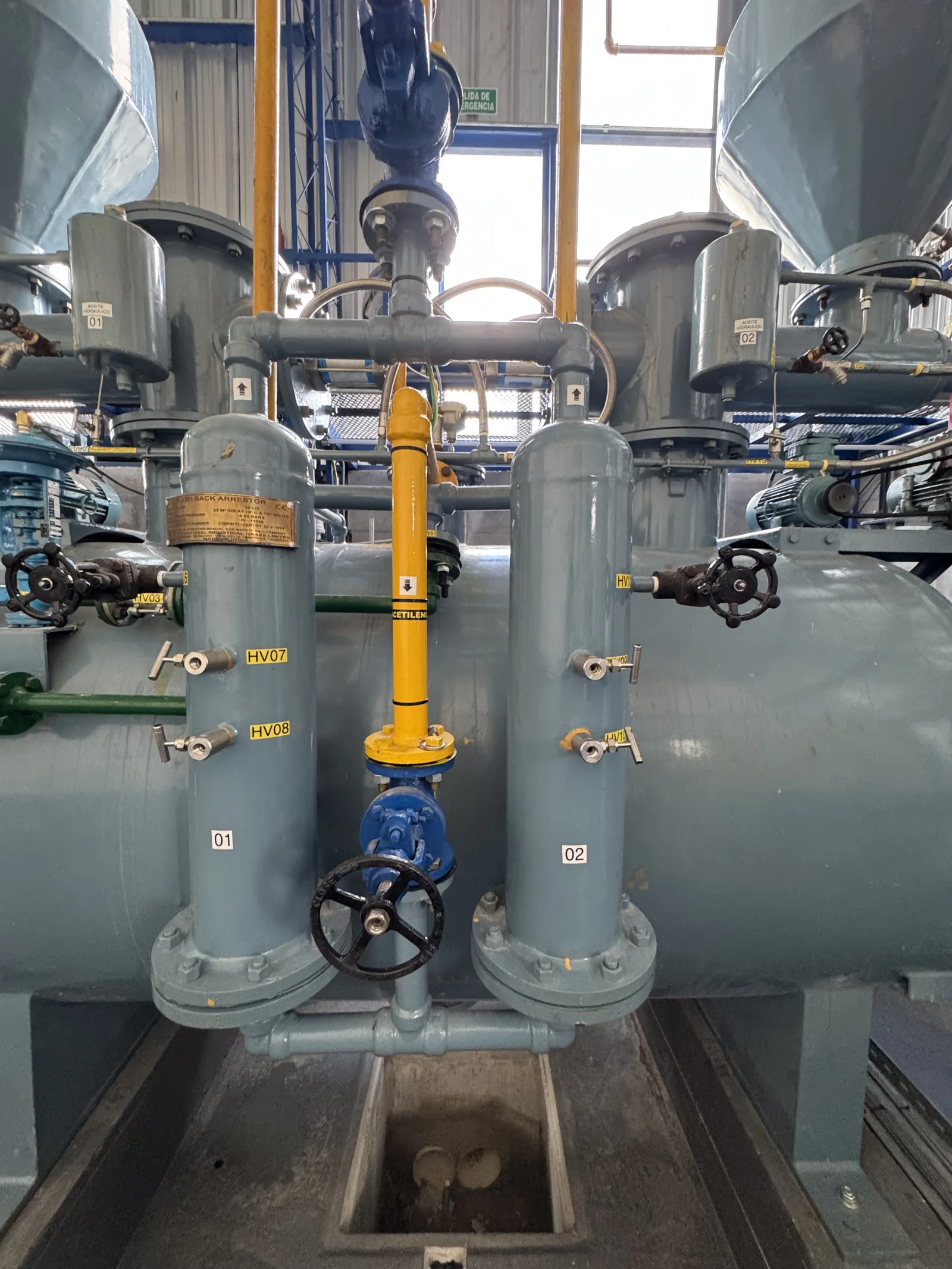
A flashback is the flame travelling backwards from the torch into the hose and toward the cylinder. It starts when gas velocity at the nozzle falls below the flame speed — from low pressure, a blocked or overheated nozzle, or reverse flow. Arrestors to IS 11006 stop it at two points: regulator and torch.
- Standard
- IS 11006
- International equivalents
- ISO 5175
- Where they must be fitted
- Regulator end and torch end
- Typical elements
- Flame arrestor
- Thermal cut-off
- Temperature-activated shut-off on fuel gas
What a flashback is
Gas leaves a cutting or welding nozzle at speed. The flame sits just off the nozzle because the gas is travelling out faster than the flame can burn back into it. That balance is the whole of it.
When gas velocity at the nozzle falls below the flame speed, the flame travels backwards. It goes into the torch, then into the hose, then toward the cylinder — carrying a burning front into a pipe full of fuel gas, or into a hose that may contain a mixture.
That is a flashback, and it is different from a backfire, which is the flame popping back into the torch and either going out or re-lighting at the nozzle. A backfire is a bang and a fright. A flashback is an event that can reach the regulator, and in the worst case the cylinder.
What starts one
| Cause | What is happening |
|---|---|
| Working pressure too low | Gas velocity falls below flame speed |
| Blocked or damaged nozzle | Flow is disturbed and velocity drops locally |
| Overheated nozzle | Gas ignites prematurely at the tip |
| Nozzle touched against the work | Flow is momentarily obstructed |
| Reverse flow between hoses | Oxygen enters the fuel hose, or the reverse, and a burnable mixture forms inside the hose |
| Hose or connection fault | Leaks and pressure loss disturb the balance |
The last one deserves emphasis. A flashback is far more dangerous if the two gases have already mixed inside the hose, because the flame then has fuel and oxidant waiting for it the whole way back. That is what non-return valves exist to prevent.
Rules that matter
A flashback arrestor is not one device. It is a set of elements in one body:
What an arrestor does
- Flame arrestor element — a sintered or wound element with passages small enough to take heat out of the flame front faster than it can propagate. The flame arrives and is quenched.
- Non-return valve — stops gas flowing backwards, so the two gases cannot mix in the hose in the first place.
- Contamination filter — keeps debris out of the element, because a blocked element is a restriction and a restriction causes the very pressure drop that starts flashbacks.
- Temperature-activated cut-off, on fuel gas — if the body gets hot, the gas is shut off mechanically.
KIGL manufactures these to IS 11006, with ISO 5175 and EN 730-1 as the international equivalents.
Where they go
Both ends, both gases. Four devices on a standard oxy-fuel set:
- At the regulator, fuel gas and oxygen — protecting the cylinder
- At the torch, fuel gas and oxygen — protecting the hose
Fitting one only at the torch protects the torch and leaves the hose exposed. Fitting one only at the regulator leaves a full hose between the flame and the arrestor. The pair, on each gas, is the system — not a belt-and-braces option.
They are the last line, not the first
An arrestor exists for the day something else fails. It does not make an unsound setup safe. Before it, in order:
- Correct working pressure — and for acetylene, never above 0.62 bar g without statutory clearance
It takes remarkably little to start one. IS 14814 : 2023 gives acetylene an ignition temperature of 325 °C and an auto-ignition temperature of 305 °C, the second being the lower of the two, and both far below the temperature of any flame you are working with. A flashback does not need a spark; a hot enough surface anywhere in the gas path will do. 2. A clean, undamaged, correctly sized nozzle, not overheated 3. Sound hoses and connections, gas-specific and in date 4. The right equipment for the gas — acetylene fittings for acetylene, no adaptors, no copper 5. An operator who knows why, not only what
Maintenance
Arrestors are safety devices with a service life. Check them periodically for leak-tightness and flow, replace them at the stated interval, and take any arrestor that has actually arrested a flashback out of service. It has done its job once, and it is not the component to gamble on.
The standards behind them are set out on flashback arrestor standards.
What causes — frequently asked questions
What is the difference between a backfire and a flashback?
A backfire is the flame popping back into the torch and going out or re-lighting at the nozzle — startling, usually harmless. A flashback is the flame continuing back through the torch and into the hose toward the cylinder. That is the dangerous one, and it is what an arrestor exists to stop.
What actually starts a flashback?
The flame travels back when gas velocity at the nozzle drops below the speed at which the flame burns. Common causes are too low a working pressure, a nozzle that is blocked, damaged or overheated, touching the nozzle against the work, or one gas flowing back into the other's hose because a non-return valve has failed or was never fitted.
What does a flashback arrestor do?
Several things at once. A flame arrestor element quenches the flame front by taking heat out of it faster than it can propagate. A non-return valve stops reverse flow so the gases cannot mix in the hose in the first place. A filter keeps contamination out of the element. On fuel gas, a temperature-activated cut-off shuts the line if the arrestor gets hot.
Where must arrestors be fitted?
At both ends and on both gases: at the regulator and at the torch, on the fuel gas line and on the oxygen line. Fitting one only at the torch protects the torch; fitting one only at the regulator leaves a hose full of gas between the two. The pair is the system.
Do arrestors need replacing?
Yes. They are safety devices with a service life, and one that has actually arrested a flashback should be taken out of service rather than reused. They should also be checked periodically for leak-tightness and flow, and replaced at the interval the manufacturer states — not left in place until something happens.
Does an arrestor make a bad setup safe?
No. An arrestor is the last line, not the first. Correct working pressure, a clean undamaged nozzle, sound hoses, the right equipment for the gas and an operator who knows why acetylene never exceeds 0.62 bar g all come first. The arrestor is there for the day one of those fails.
Enquiries
Request a quotation
State the gas or equipment, the quantity or capacity, and your location. KIGL will confirm the grade, the cylinder or plant size, and whether the location can be served from Noonmati, or through our agent network.