
Material safety data sheets
Hazard data for every gas KIGL supplies
A safety data sheet for every gas KIGL supplies — sixteen GHS sections covering hazards, first aid, firefighting, handling, storage, physical properties and transport classification. Grouped by hazard class, which is how cylinders must be segregated in store.
- 8
- Sheets published
- 16
- GHS sections each
- IS 4379
- Cylinder identification
One sheet per gas
Grouped by hazard class, because that is what decides how cylinders are segregated in store and which sheet is wanted first in an incident. Each row carries the UN number, the CAS number and the cylinder livery you would be looking at.
| Gas | UN | CAS | Cylinder colour | Safety data sheet |
|---|---|---|---|---|
| Flammable gases 2 Class 2.1. Segregate from oxidisers and from every source of ignition. | ||||
| Acetylene, dissolved | UN 1001 | 74-86-2 | Maroon, shade 541 | Read PDF |
| Hydrogen, compressed | UN 1049 | 1333-74-0 | Signal red, shade 537 | Read PDF |
| Oxidising gases 2 Class 2.2 with subsidiary risk 5.1. They do not burn — they make everything else burn harder. | ||||
| Nitrous oxide | UN 1070 | 10024-97-2 | Blue — medical, IS 3933 | Read PDF |
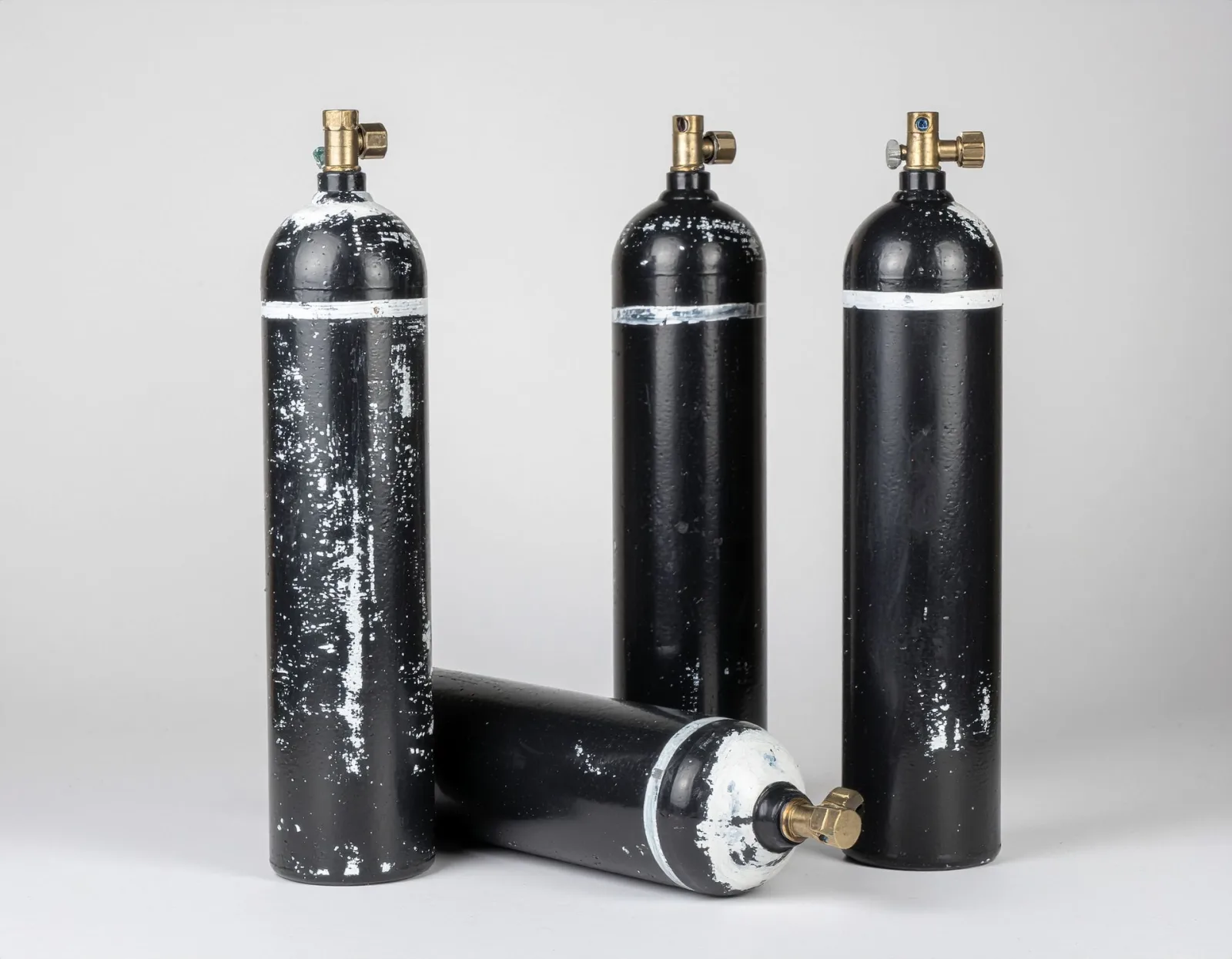
| Oxygen, compressed | UN 1072 | 7782-44-7 | Black, no band | Read PDF |
| Inert and non-flammable gases 4 Class 2.2. The hazard is asphyxiation, which is silent and gives no warning. | ||||
| Argon, compressed | UN 1006 | 7440-37-1 | Peacock blue, shade 103 | Read PDF |
| Carbon dioxide | UN 1013 | 124-38-9 | Black + white band | Read PDF |
| Helium, compressed | UN 1046 | 7440-59-7 | Middle brown, shade 411 | Read PDF |
| Nitrogen, compressed | UN 1066 | 7727-37-9 | French grey 630 + black band | Read PDF |