
Guide
Testing and replacing flashback arrestors: the IS 11006 type tests annual checks and when a device is spent
Flashback arrestor testing works at two levels. IS 11006:2011 type-tests each design with five flashbacks per sample and a 60 bar casing test, and production tests every device for reverse flow. In service, a competent person should check leak-tightness, non-return action and flow every 12 months, and replace the device after any flashback.
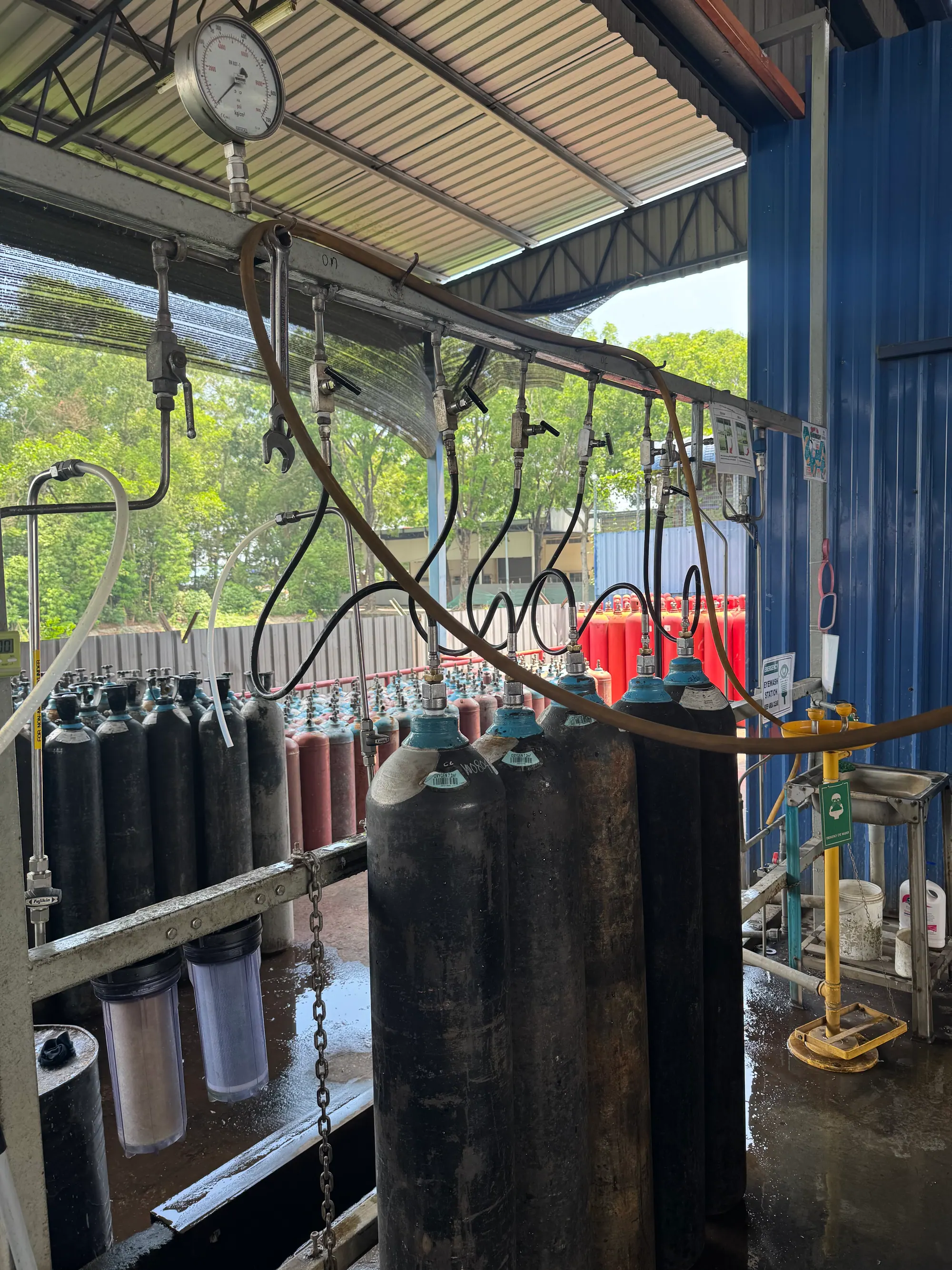
- Casing pressure test
- 10 times maximum working pressure or 60 bar
- Flashback type test
- Five flashbacks per sample
- Production testing
- Reverse-flow test on every device; pressure and flashback tests on 1 sample in every lot of 100
- Internal leakage limit
- 50 cm³/h for connection bores under 11 mm; 0.41 d² cm³/h above
- In-service inspection
- Every 12 months by a competent person; after every flashback
A flashback arrestor is tested twice before it reaches the user, as a design and as part of a production batch, and then continually as an installed device. The design is proved by the type tests in IS 11006:2011, and each production batch by the factory tests the standard makes compulsory. Once it is fitted, nothing in the standard tells the user how often to check it, so the interval comes from regulators and manufacturers: inspect and test every 12 months, and replace after any flashback. The reason is simple. You cannot see inside a sintered element, and an arrestor that has stopped one flame is the arrestor most likely to fail on the next.
What does IS 11006 test before a device is sold?
IS 11006:2011 cl 11 sets type tests on new devices with every safety function working. Tests are run at ambient pressure and 27 ± 5 °C, an Indian ambient rather than the 20 °C European convention, with air or nitrogen whose oil-vapour mass fraction is below 5 × 10⁻⁶ and suspended droplets below 1 mg/m³, dried to a dew point of 0 °C. Flow must be measured to ±10 % and pressure to ±3 %.
| Test | IS 11006:2011 clause | Samples | Pass criterion |
|---|---|---|---|
| Pressure resistance | 4.1, 11.4 | 1 (not reused) | 10 × maximum working pressure or 60 bar, whichever is higher, 5 min, no deformation or leak |
| Non-return valve, reverse flow | 11.5 | 5 | back-pressure raised at 6 mbar/min to 10 % of maximum working pressure, and from 0 to maximum within 1 s; leakage within cl 10.2 during and for 1 min after |
| Flashback | 11.6, Table 2 | 5 | five flashbacks each with static 32–35 % acetylene in oxygen at maximum operating pressure; upstream gas never ignites |
| Temperature cut-off | 11.7 | 1 new unit | valve closes before upstream gas ignites |
| Pressure cut-off | 11.8 | 5 | actuates at or below 1,200 mbar |
| Gas flow | 11.9 | 5 | flow and pressure drop at 0.25, 0.5, 0.75 and 1.0 of maximum pressure; samples within 10 % |
| Internal gas tightness | 10.2 | with the above | 50 cm³/h for bores under 11 mm, 0.41 d² cm³/h above |
The non-return valve is tested in its most disadvantageous position, with gravity acting to open it, a detail that rules out testing in the easy orientation. The test mixtures differ by gas: LPG devices use 13–15 % propane in oxygen and hydrogen devices 40–50 % hydrogen.
What must the factory test on every batch?
IS 11006:2011 cl 12 is normative: a reverse-flow test on each device, and a pressure-resistance test and a flashback test on one sample from each lot of 100. This is stricter than ISO 5175-1:2017, whose production-test annex (Annex C) is informative only. A supplier claiming IS 11006 conformity should be able to show these records.
Why test in service at all?
Because the conditions that defeat an arrestor develop after installation, and none of the type tests reproduce them. The failure modes reported by manufacturers and investigators are consistent: carbon from earlier flashbacks plugging the element; scale, rust and carbide dust; water in the element; oil in oxygen service; body corrosion; transport and handling damage; and a temperature cut-off that operated unnoticed. The worst is simple absence. In an Energy Institute case, a cutting torch lacked the required arrestors, trained operators did not notice, and a similar fire followed about seven weeks later. NTSB's 2009 special investigation of mobile acetylene trailer fires (SIR-09/01) recorded, among the equipment at one site, a flash arrestor on the compressors that had lost its packing, a device that looked fitted and protected nothing.
What is the in-service schedule?
| When | What to do | Basis |
|---|---|---|
| Before each use | Check the arrestor is present on each line, the right gas, the flow arrow correct, the body undamaged and connections tight | Energy Institute case; IMCA SF 02/14 |
| After any flashback | Isolate, replace the arrestor; inspect torch, hoses, regulator and fittings | WorkSafe ACT; IMCA SF 02/14; IS 11006 cl 10.5 |
| Every 12 months | External leak test at working pressure; reverse-flow test of the non-return valve; flow check on a bench; clean inlet filter | WorkSafe ACT; Witt; Wilhelmsen/Unitor |
| Every 5 years, or after 3 months idle | Corrosion inspection of generator wet arrestors | EIGA Doc 239/23 Table 12 |
| At 5 years (one maker's policy) | Replace, because internal condition cannot be judged | Wilhelmsen/Unitor manual |
The C.P.I. made the same point in 1968 for plant devices: arresters "must be of approved type and tested periodically" (C.P.I., Safety in the Production and Use of Acetylene, Paris 1968), with at least one fitted on every cylinder charging rack between compressor and rack inlet.
Rules that matter
How are the field tests done?
- External leak test Pressurise to working pressure and apply a bubble-forming leak-detection liquid to the body and joints. Never search with a flame. For oxygen equipment, IMCA Safety Flash 02/14 recommends a fluid made for oxy-fuel systems rather than soapy water.
- Reverse-flow test Remove the arrestor and apply dry, oil-free nitrogen at about 1–2 bar to the outlet; no gas should reach the inlet. This is the procedure Wilhelmsen/Unitor publish.
- Flow test Needs a calibrated bench and is not practical in the field. The method is the one in IS 11006:2011 cl 11.9; compare against the maker's curve. A falling flow at the same inlet pressure means a fouled element.
- Gas for testing Use only oil-free nitrogen or oil-free air, never oxygen. An arrestor used on compressed air must not afterwards be put into oxygen service.
Rules that matter
What are the signs of a spent arrestor?
- A tripped reset indicator, or a temperature cut-off that has operated.
- Soot or discolouration at the outlet, or heat-damaged paint on the body.
- A torch that starves or pops at settings that used to be stable, which suggests a fouled element.
- Corrosion, dents, damaged threads or a missing or illegible marking.
- An unknown history, or any device moved from air or fuel service to oxygen.
What about wet arrestors on generators and plant?
A hydraulic arrestor is tested differently, because its quenching medium is the water level. The C.P.I. required the water in a low-pressure hydraulic valve to be checked every day and again after every oxygen blowback or flashback, with the inside examined after each flashback. IS 11006:2011 cl 6.3 requires that the liquid level can be filled, observed and adjusted without letting air into the circuit, and cl 9 that internal parts can be examined and maintained. EIGA Doc 239/23 names loss of water in the arrestor as a failure mode and sets a corrosion inspection every five years or after any shutdown of three months or more, because a water-seal vessel left standing corrodes. On KIGL generators the operation manual has the level checked at every hopper fill, the arrestors drained, flushed and refilled weekly, and drained and cleaned annually. The detail is in the wet arrestor guide.
Rules that matter
Rules to apply
- Replace after any arrested flashback; do not reset or reuse.
- Inspect and test every 12 months, record results by serial number, and keep the register; IS 11006 does not require a date of manufacture on the body.
- Test with oil-free nitrogen, never oxygen, and never with a flame.
- Ask suppliers for the IS 11006 cl 12 production-test records for your batch.
- For plant duty see the maintenance checklist; for the product range see KIGL flash-back arrestors.
Testing — frequently asked questions
How often should a flashback arrestor be tested?
Every 12 months as a minimum, by a competent person, and immediately after any flashback. That interval is the nearest thing to consensus in the field: WorkSafe ACT in Australia states it, and Witt and Wilhelmsen/Unitor publish it for their devices. The check covers external leaks, the non-return valve under reverse pressure and, on a bench, the flow capacity.
Can a flashback arrestor be reused after a flashback?
Treat it as spent. Soot and carbon from the arrested flame foul the element, which is then more likely to fail next time, and a temperature cut-off that has operated is non-resettable under IS 11006:2011 cl 10.5. Replace the arrestor, then inspect the torch, hoses, regulator and fittings before the set is used again.
How do I test the non-return valve in a flashback arrestor on site?
With the arrestor isolated and removed, apply dry, oil-free nitrogen at about 1–2 bar to the outlet side and check that no gas passes to the inlet. This is the field method one manufacturer publishes. Never use oxygen or shop air for the test, and never test with a flame. Record the result against the arrestor's serial number.
Can I clean a sintered flashback arrestor element?
Generally no. A sintered element cannot be inspected internally, and the manufacturers who publish service guidance treat the dry element as non-serviceable in the field. Clean and check the inlet filter where the design allows it; replace the arrestor if the element is fouled, wet, oily or has stopped a flame.
What tests does IS 11006 require before a flashback arrestor is sold?
Type tests on new samples cover pressure resistance at ten times maximum working pressure or 60 bar, reverse flow, five flashbacks per sample, temperature and pressure cut-offs, gas tightness and flow. Production tests are compulsory: reverse flow on every device, and pressure and flashback tests on one sample from each lot of 100.
How do I know how old my flashback arrestor is?
Often you cannot from the body. IS 11006:2011 cl 14.1 requires a serial number, gas, flow direction, maximum pressure and functions, but not a date of manufacture. Keep a register that links each serial number to its purchase and installation date, inspection results and any flashback, and replace any device whose history is unknown.
What should I use to leak-test a flashback arrestor?
A bubble-forming liquid, never a flame. The C.P.I. specified soapy water or a wetting agent in 1968, and many manuals still do. For oxygen equipment, the IMCA investigation of a hose fire recommended a leak-detection fluid made for oxy-fuel systems instead of soapy water, to avoid leaving residues where oxygen flows.
References
- Bureau of Indian Standards. (2011). Flash Back Arrestor (Flame Arrestor) — Specification, Bureau of Indian Standards (full text) (IS 11006:2011, First Revision).
- European Industrial Gases Association. (2023). Mechanical Integrity of Generator Systems in Acetylene Plants (EIGA Doc 239/23). https://www.eiga.eu/uploads/documents/DOC239.pdf
- IMCA Safety Flash 02/14, Hose fire caused by flashback in oxygen and acetylene hoses https://imca-int.com/resources/safety/safety-flashes/0214-hose-fire-caused-by-flashback-in-oxygen-and-acetylene-hoses
- NTSB Special Investigation Report SIR-09/01, Mobile Acetylene Trailer Accidents https://www.ntsb.gov/safety/safety-studies/Documents/SIR0901.pdf
- WorkSafe ACT, Flashback arrestors https://www.worksafe.act.gov.au/health-and-safety-portal/safety-by-industry/building-and-construction/flashback-arrestors
Enquiries
Request a quotation
State the gas or equipment, the quantity or capacity, and your location. KIGL will confirm the grade, the cylinder or plant size, and whether the location can be served from Noonmati, or through the agent network.