
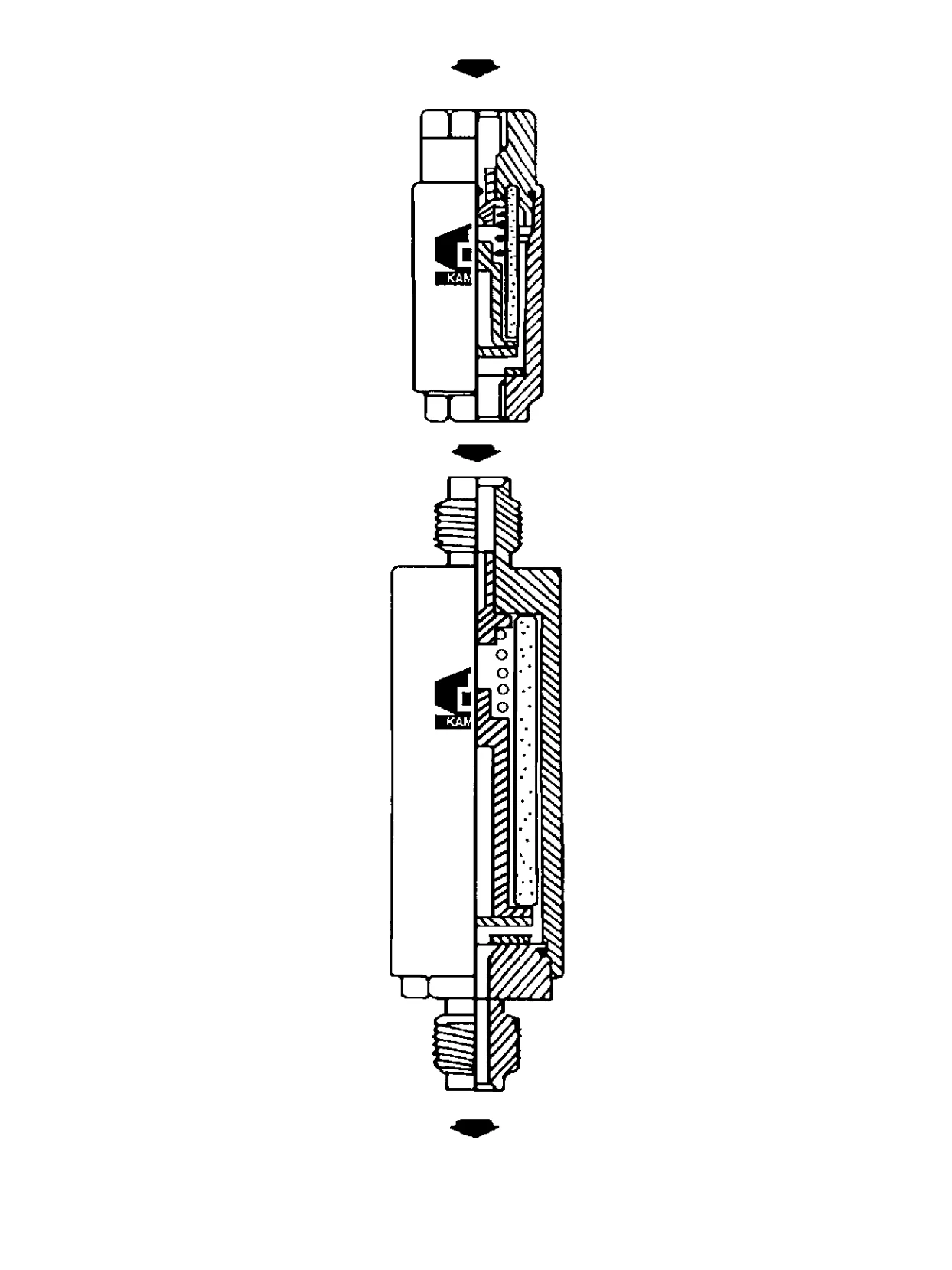
Equipment
KIGL-FBA-NRV — non-return valve with flame trap, DN6 to DN150
The KIGL-FBA-NRV combines a non-return valve with a flame trap, for fuel gases running beside air or oxygen at equal or higher pressure. It is offered threaded DN6 to DN40 and flanged DN32 to DN150, and the maximum working pressure is 25.0 bar on acetylene and 16.0 bar on air, oxygen, LPG or hydrogen.
Written and checked by KIGL technical staff
- 25.0 bar
- Acetylene maximum
- 16.0 bar
- Air or oxygen maximum
- 10.0 bar
- Natural gas maximum
- DN6 to DN40
- Threaded sizes
- DN32 to DN150
- Flanged sizes
On this page 8 sections
What the KIGL-FBA-NRV is for #
The KIGL-FBA-NRV is the two-element model in the KIGL-FBA range. It carries a non-return valve and a flame trap, and KIGL recommends it for LPG, natural gas and hydrogen wherever those gases run alongside air or oxygen at equal or higher pressure. It also suits manifold and pipeline systems generally.
That recommendation is about one failure. When a fuel gas and an oxidant share a system at similar pressures, the thing that goes wrong is not usually a flame coming back down the line: it is the oxidant crossing into the fuel line through a leaking torch, a shut-down burner or an unequal regulator setting. A combustible mixture then exists inside the pipe before anything is lit. The non-return valve answers that, and the flame trap answers what happens if it ignites.
This model is also the one body in the range specified by nominal bore rather than by thread form, in both threaded and flanged construction, which is why it is the model that appears on a piping drawing. It is not a welding-set fitting: a torch and its hose take the hose-mounted KIGL-FBA-HP, which is sized by hose bore in millimetres on ¼″ or ⅜″ BSP threads. The general treatment of flashback, quenching and model selection is on the range page, flash back arrestors.
Maximum working pressure, gas by gas #
| Gas | Maximum working pressure |
|---|---|
| Acetylene | 25.0 bar |
| Air / oxygen | 16.0 bar |
| LPG / hydrogen | 16.0 bar |
| Natural gas | 10.0 bar |
This table inverts the one on every other model in the range, and the inversion is the point. Acetylene is the highest figure here at 25.0 bar, where the pipeline KIGL-FBA-PM caps acetylene at 1.5 bar and runs oxygen to 25.0 bar. The figure is the published maximum working pressure of the body, and it exists because this is a pipeline and manifold fitting. It is not permission to run acetylene at 25 bar. IS 14814 : 2023 cl 7.2.1 holds free acetylene at 0.612 atm, or 1.021 atm with PESO clearance, and that limit comes from the gas: free acetylene decomposes without any oxidant once compressed.
Threaded sizes, by gas #
| Threaded | DN6 | DN8 | DN10 | DN15 | DN20 | DN25 | DN32 | DN40 |
|---|---|---|---|---|---|---|---|---|
| Air / oxygen | ● | ● | ● | ● | ● | |||
| LPG / natural gas | ● | ● | ● | ● | ● | ● | ||
| Hydrogen | ● | ● | ● | ● | ● | ● | ||
| Acetylene | ● | ● | ● | ● | ● |
KIGL-FBA-NRV, filled and despatched from KIGL's own works.
Guwahati works · agent network
Flanged sizes, by gas #
| Flanged | DN32 | DN40 | DN50 | DN65 | DN80 | DN100 | DN125 | DN150 |
|---|---|---|---|---|---|---|---|---|
| Air / oxygen | ● | ● | ● | ● | ● | |||
| LPG / natural gas | ● | ● | ● | ● | ● | ● | ● | ● |
| Hydrogen | ● | ● | ● | ● | ● | |||
| Acetylene | ● | ● | ● |
Read the two matrices together before sizing a line. Acetylene is the narrowest service in both: DN6 to DN20 threaded and DN32 to DN50 flanged. LPG and natural gas are the widest, with the full flanged range to DN150. Hydrogen starts smallest, at DN6, and stops at DN80 flanged. Air and oxygen do not start below DN15. Size and gas service are confirmed at order, and other thread forms, flanged connections, materials and surface finishes are made to order.
Where the line is larger than the flanged range for its gas, the device changes rather than the size: a bulk acetylene line takes the water-seal KIGL-FBA-WT, and a large distribution main takes a packed tower, which is covered in packed tower arrestors for large pipelines.
The two elements, and why neither works alone #
-
Non-return valve
This blocks reverse gas flow. On a shared fuel-and-oxidant system that is the primary duty, because reverse flow is how an oxidant reaches a fuel line and makes a combustible mixture inside the pipe before anything is lit.
-
Flame trap
This quenches an advancing flame front, stopping propagation into the pipe at any mixture velocity, by removing heat from the reaction zone faster than the reaction can produce it.
-
Neither one is flashback protection on its own
A check valve does nothing to a flame front, and a quenching element does nothing to the pressure wave that runs ahead of one. The reason the two are specified as a pair is set out in non-return valve vs flashback arrestor.
Key points
Specifying a KIGL-FBA-NRV #
- Name the gas first, because the gas decides the available sizes Acetylene threaded stops at DN20 and flanged at DN50, where LPG and natural gas run to DN150.
- Give the DN size and say whether the connection is threaded or flanged DN32, DN40 and DN50 exist in both constructions, so the drawing has to say which.
- Give the working pressure the line sees, against the limit for that gas 25.0 bar on acetylene is a device maximum and not a working point.
- State whether a fuel gas shares the system with air or oxygen, and at what pressure That is the condition this model is recommended for, and it changes the quantity as well as the model.
- Give the flow the line must pass in Nm³/h The device is sized on its flow curve at the working pressure rather than on the marked maximum, and a loss that rises in service is the first sign of a fouling element.
- Name the standard to be cited on the documents On an Indian tender that is IS 11006 : 2011, with EN ISO 5175-1 as the international equivalent. A quotation citing EN 730-1 is citing a withdrawn standard.
Every unit is tested for gas tightness and gas return before dispatch, and should be tested again at least once a year by a qualified person.
Specification
KIGL-FBA-NRV — full specification
| Property | Value | Basis |
|---|---|---|
| Acetylene maximum | 25.0 bar | Maximum working pressure, KIGL-FBA technical specification |
| Air or oxygen maximum | 16.0 bar | Maximum working pressure, KIGL-FBA technical specification |
| Natural gas maximum | 10.0 bar | Maximum working pressure, KIGL-FBA technical specification |
| Threaded sizes | DN6 to DN40 | Availability by gas, KIGL-FBA technical specification |
| Flanged sizes | DN32 to DN150 | Availability by gas, KIGL-FBA technical specification |
| Safety elements | Non-return valve and flame trap | KIGL-FBA technical specification |
| Governing standard | IS 11006 : 2011 | International equivalent EN ISO 5175-1 |
| LPG or hydrogen maximum | 16.0 bar | Maximum working pressure, KIGL-FBA technical specification |
| Recommended service | LPG, natural gas and hydrogen running beside air or oxygen | KIGL-FBA technical specification |
Questions
KIGL-FBA-NRV — frequently asked questions
Why is the acetylene rating 25.0 bar when the other arrestors are rated 1.5 bar?
Because this is a pipeline and manifold fitting, not a welding-set fitting. 25.0 bar is the published maximum working pressure of the body. It is not a statement that acetylene may be run at 25 bar: IS 14814 : 2023 cl 7.2.1 holds free acetylene near atmospheric, and that limit is set by the gas rather than by the device. The figure was checked against the KIGL-FBA specification on 14 November 2026.
Which DN sizes are available for which gas?
Threaded, air and oxygen run DN15 to DN40, LPG and natural gas DN10 to DN40, hydrogen DN6 to DN25 and acetylene DN6 to DN20. Flanged, LPG and natural gas run the full DN32 to DN150, air and oxygen DN40 to DN100, hydrogen DN32 to DN80 and acetylene DN32 to DN50. The matrix is on this page, and the size and gas service are confirmed at order.
When is a KIGL-FBA-NRV specified rather than a KIGL-FBA-PM?
When a fuel gas runs beside air or oxygen at equal or higher pressure, and when the specification calls for a DN size rather than a thread form. The [KIGL-FBA-PM](/kigl-fba-pm-pipeline-flashback-arrestor) carries five elements including a filter and a temperature cut-off and is specified by thread form; the -NRV carries two elements and publishes a DN range in both threaded and flanged bodies.
Is a non-return valve on its own enough protection?
No. A non-return valve prevents reverse gas flow and does nothing to a flame front. This model pairs it with a flame trap, which is what quenches the flame. A check valve specified on its own, as sometimes happens on a manifold drawing, is not flashback protection. The distinction is set out in [non-return valve vs flashback arrestor](/guides/non-return-valve-vs-flashback-arrestor).
Can a flanged KIGL-FBA-NRV be used on acetylene above DN50?
Not on the published range. Flanged acetylene bodies are offered DN32, DN40 and DN50 only, while LPG and natural gas run to DN150. For a larger bulk acetylene line the water-seal [KIGL-FBA-WT](/kigl-fba-wt-water-seal-flashback-arrestor) and the packed tower are the devices that scale, and the packed tower is covered in [packed tower arrestors](/guides/packed-tower-flashback-arrestors-for-large-pipelines).
What does the body have to withstand under IS 11006?
A non-fragmenting casing that holds ten times maximum working pressure, or 60 bar, whichever is higher, for five minutes with no permanent deformation and no leak. On a body rated at 25.0 bar that is a 250 bar test. Leakage must not exceed 50 cm³/h for a connection bore under 11 mm, or 0.41 d² cm³/h above it, under cl 10.2.
References
Bureau of Indian Standards.
- IS 11006:2011, First RevisionFlash back arrestor (flame arrestor) — Specification (2011)
- IS 14814:2023, First RevisionAcetylene — Code of safety (2023)
- The Kamrup Industrial Gases Limited. (2026). Company information and manufacturer's data [Company statement].
Read next
Enquiries
Request a quotation for KIGL-FBA-NRV
State the gas or equipment, the quantity or capacity, and your location. KIGL will confirm the grade, the cylinder or plant size, and whether the location can be served from Noonmati, or through the agent network.