
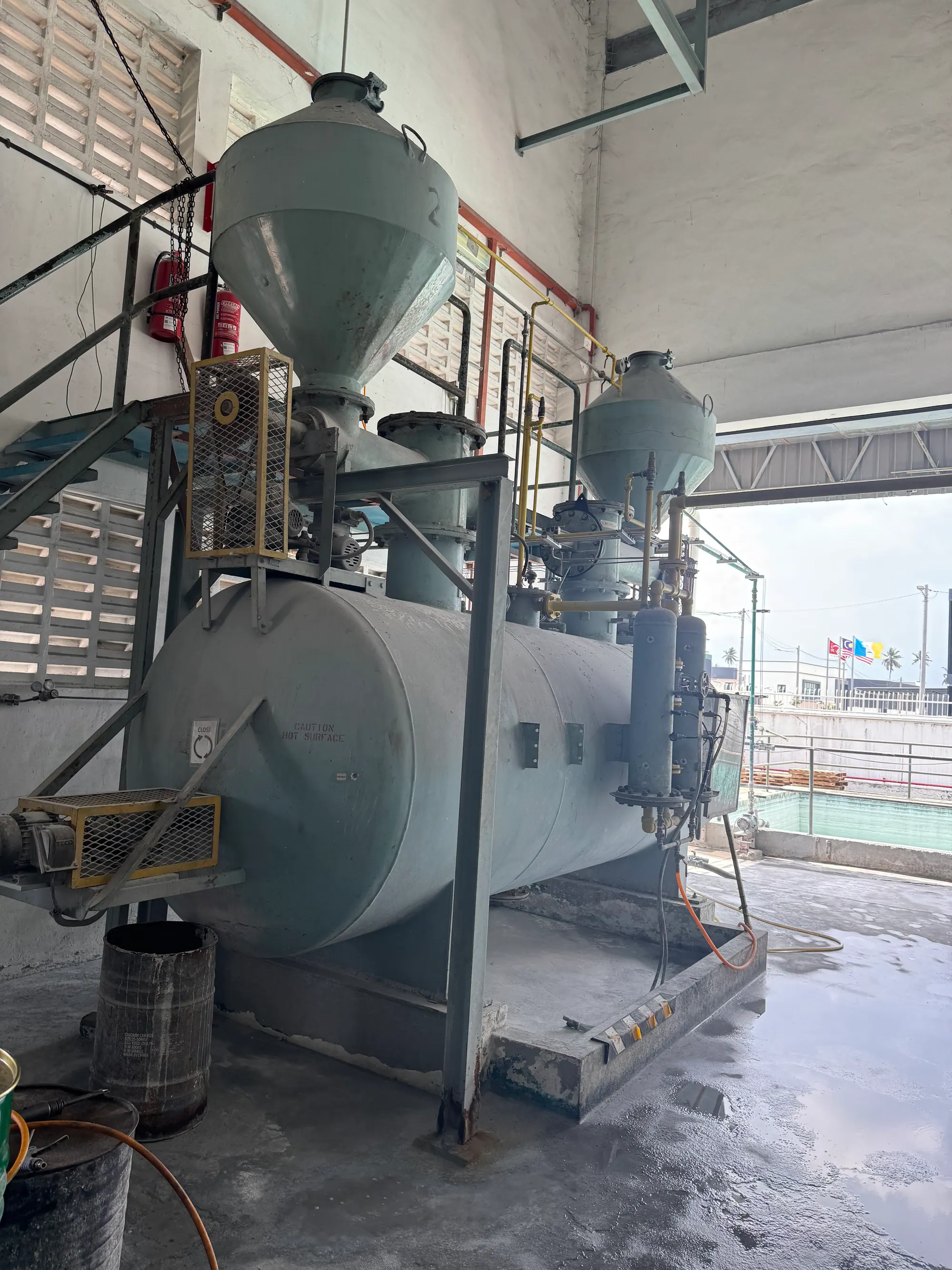
Equipment
Acetylene gas plants — designed, built and commissioned in India since 1947
KIGL designs and builds carbide-to-cylinder acetylene gas plants to IS 8471, with generation controlled between 0.2 and 0.92 kg/cm²g and a 70 °C ceiling. Plants ship and commission anywhere in India. The company has manufactured acetylene equipment since 1947 and sits on the BIS and PESO committees that write the standards.
₹35,00,000 – ₹1,20,00,000 per plant Indicative. Your quotation is the figure that counts — price moves with quantity, cylinder size, contract term and delivery.
KIGL acetylene gas plant range — 25 to 100 Nm³/h
| Model | Nominal capacity | Typically suits |
|---|---|---|
| KIGL-DA-25 | 25 Nm³/h | A works that has outgrown buying cylinders |
| KIGL-DA-50 | 50 Nm³/h | Continuous fabrication, filling your own cylinders |
| KIGL-DA-100 | 100 Nm³/h | Continuous operation and cascade filling at volume |
The generation chemistry and the operating envelope are identical across all three: every carbide generator runs in the same low pressure band because that is set by the chemistry, not the capacity. What changes is throughput, the scale of the civil works, and how much redundancy you get.
How an acetylene generator works: carbide to gas
Calcium carbide and water react on contact, exothermically and irreversibly. There is no throttle. Everything that makes an acetylene plant safe and economic comes down to how precisely that reaction is metered, cooled and contained, which is why plants that look alike on a datasheet behave very differently in a shed in July.
KIGL has been building this equipment since 1947. The group has contributed to the BIS and PESO committees that set the Indian standards for acetylene generators and cylinders, which means our plants are not merely certified against those standards — we helped write them.
Inside an acetylene gas plant: generator, purifier, drier, compressor
Eight stages, carbide in at one end and filled cylinders out at the other.
- Carbide charging. Sized carbide, 4–50 mm, is fed through the hopper. Grading matters more than most operators expect: fines react too fast and spike both pressure and temperature, oversize reacts incompletely and wastes carbide.
- Controlled generation. Carbide meets water in the generator. The reaction is held in the 0.2–0.92 kg/cm²g band, with a 1.05 kg/cm²g ceiling and a hard 70 °C limit. Cooling water is supplied at 1.5 × operating pressure.
- Cooling and condensing. Gas leaves the generator hot and wet. The cooler-condenser drops it and knocks out the bulk of the moisture.
- Low-pressure drying. Removes the water the condenser did not.
- Purification. Strips phosphine and hydrogen sulphide, the impurities that determine whether the gas is fit for anything beyond rough cutting.
- Scrubbing. Final wet clean-up before compression.
- Compression. An acetylene-rated compressor raises the gas to filling pressure. Acetylene compressors are not ordinary compressors: clearances, lubrication and materials are all specific to the gas.
- High-pressure drying and filling. Final dry, then into the manifold for cylinder filling.
Lime slurry, the by-product, is discharged continuously and is the plant’s main effluent stream.
What separates a good acetylene plant from a cheap one
Carbide yield
Carbide dominates operating cost. A plant that extracts more gas per kilogram pays for itself in months rather than years, and the difference between a well-designed generator and a poor one shows up on the carbide invoice, not the electricity bill.
Thermal control
The 70 °C limit exists because acetylene becomes unstable when hot. A generator that cannot hold temperature under a heavy carbide charge is not a cheaper plant — it is a hazard with a lower purchase price.
Purification that actually works
Phosphine and hydrogen sulphide carry through into the cylinder if the purifier is undersized or badly maintained. They corrode customer equipment, contaminate weld metal, and make the gas unusable for laboratory work.
Maintainability
Every internal that needs cleaning should be reachable without cutting pipework. Our plants are laid out so annual generator cleaning, agitator inspection and dryer regeneration are routine jobs, not shutdown projects.
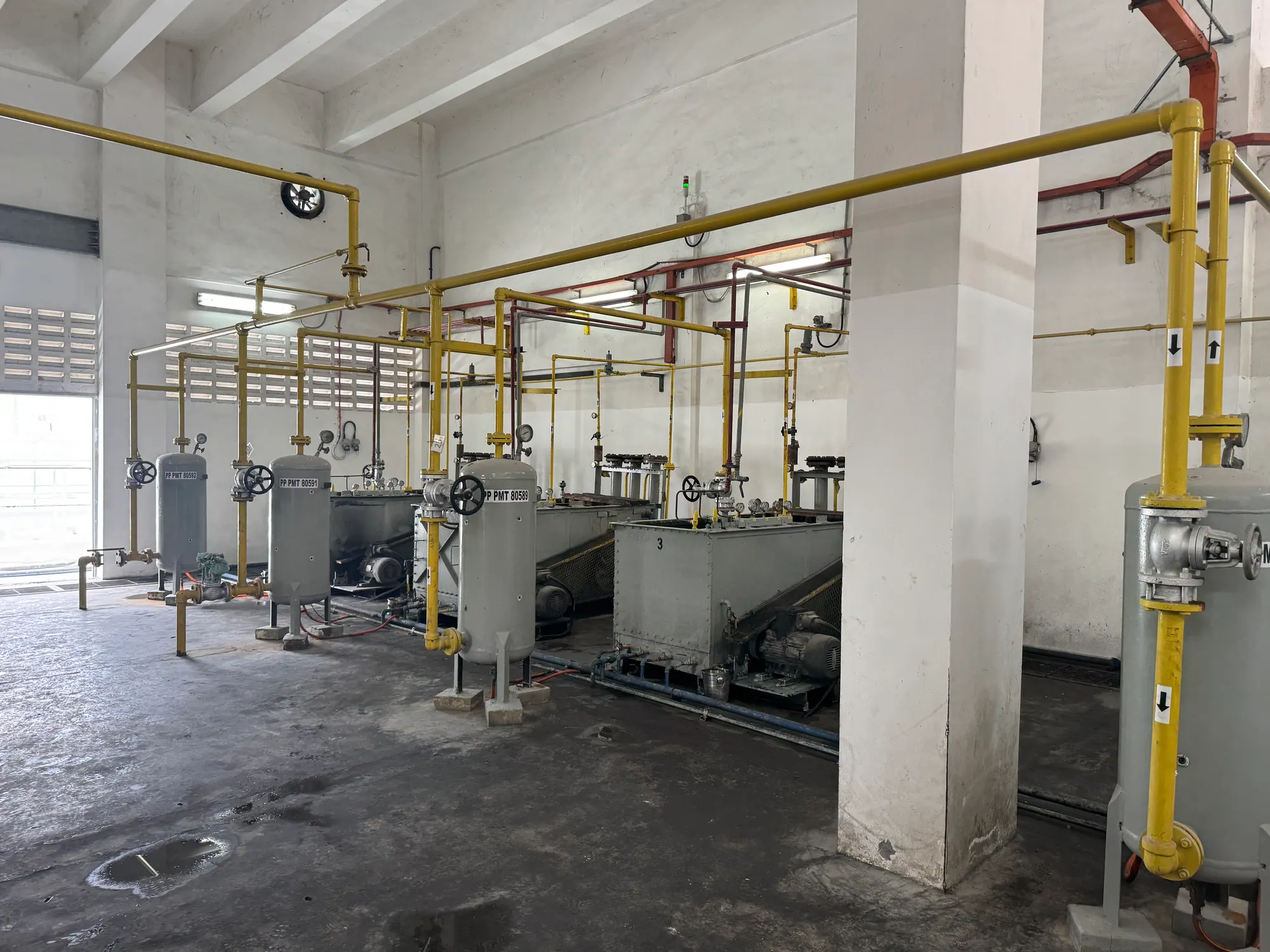
Gas plant room, pressure vessels and skids along the service run
Guwahati works · agent network
Safe handling
Acetylene forms a flammable mixture with air over an unusually wide concentration range, and it needs very little energy to ignite. That drives four design rules we do not negotiate:
Acetylene plant safety and PESO compliance
- Nitrogen purging only Air purging can create an explosive atmosphere inside the equipment being purged.
- No ignition sources within the exclusion zone Electrical equipment inside the zone is of the appropriate protection class throughout.
- High-level natural ventilation Acetylene must never be allowed to accumulate.
- Flashback protection at every take-off Reverse flame propagation is the failure mode that destroys plants, and it is entirely preventable.
The governing documents are IS 8471 for generator design and performance, IS 14814 as the acetylene safety code, and the Gas Cylinders Rules, 2016 for the filling installation. Carbide storage is separately governed by the Calcium Carbide Rules, 1987.
Acetylene plant supply, commissioning and operator training
A complete plant: generator, cooling and condensing, drying, purification, scrubbing, acetylene compressor, high-pressure drying and the cylinder filling manifold, plus erection supervision, commissioning, operator training and the operating manual.
We ship and commission across India, including all seven North-East states, West Bengal, Uttar Pradesh, Madhya Pradesh, Chhattisgarh, Bihar and Odisha. Equipment travels; unlike cylinder gas, distance is not a constraint.
Afterwards we hold spares and offer annual maintenance support. Plants we built decades ago are still running on parts we still make.
Why KIGL
Why buy an acetylene gas plant from KIGL
Seventy-nine years of continuous manufacture, contribution to the Indian standards themselves, and a group that both builds acetylene plants and operates them daily to fill its own cylinders. That last point matters more than any brochure claim: we live with the consequences of our own design decisions every shift.
Specification
Acetylene gas plants — full specification
| Property | Value | Basis |
|---|---|---|
| Governing standard (generators) | IS 8471 | Bureau of Indian Standards |
| Typical generation pressure | 0.2 – 0.92 kg/cm²g | KIGL-DA series operating manual |
| Maximum safe gas temperature | 70 °C | KIGL-DA series operating manual |
| Carbide size accepted | 4 – 50 mm | KIGL-DA series operating manual |
| Manufacturing since | 1947 | Company records |
| Plant type | Carbide-to-water, medium-pressure, fully enclosed | IS 8471 |
| Output gas | Dissolved acetylene, ≥98 % (C₂H₂) | IS 308 |
| Generation pressure, recommended ceiling | 1.05 kg/cm²g | KIGL-DA operating manual |
| Generation pressure, normal band | 0.2 – 0.92 kg/cm²g | KIGL-DA operating manual |
| Gas temperature limit | 70 °C | KIGL-DA operating manual |
| Feed carbide granulometry | 4 – 50 mm | IS 1040 carbide grades |
| Cooling water supply pressure | 1.5 × operating pressure | KIGL-DA operating manual |
| Purge medium | Nitrogen only — never air | IS 14814 |
Questions
Acetylene gas plants — frequently asked questions
What does an acetylene gas plant cost to run per cubic metre?
Running cost is dominated by calcium carbide, which typically accounts for the large majority of the cost per cubic metre. Carbide yield is therefore the number that matters: a plant that extracts more gas per kilogram of carbide, and loses less to venting and incomplete reaction, wins on economics regardless of its capital cost. Ask any supplier for measured yield under load, not a nameplate figure.
How much space does an acetylene plant need?
Layout is driven by the safety code rather than the equipment footprint. IS 14814 governs separation distances, ventilation and ignition-source exclusion, and in practice the exclusion zone around the generator sizes the building. KIGL prepares a site layout against your plot before quoting.
Can an acetylene plant be installed inside an existing shed?
Sometimes, but it must be assessed rather than assumed. The building needs adequate natural ventilation at high level, electrical equipment of the correct protection class, and compliant separation from ignition sources and occupied areas. We survey the building first.
What approvals are needed to operate an acetylene plant in India?
Acetylene generation and cylinder filling fall under the Gas Cylinders Rules, 2016, administered by PESO, and carbide storage falls under the Calcium Carbide Rules, 1987. Both the filling installation and the storage need licensing. We support the application with drawings and equipment certification.
Why is nitrogen used for purging instead of compressed air?
Because acetylene forms a flammable mixture with air across an extremely wide range, purging with air can create an explosive atmosphere inside the very equipment being cleaned. Nitrogen is inert and displaces the acetylene without forming a combustible mixture. This is not optional.
How long does commissioning take?
Commissioning depends on civil readiness and utility availability more than on the plant itself. We provide erection supervision and commissioning, train the operators, and hand over the operating manual and maintenance schedule. Talk to us with your civil programme and we will give a realistic date.
Do you supply spares and service after commissioning?
Yes. We hold spares for the generator, compressor, dryers and purifiers, and offer annual maintenance support. Plants we built decades ago are still running on our spares.
Read next
Enquiries
Request a quotation for acetylene gas plants
State the gas or equipment, the quantity or capacity, and your location. KIGL will confirm the grade, the cylinder or plant size, and whether the location can be served from Noonmati, or through our agent network.