
Guide
Non-return valve or flashback arrestor? Why an acetylene system needs both and where each one goes
A non-return valve and a flashback arrestor do different jobs. The valve stops gas flowing backwards, so oxygen cannot enter the acetylene line; the arrestor stops a flame. A check valve alone cannot reliably stop a flashback, so fit both: a non-return valve per cylinder lead and 1 or more arrestors after the regulator.
- Dry non-return valves
- Do not necessarily stop flashbacks
- Check valves alone
- Reverse-flow check valves alone will not stop a flashback in the system
- Manifold rule
- Non-return valve between each cylinder and the header; one or more arrestors after the regulator
- Indian manifold requirement
- Three flame arrestors with non-return valve in series on each charging or discharging manifold
- Non-return valve type test
- Back-pressure raised from 0 to maximum operating pressure within 1 s
A non-return valve and a flashback arrestor are often sold in the same body and often confused, but they do different jobs. The non-return valve stops gas flowing the wrong way; the flashback arrestor stops a flame. An acetylene system needs both, because each one covers the failure the other cannot. This page sets out what each device does, why a check valve is not flashback protection, and where each belongs.
What does each device actually do?
A non-return valve, also called a check valve, uses a spring-loaded or gravity-loaded disc or ball to let gas pass in one direction only. It stops oxygen being pushed back into the acetylene hose, or gas from one cylinder flowing into another, or a high-pressure line back-feeding a low-pressure one. A flashback arrestor contains a quenching element of sintered metal, packed grains or water that extinguishes a flame travelling back up the line. The C.P.I.'s 1968 code drew the line clearly. A device built to stop flashbacks must halt a flame before it reaches the accessories and generator upstream, and if it does not also stop other gases entering, a separate non-return valve is needed. Of dry non-return valves it said they "do not necessarily stop flashbacks" (C.P.I., Safety in the Production and Use of Acetylene, Paris 1968).
| Feature | Non-return valve | Flashback arrestor (flame-arrestor element) |
|---|---|---|
| Stops reverse gas flow | Yes | Not inherently; most include an N valve |
| Stops a flame | Not reliably | Yes, by quenching |
| Typical mechanism | Spring or weighted disc, ball or rubber seat | Sintered metal, packed grains, wire mesh or water |
| IS 11006:2011 marking | N | F |
| ISO standard | ISO 5175-2:2017 if no flame arrestor is fitted | ISO 5175-1:2017 |
| Main failure | Seat dirt or wear lets gas past | Fouled, wet, oily or spent element |
The ISO split makes the distinction formal. ISO 5175-1:2017 covers devices incorporating a flame arrestor; ISO 5175-2:2017 covers those without, including bare non-return valves, pressure relief valves and excess-flow cut-off valves. Part 2 includes a clause titled flashback resistance, but a Part 2 device by definition has no flame-arrestor element, so at most it can claim to survive a flashback, not to stop one.
Why is a check valve not enough?
Because it was never designed to quench a flame, and a flame moves faster than a valve closes. The American Welding Society puts it in one line: "Reverse flow check valves alone will not stop a flashback in the system" (AWS Fact Sheet 28). An Oregon OSHA interpretation adds that a backflow device only stops gas flowing back into the torch and hoses and does not reliably stop a flashback reaching hoses, regulator or cylinders.
The incident record says the same. In the hose fire investigated by IMCA (Safety Flash 02/14), a welder lit an oxy-acetylene cutting torch, there was a bang, and flame came from a coil of hoses on deck. The hoses split in three places, all at in-line connection points. The torch's non-return valve was suspected of being inoperative, the hose was perished along its length, and the connections had not been leak-checked. IMCA recommended arrestors on both the oxygen and fuel lines near the regulators, and at both torch and regulator for long hose runs.
Then why is the non-return valve essential?
Because the commonest route to a flashback is gas in the wrong hose. Oxygen is supplied at a higher pressure than acetylene. When a nozzle is obstructed, or the joint between the torch head and handle leaks, oxygen can climb the acetylene duct and fill the fuel hose with an explosive mixture; ignition at lighting-up then sends a flame back through a hose already full of fuel. The C.P.I. described both routes from experience. A non-return valve stops the mixing; the arrestor stops the flame if ignition happens anyway.
The acetylene literature gives a striking demonstration of why mixing, not pressure, is the danger. In experiments recorded by S. A. Miller (1965), nitrogen shock waves at 90 atm failed to explode acetylene at 3 atm, but air at 90 atm, or oxygen at only 18 atm, did, and a 65 atm oxygen shock initiated acetylene at pressures as low as 0.5 atm absolute. The difference was the driver gas mixing into the acetylene. That is why oxygen and acetylene must never be cross-connected and why the non-return valve sits on every fuel line.
Where does each one go?
| Location | Non-return valve | Flashback arrestor | Source |
|---|---|---|---|
| Torch inlet, both hoses | Yes | Recommended | Oregon OSHA rule; AS 4839-2001 via WorkSafe ACT |
| Regulator outlet, both gases | Usually combined in the arrestor | Yes | AS 4839-2001; IMCA SF 02/14 |
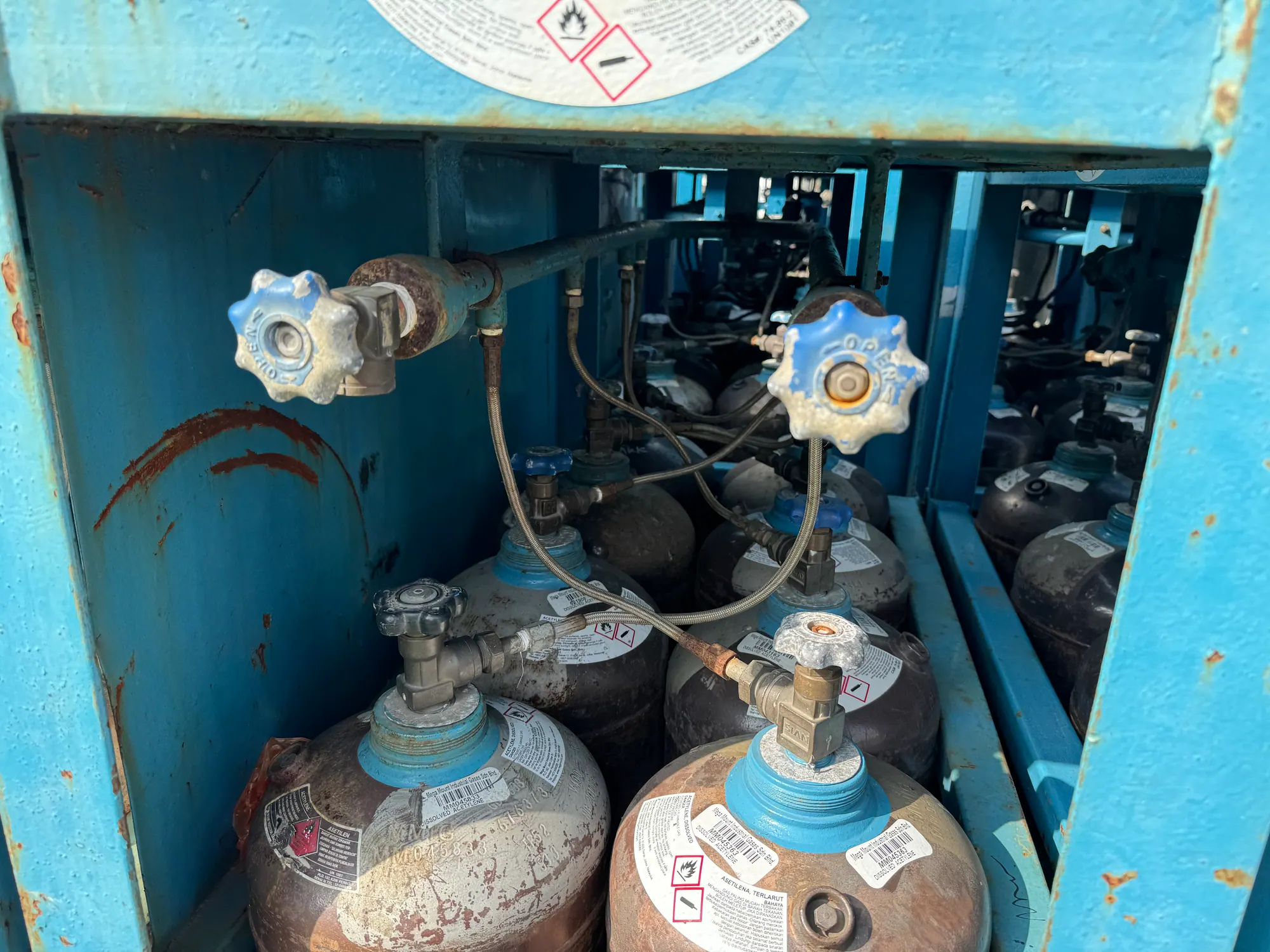
| Cylinder manifold, high-pressure side | One per cylinder lead | — | British Acetylene Association, 1962 |
| Cylinder manifold, after the regulator | — | One or more | British Acetylene Association, 1962 |
| Each charging or discharging manifold | With each arrestor | At each manifold or lead; three with non-return valves in series per manifold | IS 15190 (Part 2):2002 cl 8.2, 8.6 |
| Cylinder charging station | Efficient non-return device per station | At least one per rack, between compressor and rack inlet | C.P.I. 1968 |
The British Acetylene Association's 1962 code, 'Design and Installation of Acetylene Supply/Distribution Systems for Flame Processes', stated the manifold rule that still underlies practice: a non-return valve between each cylinder and the main header on the high-pressure side, and one or more flashback arrestors after the regulator on the low-pressure side. The non-return valves stop cylinders feeding into each other; the arrestors catch a flame arriving from the workstations. In IS 15190 (Part 2):2002 cl 6.7.4, flashback arrestors fitted with non-return valves at bends and joints can replace wall reinforcement, but not at the end of a pipe, where an arrestor serves no purpose. More on manifolds is in cylinder manifolds and bulk supply.
How is the non-return function tested?
IS 11006:2011 cl 11.5 tests five samples. Gas is first passed forward for 5 seconds; the valve is mounted in its most disadvantageous position, with gravity acting to open it; back-pressure is then raised slowly at 6 mbar per minute to 10 % of maximum working pressure, and separately from zero to maximum operating pressure within 1 second. Leakage during the test and for one minute after it must stay within the cl 10.2 limit of 50 cm³/h for bores under 11 mm. Production testing under cl 12 applies the reverse-flow test to every device made. In service, a check with 1–2 bar of dry nitrogen applied to the outlet is the usual field method, covered in testing and replacement.
Rules that matter
Rules to apply
- Never accept a non-return valve as flashback protection; look for the F marking.
- Fit a non-return valve on every fuel and oxygen line, and on every cylinder lead into a manifold.
- Fit flame arrestors after the regulator, and at the torch for long hose runs.
- Keep seats clean: the safety of a dry non-return valve depends on the care given to its seal (C.P.I. 1968).
- For combined devices and the KIGL range, see KIGL flash-back arrestors.
Non-return valve or flashback arrestor? Why an acetylene system needs both — frequently asked questions
Will a non-return valve stop a flashback?
Not reliably. A non-return valve is designed to stop gas flowing backwards, not to quench a flame. The C.P.I. wrote in 1968 that dry non-return valves do not necessarily stop flashbacks, and the American Welding Society states that reverse-flow check valves alone will not stop a flashback in the system. Fit a device with a flame-arrestor element as well.
Then why fit a non-return valve at all?
Because most flashbacks start with gas in the wrong place. If oxygen, at its higher pressure, pushes back into the acetylene hose through a blocked tip or a leaking torch joint, the hose fills with an explosive mixture. The non-return valve prevents that mixing; the arrestor stops the flame if ignition happens anyway. Each covers the other's gap.
Where should the non-return valve and the arrestor go on a cylinder manifold?
The British Acetylene Association's 1962 rule is a non-return valve between each cylinder and the header on the high-pressure side, and one or more flashback arrestors after the regulator on the low-pressure side. In India IS 15190 (Part 2):2002 also requires an arrestor at each manifold or in each lead, and three arrestors with non-return valves in series per manifold.
Is a device certified to ISO 5175-2 a flashback arrestor?
No. ISO 5175-2:2017 covers safety devices that do not incorporate a flame arrestor, such as non-return valves, pressure relief valves and excess-flow cut-offs. Flame-arrestor devices are covered by ISO 5175-1:2017. A bare non-return valve certified to Part 2 must never be sold or fitted as flashback protection.
Does a combined arrestor already include a non-return valve?
Most do. Under IS 11006:2011 the body marking tells you: N means a non-return valve is fitted, F a flame arrestor, T a temperature cut-off and P a pressure cut-off, so A D F N is a dry acetylene arrestor with a non-return valve. Every combination in IS 11006 Table 1 beyond the plain arrestor is built on a non-return valve.
Why does an oxygen backflow matter more than an inert gas one?
Experiments recorded in the acetylene literature showed nitrogen shock waves failed to explode compressed acetylene, while air or oxygen shocks did, because the driver gas mixed into the acetylene. The danger is mixing, not the pressure wave itself. That is the physics behind the non-return valve and the rule never to cross-connect oxygen and acetylene.
References
- American Welding Society, Safety and Health Fact Sheet No. 28
- Bureau of Indian Standards. (2002). Acetylene Pipelines — Code of Practice (IS 15190 (Part 2):2002).
- Bureau of Indian Standards. (2011). Flash Back Arrestor (Flame Arrestor) — Specification, Bureau of Indian Standards (full text) (IS 11006:2011, First Revision).
- IMCA Safety Flash 02/14, Hose fire caused by flashback in oxygen and acetylene hoses https://imca-int.com/resources/safety/safety-flashes/0214-hose-fire-caused-by-flashback-in-oxygen-and-acetylene-hoses
- International Organization for Standardization. (2017). Safety devices not incorporating a flame (flashback) arrestor (ISO 5175-2:2017).
Enquiries
Request a quotation
State the gas or equipment, the quantity or capacity, and your location. KIGL will confirm the grade, the cylinder or plant size, and whether the location can be served from Noonmati, or through the agent network.