
Gases
Hydrogen gas supply for industrial, laboratory and process use
Hydrogen is the lightest element and burns across an unusually wide range — roughly 4 % to 75 % in air — with a flame that is almost invisible in daylight. It ignites on a fraction of the energy other fuel gases need. KIGL supplies hydrogen in high-pressure cylinders for industrial and laboratory use.
₹600 – ₹700 per Nm³ Indicative. Your quotation is the figure that counts — price moves with quantity, cylinder size, contract term and delivery.
- 2.01588 g/mol
- Molecular weight
- ≈4 %
- Flammability range in air
- ≈0.02 mJ
- Minimum ignition energy
- Nearly invisible in daylight
- Flame visibility
- ≈0.07
- Vapour density (air = 1)
The gas that behaves unlike the others
Almost every safety habit built around other industrial gases is wrong for hydrogen, and that is the most useful thing this page can tell you.
It rises instead of sinking. At roughly one-fourteenth the density of air, hydrogen goes straight up. It collects under roofs, in ceiling voids and at the top of enclosed spaces. Ventilation must be at high level, and a detector mounted at floor height will never see it.
It ignites on almost nothing. Minimum ignition energy is around a tenth that of most hydrocarbon gases — low enough that static discharge from clothing will do it. Bonding and earthing are the primary control, not a precaution.
It burns over an enormous range — roughly 4 % to 75 % in air. There is very little dilution margin between “no hazard” and “flammable”.
And the flame is nearly invisible. A hydrogen flame emits almost no visible light. In daylight you will not see it. People have walked into burning hydrogen leaks. The traditional test is to advance a broom or dry straw ahead of you and watch for charring; thermal imaging is the modern answer.
Hydrogen applications in industry
Hydrogenation of fats, oils and organic compounds — the largest chemical use.
Reducing atmospheres in heat treatment, annealing, sintering and metal processing, where hydrogen prevents oxidation.
Float glass and semiconductor manufacture, as a protective and reducing atmosphere.
Laboratory carrier gas in gas chromatography, increasingly replacing helium as helium supply tightens.
Ammonia and methanol synthesis in chemical plants.
Fuel cells and energy research, where hydrogen is the energy carrier.
Materials matter
Hydrogen diffuses into some steels and alloys and reduces their ductility — hydrogen embrittlement — which can cause cracking and sudden brittle failure, particularly at high pressure and in high-strength steels.
The practical consequence: hydrogen service needs materials selected for hydrogen service. Ordinary high-pressure fittings, hoses and regulators must not be repurposed because they happen to be rated for the pressure. Pressure rating is not the same as hydrogen compatibility.
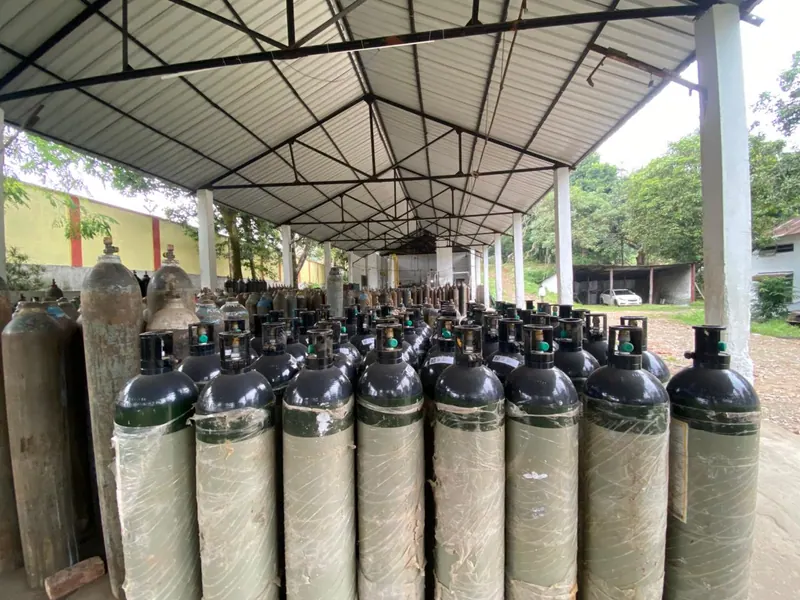
Filled industrial gas cylinders, ranked upright in the yard for despatch
Guwahati works · agent network
Safe handling
Handling
- Ventilate at high level. This is the opposite of argon and CO₂.
- Bond and earth everything. Static is a sufficient ignition source.
- Purge with nitrogen before and after maintenance — never with air.
- Use hydrogen-rated equipment throughout, with left-hand thread fittings as standard for fuel gases.
- Assume a leak may be burning even if you can see nothing.
- Secure cylinders upright, away from oxidisers and ignition sources.
Full detail is in our hydrogen safety data sheet.
Hydrogen cylinder sizes and supply across India
High-pressure cylinders, specified against the stated application and required purity — laboratory carrier gas and furnace atmosphere have very different requirements, and being sold the wrong grade is either expensive or useless.
Why KIGL
Why buy hydrogen from KIGL
We supply hydrogen rather than producing it, and we would rather tell you that plainly than let you assume otherwise. What seventy-nine years in industrial gas adds is the handling: hydrogen defeats almost every habit built around other gases. It rises instead of pooling, it ignites on a fraction of the energy, and its flame is close to invisible in daylight. Ask us how the hydrogen we supply is produced and how it should be stored on your site, and you will get a straight answer.
Specification
Hydrogen gas supply — full specification
| Property | Value | Basis |
|---|---|---|
| Molecular weight | 2.01588 g/mol | NIST |
| Flammability range in air | ≈4 % – 75 % — exceptionally wide | Literature |
| Minimum ignition energy | ≈0.02 mJ — roughly a tenth of most hydrocarbons | Literature |
| Flame visibility | Nearly invisible in daylight | Literature |
| Vapour density (air = 1) | ≈0.07 — rises and accumulates at high level | Calculated |
| Cylinder colour | Signal red | IS 4379 |
| Chemical formula | H₂ | — |
| Normal boiling point | −252.9 °C | Literature |
| Critical temperature | −240.0 °C (33.18 K) | NIST |
| Critical pressure | 13.00 bar | NIST |
| Flammability limits in air | ≈4 % – 75 % v/v | Literature |
| Supply form | High-pressure cylinders | — |
Documents
Hydrogen gas supply — safety and technical documentation
Questions
Hydrogen gas supply — frequently asked questions
Why is a hydrogen flame dangerous even though hydrogen burns cleanly?
Because you cannot see it. A hydrogen flame emits almost no visible light and in daylight is effectively invisible — people have walked into them. The traditional detection method is to advance a broom or a dry straw ahead of you, which will char on contact. Thermal imaging is the modern answer. Never assume a leak is not burning simply because you see no flame.
How easily does hydrogen ignite?
Extremely easily. Its minimum ignition energy is around a tenth that of most hydrocarbon gases, low enough that an ordinary static discharge from clothing is sufficient. Bonding and earthing are not precautionary here; they are the primary control.
Does hydrogen collect at floor level like other gases?
No — the opposite, and it changes where the hazard is. Hydrogen is about fourteen times lighter than air and rises rapidly, accumulating under roofs, in ceiling voids and at the top of enclosed spaces. Ventilation must be at **high** level, and detectors mounted near the floor will never see it.
What is hydrogen embrittlement?
Hydrogen diffuses into some steels and alloys and reduces their ductility, which can lead to cracking and sudden brittle failure — particularly at high pressure and in high-strength steels. This is why hydrogen service requires materials selected for it, and why ordinary high-pressure fittings must not be repurposed.
Do you supply green hydrogen?
Ask us and we will tell you honestly how the hydrogen we supply is produced. Most industrial hydrogen in India comes from steam methane reforming or as a by-product of chlor-alkali production. We will not label a product green without being able to substantiate it.
What purity is available?
Hydrogenation, heat treatment and general industrial use have different requirements from gas chromatography carrier gas or fuel-cell testing, and KIGL will specify against your need than quote a headline figure.
Read next
Enquiries
Request a quotation for hydrogen gas supply
State the gas or equipment, the quantity or capacity, and your location. KIGL will confirm the grade, the cylinder or plant size, and whether the location can be served from Noonmati, or through our agent network.