
Guide
Packed-tower flashback arrestors for large acetylene pipelines: Raschig rings gas velocity, packed height and the upstream bursting disc
A packed-tower flashback arrestor is a vessel of Raschig rings that quenches acetylene decomposition in large, low-pressure pipelines. The rules compiled by S. A. Miller (1965) from Schmidt and Haberl's tests are: rings under one-fifteenth of tower diameter, gas below 60 cm/s, and at least 1.2 m of wetted or 2.4 m of dry packing.
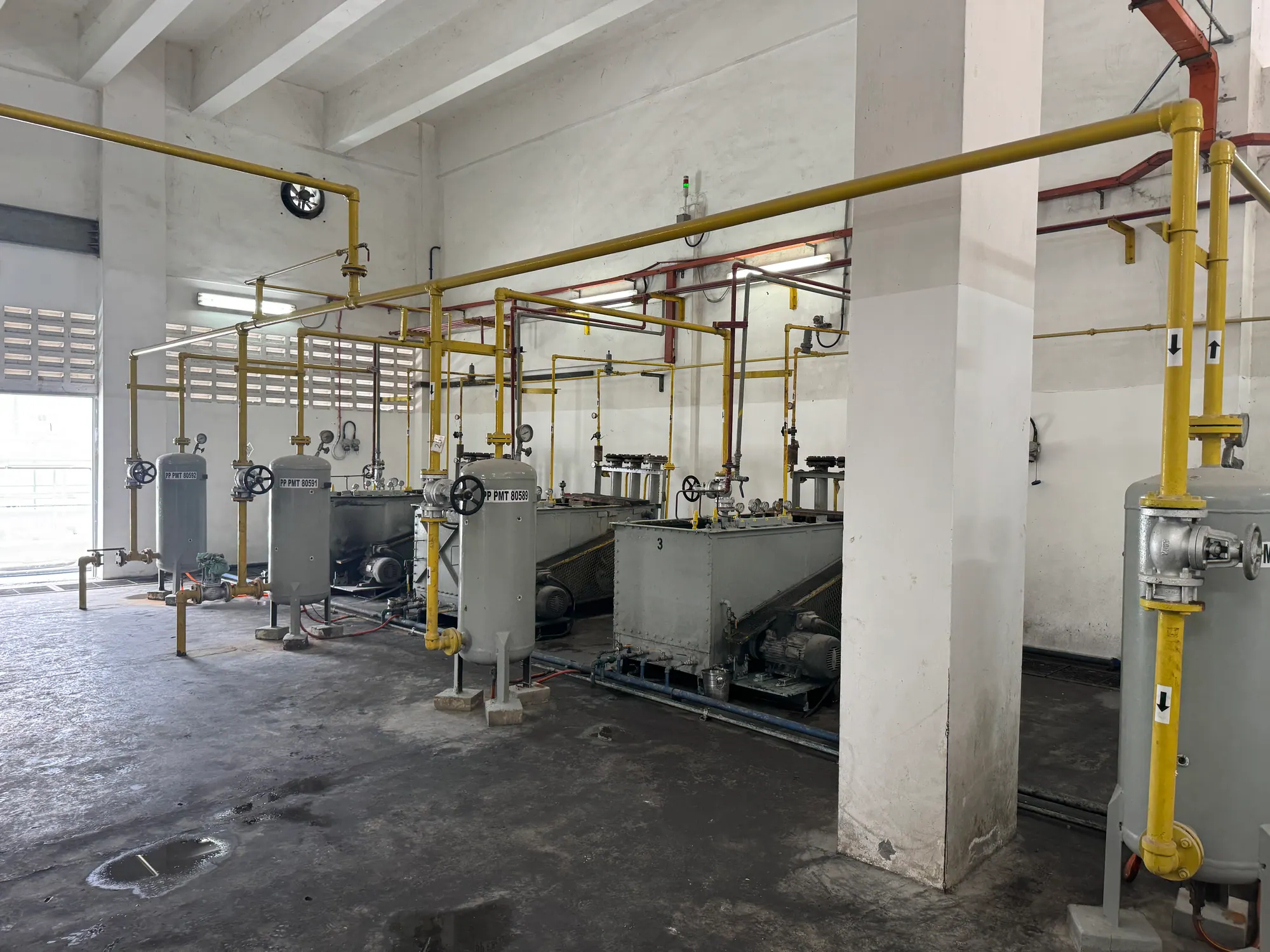
- Test tower that repeatedly quenched detonations
- 25 cm tower
- Ring size and gas velocity
- Rings smaller than 1/15 of tower diameter; linear gas velocity below 60 cm/s
- Minimum packed height
- 1.2 m if wetted
- Pressure pulse passing a successful tower
- More than 10 atm without venting; about 3.5 atm gauge with a 10 atm bursting disc upstream
- The incident that prompted the work
- Decomposition travelled over 2 km of 15
A packed-tower flashback arrestor is the answer to a problem small arrestors cannot solve: a long, wide acetylene pipeline at low pressure, where a sintered element would cost too much pressure and a decomposition can still travel kilometres. The tower is a vessel full of Raschig rings, sometimes irrigated with water, that offers a large cooling surface to the flame while leaving wide passages for the gas. Its design rules come from tests made after the Hüls pipeline explosion of 1954, and they still set the numbers: ring size, gas velocity, packed height and an upstream vent.
Why do large pipelines need a different arrestor?
Because acetylene in a wide pipe is far less stable than in a narrow one, and the pressure available to push gas through an arrestor is small. On 2 January 1954 at the Chemische Werke Hüls in Germany, chlorine was admitted into an acetylene line by a sequence of mishaps. The decomposition it started travelled through more than 2 km of 15, 30 and 60 cm pipe at only 1.03 atm absolute, below 0 °C, wrecked several large items of plant and injured a number of people (Dechema Information Bulletin, 7 March 1954; Chemical and Engineering News, 1954).
The pipe-diameter data explain why. The C.P.I. recorded that in 100 mm pipe a detonation is to be feared above 0.6 kg/cm², against more than 7 kg/cm² needed for full propagation in 10 mm pipe (C.P.I., Safety in the Production and Use of Acetylene, Paris 1968). Kogarko and colleagues proposed limiting transport to 1.4 atm absolute in 20 cm pipe and 1.05 atm absolute in pipe up to 38 cm (Khimicheskaya Promyshlennost, 1962). Long lines of 15–60 cm carrying acetylene at 0.03–1.5 atm gauge existed at a number of locations, and they needed an arrestor with very low pressure drop. Some used towers containing porous metal plates; the design that was tested and widely adopted was the Raschig-ring tower. Containment is not an option either: Carver, Smith and Webster measured terminal pressure ratios above 320, a lower bound, in a 12.7 mm tube (IChemE Symposium Series No. 33, 1972). The pipe diameter and detonation guide covers the underlying data.
What did the tests show?
Schmidt and Haberl tested a ring-packed tower against real detonations (Technische Überwachung, 1955, 423; Chemie-Ingenieur-Technik, 1956, 677):
| Parameter | Value |
|---|---|
| Tower diameter | 25 cm |
| Packing | 2.5 cm Raschig rings |
| Packed depth | 1.2 m |
| Challenge | Detonations set up in 180 m of 8 cm pipe holding acetylene at 3 atm gauge |
| Result | Repeatedly quenched |
| Quench zone, irrigated packing | Complete within the first few centimetres |
| Quench zone, dry packing | Effective, but spread over 30–45 cm |
| Pulse passing the tower, no vent | More than 10 atm |
| Pulse passing the tower, 10 atm bursting disc in a tee near the inlet | About 3.5 atm gauge |
Water makes a large difference. Irrigated rings quench almost at once because the water film and spray add a heat sink to the metal or ceramic surface, the same reason a wet hydraulic seal works. Dry rings still work but need far more depth.
What are the design rules?
The rules drawn from that work, as compiled by S. A. Miller (1965), are short:
| Rule | Value | Reason |
|---|---|---|
| Ring diameter | Less than 1/15 of the tower diameter | Keeps passages small relative to the tower and avoids wall channelling |
| Tower diameter | Wide enough to keep linear gas velocity below 60 cm/s | Low velocity keeps pressure drop low and gives the flame time to lose heat |
| Minimum packed height, wetted | 1.2 m | Matches the tested depth, which quenched within centimetres |
| Minimum packed height, dry | 2.4 m | Doubles the wetted height to cover the deeper 30–45 cm quench |
| Packing extent | Right up to the inlet and the outlet | No empty headspace where a flame can burn before meeting rings |
| Direction | Arrests explosions in either direction | Pipeline flames can start at either end |
The ring rule is stricter than the test. The tested tower used 2.5 cm rings in a 25 cm shell, a ratio of one-tenth; under the rule, a 25 cm tower would take rings below about 1.7 cm.
How big does a tower need to be?
The 60 cm/s rule sets the tower diameter for a given flow. Taking it as the velocity through the empty cross-section at line pressure, the arithmetic is:
| Tower diameter, cm | Cross-section, m² | Maximum actual flow at 60 cm/s, m³/h | Maximum ring size (D/15), cm |
|---|---|---|---|
| 15 | 0.018 | 38 | 1.0 |
| 25 | 0.049 | 106 | 1.7 |
| 30 | 0.071 | 153 | 2.0 |
| 40 | 0.126 | 271 | 2.7 |
| 50 | 0.196 | 424 | 3.3 |
| 60 | 0.283 | 611 | 4.0 |
Flow here is actual volume at line pressure. At 0.5 atm gauge, 1 m³ of line gas is about 1.5 m³ at atmospheric pressure, so a 25 cm tower handles roughly 160 m³/h measured at atmospheric conditions. These figures are arithmetic on the published rules, not tested ratings.
Why must the packing reach the inlet and outlet?
Because an empty space inside the housing is a combustion chamber. If a flame from the pipeline can enter a void above or below the packing before it meets the rings, it can burn there as a deflagration, and a deflagration in a closed vessel raises pressure about elevenfold: 11.1 ± 0.6 times the initial absolute pressure in sixteen runs by Miller and Penny (IChemE symposium, 1960). With rings packed right to the nozzles, quenching starts at once and the housing never sees that load. Check any tower drawing for unpacked plenums, distributor spaces and settling gaps, and allow for rings settling in service.
Why does a tower need a bursting disc upstream?
A tower that stops the flame still passes a pressure wave. In Schmidt and Haberl's tests the gas in the long feed pipe had been heated to about 2,800 °C and raised to 72 atm before reaching the tower, and it did not instantly return to ambient conditions. More than 10 atm passed into the pipe beyond, although no explosion happened there. A bursting disc set at 10 atm, mounted in a tee near where the explosion entered the tower with its outlet pointing upwards, gave the gas an escape and limited the transmitted pulse to about 3.5 atm gauge.
The disc is a partner to the arrestor, not a substitute. Miller and Penny measured peaks of 50–150 atm near a disc set to burst at 32 atm, and a disc cannot outrun a detonation front. Design the tower and its upstream vent together, and rate the downstream pipe for the residual pulse. See bursting discs vs flashback arrestors.
Where does a tower fit in Indian practice?
Rarely in welding distribution. IS 15190 (Part 1):2002 covers acetylene pipelines up to 155 kPa gauge and DN 100, recommends restricting pipe to DN 50, and excludes pipelines in chemical plants where acetylene is a process feed. Within that scope ordinary wet and dry arrestors serve, and cl 4.12.1.5 allows several units in parallel where one cannot carry the flow. Towers belong on large-bore plant and process lines, gasholder connections and long transfer mains outside that envelope. IS 11006:2011 names delivery pipelines and acetylene generators in its scope, but its flashback type test, five flashbacks with 32–35 % acetylene in oxygen, was written for compact devices; a tower should also be proved against pipeline decomposition, as Schmidt and Haberl did.
Rules that matter
Rules to apply
- Consider a packed tower where pipe bore reaches about 15 cm or more at low pressure.
- Size the shell for gas velocity below 60 cm/s and use rings under one-fifteenth of its diameter.
- Pack at least 1.2 m if irrigated and 2.4 m if dry, right up to inlet and outlet.
- Fit an upstream bursting disc and rate the downstream pipe for the residual pulse.
- Keep irrigation water supplied, drained and protected from frost.
- Treat any arrested event as a reason to inspect the packing; see the twenty-minute delay.
- For standard pipeline and generator units, see KIGL flash-back arrestors.
Packed-tower flashback arrestors — frequently asked questions
What is a packed-tower flashback arrestor?
A vertical vessel, inserted in a large acetylene pipeline, filled with Raschig rings and sometimes irrigated with water. The rings present a large cooling surface to a decomposition flame or detonation while leaving wide, open passages for the gas, so the pressure drop is low. The design was tested after the 1954 Hüls pipeline explosion and used in Germany, the USA and Britain.
How big should the Raschig rings be in a flashback arrestor tower?
Smaller than one-fifteenth of the tower diameter, under the design rules drawn from Schmidt and Haberl's tests. In a 30 cm tower that means rings under 2 cm; in a 60 cm tower, under 4 cm. The rule is more conservative than the tested tower itself, which used 2.5 cm rings in a 25 cm shell, a ratio of one-tenth.
How tall must the packing be?
At least 1.2 m if the packing is wetted and 2.4 m if it is dry. Schmidt and Haberl found that in an irrigated tower the detonation was quenched in the first few centimetres, while in a dry tower quenching was still effective but spread over 30–45 cm of packing. The doubled dry height covers that slower, deeper quench with margin.
Why does a packed-tower arrestor need a bursting disc?
Because stopping the flame does not stop the pressure. In Schmidt and Haberl's tests the gas in the long feed pipe had been heated to about 2,800 °C and 72 atm, and a pulse of more than 10 atm passed beyond the tower even though nothing burned there. A 10 atm bursting disc in a tee near the tower inlet cut that pulse to about 3.5 atm gauge.
Do packed towers work in both directions?
Yes. The design rules state that a correctly built tower arrests explosions travelling in either direction, which suits a pipeline where a flame could start at the source or at a consumer. That depends on the packing running right up to the inlet and the outlet, so that a flame entering from either side meets rings at once.
When is a packed tower used instead of a sintered arrestor?
On long, wide pipelines of about 15 cm and up to 60 cm bore carrying acetylene at 0.03–1.5 atm gauge, where a sintered or powder element would cost too much pressure. For ordinary welding distribution in India, IS 15190 (Part 1):2002 recommends pipe no larger than DN 50, and normal wet or dry arrestors serve. Towers belong on large process and plant lines.
References
- Bureau of Indian Standards. (2002). (Part 1 and Part 2):2002 Acetylene Pipelines — Code of Practice (IS 15190:2002).
- Bureau of Indian Standards. (2011). Flash Back Arrestor (Flame Arrestor) — Specification, Bureau of Indian Standards (full text) (IS 11006:2011, First Revision).
- Carver, Smith and Webster, The Explosive Decomposition of Acetylene in Pipelines, IChemE Symposium Series No. 33, 1972 https://www.icheme.org/media/10611/iv-paper-08.pdf
- EIGA documents on acetylene plant and pipeline safety, European Industrial Gases Association
Enquiries
Request a quotation
State the gas or equipment, the quantity or capacity, and your location. KIGL will confirm the grade, the cylinder or plant size, and whether the location can be served from Noonmati, or through the agent network.