
Equipment
KIGL-FBA-WT — the water-seal arrestor for acetylene plant and bulk lines
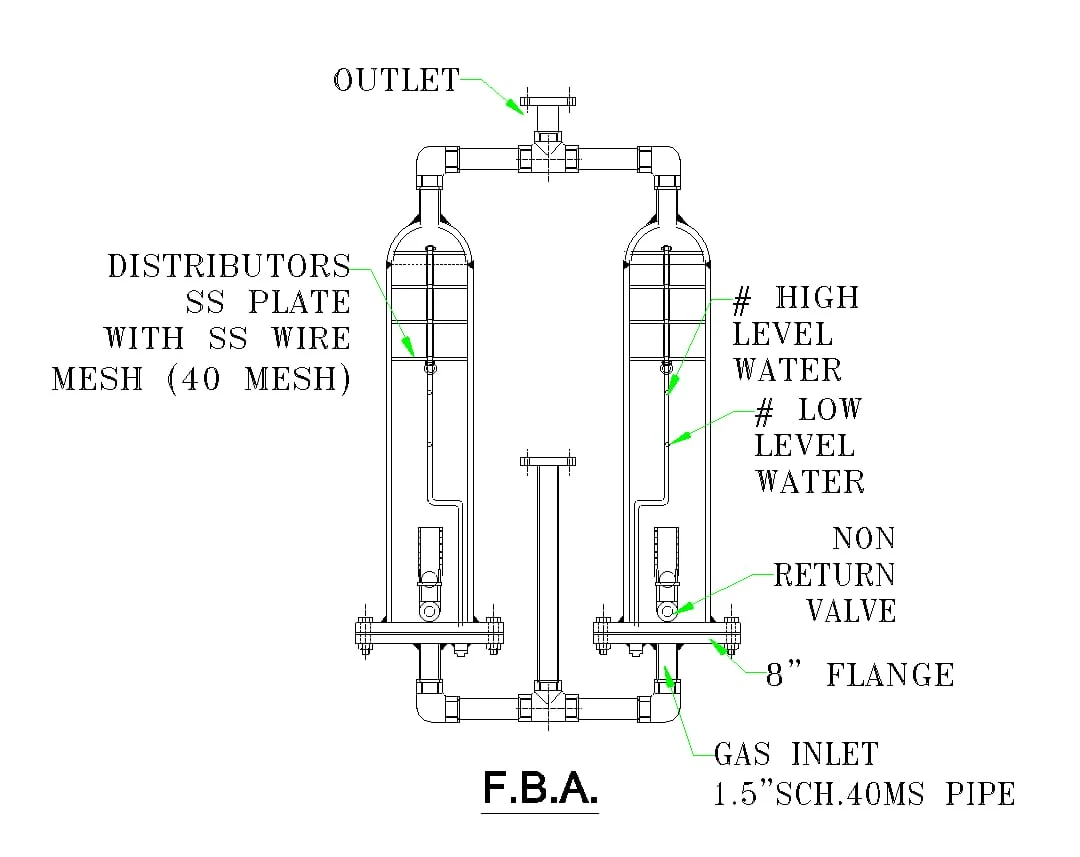
The KIGL-FBA-WT is the wet-type model in the KIGL-FBA range, for acetylene plant and bulk lines. Water and a distributor disc quench the flame, a bottom non-return valve blocks flame from downstream and a top relief valve vents hot gas. It is built for 25 or 50 Nm³/h at 1.5 bar.
Written and checked by KIGL technical staff
- 1.5 bar
- Maximum pressure
- 25 and 50 Nm³/h
- Rated flows
- Acetylene
- Medium
- 1 inch or 1.5 inch
- Inlet and outlet
- Water seal with distributor disc
- Quenching method
On this page 7 sections
Where the KIGL-FBA-WT sits on an acetylene plant #
The KIGL-FBA-WT is the wet-type model in the KIGL-FBA range, and it is the only one of the four that is part of a plant rather than part of a gas distribution system. It sits at the acetylene generator outlet, and it is the first line of flashback defence on the plant itself.
IS 11006 cl 2.2 separates the two categories, and the names matter on a purchase order. A wet type, also called a hydraulic back pressure valve, seals with a liquid. A dry type seals with sintered metal, perforated discs, a ceramic cartridge or any means other than a liquid. The other three KIGL-FBA models are dry bodies. This one is the wet body, and it cannot be substituted by a dry arrestor at a generator outlet, which is a substitution that turns up on plant audits.
The general treatment of flashback and of the standard is on the range page, flash back arrestors. This page covers the -WT alone.
Published duty #
| Medium and maximum flow | Maximum pressure |
|---|---|
| Acetylene, 25 Nm³/h | 1.5 bar |
| Acetylene, 50 Nm³/h | 1.5 bar |
Acetylene is the only medium on the table, and 1.5 bar is the maximum pressure at either flow. The inlet and outlet are 1″ or 1½″. Other connections, materials and surface finishes are made to order.
The pressure is the same at both flows because it is set by the gas rather than by the vessel. Free acetylene decomposes without an oxidant once compressed, and IS 14814 : 2023 cl 7.2.1 holds it at 0.612 atm, or 1.021 atm with PESO clearance. A generator outlet on a KIGL-DA plant runs at about 0.92 to 1.05 kg/cm²g, well inside the figure above.
How the water seal quenches a flashback #
-
Water and a distributor disc
The flame front is quenched by water, and the distributor disc spreads the gas through it so that the whole flow passes the seal rather than channelling past it.
-
A non-return valve at the bottom
This cuts off a flame arriving from downstream equipment, which on a plant means the charging manifold and whatever is connected to it.
-
A relief valve at the top
This vents vapour and hot gases, so that the pressure rise from an arrested flame leaves the vessel instead of being carried into the installation.
Why water rather than a sintered element at this position: a generator outlet passes gas that is saturated and carries sludge, and a sintered element in that service fouls, loses its pore geometry and has to be replaced rather than cleaned. A liquid seal cannot be clogged by the gas it is sealing. The mechanism is set out in detail in wet arrestor hydraulic seal.
KIGL-FBA-WT, filled and despatched from KIGL's own works.
Guwahati works · agent network
Key points
Count, operation and the checks that go with a wet arrestor #
- The count scales with generator capacity, not with the number of outlets On the KIGL-DA series it runs from two units on a DA-25 to six on a DA-150, and a plant running two where the capacity calls for six is a recurring audit finding.
- Check the water level hourly through a running shift The seal is the water. A unit whose level has fallen is not a weaker arrestor, it is not an arrestor.
- Do not let it carry water into the downstream line Water carried forward reaches the compressor and the driers, and grey oil in a crankcase is read as a drainage failure somewhere upstream of it.
- A wet arrestor does not replace the dry protection at the manifold The charging rack still takes dry-type bodies with uniflow valves, fitted three in series, as described on acetylene cylinder filling plants.
- Have every unit tested for gas tightness and gas return at least once a year by a qualified person Every unit is also tested before dispatch.
- Replace after any flashback A device that has arrested a flame has done its work once, and IS 11006 does not recognise it as reusable afterwards.
Supply for plants of other makes #
KIGL supplies wet flash back arrestors for its own acetylene gas plants and for plants of other makes, sized to the generator rather than selected from a catalogue. A quotation needs the plant's rated output in Nm³/h, the inlet and outlet line size, and the generator outlet pressure as the plant is piped today.
An arrestor at a generator outlet sits inside the licensed envelope of the plant, so the amended drawing is approved by PESO before a replacement vessel is commissioned. The forms and their order are in the PESO licence guide.
Specification
KIGL-FBA-WT — full specification
| Property | Value | Basis |
|---|---|---|
| Maximum pressure | 1.5 bar | Acetylene at either rated flow, KIGL-FBA technical specification |
| Rated flows | 25 and 50 Nm³/h | KIGL-FBA technical specification |
| Medium | Acetylene | The only medium on the published table |
| Inlet and outlet | 1 inch or 1.5 inch | KIGL-FBA technical specification |
| Quenching method | Water seal with distributor disc | KIGL-FBA technical specification |
| Governing standard | IS 11006 : 2011 | International equivalent EN ISO 5175-1 |
| Device category | Wet type, also called a hydraulic back pressure valve | IS 11006 : 2011, cl 2.2 |
| Non-return valve | Fitted at the bottom | Cuts off flame arriving from downstream equipment |
| Relief valve | Fitted at the top | Vents vapour and hot gases |
Questions
KIGL-FBA-WT — frequently asked questions
How many KIGL-FBA-WT units does an acetylene plant need?
The count scales with generator capacity rather than with the number of outlets. On the KIGL-DA series it runs from two on a DA-25 to six on a DA-150. Plants are found running with two where the capacity calls for six, which is why the figure is checked against the rated output rather than against what is installed.
What maintenance does a water-seal arrestor need that a dry one does not?
Its water level. The seal is the water, so the level is checked hourly through a running shift, and the unit must not carry water over into the downstream line. A dry arrestor has no equivalent daily duty. How the seal holds and what defeats it is set out in [wet arrestor hydraulic seal](/guides/wet-flashback-arrestor-hydraulic-seal).
Is a KIGL-FBA-WT the only flashback protection on an acetylene plant?
No. The wet type sits at the generator outlet as the first line of defence, and a dry-type arrestor with uniflow valves guards the charging manifold, where [KIGL-FBA-PM](/kigl-fba-pm-pipeline-flashback-arrestor) bodies are fitted three in series. The full train is on [acetylene gas plants](/acetylene-gas-plant).
Can the KIGL-FBA-WT be used on a gas other than acetylene?
Acetylene is the only medium on the published table, at either rated flow, so nothing else is offered against it here. For fuel gases other than acetylene the dry bodies are the published route: the [KIGL-FBA-NRV](/kigl-fba-nrv-non-return-valve-flame-trap) runs LPG, natural gas and hydrogen in threaded and flanged sizes to DN150.
Will KIGL supply a water-seal arrestor for a plant it did not build?
Yes. KIGL supplies wet flash back arrestors for its own plants and for plants of other makes, sized to the generator. The rated output in Nm³/h and the inlet and outlet line size are what a quotation needs, because the device is sized to the gas volume at the generator rather than from a catalogue.
What does IS 11006 call this device?
A wet type, also called a hydraulic back pressure valve, defined at cl 2.2 as one that seals with a liquid. A dry type seals with sintered metal, perforated discs, a ceramic cartridge or any means other than a liquid. The two are different categories on a purchase order, and the clause detail is on [flashback arrestor standards](/standards/flashback-arrestor-standards).
References
Bureau of Indian Standards.
- IS 11006:2011, First RevisionFlash back arrestor (flame arrestor) — Specification (2011)
- IS 14814:2023, First RevisionAcetylene — Code of safety (2023)
- The Kamrup Industrial Gases Limited. (2026). Company information and manufacturer's data [Company statement].
Read next
Enquiries
Request a quotation for KIGL-FBA-WT
State the gas or equipment, the quantity or capacity, and your location. KIGL will confirm the grade, the cylinder or plant size, and whether the location can be served from Noonmati, or through the agent network.