
Gases
Industrial oxygen gas to IS 309, in cylinders and cascades
Industrial oxygen supports combustion rather than burning itself, which is why it drives oxy-fuel cutting at flame temperatures around 3,100 °C with acetylene. KIGL fills oxygen to IS 309 at ≥99.5 % purity into high-pressure cylinders and cascades. Supply from Guwahati and through a network of agents. Manufacturing since 1947.
₹32 – ₹40 per Nm³ Indicative. Your quotation is the figure that counts — price moves with quantity, cylinder size, contract term and delivery.
What industrial oxygen does
Oxygen does not burn. It makes everything else burn harder, and that single property is why it is the highest-volume industrial gas in the world.
Paired with acetylene it produces a flame around 3,100 °C, hot enough and concentrated enough to cut steel. Injected into a furnace it raises combustion temperature and cuts fuel consumption. In water treatment it accelerates biological processes. In aquaculture it keeps stocking densities viable.
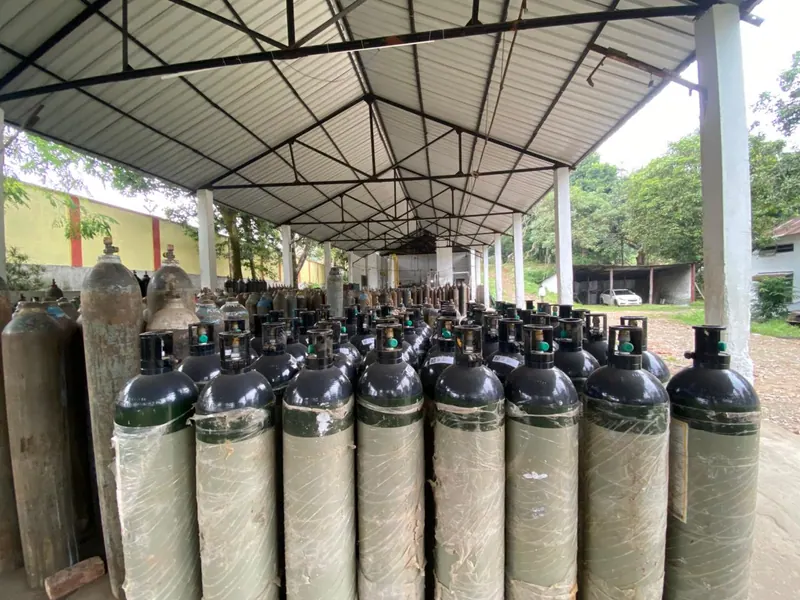
KIGL fills industrial oxygen to IS 309 at ≥99.5 %, in high-pressure cylinders and cascades built to IS 7285 with valves to IS 3224.
Industrial oxygen applications in industry
Cutting and welding
With acetylene for the highest flame temperature, or with LPG and propane where cutting speed matters more than heat concentration. The dominant use in fabrication, shipbuilding, structural steel and demolition.
Combustion enrichment
Enriching combustion air raises flame temperature and improves fuel efficiency in furnaces and kilns.
Chemical and biological processes
Oxidation reactions and fermentation, where oxygen availability limits yield.
Water and effluent treatment
Raising dissolved oxygen improves the performance of biological treatment stages.
Aquaculture
Maintaining dissolved oxygen in hatcheries and fish farms.
Food
Modified-atmosphere packaging, where controlled oxygen preserves the colour of red meat.
For clinical use, see medical oxygen; the two are not interchangeable.
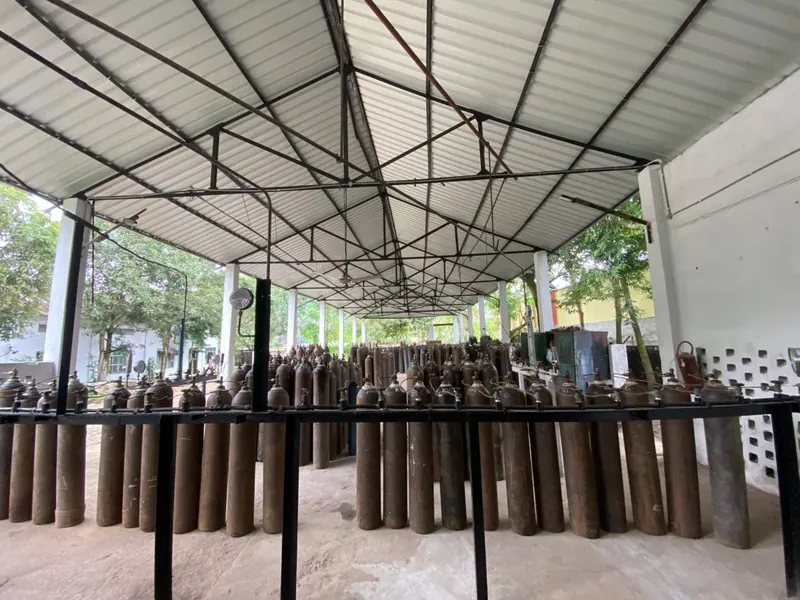
Inside the cylinder filling shed, every cylinder secured upright in rows
Guwahati works · agent network
Safe handling
The defining risk with oxygen is not the gas igniting. It is that oxygen makes ordinary materials extraordinarily flammable.
Safety: oil and grease are the hazard
- No oil or grease anywhere in the system. Hydrocarbons can auto-ignite on contact with high-pressure oxygen with no ignition source at all.
- Never lubricate an oxygen regulator or valve. If it is stiff, it is faulty.
- Open valves slowly. Rapid pressurisation causes adiabatic compression heating at the regulator, which has ignited many regulators.
- Never use oxygen as compressed air — not for blowing down, not for cooling, not for ventilation. Oxygen-saturated clothing burns ferociously.
- Store away from fuel gases and from combustible materials, and keep cylinders secured and upright.
The code of practice is IS 6044. Full detail is in our oxygen safety data sheet.
Industrial oxygen cylinder sizes and supply across India
Compressed oxygen in cylinders and cascades — filled at our own works in Guwahati (Assam) and supplied through our network of agents across Uttar Pradesh, Madhya Pradesh, West Bengal, Assam, Odisha and other states, with exchange and refill programmes and cascades sized against measured consumption.
Liquid oxygen — also available. Worth being precise here: the compressed gas we manufacture ourselves; liquid oxygen we supply but do not produce, since we operate cylinder-filling plants rather than an air-separation unit. For a high-volume user that distinction affects lead time and commitment, and it is stated here so that it is known at the specification stage.
Why KIGL
Why buy industrial oxygen from KIGL
KIGL has filled industrial oxygen since 1947 at its own works in Guwahati, and supplies through a network of agents across Uttar Pradesh, Madhya Pradesh, West Bengal, Assam, Odisha and other states. It has contributed to the BIS and PESO committees that write the Indian standards for gas cylinders and valves.
With oxygen the hazard is never the gas by itself — it is what the gas does to everything it touches. Cylinders leave here clean, built to IS 7285 with valves to IS 3224, because a cylinder that arrives with oil in it is not a quality complaint. It is a fire.
Specification
Industrial oxygen gas — full specification
| Property | Value | Basis |
|---|---|---|
| Specification | IS 309 (Industrial Oxygen) | Bureau of Indian Standards |
| Purity | ≥99.5 % v/v | IS 309 |
| Cylinder standard | IS 7285 seamless steel | — |
| Valve standard | IS 3224 | Bureau of Indian Standards |
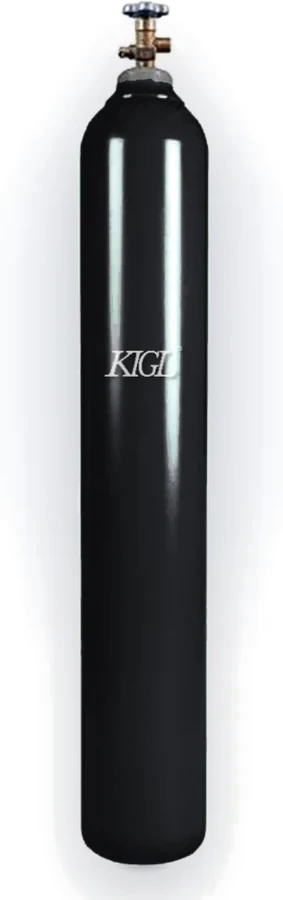
| Cylinder colour | Black body | IS 4379 |
| UN number | UN 1072 | ADR 2025 |
| HSN code | 2804 40 | India GST tariff |
| Chemical formula | O₂ | — |
| Supply form | High-pressure cylinders and cascades | — |
| Code of practice | IS 6044 — safe use of oxygen cylinders | — |
Documents
Industrial oxygen gas — safety and technical documentation
Questions
Industrial oxygen gas — frequently asked questions
Why must oxygen equipment be kept completely free of oil and grease?
Oxygen does not burn, but it makes other things burn violently. Hydrocarbons such as oil and grease can ignite spontaneously in the presence of high-pressure oxygen — no spark is needed. This is the single most common cause of serious oxygen incidents. Never lubricate an oxygen regulator, never handle fittings with oily gloves, and never use PTFE tape unless it is rated for oxygen service.
Is industrial oxygen the same as medical oxygen?
No, and they must not be substituted. Medical oxygen is manufactured, filled and documented under pharmaceutical controls with traceability appropriate to a medicine. Industrial oxygen is not, regardless of the purity figure on the analysis. Use [medical oxygen](/medical-oxygen-gas) for any patient application.
Do you supply liquid oxygen?
Yes. We supply liquid oxygen alongside our cylinder range. The distinction worth understanding is that we manufacture the compressed gas ourselves at our own filling plants, whereas liquid oxygen is sourced — we do not operate an air-separation unit. Tell us your volume and how you want it delivered and we will confirm what we can commit to.
How do I know how much oxygen is left in a cylinder?
Unlike acetylene, oxygen is a permanent compressed gas, so the pressure gauge reads true. Content is proportional to pressure. Note that pressure falls with temperature — a cylinder left outdoors overnight in winter will read low and recover as it warms.
What colour is an industrial oxygen cylinder in India?
Black body, under IS 4379. Never rely on colour alone to identify a cylinder — always read the stamped markings and the label, particularly with customer-owned or traded cylinders.
Can I use an oxygen cylinder to blow dust off my workbench?
Absolutely not, and people are killed doing it. Oxygen-enriching clothing or the surrounding air makes ordinary materials violently flammable, and clothing saturated with oxygen can ignite from a spark and burn faster than it can be removed. Use compressed air.
Read next
Enquiries
Request a quotation for industrial oxygen gas
State the gas or equipment, the quantity or capacity, and your location. KIGL will confirm the grade, the cylinder or plant size, and whether the location can be served from Noonmati, or through our agent network.