
Gases
Helium gas supply — sourced, filled and delivered by KIGL
Helium is inert, non-flammable and has the lowest boiling point of any element at −269 °C. India has no significant domestic helium production, so all helium here is imported. KIGL supplies helium in cylinders rather than manufacturing it, and says so plainly. Available for laboratory, welding and industrial use.
- Supplier
- KIGL’s role
- −269 °C
- Boiling point
- Inert
- Reactivity
- UN 1046
- UN number
- Cylinders
- Supply form
What helium is, and where it comes from
Helium is the second-lightest element, completely inert, non-flammable, and has the lowest boiling point of anything known, −269 °C. Those properties make it irreplaceable for a small number of jobs and unnecessarily expensive for everything else.
It also cannot be manufactured. Helium is extracted from natural gas deposits that happen to contain it in commercially useful concentration, and only a handful of places in the world have those. India is not one of them: essentially all helium used in this country is imported.
So we will be direct: KIGL supplies helium, we do not produce it. No company in India does. We would rather tell you that than imply a capability nobody here has.
What we supply, and what we do not
We supply: compressed helium in cylinders for laboratory, analytical, welding and industrial use.
We do not supply: liquid helium. Maintaining a liquid helium supply chain means specialised dewars with active boil-off management, and it exists to serve MRI magnets and cryogenic research. It is a different business from cylinder gas. If that is what you need, you need a dedicated cryogenic helium supplier — and we will say so rather than take the order.
Where helium is genuinely necessary
Leak detection
Helium’s small atomic size lets it pass through leaks nothing else will find, and mass-spectrometer leak detectors are built around it. There is no substitute.
Carrier gas
In gas chromatography and mass spectrometry, where its inertness and low mass matter.
Welding non-ferrous and thick sections
Higher thermal conductivity than argon gives a hotter, broader arc. Usually as an argon-helium mixture rather than pure.
Controlled atmospheres in semiconductor and fibre-optic manufacture, where absolute inertness is required.
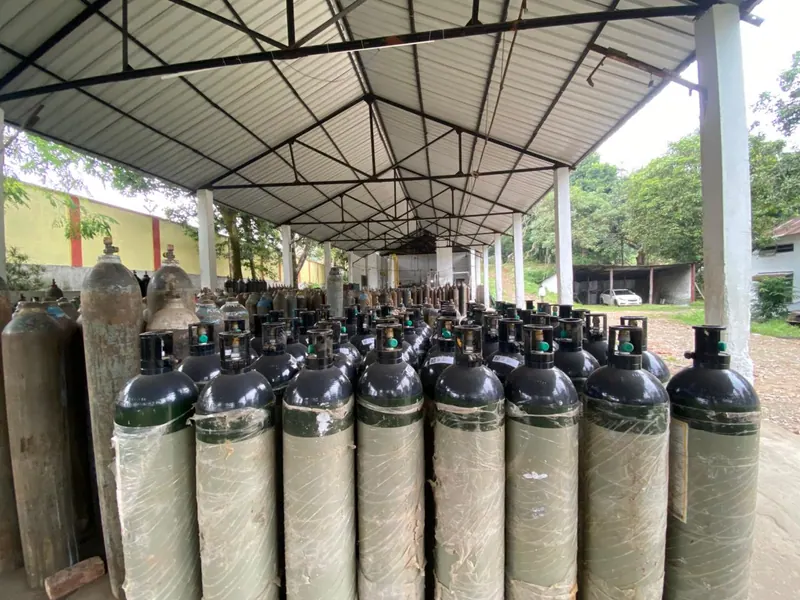
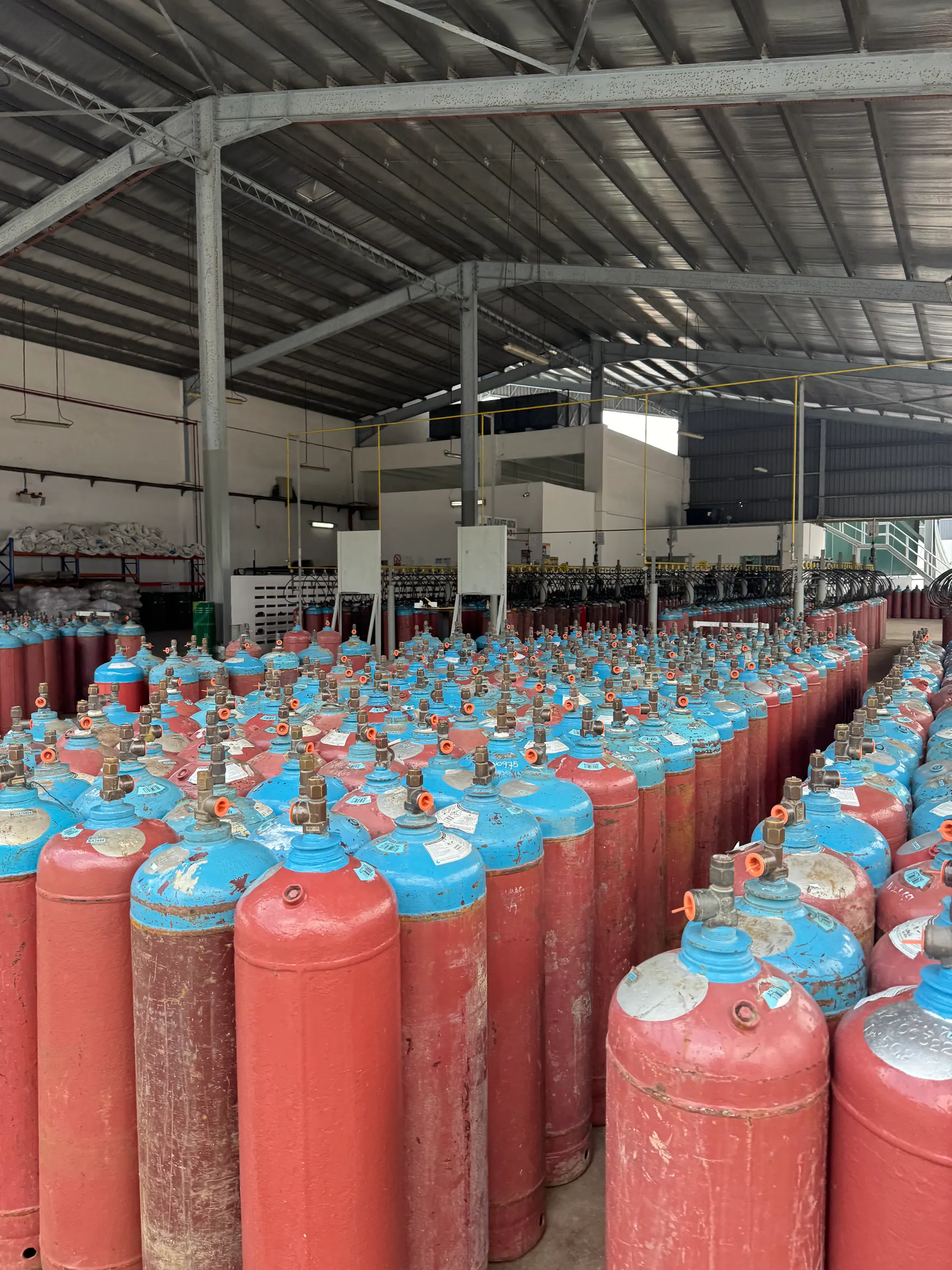
Filled industrial gas cylinders, ranked upright in the yard for despatch
Guwahati works · agent network
Where it probably is not
This is the more useful section, and most suppliers will not write it.
If you are purging or inerting, nitrogen almost certainly does the job at a fraction of the cost. If you are TIG or MIG welding steel, stainless or aluminium, argon is usually better as well as cheaper. Helium is a specialist gas with a global supply constraint, and using it where a cheaper inert gas works is money vented into the atmosphere — permanently, since released helium escapes Earth entirely.
KIGL specifies against the stated application. Where helium is not required, an alternative is recommended.
Safety
Inert, non-toxic, non-flammable — and an asphyxiant that gives no warning at all. It is also extremely light, so it accumulates at high level in enclosed spaces rather than dispersing at floor level as heavier gases do.
Never inhale helium from a cylinder or a balloon. The delivery pressure can rupture lung tissue and the oxygen displacement can cause unconsciousness without any sensation of breathlessness.
Full detail is in our helium safety data sheet.
Availability
Global helium supply is concentrated and periodically constrained, so availability and price move with events far outside India. We will give you a realistic lead time rather than an optimistic one, and if we cannot commit we will say so.
Why KIGL
Why buy helium from KIGL
Helium is not produced in India, so nobody here manufactures it. We supply it from licensed producers, and we say so rather than leaving you to assume otherwise. What seventy-nine years in industrial gas gives you is the other half of the conversation: whether argon or nitrogen will do the same job at a fraction of the cost, and how to stop venting the helium you have already paid for.
Specification
Helium gas supply — full specification
| Property | Value | Basis |
|---|---|---|
| KIGL’s role | Supplier — helium is not manufactured in India | Company position |
| Boiling point | −269 °C (4.2 K) | Literature |
| Reactivity | Chemically inert, non-flammable | Literature |
| UN number | UN 1046 (compressed) | ADR 2025 |
| Supply form | Compressed gas cylinders | KIGL product range |
| Chemical symbol | He | — |
| Atomic weight | 4.003 | — |
| Relative vapour density (air = 1) | ≈0.14 — far lighter than air | Literature |
Documents
Helium gas supply — safety and technical documentation
Questions
Helium gas supply — frequently asked questions
Does KIGL manufacture helium?
No, and neither does anyone else in India. Helium is extracted from natural gas reserves with unusually high helium content, which India does not have at commercial scale — essentially all helium used here is imported. KIGL is a supplier. We would rather state that than imply a capability that does not exist anywhere in the country.
Do you supply liquid helium for MRI scanners?
No. Liquid helium sits at −269 °C and requires specialised dewars with active boil-off management and a supply chain built specifically around it. That is a distinct business from cylinder gas supply and we do not operate in it. If you are maintaining an MRI magnet, you need a dedicated cryogenic helium supplier.
Why is helium expensive and sometimes unavailable?
Global supply is concentrated in a handful of extraction sites, and it cannot be manufactured — once vented, it is effectively lost to the atmosphere. Prices and availability move with global supply events rather than local demand. We will always tell you honestly what lead time we can commit to.
Can I use nitrogen or argon instead of helium?
Often, yes, and it is worth asking. For many purging and inerting applications nitrogen works at a fraction of the cost. For shielding, argon is usually the better and cheaper choice. Helium is genuinely necessary for leak detection, cryogenics, certain carrier-gas applications and where its very high thermal conductivity matters. KIGL will state whether you need it.
What is helium used for in welding?
As a shielding gas or in argon-helium mixtures, mainly for non-ferrous metals and thick sections. Helium’s higher thermal conductivity gives a hotter, broader arc and better penetration than argon alone. It is normally used as a mixture rather than pure.
Is helium dangerous?
It is inert and non-toxic, but it is an asphyxiant — it displaces oxygen with no warning whatsoever. It is also extremely light and will accumulate at high level in an enclosed space. Never inhale helium from a cylinder or balloon; the pressure and the oxygen displacement can both cause serious injury.
Read next
Enquiries
Request a quotation for helium gas supply
State the gas or equipment, the quantity or capacity, and your location. KIGL will confirm the grade, the cylinder or plant size, and whether the location can be served from Noonmati, or through our agent network.