
Gases
Carbon dioxide gas for welding, beverage, food and process use
Carbon dioxide is the cheapest usable shielding gas for MIG welding on steel and the standard carbonation gas for beverages. KIGL supplies CO₂ to IS 307 in industrial and food grades, in cylinders. Cylinders are filled by weight, not pressure, because CO₂ is stored as a liquid under its own vapour pressure.
₹35 – ₹50 per kg Indicative. Your quotation is the figure that counts — price moves with quantity, cylinder size, contract term and delivery.
- IS 307
- Specification
- ≥99.7 % CO₂
- Purity, industrial
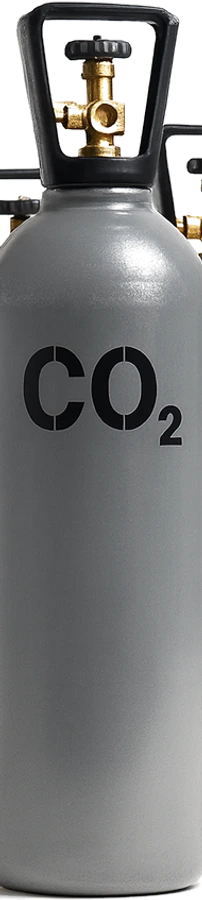
- Black body with white band
- Cylinder colour
- IS 3078
- Valve standard
- UN 1013
- UN number
What makes CO₂ different from the other cylinder gases
Two things, and both catch people out.
It is stored as a liquid. Carbon dioxide liquefies under modest pressure at ambient temperature, so a CO₂ cylinder contains liquid with vapour above it — not compressed gas. That is why cylinders are filled and sold by weight, and why the pressure gauge is nearly useless as a contents indicator: it reads vapour pressure, which stays flat while any liquid remains and then collapses.
It is genuinely toxic, not merely asphyxiating. Nitrogen and argon kill by displacing oxygen. CO₂ interferes with respiration directly, at concentrations far below those needed to displace oxygen. It is also about 1.5 times heavier than air, so it pools and stays pooled.
KIGL supplies CO₂ to IS 307, with valves to IS 3078.
Carbon dioxide applications in industry
MIG welding
The cheapest usable shielding gas for carbon steel, with deep penetration. Harsher arc and more spatter than an argon-CO₂ mixture — a genuine cost-versus-finish trade-off.
Beverage carbonation
Food grade only. Soft drinks, beer, sparkling water and dispense systems.
Food processing
Modified atmosphere packaging, where CO₂ suppresses bacterial growth and extends shelf life.
Water treatment
pH control, as a safer alternative to mineral acids in municipal and industrial treatment.
Greenhouse enrichment
Raising CO₂ concentration to increase crop yield under controlled conditions.
Fire suppression
In fixed systems, where its inerting property and lack of residue suit electrical and machinery risks.
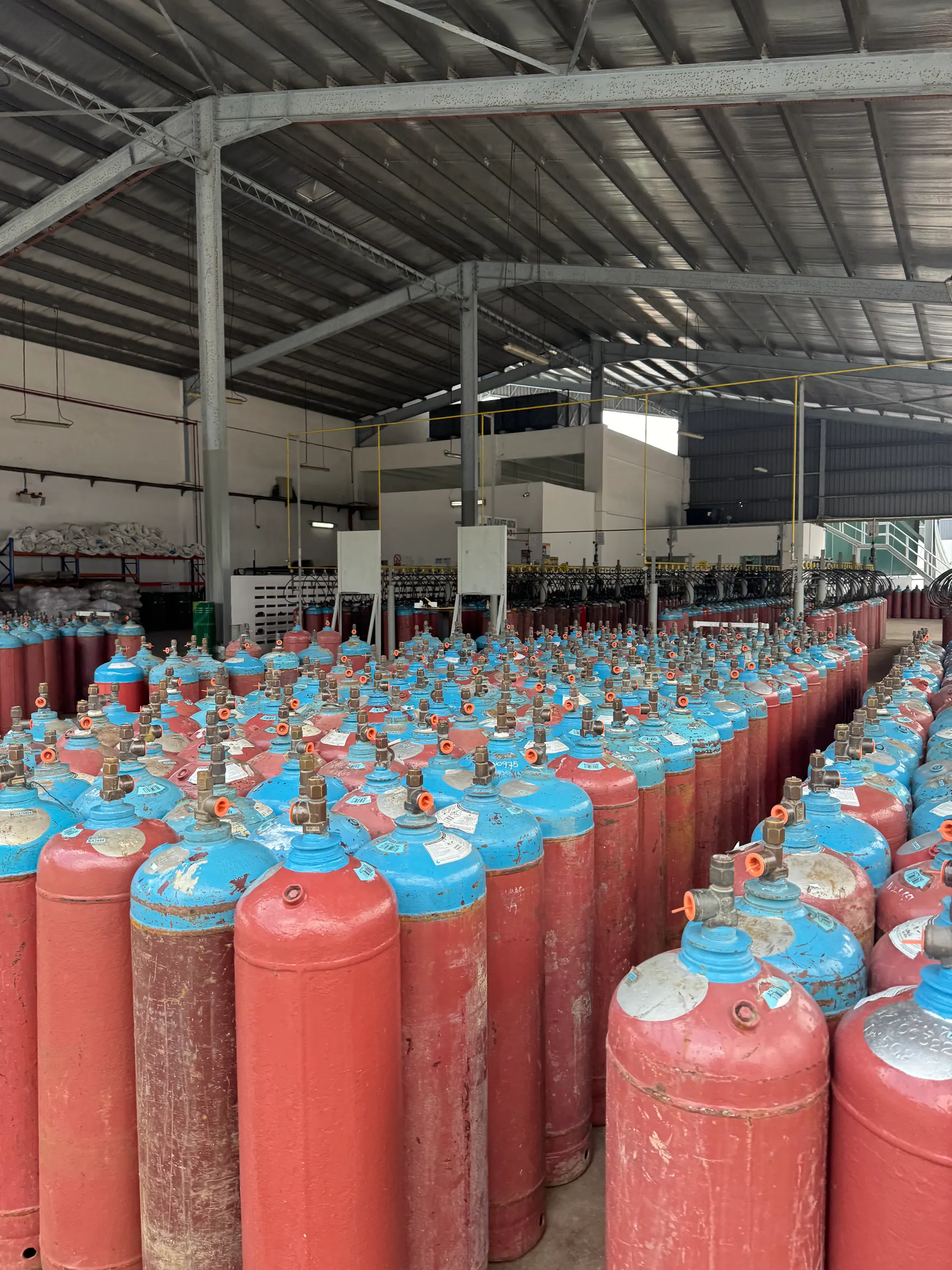
Cylinder storage hall, stock segregated by gas as the standards require
Guwahati works · agent network
The problem specific to Indian summers
Carbon dioxide has a critical temperature of 31.0 °C. Above that, no liquid phase can exist at any pressure — the contents become a single supercritical phase, and cylinder pressure then rises steeply with further heating.
Thirty-one degrees is not an unusual temperature in Guwahati or Kolkata. A cylinder standing in direct sun on a summer afternoon will pass it comfortably.
Practical consequences: store CO₂ in shade, never let cylinders get hot, and be aware that a cylinder which felt normal in the morning can be at substantially higher pressure by mid-afternoon. Most CO₂ guidance is written for temperate climates and glosses over this. Here it is a routine operating condition, not an edge case.
The two practical problems
Regulator freezing. Drawing CO₂ fast boils liquid inside the cylinder, and boiling absorbs heat — enough to ice up the regulator and choke the flow. Common on heavy MIG work. Fix it with a lower withdrawal rate, a bigger cylinder, a manifolded pair, or a heated regulator.
Knowing how much is left. Weigh the cylinder and subtract the tare weight stamped on the shoulder. The pressure gauge will read normal right up until the cylinder is nearly empty, which is how a shift loses an hour mid-weld.
Safe handling
CO₂ fatalities happen in cellars, brewery basements, dispense rooms, pits and tank bottoms, because the gas is heavy, invisible and odourless, and it stays where it settles.
Safety — the one people underestimate
- Ventilate at low level, since CO₂ collects at floor level rather than rising.
- Treat any cellar or pit with CO₂ storage as a confined space, with monitoring before entry.
- Fit fixed CO₂ monitoring where cylinders are stored in occupied basements — this is standard practice in the beverage trade for good reason.
- Never enter a space to rescue someone without breathing apparatus. Rescuers are routinely the second casualty.
Full detail is in our carbon dioxide safety data sheet.
Grades
Grade 1 — reagent and welding, at ≥ 99.7 % CO₂. This is the grade IS 307 specifies for welding, and it is the drier of the two: moisture is capped at 0.001 % by volume, a hundred times tighter than Grade 2, because moisture in a shielding gas ruins the weld.
Grade 2 — beverages, fire extinguishers, refrigeration and general commercial, at ≥ 99.9 % CO₂. Higher assay, because a beverage gas must taste of nothing, but a looser moisture limit of 0.1 %.
Neither grade is simply "better" than the other — they are specified for different jobs, and asking for "the purer one" without saying what it is for is how the wrong gas gets ordered.
Industrial-grade CO₂ must never be used for anything entering the food chain. The purity number is not the point; the control regime is.
Carbon dioxide cylinder sizes and supply across India
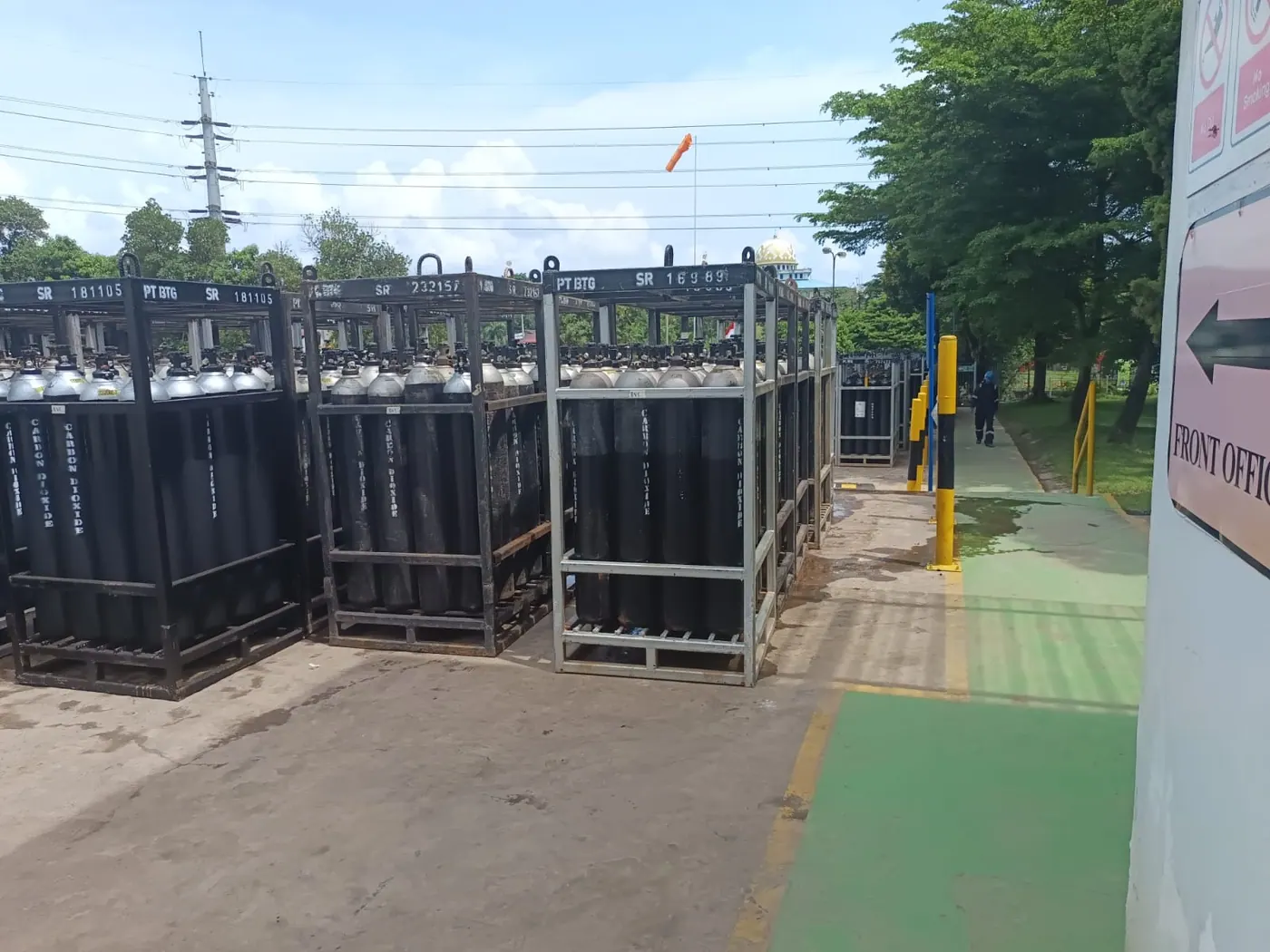
Cylinders from Guwahati, and through a network of agents, filled by weight, with exchange and refill programmes.
Why KIGL
Why buy carbon dioxide from KIGL
Filling under PESO licence since 1947, with four generations of the same family answering for it. Carbon dioxide is the cylinder most often confused with oxygen on a busy site, because under IS 4379 both carry a black body and only a white neck band separates them. We paint, stamp and label to the standard, and we would always rather you checked the stamping than trusted the paint.
Specification
Carbon dioxide gas — full specification
| Property | Value | Basis |
|---|---|---|
| Specification | IS 307 | Bureau of Indian Standards |
| Purity, industrial | ≥99.7 % CO₂ — IS 307 Grade 1 | IS 307 : 2024, Table 1 |
| Cylinder colour | Black body, white band | IS 4379 |
| Valve standard | IS 3078 | Bureau of Indian Standards |
| UN number | UN 1013 | ADR 2025 |
| Cylinder contents measured by | Weight, not pressure | Physical property of liquefied CO₂ |
| Chemical formula | CO₂ | — |
| Purity, industrial grade | ≥99.7 % (IS 307 Grade 1 — reagent and welding) | IS 307 : 2024, Table 1 |
| Purity, food grade | ≥99.9 % | IS 307 / food-grade requirement |
| State in cylinder | Liquid under its own vapour pressure | — |
| Relative vapour density (air = 1) | ≈1.52 — significantly heavier than air | Literature |
| Sublimation point | −78.5 °C at atmospheric pressure | Literature |
Documents
Carbon dioxide gas — safety and technical documentation
Questions
Carbon dioxide gas — frequently asked questions
Why does my CO₂ cylinder pressure gauge stay the same until it suddenly drops?
Because CO₂ is stored as a liquid. The gauge reads the vapour pressure above that liquid, which stays constant while any liquid remains, then falls away rapidly once the last of it has boiled off. **Weigh the cylinder** against the stamped tare weight to know what is left — the gauge will not tell you until it is nearly too late.
Why does the regulator freeze up during heavy MIG welding?
Withdrawing CO₂ quickly boils liquid inside the cylinder, and that absorbs a lot of heat. The regulator can drop below freezing and ice up, restricting flow. Reduce the withdrawal rate, use a larger cylinder, use a manifolded pair, or fit a heated regulator for sustained heavy use.
Is food-grade CO₂ different from industrial?
Yes. Food grade is held to tighter purity and impurity limits and is produced and handled under controls appropriate for something entering the food chain. Industrial-grade CO₂ must never be used for carbonation or food contact, regardless of what the purity figure says.
Can CO₂ be used alone for MIG welding?
Yes, and it is the cheapest option for carbon steel with good penetration. The trade-off is a harsher arc and more spatter than an argon-CO₂ mixture. Most fabricators using pure CO₂ do so on cost; most who switch to a mixture do so for weld appearance and reduced cleanup.
Is carbon dioxide dangerous? It is in the air already.
Yes, and more dangerous than most people assume. Unlike nitrogen or argon, CO₂ is **toxic as well as asphyxiating** — it interferes with respiration directly at concentrations well below those needed to displace oxygen. It is also half again as heavy as air, so it pools in cellars, pits and tank bottoms. Breweries and beverage plants are where CO₂ fatalities happen.
Do you supply dry ice?
Not currently. We supply CO₂ in cylinders. If you need dry ice, tell us and we will point you to someone who does rather than take the order.
Read next
Enquiries
Request a quotation for carbon dioxide gas
State the gas or equipment, the quantity or capacity, and your location. KIGL will confirm the grade, the cylinder or plant size, and whether the location can be served from Noonmati, or through our agent network.