
Guide
How a flashback arrestor works: quenching sintered and wet elements, and the valves that back them up
A flashback arrestor stops a returning flame by pulling heat out of it faster than combustion can replace it, forcing the gas through passages narrower than the quenching diameter, about 0.12–0.16 mm for oxyacetylene at 1 atm. A non-return valve and thermal or pressure cut-offs back the element up under IS 11006:2011.
- Quenching diameter, oxyacetylene
- 0.12
- Quenching diameter, acetylene decomposition flame
- 0.6 cm at 2.02 atm absolute
- Casing strength
- 10 times maximum working pressure or 60 bar
- Flashback type test
- Five flashbacks per sample with 32
- Pressure-sensitive cut-off
- Must actuate at or below 1
A flashback arrestor stops a flame travelling backwards through a gas line by taking heat out of it faster than the burning gas can replace it. It forces the flame through a mass of very fine passages (sintered metal, packed grains, wire mesh or a column of water broken into bubbles), and it is usually backed by a non-return valve and a cut-off valve that shut off the gas once the flame has been stopped. This page explains the mechanism, the numbers behind it, and how the Indian and international standards define a device that works.
What is a flashback, and why is acetylene the hard case?
A torch flame sits still only while the gas leaving the nozzle moves faster than the flame can burn back into it. When the local gas velocity in a passage falls below the burning velocity of the mixture, the flame retreats into the torch, the hose and, if nothing stops it, the regulator and the cylinder or pipeline. That is a flashback. The common triggers are well documented: unequal pressures in the oxygen and fuel hoses, a blocked or overheated tip, a cylinder allowed to run nearly empty, a faulty check valve and careless lighting-up or shutting-down (American Welding Society Fact Sheet 28; WorkSafe ACT guidance). The guide to what causes flashback covers them in detail.
Acetylene is the difficult gas for two reasons. Its oxyacetylene flame burns faster, in a thinner reaction zone, than that of any other common fuel gas, so it penetrates smaller gaps. And acetylene can decompose with no oxygen at all: above a limiting pressure a flame can run through pure acetylene in a pipe, and in a long enough pipe it can accelerate into a detonation. An acetylene arrestor must therefore stop a mixture flame coming back from the torch and, on plant and pipeline duty, a decomposition flame or detonation as well.
How does a narrow passage kill a flame?
A flame survives because its reaction zone passes enough heat forward to ignite the gas ahead. Confine that zone between walls set close together and the walls absorb heat faster than the reaction produces it; below a critical size the flame goes out. The critical size is the quenching diameter for a round passage, or the quenching distance between parallel plates. It falls as pressure rises, which is why a device that quenches at low pressure can fail at a higher one.
The figures that matter for acetylene are small:
| Quantity | Value | Conditions | Primary source |
|---|---|---|---|
| Quenching diameter, stoichiometric oxyacetylene | 0.12–0.16 mm | extrapolated to 1 atm | Gaydon and Wolfhard data, as compiled by S. A. Miller (1965) |
| Quenching distance, stoichiometric oxyacetylene | 1.68 mm | 11 mm Hg | Berlad, Rowe and Yang, Combustion and Flame, 1959 |
| Quenching diameter, pure acetylene decomposition flame | 0.6 cm | 2.02 atm absolute | Cummings, Hall and Straker, 1962 |
| Restriction that turns a detonation back into a deflagration | 6 mm or less | detonation from 4 m of 2 cm pipe | as compiled by S. A. Miller (1965) |
| Detonation still observed in tubes of | 3 mm | 10 atm absolute | as compiled by S. A. Miller (1965) |
Two practical conclusions follow. A fine wire gauze does not stop an oxyacetylene flame, because its openings are far larger than 0.12 mm. And although the decomposition flame in pure acetylene is easier to quench at low pressure, the margin closes quickly as pressure rises; at 10 atm a detonation passes a 3 mm tube. The same literature records that a detonation is slowed not as it enters a narrow restriction but as it expands out of it.
The Commission Permanente Internationale de l'Acétylène described the dry arrestor in 1968 in the same terms: a small steel body filled with grains of controlled porosity that stops the flame by cooling it through "a large number of pipes of small section" (C.P.I., Safety in the Production and Use of Acetylene, Paris 1968). The C.P.I. also recorded the pipe-diameter effect underlying every acetylene arrestor: in 0.4 mm capillaries, decomposition propagated only at pressures far above 30 kg/cm², whereas in 100 mm pipe detonation was to be feared above 0.6 kg/cm².
Rules that matter
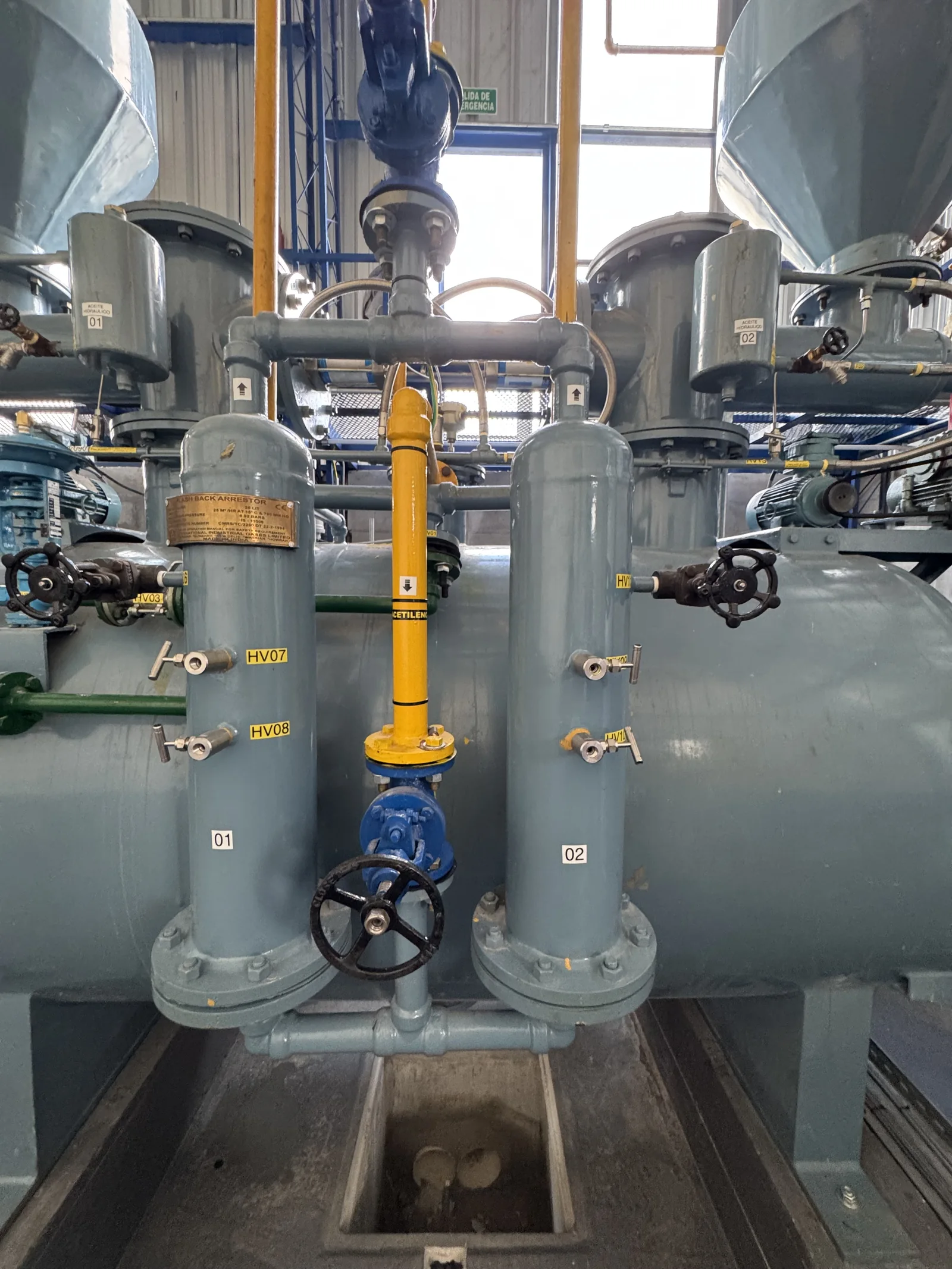
IS 11006:2011 recognises two families. A dry arrestor is sealed by sintered metal, perforated discs, a ceramic cartridge or another non-liquid medium. A wet arrestor, also called a hydraulic back-pressure valve, is sealed by a liquid. The standard asks for an element with good thermal conductivity, high porosity, large surface area and small pore size, and leaves the proof to the flashback test rather than to a pore measurement.
What is inside an arrestor?
- Sintered metal Stainless-steel powder sintered into a porous body with a tortuous path and a very large internal surface; the standard modern element for welding and regulator-outlet devices. An early design patented by Stephenson for Allen-Liversidge in 1930 (BP 363,628) used hollow sintered cylinders fed from an annular space, supported from inside so the explosion wave could not crush them, and arranged so that a flame from either direction met the outer surface first.
- Packed grains and compressed fibre The C.P.I.'s 1931-pattern dry arrestor held graded grains between felt and wire gauze under a soft metal cap, and the C.P.I. reported tens of thousands distributed. Steel-wool plugs 2.5 cm long compressed to 75 % porosity have suppressed detonations at 20–25 atm in 2.5 cm pipe (as compiled by S. A. Miller, 1965).
- Water In a wet arrestor the gas is broken into bubbles rising through water; each bubble is below the quenching size and the water is an effectively unlimited heat sink. See wet flashback arrestors.
- Packed towers For large-bore, low-pressure lines, towers packed with Raschig rings, sometimes irrigated. See packed-tower arrestors.
Why are there valves as well as an element?
The element stops the flame. It does not stop gas flowing the wrong way, and it does not stop a fire burning on its face if gas keeps arriving. Modern devices therefore stack functions, and IS 11006:2011 Annex B gives each a letter for the body marking:
| IS 11006 letter | Function | What it does | IS 11006 requirement |
|---|---|---|---|
| F | Flame arrestor | Quenches the returning flame | five flashbacks per sample, no upstream ignition (cl 11.6) |
| N | Non-return valve | Blocks reverse flow, so oxygen cannot be pushed into the fuel line | reverse-flow test on five samples (cl 11.5) |
| T | Temperature-sensitive cut-off | Shuts off gas if a sustained flame heats the body; not resettable | cl 10.5, tested on one new unit (cl 11.7) |
| P | Pressure-sensitive cut-off | Closes on the pressure wave from downstream | actuates at or below 1,200 mbar (cl 11.8) |
| W / D | Wet or dry type | Sealing method | marking only |
A dry acetylene device with a flame arrestor and a non-return valve is marked A D F N. The layered idea is not new: the Tri-Sure arrestor described in Engineering in 1962 (vol. 193, p. 425) trapped the flame, closed a diaphragm-operated valve, then locked off the gas flow. A non-return valve on its own is never a substitute for the element; see non-return valve vs flashback arrestor.
Why does a plant need arrestors at all?
Because no practical vessel can be built to contain an acetylene detonation. Measured deflagration pressure rises are about 11 times the initial absolute pressure (11.1 ± 0.6 in sixteen runs, Miller and Penny, IChemE symposium, 1960). A detonation in a long pipe exerts 40–50 times, the cascading described by Sargent (1957) pushes the rise beyond 100–200 times, and Webster and colleagues measured terminal ratios above 320 times in a 12.7 mm tube (IChemE Symposium Series No. 33, 1972). An arrestor at every pipe-to-vessel junction confines the design case to deflagration, which is buildable. IS 11006:2011 cl 4.1 reflects the same thinking: the casing must withstand 10 times its maximum working pressure or 60 bar, whichever is higher, for at least 5 minutes, so a 1.5 bar acetylene device is tested to the 60 bar floor.
What do IS 11006 and ISO 5175-1 cover?
IS 11006:2011, first published in 1984, is the Indian specification. Its scope is broad: delivery pipelines, acetylene generators, fuel-gas storage and piping, and welding and cutting systems, wet and dry. It is an indigenous text, not an adoption of ISO, and BIS records no amendment. ISO 5175-1:2017 covers devices incorporating a flame arrestor installed downstream of manifold, cylinder or pipeline outlet regulators and upstream of blowpipes; ISO 5175-2:2017 covers safety devices without one. ISO 5175-1 states that it "does not specify the location of these devices in the gas system" and excludes premixed supplies. A generator-outlet wet arrestor therefore falls under IS 11006, not ISO 5175-1. The flashback arrestor standards page sets out the clauses.
What an arrestor cannot do
An arrestor that has stopped a flame has done its job once. Soot from the event fouls the element, a temperature cut-off that has operated cannot be reset, and a decomposition can creep slowly through a packed element and re-ignite the gas beyond it minutes later, the subject of the twenty-minute delay. Even a successful quench in a large pipeline sends a pressure pulse downstream.
Rules that matter
Rules to apply
- Fit a device with a flame-arrestor element (marking F), not a non-return valve alone.
- Match the marked gas and maximum operating pressure to the duty. Acetylene arrestors are normally rated to 1.5 bar, but IS 14814:2023 cl 7.2.1 limits free-state acetylene to 0.612 atm, or 1.021 atm with PESO clearance.
- Use IS 11006:2011 for generator, pipeline and wet devices; ISO 5175-1:2017 applies only between regulator and blowpipe.
- Replace any arrestor that has arrested a flashback or whose temperature cut-off has operated.
- Keep oil, grease and dirt off and out of the element; contamination reduces its ability to quench.
- See KIGL flash-back arrestors for the range and the selection guide for sizing.
How — frequently asked questions
Does a flashback arrestor stop a flame coming from either direction?
The quenching element in a well-designed arrestor can stop a flame arriving from either side, but the device as a whole is directional. Its non-return valve and cut-off valves only work with gas flowing the way the arrow shows, and IS 11006:2011 cl 14 requires the direction of flow to be marked on the body. Install every arrestor by its arrow, never reversed.
What is the quenching diameter of acetylene?
It depends on the flame. For a stoichiometric oxyacetylene mixture the quenching diameter extrapolates to 0.12–0.16 mm at 1 atm, and it falls further as pressure rises. For the flame of pure acetylene decomposing without oxygen, Cummings, Hall and Straker measured 0.6 cm at 2.02 atm absolute in 1962. Both numbers explain why ordinary wire gauze is useless for acetylene.
Is a flashback arrestor the same as a non-return valve?
No. A non-return valve only blocks gas flowing backwards, so that oxygen cannot be pushed into the fuel hose. It does not reliably stop a flame. The C.P.I. warned in 1968 that dry non-return valves do not necessarily stop flashbacks, and the American Welding Society says the same today. Use a device marked F for flame arrestor, usually combined with N.
Which standard covers flashback arrestors in India?
IS 11006:2011, Flash Back Arrestor (Flame Arrestor) — Specification, first revision of the 1984 standard. It covers generators, pipelines, storage piping and welding systems, wet and dry. BIS records no amendment. The BIS Standard Mark is optional under cl 14.2, and only five BIS licences exist against IS 11006 nationally, so ask a supplier for the licence number.
What pressure must a flashback arrestor body withstand?
Under IS 11006:2011 cl 4.1 the casing must take an internal hydraulic pressure of ten times its maximum working pressure or 60 bar, whichever is higher, for at least five minutes without permanent deformation or leakage. For an acetylene device rated at 1.5 bar, ten times is only 15 bar, so the 60 bar floor governs.
Do I still need arrestors if I use dissolved acetylene cylinders?
Yes. The porous mass inside a dissolved acetylene cylinder resists a flashback reaching the stored gas, but hoses, regulators and branched pipework still hold free gas that can burn or decompose. The C.P.I. called extra protection indispensable where cylinder gas first feeds a pressurised distributor or balancing vessel. Fit arrestors at the regulator outlet as a minimum.
How long does a flashback arrestor last?
No standard sets a service life. Regulators and manufacturers converge on inspection and testing by a competent person every 12 months, and immediate replacement after any arrested flashback or operated temperature cut-off. One marine manufacturer replaces at five years because the element cannot be inspected. See the KIGL guide to testing and replacement.
References
- American Welding Society, Safety and Health Fact Sheet No. 28, Flashback arrestors
- Bureau of Indian Standards
- Bureau of Indian Standards. (2011). Flash Back Arrestor (Flame Arrestor) — Specification, Bureau of Indian Standards (full text) (IS 11006:2011, First Revision).
- International Organization for Standardization. (2017). Gas welding equipment — Safety devices — Part 1: Devices incorporating a flame (flashback) arrestor (ISO 5175-1:2017).
- Webster and colleagues, The Explosive Decomposition of Acetylene in Pipelines, IChemE Symposium Series No. 33, 1972 https://www.icheme.org/media/10611/iv-paper-08.pdf
Enquiries
Request a quotation
State the gas or equipment, the quantity or capacity, and your location. KIGL will confirm the grade, the cylinder or plant size, and whether the location can be served from Noonmati, or through the agent network.