
Guide
Inside a dissolved acetylene cylinder: porous mass acetone and the numbers that make it safe
A dissolved acetylene cylinder is a welded steel shell filled with a monolithic calcium silicate mass of 90–92 % porosity, charged with acetone (up to 43.4 % of water capacity) in which acetylene is dissolved to no more than 16 kgf/cm² at 15 °C. The mass, not the shell, stops decomposition.
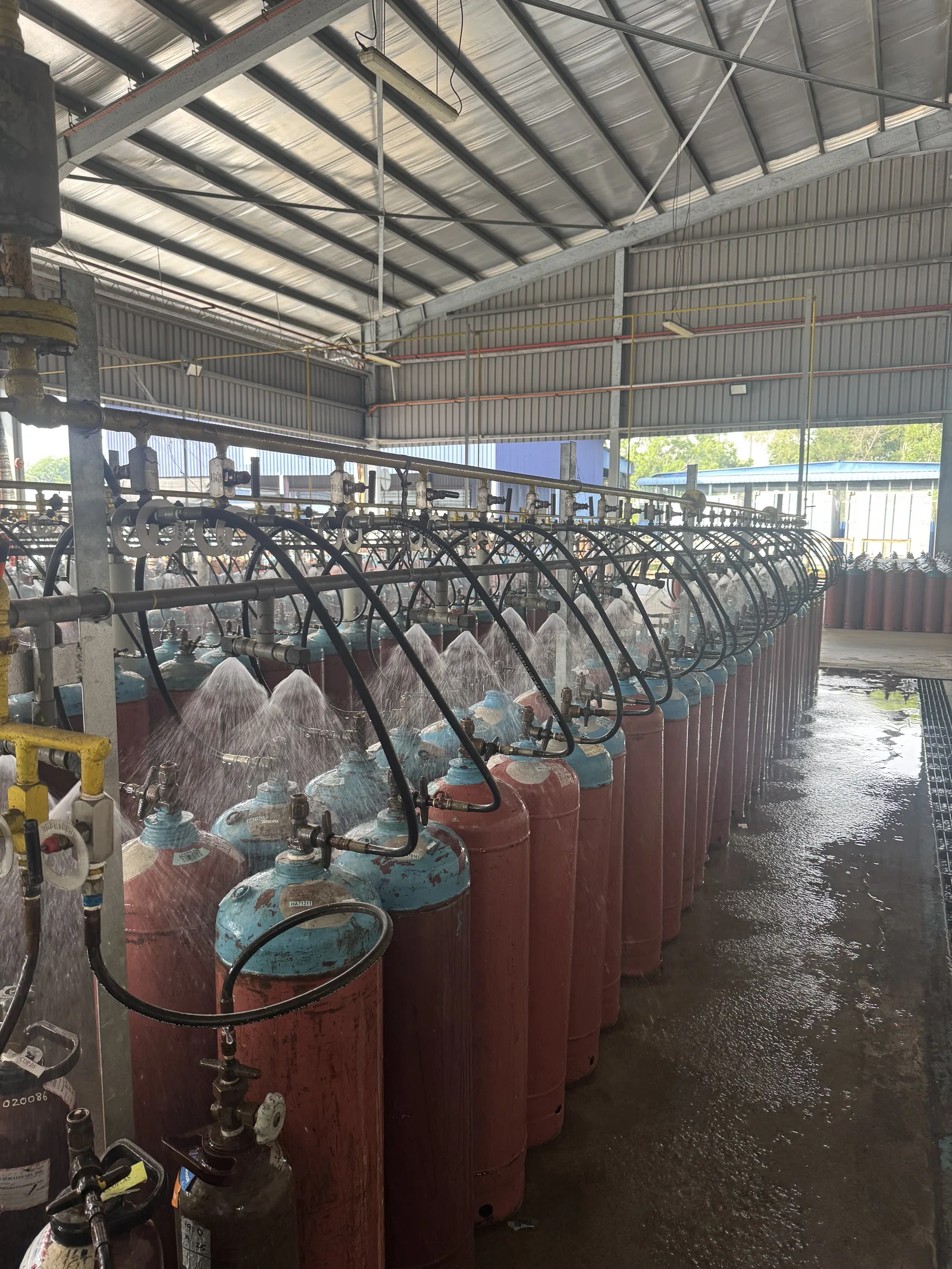
- Porous mass porosity
- 90
- Maximum acetone charge
- 43.4 % of water capacity by volume for cylinders above 9 litres at 90
- Maximum settled pressure
- 16 kgf/cm² at 15 °C with acetone
- Crushing strength of the mass
- Not less than 2 156 kN/m²
- Shell test pressure
- 60 kgf/cm² before the mass is cast
A dissolved acetylene (DA) cylinder is the only compressed-gas package in which the contents system, not just the shell, is the safety device. The steel shell is a low-pressure vessel proved at 60 kgf/cm². What stops an acetylene decomposition from running through the charge is a monolithic porous mass of 90–92 % porosity, filled with acetone in which the acetylene is dissolved. Every figure on this page exists to keep that combination inside the envelope in which Berthelot and Vieille found acetone solutions would not propagate a decomposition.
Why the gas has to be dissolved at all
Acetylene is endothermic: it stores +226.9 kJ/mol of heat of formation, and above roughly 1.4 atm absolute a decomposition into carbon and hydrogen can propagate through the pure gas without any air present (Jones, Scott, Kennedy and Huff, US Bureau of Mines RI 3755, 1944). Compressing it to cylinder pressures is therefore out of the question. The history of the DA cylinder is the story of three findings being combined: Claude and Hess showed in 1897 that acetone dissolves an extraordinary amount of acetylene; Berthelot and Vieille reported in 1897 and 1900 that acetone solutions up to 10 atm were not decomposed by detonators or hot wires, explosion being confined to the gas above the liquid; and Le Chatelier and Janet added the porous mass that stops a decomposition in that gas space from spreading.
As compiled by S. A. Miller (1965), the solvent does four things at once. It dilutes the acetylene into a condensed phase. It provides thermal mass. It decomposes endothermically into methane, carbon monoxide and ethylene, so that the heat released per mole of acetylene decomposed falls from 53.7 kcal in the gas to about 40 kcal at 40 g of acetylene per kg of acetone and about 20 kcal at 20 g/kg. And it rate-limits the whole event: decomposition in the gas space is over in milliseconds, but it can only reach the liquid as fast as heat drives acetylene out of solution, so a cylinder decomposition can take up to 100 seconds rather than exploding. See why acetylene is dissolved in acetone for the solvent chemistry.
What the porous mass is
The modern mass is calcium silicate. Lime and finely ground silica are mixed into a water slurry with a reinforcing fibre, poured into the shell, and reacted under steam at about 185 °C for one to three days, after which the water is driven off to leave the pore volume (as compiled by S. A. Miller, 1965; the same process is described by current manufacturers). The crystalline calcium silicate hydrates formed under those conditions give the mass both its compressive strength and its dimensional stability, which is why strength and freedom from shrinkage are controlled by the same variable, the degree of hydrothermal cure.
Historically the filler was granular or fibrous: kapok, asbestos discs, balsa wood and kieselguhr in the United States, and an 85:15 charcoal–kieselguhr packing in Britain at 78–80 % porosity. Regulators have since closed the door on those. 49 CFR 173.303(f) requires a homogeneous monolithic mass for UN cylinders to ISO 3807:2013, and CGA C-13 condemns all non-monolithic fillers except balsa wood. Indian law still contemplates loose masses, which is why the Gas Cylinders Rules 2016 Rule 39(2) sets a one-year examination interval for them against two years for monolithic masses.
Miller's eight requirements for a mass, compiled from the industry of his day, remain the best short specification: chemical stability over decades in contact with acetylene, acetone and steel; the highest porosity the law allows; mechanical stability against subsidence, cracks and cavities; resistance to the spread of decomposition whether it enters through the valve or starts at a heated wall; chargeability; dischargeability; retention of the acetone during discharge; and cost. The C.P.I., Safety in the Production and Use of Acetylene (Paris 1968), reduced this to four: fill the container as completely as possible, do not disintegrate, oppose the propagation of decomposition, and carry official approval.
The numbers, and where each one comes from
| Parameter | Figure | Source |
|---|---|---|
| Porosity, legal range | 75 % to 92 % | GCR 2016 Rule 37(ii); IS 7312:1993 cl 19.2.3 |
| Porosity, ISO rule | No absolute limit; declared band Pmax − Pmin ≤ 3 % | ISO 3807:2013 cl 4.2 |
| Porosity, KIGL | 90–92 % | KIGL specification |
| Crushing strength | ≥ 2 156 kN/m² (22 kgf/cm²) | IS 7312:1993 cl 19.2.4 |
| Compressive strength, ISO | ≥ 2 MPa, every sample | ISO 3807:2013 Annex B.3 |
| Shell-to-mass clearance | ≤ 0.5 % of diameter or length, and never over 3.2 mm, measured diametrically and longitudinally | IS 7312:1993 cl 19.2.2; IS 8433:2017 cl 6.2.3 |
| Acetone, 90–92 % mass, > 9 l | 43.4 % of water capacity by volume | IS 7312:1993 cl 19.3.2 |
| Acetone, 90–92 % mass, ≤ 9 l | lower; 41.8 % in the ICC table, IS 7312 cell to be read from the print copy | ICC Reg. 78.59-16; IS 7312:1993 cl 19.3.2 |
| Settled pressure | ≤ 16 kgf/cm² at 15 °C | GCR 2016 Rule 37(vi) |
| Shell test pressure | 60 kgf/cm², or 53 with fusible plug | GCR 2016 Rule 37(vii); IS 7312 cl 3.5 |
| Minimum shell thickness | 2.5 mm up to 10 l; 3.5 mm above | IS 7312:1993 cl 6.2.2 |
| Fusible plug yield | 100 °C +4/−2 | IS 13497:2017 cl 5; GCR 2016 Rule 37(viii) |
Three of these deserve comment.
Porosity
The Indian band is 17 points wide. A mass declared at "75–92 %" would be legal in India but would fail the ISO 3807:2013 spread rule, because the acetone and acetylene charges are computed against the declared porosity and a 17-point uncertainty makes that arithmetic meaningless. A 2-point band such as 90–92 % is a genuine quality position, not merely compliance. The literature compiled by S. A. Miller (1965) records that 90 % masses, described as 90–92 %, had become current in North America by 1965, accepted on the condition that the pores were too fine to be visible at 500× magnification.
Crushing strength
The 22 kgf/cm² figure is sometimes presented as a house specification. It is in fact the exact minimum of IS 7312:1993 cl 19.2.4, and it sits about 8 % above the ISO 3807:2013 requirement of 2 MPa (20.4 kgf/cm²). Miller's 1965 figure of about 200 psi (14.1 kgf/cm²) for the masses of that era is below every modern requirement and should not be quoted as current. The IS and ISO test methods differ in specimen and loading, so treat the comparison as order-of-magnitude.
Acetone
IS 7312's table appears to descend from the United States ICC table (Regulation 78.59-16), as compiled by Miller in 1965, metricated: the 20 lb water-capacity break became 9 litres, and the 43.4 % top-band figure is common to both. Indian filling arithmetic therefore works in volume per cent of water capacity, whereas ISO 11372 and AIGA 037/16 work in kg per litre of water capacity using a solution-volume equation. Both must satisfy the same two constraints: the loaded solution must not fill the free volume at 65 °C, and the acetylene-to-solvent ratio must not exceed the type-approved value, or the cylinder becomes backfire-prone.
How the pieces fit together at 15 °C
Take the acetone solubility data of Hölemann and Hasselmann (Forschungsberichte des Landes Nordrhein-Westfalen, 1952–1959), as compiled by Miller: at 15 °C and 15 atm total pressure, 1 kg of acetone holds 546 g of acetylene. Dissolving that much gas swells the acetone by about 84 %, because each gram of acetylene dissolved adds roughly 1.6 ml to the solution volume. So a solvent charge that occupies 43 % of the shell when it goes in occupies far more of the pore volume when the cylinder is full, and the remaining gas space is the entire margin against hydraulic over-pressure. That margin is tested at 65 °C, the tropical design temperature used identically by IS 7312 cl 20.3 and ISO 3807:2013 Annex D, and type-test cylinders are charged to 105 % of the maximum content to prove it.
The settled pressure follows from the same solubility curve. The C.P.I. (1968) recorded the general rule as an effective pressure not exceeding 15 kg/cm² at 15 °C after thermal balance, with filling racks running up to 25 kg/cm²; Indian law caps it at 16 kgf/cm². Because solubility falls steeply with temperature, the same charge at 30 °C sits at a markedly higher pressure, which is the subject of why cylinder pressure does not show contents.
What the shell does and does not do
The shell is welded steel to IS 7312 (at most one longitudinal and two circumferential seams), normalised or stress-relieved above 600 °C after welding, and stretch-tested before the mass is cast with no more than 7.5 % permanent expansion. Seamless shells to IS 7285 are also permitted. In service it is not pressure-tested again: IS 8433:2017 states in its foreword that neither a hydraulic nor a pneumatic test, nor an internal visual inspection, can be carried out once the mass is in. (ISO 10462 does require a hydraulic test before new porous mass is introduced into a shell whose test interval has lapsed.)
It is also not a containment vessel for decomposition. AIGA 022/26 puts deflagration final pressures at 10 to 11 times the initial pressure and detonation peaks at about 50 times. From a working pressure of 16 kgf/cm² those are 160–176 kgf/cm² and about 800 kgf/cm², against a shell proved at 60. ISO 3807:2013 cl 4.2 states the design intent plainly: the mass must prevent propagation of acetylene decomposition within the cylinder. The two cylinder fires with published investigations, in Great Britain in 2010 and Taiwan in 2005, were both traced to the same pair of causes: a settled or voided mass, and too little acetone (in the British case, "too little acetone and/or too much acetylene"). The British cylinder was 75 years old with a charcoal mass, so read-across to a modern monolithic fleet is limited, but the pairing is why the filling inspection and the periodic inspection concentrate on exactly those two things.
The fittings
The valve is to IS 3224:2021, with the acetylene outlet G5/8-14 TPI left-hand, outlet No. 2, and Rule 37(v) limits valve copper content to 70 %. The protection cap under IS 7312 cl 9.2 is perforated steel at least 3.5 mm thick. Fusible plugs to IS 13497:2017 sit in the bung on both sides of the valve shank and yield at 98–104 °C; the shell test pressure may be reduced from 60 to 53 kgf/cm² when they are fitted. Seamless cylinders carry no plug in the body. The valve page and the fusible plug page cover each in detail.
Rules that matter
Rules to apply
- Treat the porous mass and the acetone as the safety system. A cylinder with a settled mass or a solvent shortfall has lost its protection whatever the shell looks like.
- Fill by weight against the stamped tare, never by pressure alone, and replenish acetone before every fill where the weight shows a deficiency.
- Keep the cylinder upright and below the temperature at which the loaded solvent approaches the free volume; the design limit is 65 °C.
- Never apply heat, welding or repairs to the shell; Rule 12(5) forbids repair of weld-seam leaks and Rule 24(2) condemns any fire-damaged DA cylinder outright.
- Draw gas within the withdrawal limit so that acetone stays in the cylinder.
KIGL supplies dissolved acetylene conforming to IS 308:2024 in cylinders filled under the Gas Cylinders Rules 2016; the safety data sheet is at /sds/acetylene.
Inside — frequently asked questions
Why is acetylene dissolved in acetone instead of being compressed like oxygen?
Because compressed acetylene above roughly 1.4 atm absolute can decompose explosively without any air, releasing its heat of formation of 226.9 kJ/mol. Berthelot and Vieille showed in 1897 and 1900 that acetone solutions resisted detonators and hot wires to 10 atm, and Claude and Hess had shown acetone's extraordinary solvent power. Dissolving the gas dilutes it, gives it a heat sink and limits any decomposition to the rate at which heat can drive gas out of solution.
What is the porous mass made of?
Modern masses are monolithic calcium silicate, formed by reacting lime and fine silica in a water slurry inside the shell under steam at about 185 °C, then drying. Older cylinders used granular charcoal and kieselguhr, kapok or asbestos. India still permits loose masses at a one-year inspection interval, but the United States and ISO 3807:2013 now require a homogeneous monolithic mass for new cylinders.
What porosity does Indian law require for the porous mass?
Rule 37(ii) of the Gas Cylinders Rules 2016 and IS 7312:1993 cl 19.2.3 both permit 75 % to 92 %. ISO 3807:2013 sets no absolute figure but limits the declared band to 3 percentage points. KIGL specifies 90–92 %, a 2-point band at the top of the legal range, which also satisfies the ISO spread rule.
How much acetone goes into an acetylene cylinder?
IS 7312:1993 cl 19.3.2 fixes it as a percentage of water capacity by volume, in a table banded by porosity and split at 9 litres of water capacity. For a 90–92 % mass in a cylinder over 9 litres the limit is 43.4 %; lower porosity bands and smaller cylinders get less. The older United States ICC regulation 78.59-16 carries the same top-band figure. Size the charge from the full table, not from one number.
What pressure is a full acetylene cylinder at?
Not more than 16 kgf/cm² gauge at 15 °C under Rule 37(vi) of the Gas Cylinders Rules 2016; IS 14814:2023 gives the same limit as 15.495 atm. Filling manifolds run higher (Form E of the Rules notes they may be at 25 bar), so the cylinder settles as it cools. The pressure rises steeply with temperature, which is why pressure alone does not tell you how much gas is inside.
Why is the cylinder hydraulically tested only once?
Because the porous mass is cast into the shell after the test and cannot be removed. Rule 37(vii) requires the hydrostatic stretch test at 60 kgf/cm² (53 with a fusible plug) before the mass is added. IS 8433:2017 states that neither a hydraulic nor a pneumatic test can be done on a filled cylinder, so periodic inspection is visual, dimensional and gravimetric. ISO 10462 does require a fresh hydraulic test before new porous mass is put into a shell whose test interval has lapsed.
Can the steel shell contain a decomposition if the mass fails?
No. AIGA's acetylene code of practice puts deflagration final pressures at 10–11 times the starting pressure and detonation peaks at about 50 times. From 16 kgf/cm² that is 160–800 kgf/cm² against a shell proved at 60 kgf/cm². The porous mass is the only barrier; the shell is designed for working pressure, not decomposition.
What is the full form of DA in a DA cylinder?
DA stands for dissolved acetylene. A DA cylinder holds acetylene dissolved under pressure in a solvent, acetone for industrial grades and DMF for high-purity grades, held in a porous mass that fills the shell. Free acetylene cannot safely be compressed into a cylinder like oxygen: IS 14814:2023 limits acetylene in the free state to 0.612 atm in normal use. So in India 'DA cylinder' simply means an acetylene cylinder.
References
- Asia Industrial Gases Association. (2016). Permissible Charge for Acetylene Cylinders (AIGA 037/16).
- Asia Industrial Gases Association. (2026). Code of Practice: Acetylene (AIGA 022/26).
- Bureau of Indian Standards. (1993). Welded and Seamless Steel Dissolved Acetylene Gas Cylinders (public BIS mirror) (IS 7312:1993).
- Bureau of Indian Standards. (2023). Acetylene — Code of Safety (IS 14814:2023, First Revision).
- Government of India. (2016). Gas Cylinders Rules, 2016 (G.S.R. 1081(E)). Petroleum and Explosives Safety Organisation.
- International Organization for Standardization. (2013). Gas cylinders — Acetylene cylinders — Basic requirements and type testing (CFR incorporation-by-reference copy) (ISO 3807:2013).
Enquiries
Request a quotation
State the gas or equipment, the quantity or capacity, and your location. KIGL will confirm the grade, the cylinder or plant size, and whether the location can be served from Noonmati, or through the agent network.