
Guide
Periodic inspection of dissolved acetylene cylinders under IS 8433:2017: what is checked when, and what condemns a cylinder
A dissolved acetylene cylinder is never pressure-tested after its mass is cast. Inspection under IS 8433:2017 is visual and gravimetric: the valve is removed at least every 2 years (1 year for loose mass), the mass checked for gaps beyond 0.5 % or 3.2 mm, cracks or soot, and the shell for dents and corrosion.
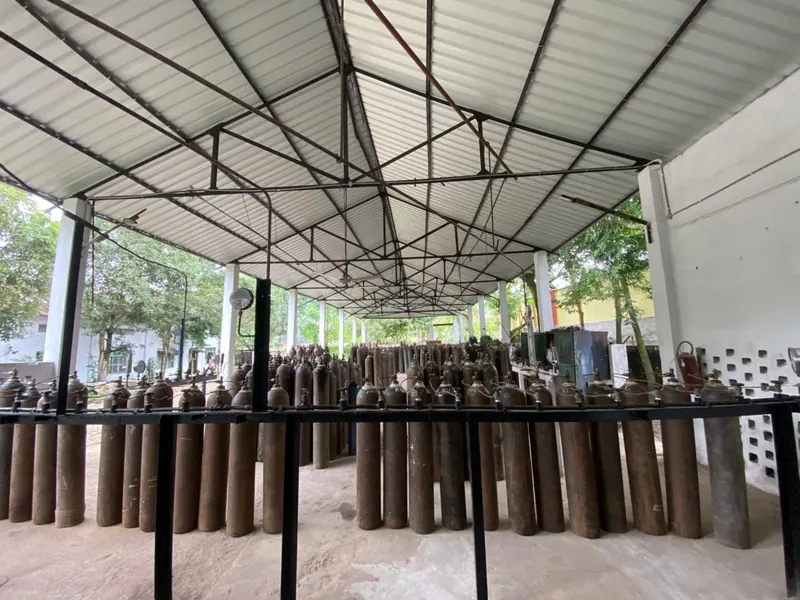
- No pressure test
- Neither a hydraulic nor a pneumatic test
- Interval for the neck check
- Valve removed and porous mass at the neck checked if no such examination within the previous 2 years; 1 year for loose porous mass
- Maximum gap at the top of the mass
- 0.5 % of diameter or length
- Cracks in a monolithic mass
- Cracking or crumbling less than 1 mm wide is acceptable if there is no break-out or dislodging of the mass
- Dent rejection
- Depth over 3 % of external diameter
A dissolved acetylene cylinder is the one gas cylinder that cannot be pressure-tested in service. Its porous mass is cast into the shell and stays there for the cylinder's life, so the periodic inspection that Indian law requires is a different exercise from the hydrostatic retest of an oxygen or nitrogen cylinder. IS 8433:2017, drawn from ISO 10462:2013, sets out what is examined instead: the mass, the neck, the valve and the outside of the shell, with numerical limits for each.
Why there is no pressure test
The foreword to IS 8433:2017 states that, because of the porous mass, neither a hydraulic nor a pneumatic pressure test, nor a visual inspection of the internal surface of the shell, can be carried out. IS 8868:1988 cl 2.1 says the same in a note: dissolved acetylene cylinders are not hydrostatically tested at periodical inspection. The hydrostatic stretch test is done before the mass is cast, normally at manufacture (ISO 10462:2013 cl 6.4 also requires a hydraulic test at the stamped test pressure before new porous material is introduced into a shell whose test interval has lapsed), at not less than 60 kgf/cm² or 53 kgf/cm² with a fusible plug, with permanent stretch limited to 7.5 % of the total (Gas Cylinders Rules 2016 Rule 37(vii)). That test is covered on hydrostatic stretch testing; the cylinder testing and retest page sets DA cylinders against the other gases.
The consequence is that everything the inspector can learn about the shell comes from its outside, and everything about the mass comes from what can be seen or felt through the valve opening.
When the inspection is due
Two instruments set the timing, and they agree:
| Instrument | Requirement |
|---|---|
| Gas Cylinders Rules 2016 Rule 39(1) | Thorough visual examination to IS 8433 every time the cylinder is charged |
| Rule 39(2) | If the history shows no such examination within the previous 2 years, remove the valve and check the porous substance at the neck; 1 year for loose porous mass |
| IS 8868:1988 cl 2.1 | Monolithic mass every 2 years; loose mass every 1 year; no hydrostatic test |
| IS 8433:2017 cl 4 | Due on first receipt by a filler after expiry of the interval in the Rules and IS 15975 |
IS 8433 refers the interval itself to IS 15975, and Rule 35(1) refers the period for all cylinders to the same standard. The two-year and one-year figures above are from Rule 39(2) and IS 8868. For comparison, CGA C-13 in the United States requalifies the shell every 10 years and the porous mass once, at 20 years from manufacture. India therefore inspects a monolithic-mass cylinder five times in the period in which the US inspects the shell once. Note that IS 8433:2017 still cites the Gas Cylinder Rules 2004, which Rule 73 of the 2016 Rules repealed; the 2016 Rules govern.
Preparing the cylinder
The cylinder is emptied to atmospheric pressure, allowed to warm to ambient, and its pressure and weight are recorded. Before the valve is removed, if a blocked valve is suspected, IS 8433 cl 5.3 requires an inert gas to be introduced at a pressure lower than 5 bar and its discharge observed; a valve that will not pass gas is treated as obstructed and dealt with under a controlled procedure. AIGA 022/26 warns that rapid blow-down cools the cylinder and gives a false "empty" indication, after which gas is released as it warms, so the cylinder must be normalised to atmospheric pressure before the valve comes off.
Once the valve is out, IS 8433 cl 5.4 requires all neck filters and felts to be rejected. Fine carbon powder on them may indicate a flashback into the cylinder, and all such cylinders are rejected.
Rules that matter
This is the heart of the inspection, because the mass is what prevents a decomposition from propagating, as explained on inside a dissolved acetylene cylinder. IS 8433:2017 gives these criteria:
The porous mass
- Contamination (cl 6.2.1) Any visible soot rejects the cylinder. Visible water or oil deposits reject it depending on the level of contamination; greying is the sign for monolithic materials.
- Cracks (cl 6.2.2) Cracking or crumbling less than 1 mm wide is acceptable provided there is no break-out or dislodging of the mass.
- Gap at the top (cl 6.2.3) The gap between the top of the cylinder and a monolithic mass may not exceed the type-approval figure. For cylinders made to IS 7312 the total clearance may not exceed 0.5 % of the respective diameter or length, and in no case 3.2 mm, measured diametrically and longitudinally. Where approval data are unavailable, an asbestos-containing monolithic mass is allowed 3.2 mm and an asbestos-free one 2 mm. Cylinders showing cavitation or significant lateral movement of the mass are rejected.
- Loose mass (cl 6.3) A non-monolithic mass showing cavitation, compaction or loss of compaction is rejected or repaired; at most 50 g of porous material may be added at each inspection, and the cumulative additions may not bring the porosity below the type-approval minimum, or below 1.5 % under nominal if no minimum is stated.
- Unacceptable mass (cl 6.4) If the mass is no longer acceptable, the complete cylinder is made unserviceable; a monolithic mass is not repaired.
The 0.5 % and 3.2 mm limits are those of IS 7312:1993 cl 19.2.2 and are identical to CGA C-13's 0.5 % and 0.125 in (3.175 mm). A new cylinder built to IS 7312 therefore cannot fail its first inspection on clearance simply by meeting its own standard; the 2 mm figure is a fallback where no approval figure exists. ISO 10462:2013 differs, defaulting to 2 mm for asbestos-free masses and operating its reject rule on whether a gauge 1 mm thicker than the maximum allowed clearance can be inserted.
The clearance exists because calcium silicate masses shrink slightly over life; a tiny gap is harmless and even helps charging, as compiled by S. A. Miller (1965), but a large gap is an unpacked gas space against the hot shell wall, which is where decomposition starts. A conference paper by HSE staff on the January 2010 explosion in Great Britain found an undetected void in a 75-year-old charcoal-mass cylinder and criticised inspection that had drifted from a two-yearly bump test to five-yearly visual and rodding checks of the top of the mass only; one of six comparable cylinders then failed a backfire test. Read-across to a modern monolithic fleet is limited, but the lesson that a top-of-mass check has a blind spot stands.
The shell
IS 8433 cl 6.1 requires external visual inspection for dents, cuts, gouges, bulges, cracks, laminations and loss of material from the base; heat, torch or arc damage; corrosion, with special attention to the base, the shell-to-footring junction and the neck-ring junction; illegible or unauthorised stampings; and the integrity of permanent attachments. Damaged valve guards, neck rings and footrings may be repaired or replaced, but no welding or heat may be applied to the pressure-containing part. Annex B gives the limits:
| Defect | Reject when |
|---|---|
| Bulge | Any visible swelling |
| Dent | Depth over 3 % of external diameter, or dent diameter less than 15 times its depth |
| Cut or gouge, welded shell | Depth over 10 % of wall thickness, or length over 25 % of external diameter |
| Cut or gouge, seamless shell | Depth over 15 % of wall thickness, or length over 25 % of external diameter |
| Crack, arc or torch burn, flashback, suspicious marks | All cylinders |
| Plug or neck inserts | All, unless shown to be part of the approved design |
| Stamping | Illegible or incorrect |
| General corrosion (over 20 % of surface) | Original surface no longer recognisable, penetration over 10 % of wall, or wall below guaranteed minimum |
| Local corrosion | Penetration over 20 % of original wall, or wall below guaranteed minimum |
| Chain, pitting or line corrosion | Total length in any direction exceeds the cylinder diameter and depth exceeds 10 % of wall |
| Crevice corrosion | Penetration over 20 % of minimum guaranteed wall |
On fire damage, IS 8433's table rejects cylinders showing partial melting or distortion and allows those with only charred paint or a damaged guard, date ring or plug to be considered after inspection. Rule 24(2) of the Gas Cylinders Rules 2016 is stricter and governs: dissolved acetylene cylinders damaged by fire shall be condemned and destroyed. Rule 12(5) adds that no repair may be made to a DA cylinder showing a leak in its weld seam.
Valve, plugs and reassembly
Fusible plugs and other relief devices are examined for damage and, where damaged, replaced and checked for gas tightness (cl 6.5); plugs are never peened or repaired. Valves are inspected and maintained under cl 6.6 and Annex E, with threads checked for diameter, form, length and taper, lubricants and elastomers compatible with acetone and acetylene per IS/ISO 11114-2, and internal and external leak checks at operating pressure after reassembly as IS 3224 requires. The cylinder-to-valve threads and neck ring are examined under cl 6.7; a neck ring is changed only by an approved procedure. At reassembly (cl 6.8) new filters are fitted so that the base of the valve stem contacts them, and a ring indicating the year of the next inspection is fitted over the valve stem where regulations require. The valve page and fusible plug page give the component requirements.
Marking, records and disposal
A cylinder that passes is marked with the inspection date and the symbol of the inspection body or test station, and the next inspection year is shown by a ring between the valve and the cylinder. For monolithic masses, stamping on the shoulder of a welded cylinder is not permitted unless a data plate or the manufacturing specification provides for it. The record, retained for 15 years under cl 9, holds the owner, serial number, any porous material added, attachment replacements, tare changes, the result with reasons for failure, the retest date, the station and the retester.
A rejected cylinder is rendered unserviceable by crushing or by irregular cutting into three or more pieces including the shoulder (cl 10, per IS 9200). Clause 11 notes that residual acetylene, solvent and a mass that may contain asbestos make the methods used for other cylinders inappropriate. Under Rule 36(1) a cylinder that fails, or that has lost more than 5 % of its tare weight, is not filled and is destroyed.
Rules that matter
What this means for a cylinder user
- Check the date ring under the valve before accepting a cylinder; a filler may not charge a cylinder past its date, and Rule 26 forbids transporting one for charging until the retest is done.
- Never grind, weld, overstamp or repair a cylinder; any of these condemns it.
- A cylinder that has been in a fire is scrap, however it looks.
- Report a cylinder that has been dropped hard, shows a dent or has had a flashback; the mass may have settled or cracked, and only the filler's inspection can tell.
Rule 39(1) requires every dissolved acetylene cylinder to be examined to IS 8433 each time it is charged; the full set of standards is on acetylene cylinder standards.
Periodic inspection of dissolved acetylene cylinders under IS 8433 — frequently asked questions
How often must an acetylene cylinder be tested in India?
The Gas Cylinders Rules 2016 Rule 39(1) require a thorough visual examination to IS 8433 every time a cylinder is charged, and Rule 39(2) requires the valve to be removed and the porous mass at the neck checked if no such examination is on record within the previous 2 years, or 1 year for loose porous mass. The statutory retest period itself is referred to IS 15975 under Rule 35(1).
Why is an acetylene cylinder not hydrostatically tested like an oxygen cylinder?
Because the monolithic porous mass fills the shell and cannot be removed. IS 8433:2017 says in its foreword that neither a hydraulic nor a pneumatic test nor an internal visual inspection can be carried out, and IS 8868:1988 states the same. The stretch test at 60 kgf/cm² under Rule 37(vii) is done before the mass is cast, normally at manufacture.
What is the maximum gap allowed between the porous mass and the top of the cylinder?
For cylinders made to IS 7312, total clearance may not exceed 0.5 % of the respective diameter or length and in no case 3.2 mm, measured diametrically and longitudinally. Where type-approval data are not available, IS 8433:2017 cl 6.2.3 allows 3.2 mm for an asbestos-containing monolithic mass and 2 mm for an asbestos-free one. CGA C-13 uses the same 0.5 % and 3.175 mm.
What condemns an acetylene cylinder outright?
Any bulge, crack, arc or torch burn, evidence of flashback, unauthorised neck or base inserts, illegible or incorrect stampings, visible soot inside, a porous mass that is no longer acceptable, and fire damage showing partial melting or distortion. Under Rule 24(2) of the Gas Cylinders Rules 2016 any DA cylinder damaged by fire is condemned and destroyed, which is stricter than IS 8433's own table.
What happens to the neck filters at inspection?
IS 8433:2017 cl 5.4 requires all neck filters and felts to be rejected and replaced. If fine carbon powder is found on the filters or packing it may indicate a flashback into the cylinder, and all such cylinders are rejected. New filters are fitted at reassembly so that the base of the valve stem contacts them as IS 3224 requires.
Can a porous mass be repaired?
Only a non-monolithic (loose) mass, and only within limits: IS 8433:2017 cl 6.3 permits no more than 50 g of porous material to be added at each inspection, and the cumulative addition may not take the porosity below the type-approval minimum or 1.5 % below nominal. If a monolithic mass is no longer acceptable, cl 6.4 requires the whole cylinder to be made unserviceable.
Why is a top-of-mass check alone considered insufficient?
Because it examines only the top of the mass. The published investigation of the 2010 cylinder explosion in Great Britain criticised the drift from a two-yearly bump test to five-yearly visual and rodding checks that look only at the top, and found an undetected void in a 75-year-old charcoal-mass cylinder; one in six comparable cylinders then failed a backfire test. Deep bump testing and radiography were recommended for ageing fleets.
How is a condemned cylinder dealt with?
IS 8433:2017 cl 10 requires it to be rendered unserviceable by crushing or by irregular cutting into three or more pieces including the shoulder, per IS 9200. Clause 11 warns that residual acetylene, solvent and a porous mass that may contain asbestos make ordinary cylinder disposal methods inappropriate.
References
- Bureau of Indian Standards. (1988). Periodical Inspection Interval for Gas Cylinders in Use (public BIS mirror) (IS 8868:1988).
- Bureau of Indian Standards. (2017). Periodic Inspection and Maintenance of Dissolved Acetylene Gas Cylinders — Code of Practice (IS 8433:2017, Second Revision).
- Compressed Gas Association. (n.d.). Guidelines for Periodic Visual Inspection and Requalification of Acetylene Cylinders (CGA C-13).
- Government of India. (2016). Gas Cylinders Rules, 2016 (G.S.R. 1081(E)). Petroleum and Explosives Safety Organisation.
- Hooker, Hodges, Geary and Wakefield (HSE), Investigation of an Acetylene Cylinder Explosion Incident, IChemE Hazards 26, 2016 https://www.icheme.org/media/11834/hazards-26-paper-06-investigation-of-an-acetylene-cylinder-explosion-incident.pdf
Enquiries
Request a quotation
State the gas or equipment, the quantity or capacity, and your location. KIGL will confirm the grade, the cylinder or plant size, and whether the location can be served from Noonmati, or through the agent network.