
Guide
Acetylene cylinder valves and spindle keys under IS 3224:2021: outlet materials and the rules for opening and closing
An Indian acetylene cylinder valve is made to IS 3224:2021 with a left-hand G5/8-14 TPI outlet (No. 2) and, if key-operated, a 7.1 mm spindle square; Rule 37(v) limits its copper to 70 %. Open it no more than one and a half turns, keep the key on, and close it when work stops.
- Acetylene outlet
- G5/8-14 TPI left-hand
- Spindle square
- 7.1 mm across flats for acetylene; 8.0 mm for marine-lighting acetylene
- Copper limit in the valve
- Not more than 70 % copper
- Opening
- Open slowly; not more than one and one-half turns
- Leak tightness
- Internal and external leakage not over 6 cm³/h at NTP
The valve is the only part of an acetylene cylinder the user operates, and it is the part through which every emergency is controlled. In India it is made to IS 3224:2021, its outlet is deliberately different from oxygen's, its copper content is capped by statute, and the rules for using it (how far to open it, where to keep the key and when to shut it) come down from codes written long before the present standard. Each rule has a reason.
Rules that matter
IS 3224:2021, the fourth revision of the Indian cylinder valve standard, covers valves for compressed, liquefiable and dissolved gases other than LPG and is aligned with ISO 10297:2014. Rule 4(1) of the Gas Cylinders Rules 2016 names it as the valve standard for industrial gas cylinders, and IS 7312 cl 9.1 requires DA cylinder bungs threaded to suit IS 3224 valves. For acetylene, Table 1 gives:
| Gas | Outlet thread | Pitch | Outlet No. | Spindle square |
|---|---|---|---|---|
| Acetylene | G5/8-14 TPI left-hand | 1.814 mm | 2 | 7.1 mm |
| Acetylene, marine lighting | G3/4-14 TPI right-hand | 1.814 mm | 1 | 8.0 mm |
| Oxygen (for comparison) | G5/8-14 TPI right-hand | 1.814 mm | 3 | 7.1 mm |
| Hydrogen, methane, ethylene | G5/8-14 TPI left-hand | 1.814 mm | 2 | 7.1 mm |
The acetylene and oxygen outlets are the same size but opposite hands, so an oxygen regulator cannot be screwed onto an acetylene cylinder or the reverse. Rule 4(3) of the Gas Cylinders Rules 2016 extends left-hand outlets to flammable gases not listed in IS 3224, and IS 3224 cl 9.1.2 requires any left-hand hexagon or nut to carry notches on its corners so the hand can be seen at a glance. Outlet No. 2 is shared with other fuel gases; the fuel-gas regulator and hose are the same family, which is why the regulator must still be one rated for acetylene.
Other requirements that matter to a user:
What IS 3224:2021 specifies for acetylene
- Leak tightness (cl 6.6) Internal and external leakage not over 6 cm³/h at NTP, about four bubbles of 3.5 mm per minute, across a service range of −20 °C to +65 °C (cl 6.1.1).
- Endurance (cl 6.3.3) 2 000 opening and closing cycles at test pressure without replacing the seal.
- Closing direction (cl 6.4.1) Clockwise viewed from the spindle end.
- Torque (Table 2 notes) Industry practice is a 7 N·m closing torque on a 65 mm handwheel, and 16 N·m is taken as the most that can be achieved by hand. A valve that needs more is defective.
- Marking (cl 14.1) Year and month of manufacture, IS 3224, working pressure, inlet code, outlet number, and the yield temperature of any fusible plug.
For acetylene, IS 3224 cl 7.1.5 gives the fusible plug yield temperature as 98–104 °C, matching IS 13497; the fusible plug page explains the device.
Why the copper is limited
Rule 37(v) of the Gas Cylinders Rules 2016 states that the valves of DA cylinders shall not contain more than 70 % copper. As compiled by S. A. Miller (1965), the mechanism was established by Brameld, Clark and Seyfang (1947): below roughly 65–70 % copper any acetylide film formed remains thin and adherent and cannot be made to spark by friction, impact or a wire at 150 °C; above it, films grow thick and detachable, and a detached flake inside pressurised acetylene is a detonator. Britain, Germany and France all legislated 70 % independently. The copper page covers the full set of Indian limits, which drop to 65 % for fusible plug bodies and high-pressure piping.
Composition at manufacture is not the whole story. The HSE investigation of the January 2010 cylinder explosion in Great Britain (Hooker, Hodges, Geary and Wakefield, IChemE Hazards 26, 2016) found that the inner spindle of a copper–zinc key-operated valve had failed by stress corrosion cracking at a change of section in the soft-seat recess, with dezincification also present; ammonia, possibly from carbide-route acetylene, was the most likely agent, with water wicking into the recess. Dezincification leaves a copper-rich surface regardless of the original alloy. After the incident the operator replaced its top-entry valves, and HSE recommended relocating the valve port and reducing the stress concentration. The read-across to a modern valve on purified gas is limited, but the lessons (keep water and ammonia out of the valve, and keep the outlet capped when not in use) are general.
Opening: slowly, and no more than one and a half turns
IS 14814:2023 cl 7.3.3 requires the cylinder valve to be opened slowly and not more than one and one-half turns. One and a half turns gives full flow for any normal draw. The reason for the limit is the next action, not this one: a valve opened to its backseat takes several turns to close, and in a hose fire or flashback the seconds matter. Opening slowly also avoids adiabatic compression of acetylene in the regulator inlet, which AIGA 022/26 lists among the recognised causes of decomposition in hoses and pipework.
The Netherlands rules compiled by Miller, from the Dutch Factory Inspector's leaflet of 1950, add two further points: the valve must not be opened before the regulator has been fitted, and the washer used must be new and of well-vulcanised rubber, leather or a suitable jointing material. A regulator outlet pressure above 1.4 atm gauge was forbidden. Do not crack an acetylene valve to blow out dust as is done with oxygen; acetylene is flammable from 2.5 % in air (IS 14814:2023 cl 4.5.3.1).
The key stays on the valve
The C.P.I., Safety in the Production and Use of Acetylene (Paris 1968), stated the rule and its reason together: valves not operated by a handwheel must be provided with their key or spanner whenever the cylinder is in use, because the valve must be closed at once if the gas catches fire or in the case of a flashback in the outlet pipe. A spindle-valve cylinder in service without its key is a cylinder that cannot be made safe. On a manifold, each cylinder needs its key in place or a fixed handle. Which torch valve to close first at a flashback is not settled by any source held for this page, and published practice differs; follow the torch maker's instruction, and close both cylinder valves at once. The daily safety checklist covers the routine checks.
Closing on every interruption
The C.P.I. (1968) also required the valve to be closed during interruptions in work and whenever a cylinder is set aside as empty, so that neither acetylene nor solvent vapour escapes. An empty DA cylinder still holds acetone saturated with acetylene. Closing it also keeps air and moisture out of the valve and the neck filters, which is the water-wicking path the HSE investigation identified. Refit the outlet cap or the valve guard; IS 7312 cl 9.2 specifies a perforated steel cap at least 3.5 mm thick, and Schedule VI of the Gas Cylinders Rules 2016 requires valve protection in transport.
Connecting the regulator
The regulator nut is left-handed on acetylene. Clean the outlet by wiping, check the seat and washer, start the nut by hand and tighten it with the correct spanner. Never use PTFE tape on the outlet thread, oil or grease anywhere on the valve or regulator, or an extension bar or hammer; the joint seals on its seat, and force damages the seat. German regulations compiled by Miller required stirrup-type valve fittings, a clamp connection, which is not the Indian pattern; IS 3224 outlets are threaded. A connection that leaks when correctly tightened needs a new washer or a different regulator. Check with a leak-detection fluid, never a flame, as described on acetylene leak detection.
When a valve misbehaves
A stiff valve, a valve that will not shut, a leaking gland or a damaged outlet is not repaired by the user. Close the valve as far as it will go without force, move the cylinder outdoors away from ignition sources, label it and inform the filler. IS 16271:2014 cl 3.4.1 requires a filler to stop filling if a valve leaks, and IS 8433:2017 Annex E covers valve maintenance; obstructed valves are dealt with by controlled procedures under the Gas Cylinders Rules 2016 Schedule IV. CGA C-13 rejects reducing bushings in the outlet and requires valve replacement where a left-handed bonnet nut is found.
Rules that matter
Rules to apply
- Fit the regulator before opening; open slowly; no more than one and a half turns.
- Leave the key on the spindle for as long as the cylinder is in use.
- Close the valve at every break and when the cylinder is empty; refit the cap.
- No oil, grease, PTFE tape, extension bars or hammers on any acetylene valve.
- Report, do not repair, any valve that is stiff, leaking or damaged.
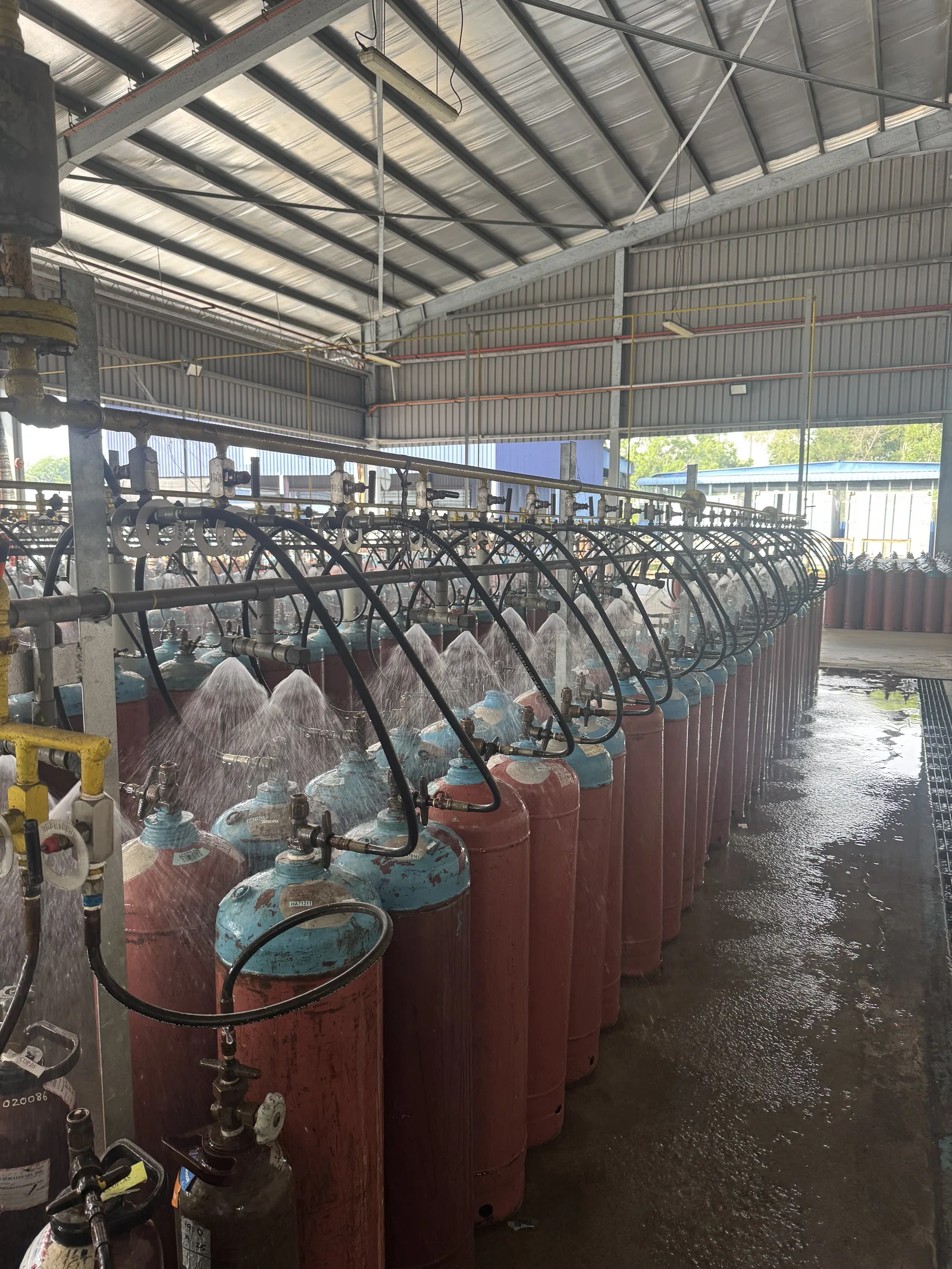
KIGL dissolved acetylene cylinders are fitted with IS 3224 valves; general handling is covered on handling acetylene cylinders.
Acetylene cylinder valves — frequently asked questions
Is an acetylene cylinder valve left-hand thread?
Yes. IS 3224:2021 Table 1 gives acetylene outlet No. 2, a G5/8-14 TPI left-hand thread, the same family used for hydrogen, methane and other fuel gases; oxygen is outlet No. 3, the same size right-handed. Rule 4(3) of the Gas Cylinders Rules 2016 extends left-hand outlets to flammable gases not listed in IS 3224. Left-hand nuts and hexagons carry notches on the corners for identification.
How many turns should an acetylene cylinder valve be opened?
Slowly, and not more than one and one-half turns, under IS 14814:2023 cl 7.3.3. That is enough for full flow and means the valve can be shut in a second or two if a hose fire or flashback occurs. A valve opened fully to the backseat takes several turns to close, which is time lost in an emergency.
Why must the key be left on the cylinder valve?
Because the first action on a fire at the cylinder or a flashback in the hose is to close the valve at once. The C.P.I. code of 1968 required valves not worked by a handwheel to have their key or spanner on the valve whenever the cylinder is in use. A key-operated cylinder without its key cannot be made safe quickly. On a manifold, each cylinder needs its own key or a fixed key.
Can I open an acetylene cylinder without a regulator?
No. The Dutch rules Miller compiled required the regulator to be fitted before the valve is opened, with a new well-vulcanised washer. Opening into the air releases acetylene, which is flammable from 2.5 % in air under IS 14814, and cracking the valve to blow dirt out, a habit carried over from oxygen, is not done with acetylene near any ignition source.
What should I use to tighten a regulator onto an acetylene valve?
The correct spanner on the nut, tightened firmly but without extension bars or hammering, and never PTFE tape, oil or grease on the seat. The joint seals on a washer or a machined seat, not on the threads. Over-tightening damages the seat and the nut; if it leaks when correctly tightened, change the washer or the regulator, never force it.
Why is the copper in an acetylene valve limited to 70 %?
Copper and copper-rich alloys form copper acetylide, a contact explosive. As compiled by Miller, below about 65–70 % copper any acetylide film stays thin and adherent and cannot be made to spark; above it, films grow thick and can flake. Rule 37(v) fixes 70 % for valves. The 2010 HSE investigation showed that a brass spindle that dezincifies can still release copper.
What should I do if the valve is stiff or will not close?
Do not use extension bars or hammers, and do not try to repair it. Leave the cylinder closed as far as it will go, take it outdoors away from ignition sources, label it, and tell the filler. IS 8433:2017 and IS 16271:2014 provide controlled procedures for obstructed valves that only a filling station should carry out.
References
- Bureau of Indian Standards. (2021). Valve for Compressed Gas Cylinders Excluding LPG Cylinders — Specification (IS 3224:2021, Fourth Revision).
- Bureau of Indian Standards. (2023). Acetylene — Code of Safety (IS 14814:2023, First Revision).
- Government of India. (2016). Gas Cylinders Rules, 2016 (G.S.R. 1081(E)). Petroleum and Explosives Safety Organisation.
- Hooker, Hodges, Geary and Wakefield (HSE), Investigation of an Acetylene Cylinder Explosion Incident, IChemE Hazards 26, 2016 https://www.icheme.org/media/11834/hazards-26-paper-06-investigation-of-an-acetylene-cylinder-explosion-incident.pdf
Enquiries
Request a quotation
State the gas or equipment, the quantity or capacity, and your location. KIGL will confirm the grade, the cylinder or plant size, and whether the location can be served from Noonmati, or through the agent network.