
Guide
How the dissolved acetylene cylinder was invented: from Willson's carbide in 1892 and the explosions of 1896 to Janet's porous mass and acetone in 1901
The dissolved acetylene cylinder was invented between 1897 and 1901. After explosions in 1896 led France and Britain to ban compressed acetylene in 1897, Claude and Hess showed acetylene dissolves in acetone, Berthelot and Vieille proved such solutions safe to 10 atmospheres, and Janet combined acetone with a porous mass in 1901.
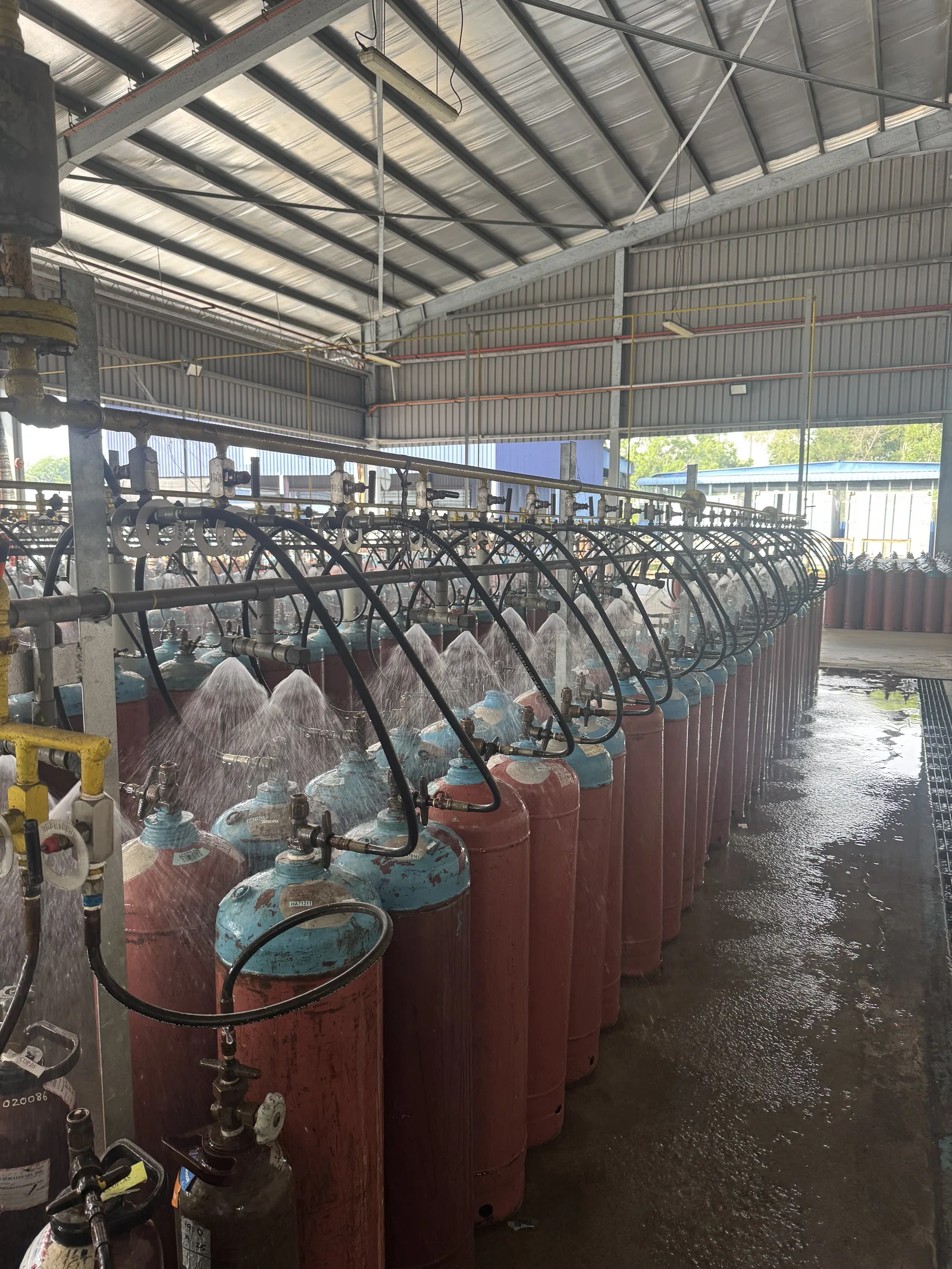
- Carbide process
- Electric-furnace calcium carbide discovered by T. L. Willson at Spray
- The bans
- French Prefecture of Police
- Solubility in acetone
- Acetylene is extraordinarily soluble in acetone
- Safety of solutions
- Acetone solutions of acetylene shown safe to 10 atmospheres
- The combination
- Acetone held in a porous mass inside the cylinder
The dissolved acetylene cylinder is one of the oldest pieces of chemical engineering still in daily use, and it exists because acetylene nearly put itself out of business within five years of becoming cheap. Between Willson's discovery of a commercial carbide process in 1892 and a British Home Office order in 1901, the gas went from novelty to banned explosive to safely bottled fuel. The porous mass and the acetone inside every cylinder KIGL fills are not packaging; they are the two halves of the invention that made the product legal to sell. This page tells that story from the primary sources.
1892 — cheap acetylene
Acetylene had been known since Edmund Davy's announcement of 1836 and Berthelot's naming and systematic study from 1860, and Wöhler had made calcium carbide in 1862. None of that made it an industrial gas. What did was an accident in May 1892 at Spray, North Carolina, where Thomas L. Willson, trying to make metallic calcium in an electric furnace, produced a lump that gave off a flammable gas in water. His patent, US 492,377, issued in 1893. Henri Moissan made calcium carbide independently in Paris in 1892 (Comptes rendus 1892, 115, 1031), and Maquenne made barium carbide, also in 1892. The date is often printed as 1893; it was 1892. Within a few years carbide was being made in quantity, and acetylene — which burns with a brilliant white flame — was lighting towns.
1896 — the explosions
Acetylene as a lighting gas had a storage problem. It could be generated at the lamp from carbide and water, but anyone wanting to carry it compressed in a cylinder, like coal gas, was compressing a gas that decomposes. In 1896 three explosions settled the matter: at Pfleghar and Son in New Haven; at one of R. Pictet's works; and at the Isaac factory in Berlin, with fatalities. Marcellin Berthelot and Paul Vieille then showed what made acetylene different from every other fuel gas: compressed or liquid acetylene could be exploded by a spark, a hot wire or a detonator with no oxygen present at all (Comptes rendus 1896, 123, 323; 1897, 124, 1000). The gas carried its own energy — a heat of formation of about +227 kJ/mol — and could release it by breaking down to carbon and hydrogen.
1897 — the bans
The regulatory response was immediate:
| Date | Instrument | Effect |
|---|---|---|
| 3 March 1897 | French Prefecture of Police instructions | Compressed acetylene prohibited in Paris |
| 26 November 1897 | British Order in Council | Compressed acetylene brought under the explosives law |
| 1899 | Rules of the US National Board of Fire Underwriters | Restriction on compressed acetylene |
Acetylene could still be generated and used at very low pressure close to where it was burned, which is how carbide lamps and small generators survived; but a portable, compressed supply was illegal in the two largest European markets. The idea of an upper pressure limit for acetylene, which survives today in the Indian free-state limit of 0.612 atm in IS 14814:2023, starts here. The liquid acetylene page explains why the gas cannot simply be bottled as a liquid.
1897 to 1901 — four pieces of work
The rescue took four years and four contributions:
| Year | Who | What | Primary citation |
|---|---|---|---|
| 1897 | Georges Claude and Albert Hess | Acetylene is extraordinarily soluble in acetone | Comptes rendus 1897, 124, 626 |
| 1900 | Berthelot and Vieille | Acetone solutions are far less explosive than compressed or liquid acetylene, and safe to 10 atmospheres | Comptes rendus 1900, 129, 988 |
| — | Henri Le Chatelier | A porous filling inside a cylinder of compressed acetylene | cited via Claude, Proc. Tenth Int. Acetylene Congress, London 1936, 380 |
| 1901 | Janet | The combination: acetone held in a porous mass, in a cylinder | Z. Kalziumkarbidfabrikation u. Acetylen 1901, 5, 237 |
Each piece was necessary. Solubility meant a cylinder could hold far more acetylene at modest pressure than as free gas — the 300 volumes page explains what the real figure is. Berthelot and Vieille's work meant the solution itself was not an explosive at the pressures needed. But acetone alone leaves a gas space above the liquid, and it slops about. The porous mass removed the gas space by dividing the cylinder into pores too small for a decomposition flame to pass, and held the acetone evenly through the volume. Janet's cylinder — porous mass, acetone, dissolved acetylene — is the device in use today; the Gas Cylinders Rules 2016 define it in nearly the same terms in Rule 2(xix), as a cylinder holding a porous mass, a solvent and at least enough acetylene to saturate the solvent at atmospheric pressure and 15 °C.
1901 — legal again
The British Home Office order of 10 April 1901 permitted the manufacture of dissolved acetylene, and the industry restarted in Britain on the new technology. In the United States, P. C. Avery's work from 1904 and the Concentrated Acetylene Company, which became the Prest-O-Lite company in 1906, put the cylinder into commercial service, at first for vehicle and marine lighting. The copper rule arrived in the same years: the Lemberg railway station lighting explosion, Grittner's study of copper acetylide (Z. Kalziumkarbidfabrikation u. Acetylen 1899, 3, 106) and the Budapest Acetylene Congress of 1899 established that copper and acetylene form an explosive acetylide, which is why Indian rules now cap cylinder valves at 70 percent copper and the code of safety avoids copper alloys altogether, as the copper and acetylene page explains.
From lamp to torch
The dissolved acetylene cylinder arrived just as acetylene lighting peaked. As compiled by S. A. Miller (1965), 465 towns, 227 of them French, used acetylene for public lighting by 1911, after which the number fell rapidly against the Welsbach gas mantle and the tungsten-filament lamp. The gas was saved by metalworking. Le Chatelier showed the oxy-acetylene flame in 1895 (Comptes rendus 1895, 121, 1144); Edmond Fouché developed oxy-acetylene welding from 1903 (British Patent 6944/1903); and Jottrand demonstrated the first oxygen cutting blowpipe at Liège in 1905 (British Patent 18,897/1905). The cylinder made the flame portable: a welder could carry acetylene to the job instead of building a generator beside it. Lighthouses kept acetylene lighting longest; it was pioneered there by Gustaf Dalén of the AGA company, later a Nobel laureate. The market shift is traced on uses of acetylene gas.
What changed after 1901, and what did not
The porous mass has changed more than anything else in the cylinder. Early fillings were charcoal, kieselguhr, asbestos and other loose or granular materials. Monolithic masses, cast in place, displaced them; in North America the predominant mass by the 1960s was calcium silicate formed in situ from lime and silica, with porosities of about 90 to 92 percent becoming current, as compiled by S. A. Miller (1965). Indian law today allows porosity between 75 and 92 percent (Gas Cylinders Rules 2016, Rule 37(ii)). The legacy masses are a modern concern: a 2010 investigation by HSE staff of a cylinder explosion in Great Britain involved a 75-year-old cylinder with a charcoal mass, and the operator then withdrew its charcoal-mass cylinders; older masses may also contain asbestos.
What has not changed is the principle. The cylinder is safe because the acetylene is in solution, the solution is spread through a fine porous structure, and the amount of acetylene is matched to the amount of solvent. Rule 37's explanation in the Gas Cylinders Rules 2016 states the two-sided constraint Janet's design created: too much solvent can make the cylinder hydraulically full and burst it on heating; too little leaves it less resistant to decomposition from a flashback. Filling discipline — weighing every cylinder and keeping its solvent correct — is the modern form of the 1901 invention.
Rules that matter
What this means for you
- The porous mass and acetone are the safety system, not the container's contents; a cylinder short of acetone is a cylinder short of protection.
- Never try to transfer acetylene between cylinders or compress it into anything else; IS 14814 forbids it, for the reasons established in 1896.
- Keep cylinders upright and draw at a moderate rate, so acetone stays in the mass where Janet put it.
KIGL, part of a family industrial-gas business founded in 1947, fills dissolved acetylene on this principle; the Indian side of the story is on acetylene in India.
How — frequently asked questions
Who invented the dissolved acetylene cylinder?
No single person. Georges Claude and Albert Hess reported in 1897 that acetylene is extraordinarily soluble in acetone; Berthelot and Vieille showed in 1900 that acetone solutions were safe to 10 atmospheres; Le Chatelier proposed filling the cylinder with a porous mass; and Janet combined the acetone and the porous mass in one cylinder in 1901. That combination is the dissolved acetylene cylinder still in use.
Why was compressed acetylene banned in 1897?
Because three explosions in 1896 — at Pfleghar and Son in New Haven, at a works of R. Pictet's, and at the Isaac factory in Berlin, with deaths — were followed by Berthelot and Vieille's demonstration that compressed or liquid acetylene explodes from a spark, hot wire or detonator with no oxygen present. The French Prefecture banned it on 3 March 1897 and a British Order in Council followed on 26 November 1897.
When did dissolved acetylene become legal in Britain?
The British Home Office order of 10 April 1901 permitted the manufacture of dissolved acetylene, restarting the industry on the porous-mass-and-acetone technology. In the United States, P. C. Avery's work from 1904 and the Concentrated Acetylene Company, which became Prest-O-Lite in 1906, brought the cylinder into commercial use.
Why is the porous mass needed if acetone already dissolves the acetylene?
Because acetone alone leaves a free gas space above the liquid, and a decomposition started there can run through it. The porous mass divides the cylinder into pores too fine for a decomposition flame to pass, and holds the acetone spread through the volume. Modern monolithic calcium silicate masses run at 90 to 92 percent porosity, the band that S. A. Miller (1965) records as having become current.
When was the oxy-acetylene flame invented?
Le Chatelier showed the oxy-acetylene flame in 1895 (Compt. rend. 1895, 121, 1144). Fouché developed oxy-acetylene welding from 1903 (British Patent 6944/1903), and Jottrand demonstrated the first cutting blowpipe at Liège in 1905 (British Patent 18,897/1905). The dissolved acetylene cylinder gave those processes a portable gas supply.
Where did the copper ban come from?
From the Lemberg railway station lighting explosion, Grittner's study of copper acetylide published in 1899 (Z. Kalziumkarbidfabrikation u. Acetylen 1899, 3, 106), and the Budapest Acetylene Congress of 1899. Copper and acetylene form copper acetylide, which can explode on friction or shock. Indian rules today limit cylinder valves to 70 percent copper.
References
- Berthelot and Vieille, Comptes rendus 1900, 129, 988 — Gallica, Bibliothèque nationale de France
- Claude and Hess, Comptes rendus 1897, 124, 626 — Gallica, Bibliothèque nationale de France
- Government of India. (2016). Gas Cylinders Rules, 2016 (G.S.R. 1081(E)). Petroleum and Explosives Safety Organisation. [Rule 2(xix) definition of a dissolved acetylene cylinder]
- T. L. Willson, US Patent 492,377 (1893), Google Patents
Enquiries
Request a quotation
State the gas or equipment, the quantity or capacity, and your location. KIGL will confirm the grade, the cylinder or plant size, and whether the location can be served from Noonmati, or through the agent network.