
Guide
Why the pressure gauge does not tell you how much acetylene is in the cylinder
An acetylene cylinder's gauge shows the equilibrium of acetylene over acetone at that temperature, not the quantity of gas. A charge reading 15 kg/cm² at 15 °C reads markedly higher at 30 °C, and a cold cylinder reads low while nearly full. Contents are found by weighing against the tare.
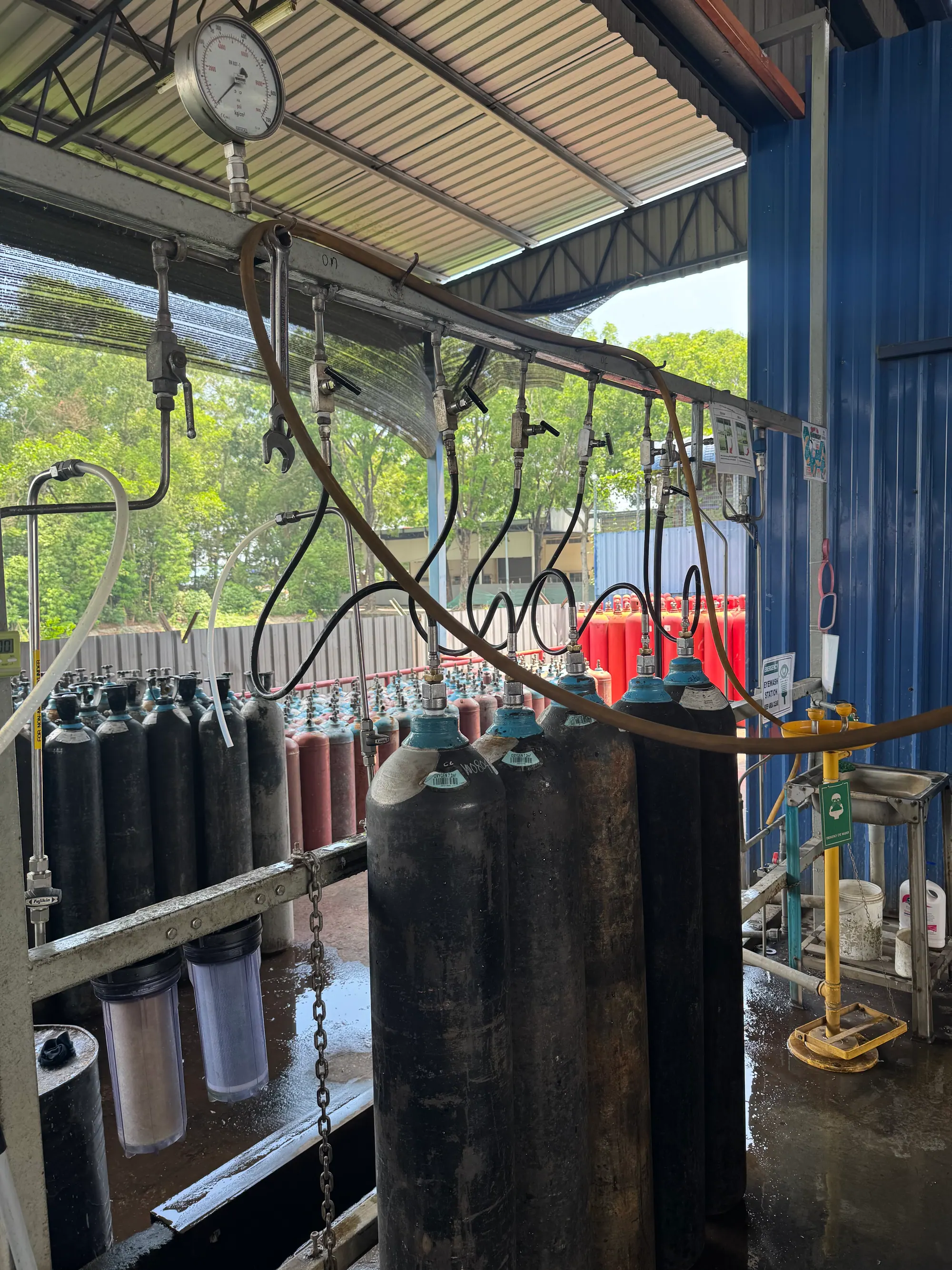
- Solubility at filling pressure
- 546 g acetylene per kg acetone at 15 °C and 15 atm; 472 at 20 °C; 413 at 25 °C; 364 at 30 °C
- Statutory settled pressure
- Not more than 16 kgf/cm² at 15 °C with acetone
- Gas left at return pressure
- At 20 °C and 3 atm total
- Low-pressure solubility coefficient
- Bunsen α = 26.6 at 15 °C
- What a wrong pressure at correct weight means
- Too high: solvent deficiency
A gauge on a dissolved acetylene cylinder is not a contents gauge. It reads the pressure at which acetylene in the gas space is in equilibrium with acetylene dissolved in the acetone at the cylinder's present temperature. Change the temperature and the reading changes with no change in contents; change the acetone-to-acetylene ratio and it changes again. The only reliable measure of what is inside is the weight, which is why every Indian filling rule is written in kilograms.
What the gauge actually measures
In a compressed-gas cylinder such as oxygen, the pressure is proportional to the mass of gas at a given temperature, so a gauge can be read as a contents indicator with a small temperature correction. In a DA cylinder almost all the acetylene is in solution. The gas space is a few litres at most, and its pressure is set by the solubility curve of acetylene in acetone, which Hölemann and Hasselmann measured in the 1950s (Forschungsberichte des Landes Nordrhein-Westfalen, Nos. 34/1952, 78/1954, 723/1959 and 792/1959). As compiled by S. A. Miller (1965), their isotherms at 15 atm total pressure run:
| Temperature | Acetylene held per kg of acetone at 15 atm | Change from 15 °C |
|---|---|---|
| 0 °C | 912 g | +67 % |
| 15 °C | 546 g | reference |
| 20 °C | 472 g | −14 % |
| 25 °C | 413 g | −24 % |
| 30 °C | 364 g | −33 % |
A cylinder is filled so that its settled pressure at 15 °C does not exceed 16 kgf/cm² (Gas Cylinders Rules 2016 Rule 37(vi); IS 14814:2023 cl 7.2.2 gives the same limit as 15.495 atm). The acetone in it is then holding of the order of 546 g of acetylene per kg. Warm that same cylinder to 30 °C and the acetone can only hold 364 g/kg at 15 atm, so acetylene leaves solution and the pressure rises until the gas space and the liquid are back in equilibrium. Interpolating between the isotherm points, holding a 546 g/kg charge needs roughly 17 atm at 20 °C, about 18.6 atm at 25 °C and about 20.6 atm at 30 °C. The contents have not changed by a gram; the gauge has moved by a third.
The C.P.I., Safety in the Production and Use of Acetylene (Paris 1968), gave the same relationship at low pressure as the Bunsen coefficient: 26.6 volumes per volume at 15 °C, 20.9 at 25 °C and 14.4 at 40 °C, a 46 % loss of solvent capacity across a range that Indian ambient temperatures cover every year. The page on acetylene in hot weather follows the consequence for storage.
Three ways the gauge misleads
A warm cylinder reads high
A part-used cylinder left in the sun can show a gauge pressure near the full-cylinder figure. The reading says nothing about contents; it says the cylinder is hot. The loaded solvent also expands at about 0.23 % per °C, half again as fast as pure acetone, so the gas space shrinks as the pressure climbs. This is the hydraulic risk that the 65 °C elevated-temperature type test in IS 7312 (cl 20.3 of the 1993 edition) exists to bound.
A cold or over-drawn cylinder reads low
Desorbing acetylene absorbs roughly 700 kJ per kg (heat of solution 4.25–4.70 kcal/mol, Schay and co-workers, as compiled by S. A. Miller, 1965; the C.P.I. gave about 160 cal/g). A fast draw chills the contents, colder acetone holds the gas more tightly, and the gauge falls while most of the charge remains. Winter mornings do the same without any draw at all: at 0 °C acetone holds 67 % more gas at the same pressure than at 15 °C, so a full cylinder reads well below its summer pressure. The one-seventh rule exists for the first case; cold-weather delivery covers the second.
A wrong solvent ratio reads wrong at any temperature
IS 16271:2014 cl 3.5.2 states the diagnosis a filler applies when a cylinder is at the correct total weight but the wrong pressure: too high a pressure at ambient temperature indicates a deficiency of solvent, solvent contaminated by water, or a high concentration of gases insoluble in the solvent; too low a pressure indicates an excess of solvent. The same clause notes that the pressure need not be checked against the stamped working pressure for every cylinder once the total weight and the solvent content have been verified, because the acetylene-to-solvent ratio was fixed at type approval. Weight is the primary measurement; pressure is the cross-check.
The residual-pressure trap
Pressure is also a poor guide at the bottom of the charge. At 20 °C and 3 atm total pressure, acetone still holds 94 g of acetylene per kg; at 2 atm, 62 g/kg; at 1 atm, 28 g/kg. Against a full charge of 472 g/kg at 20 °C, a cylinder returned at about 3 atm, which the 1965 compilation records as the average level to which industrial users empty cylinders, still contains about 20 % of its gas. High solubility at low pressure is a disadvantage in a cylinder solvent for exactly this reason: that gas is carried out and carried back without being delivered.
The user should not try to recover it. Below about 2 bar the acetone vapour fraction of the withdrawn gas rises steeply, 23 % at 1 atm and 20 °C, and the cylinder's solvent inventory goes with it. The companion page on acetone carry-over and residual pressure gives the full table. A gauge reading of 2–3 kg/cm² is the signal to change the cylinder, not evidence that it is empty.
Rules that matter
Every statutory control on a DA cylinder's contents is gravimetric:
Why the law is written in kilograms
- Rule 37(ix)(i) of the Gas Cylinders Rules 2016 requires the tare weight, inclusive of the valve, to be stamped on the cylinder, and Rule 37(ix)(k) the maximum gas capacity.
- Rule 41(1) requires, for every charge, the empty cylinder weight without gas, the weight of solvent charged before gas charging and the full weight of the cylinder.
- Rule 42 requires the warning label to carry the date of last filling, the weight of gas filled and the full cylinder weight.
- IS 16271:2014 cl 3.5.2 requires the filler to verify by weighing, after filling, that the maximum acetylene content is not exceeded.
- IS 16271 cl 3.3.1 requires the solvent content to be established before filling from the cylinder's weight after deduction of residual gas, with about 3 hours allowed for the cylinder to reach room temperature and the residual pressure brought below 7 bar for cylinders with a working pressure of 17 bar or higher.
None of these mention a gauge reading as a measure of contents. The gauge appears only as a check on the solvent ratio once the weight is known. The procedure for a user is on how to check acetylene cylinder contents by weight.
The gas-space composition changes too
A further reason the gauge drifts away from the contents is that the gas space is not pure acetylene. Rack gas is normally 99.5–99.7 % acetylene, the balance mostly nitrogen with traces of oxygen, hydrogen and methane (as compiled by S. A. Miller, 1965). Those insolubles concentrate in the small gas space: on the same compilation's figures, the top gas of a cylinder charged from zero gauge could carry 9 % insolubles, and 4–6 % in normal service where cylinders are not run to zero. Strizhevskii (Zhur. Prikl. Khim., 1963, 36, 2320) found a freshly charged cylinder behaves like a chromatography column, with air at 14.5 % by volume on the acetylene at the bottom and 0.7 % at the top, equilibrating by diffusion over 10–14 days. A gauge reads total pressure, so a cylinder rich in insolubles reads high for its acetylene content, which is precisely the IS 16271 "too high a pressure" case.
Rules that matter
What this means for you
- Read the gauge as a temperature and ratio indicator, never as a fuel gauge. Compare readings only at the same temperature, after the cylinder has stood for about 3 hours.
- For stock control and for charging to a job, use net weight: gross minus stamped tare, at roughly 0.91 m³ per kg at 20 °C.
- Change the cylinder at 2–3 kg/cm² residual rather than running it down; the last atmospheres cost acetone and deliver little.
- A full-weight cylinder that reads unusually high at ambient temperature has a solvent problem and should go back to the filler unopened.
- Keep cylinders in shade; a pressure rise from sun is a loss of safety margin, not a gain in contents.
Rule 41 requires every charge of a dissolved acetylene cylinder to be weighed and recorded, and Rule 42 requires the weight of gas filled on the label. The property data behind this page are on the acetylene technical data sheet.
Why — frequently asked questions
My acetylene cylinder gauge reads 15 kg/cm². Is it full?
Only if the cylinder is at about 15 °C and was filled to the correct acetone ratio. At 30 °C the same gauge reading corresponds to a cylinder well below full, because the acetone holds a third less gas at that temperature. The only reliable measure is the net weight: gross weight minus the stamped tare, converted at roughly 0.91 m³ per kg.
Why does the pressure rise so much when the cylinder stands in the sun?
Solubility falls steeply with temperature. At 15 atm, acetone holds 546 g/kg at 15 °C but only 364 g/kg at 30 °C, so the surplus comes out of solution into the small gas space and the pressure climbs until equilibrium is restored. The loaded solvent also expands by about 0.23 % per °C, shrinking the gas space further. Shaded storage is the practical answer.
Why does the pressure collapse when I draw gas quickly?
Desorption absorbs about 700 kJ per kg of acetylene, so a fast draw chills the contents. Colder acetone holds the gas more tightly and the pressure over it falls while most of the charge is still inside. Stop drawing, let the cylinder warm for about 3 hours, and the pressure recovers. Treat the reading during a draw as meaningless.
How much acetylene is left when the gauge reads 2–3 kg/cm²?
More than most users expect. At 20 °C and 3 atm total pressure acetone still holds 94 g of acetylene per kg, about a fifth of the full charge at 15 atm. That gas is paid for, carried and returned undelivered, which is one reason cylinders are returned with residual pressure rather than run to zero, and one reason pressure is a poor stock-control measure.
What does it mean if a freshly filled cylinder is at the right weight but the wrong pressure?
IS 16271:2014 cl 3.5.2 gives the diagnosis. Too high a pressure at ambient temperature with total weight not exceeded indicates a deficiency of solvent, solvent contaminated with water, or a high concentration of insoluble gases such as nitrogen. Too low a pressure indicates an excess of solvent. Either way the cylinder is examined before it is issued.
Why do filling plants weigh cylinders rather than fill to a gauge?
Because the pressure at the rack is set by rack temperature and gas composition, not by the charge. Rule 41 of the Gas Cylinders Rules 2016 requires the empty weight, the solvent weight and the full weight to be recorded for every charge, and IS 16271 cl 3.5.2 requires the maximum acetylene content to be verified by weighing after filling.
Does the settled pressure of 15.495 atm in IS 14814 contradict the 16 kgf/cm² in the Rules?
Numerically, 15.495 atm is 16.0 kgf/cm², so the two agree if read on the same basis; both describe an acetone-charged cylinder at 15 °C. IS 14814 does not state gauge or absolute, whereas IS 7312:1993 gives 16 kgf/cm² gauge, and one reading of the C.P.I. treats the figure as absolute. Use the Rules' 16 kgf/cm² at 15 °C as the legal limit.
References
- Asia Industrial Gases Association. (2016). Permissible Charge / Filling Conditions for Acetylene Cylinders (AIGA 037/16).
- Bureau of Indian Standards. (2014). Dissolved Acetylene Gas Cylinders — Inspection at Time of Filling (IS 16271:2014).
- Bureau of Indian Standards. (2023). Acetylene — Code of Safety (IS 14814:2023, First Revision).
- Government of India. (2016). Gas Cylinders Rules, 2016 (G.S.R. 1081(E)). Petroleum and Explosives Safety Organisation.
- Linstrom, P. J., & Mallard, W. G. (Eds.). (n.d.). NIST Chemistry WebBook (NIST Standard Reference Database 69). National Institute of Standards and Technology. [acetylene] https://webbook.nist.gov/cgi/cbook.cgi?ID=C74862
Enquiries
Request a quotation
State the gas or equipment, the quantity or capacity, and your location. KIGL will confirm the grade, the cylinder or plant size, and whether the location can be served from Noonmati, or through the agent network.