
Guide
Why acetylene is dissolved in acetone and what the porous mass does
Acetylene decomposes explosively with no oxidant present, so it cannot be stored as free compressed gas. It is still compressed into the cylinder — into solution in acetone, which holds 300 volumes of acetylene per volume at 12 bar, in a solid porous mass that stops decomposition propagating.
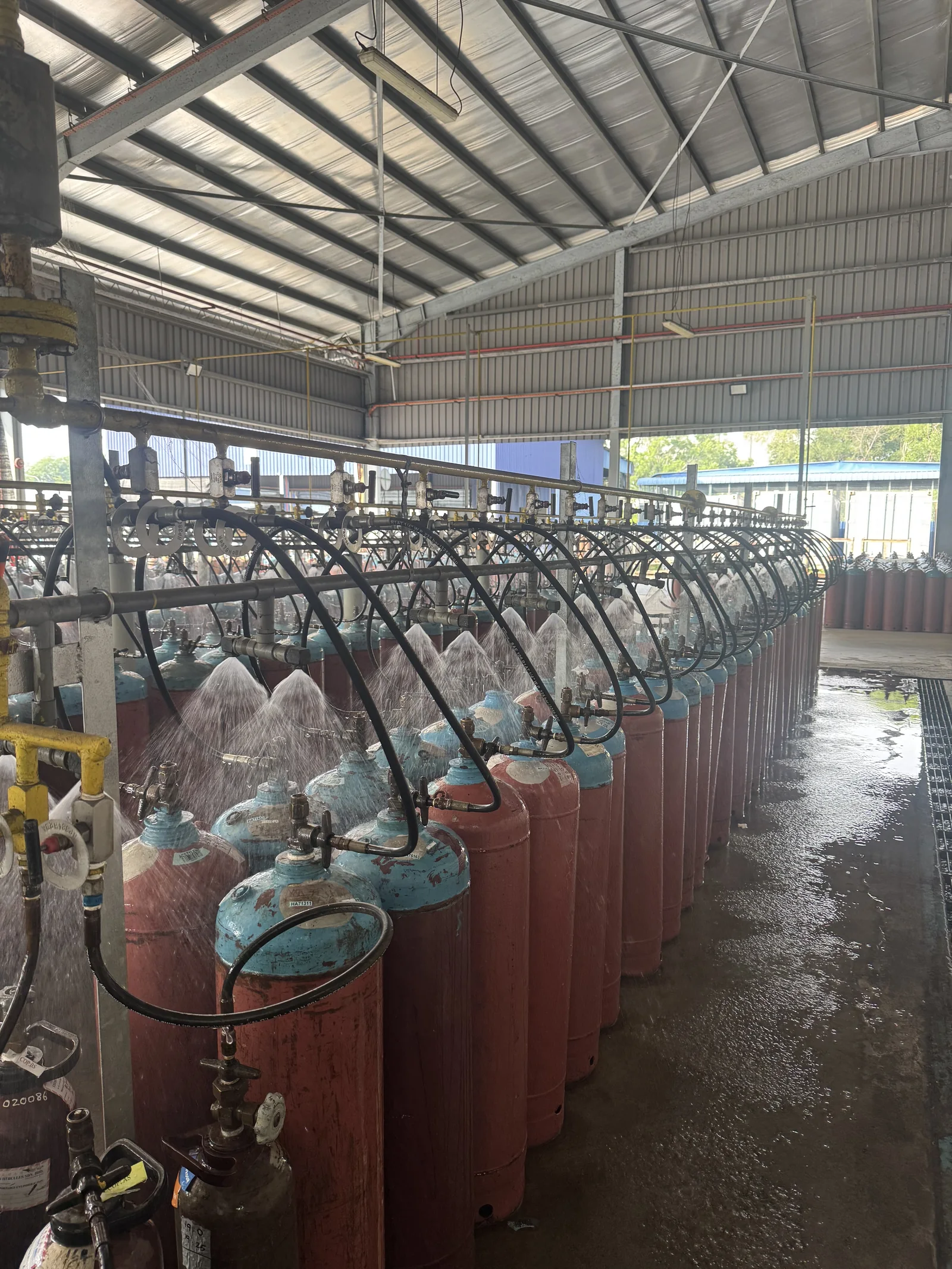
- Why it cannot be stored as free compressed gas
- Decomposes explosively without any oxidant present
- Solvent
- Acetone
- Cylinder charge
- Solid porous mass
- Maximum cylinder working pressure
- 15.495 atm at 15 °C with acetone
- Retest interval
- 2 years
The problem acetylene sets
Almost every industrial gas is stored the same way: squeeze it into a steel shell and let pressure do the work. Acetylene will not accept that treatment.
Acetylene is an endothermic compound. The molecule holds energy rather than needing to find it, and under pressure it can break down into carbon and hydrogen on its own, releasing heat, with no oxygen involved at all. Once that begins inside a vessel it can propagate, and the result is an explosion in a cylinder that never met an oxidant.
That is why free acetylene outside the cylinder is limited to 0.62 bar g, and why a cylinder simply pumped full of free acetylene is not a design that can be made safe.
To be exact about it, because it is often put loosely: acetylene is compressed. A multi-stage compressor raises it from generation pressure to charging pressure, and that compressor is part of every acetylene filling station KIGL builds and runs. What acetylene cannot do is sit in an open cylinder volume as free gas at that pressure. The compression has somewhere to go — into solution.
The solution: dissolve it
Acetylene is very soluble in acetone: about 24 volumes of acetylene per volume of acetone at 20 °C and one atmosphere, measured at NTP. In solution the acetylene is no longer free gas under pressure. It behaves like the carbon dioxide in a soft drink: held in solution, released as the pressure falls.
Solubility then climbs steeply with pressure, and that is the whole reason a cylinder is charged far above the pressure it will ever be drawn at. IS 14814 : 2023 puts the loaded figure directly: one volume of acetone dissolves 300 volumes of acetylene at 1 207 kPa, about 12 bar. The two figures agree with each other, which is a good check: 24 volumes at one atmosphere, twelve atmospheres of pressure, and you arrive at very nearly 300.
Why acetone, and not something cheaper
Water is free and acetylene does dissolve in it. IS 14814 gives the figure: 1.2 g per litre at 20 °C, around one volume of gas per volume of water. Acetone takes twenty-four times that at the same pressure, and three hundred times at charging pressure. That gap is the entire reason the cylinder industry runs on acetone rather than on water.
And why it cannot simply be liquefied instead
The obvious alternative to dissolving a gas is to liquefy it. Acetylene closes that door too. Its critical temperature is 35.15 °C, a summer afternoon in Guwahati. Above that temperature no pressure whatsoever will liquefy it, and below it the critical pressure is 6 059 kPa, around 60 bar, at which free acetylene is far beyond anything that could be called safe.
So there is no liquefied-acetylene option to fall back on. Dissolution in a solvent, held in a porous mass, is not one storage method among several. It is the only one.
So the charging pressure is what drives the gas into solution, and it is not what you work against at the torch. The line may still never exceed 0.62 bar g.
The porous mass
Acetone alone is not enough. A cylinder part-full of liquid solvent would slosh, would collect at the valve when laid down, and would leave open volumes where a decomposition could still run.
So the cylinder is filled with a solid porous mass, formed in place, doing two jobs at once:
- it holds the acetone distributed through the cylinder rather than pooled at the bottom
- it divides the interior into cells small enough that a decomposition starting in one place cannot build into a propagating reaction
IS 8433 recognises two kinds. A monolithic mass is a solid product, bonded or reacted in place; it is part of the cylinder and cannot be poured in, taken out or repaired. A non-monolithic mass is granular or fibrous material without a binder, and it may be topped up at periodic inspection, but to the mass manufacturer's instructions, no more than 50 g at any one inspection, and only while the resulting porosity stays above its permissible limit. Either way, a mass that is damaged, settled or contaminated beyond that takes the cylinder out of service.
And here is the part that surprises people: an acetylene cylinder cannot be hydraulically or pneumatically pressure-tested, and the inside of its shell cannot be visually inspected at all. The porous mass is in the way of both. IS 8433 states this outright. So an acetylene cylinder is not given a more thorough version of the ordinary cylinder retest. It is given a fundamentally different one, which is why it has a standard of its own.
What follows from this
Nearly every acetylene rule traces back to the acetone and the mass:
| Rule | Because |
|---|---|
| Keep the cylinder upright | Lying down lets liquid acetone reach the valve |
| Draw no more than one-seventh per hour | Faster draw-off pulls acetone out with the gas |
| Weigh to check contents | Pressure holds up while gas is still coming out of solution, and swings with temperature, so it does not tell you how much is left |
| Stand a horizontal cylinder for half an hour | The acetone needs to drain back into the mass — IS 14814 : 2023 cl 7.3.1 |
| Retest every 2 years, not 5 | The mass and solvent must be assessed, not just the steel |
| The cylinder is heavy | Steel, mass and solvent all travel with the gas |
The handling rules themselves are set out on handling acetylene cylinders.
Where DMF comes in
Acetone is the standard solvent, and it is what an industrial dissolved-acetylene cylinder to IS 308 contains.
For ultra-high-purity acetylene, KIGL uses dimethylformamide (DMF) instead. Acetone carries over into the gas stream in small quantities — irrelevant to a cutting torch, ruinous to an instrument. DMF has a much lower vapour pressure, so far less solvent reaches the analyser. That is the entire reason a separate UHP acetylene product exists.
Why this matters when you buy
A supplier who understands the mass is a supplier who fills correctly. Over-fast filling, incorrect acetone top-up and neglected mass inspection all produce cylinders that look normal, weigh roughly right, and then underperform or fail in service.
KIGL builds the plants that generate acetylene as well as filling the gas, so the person answering a question about your cylinder has run the generator behind it.
Why acetylene is dissolved — frequently asked questions
Is acetylene compressed into the cylinder?
Yes — acetylene is compressed, and KIGL runs the compressors that do it. What it cannot be is stored as free compressed gas in an open cylinder volume the way oxygen or nitrogen are. Acetylene is endothermic: the molecule stores energy and can decompose to carbon and hydrogen without needing anything to react with, and inside a vessel that decomposition can propagate as an explosion with no oxygen present at all. So the gas is compressed into solution in acetone held in a porous mass, and it is the solution and the mass that make the cylinder safe — not the steel.
What does the porous mass actually do?
Two things. It holds the acetone distributed through the cylinder so the solvent cannot pool or slosh, and it divides the interior into cells small enough that a decomposition starting in one place cannot build into a propagating reaction. It is a monolithic solid formed inside the cylinder, not a packing that can be poured in or taken out.
How much acetylene does acetone hold?
About 24 volumes of acetylene, measured at NTP, per volume of acetone at 20 °C and one atmosphere. Solubility climbs steeply with pressure: IS 14814 : 2023 gives 300 volumes per volume at 1 207 kPa, roughly 12 bar. That is why a cylinder is charged well above the pressure it will ever be drawn at. It is the same principle as carbon dioxide in a soft drink, at a far higher loading.
Why is an acetylene cylinder so heavy for the gas it holds?
Because most of what you are lifting is not acetylene. The steel shell, the solid porous mass and several kilograms of acetone all travel with it. It is also why contents are checked by weighing against the stamped tare rather than by reading a pressure gauge.
What happens if the acetone is drawn out?
The cylinder loses the medium that holds the gas. Acetone carried into the line contaminates the flame and damages downstream equipment, and the mass is left progressively drier, which reduces both how much gas the cylinder holds and how safely it holds it. This is why the cylinder stays upright and why draw-off is limited to one-seventh of contents per hour.
Can a porous mass be repaired or replaced?
It depends which kind it is, and this is widely got wrong. IS 8433 recognises two: a MONOLITHIC mass, a solid product bonded or reacted in place, and a NON-MONOLITHIC mass of granular or fibrous material without a binder. A monolithic mass is part of the cylinder and cannot be repaired — if it is damaged or settled the cylinder is withdrawn. A non-monolithic mass may be topped up at periodic inspection, to the mass manufacturer's instructions, but no more than 50 g at any one inspection, and cumulatively only so far as the porosity stays above its permissible limit.
Enquiries
Request a quotation
State the gas or equipment, the quantity or capacity, and your location. KIGL will confirm the grade, the cylinder or plant size, and whether the location can be served from Noonmati, or through our agent network.