
Guide
Inspecting a dissolved acetylene cylinder at filling under IS 16271:2014: before during and after the charge
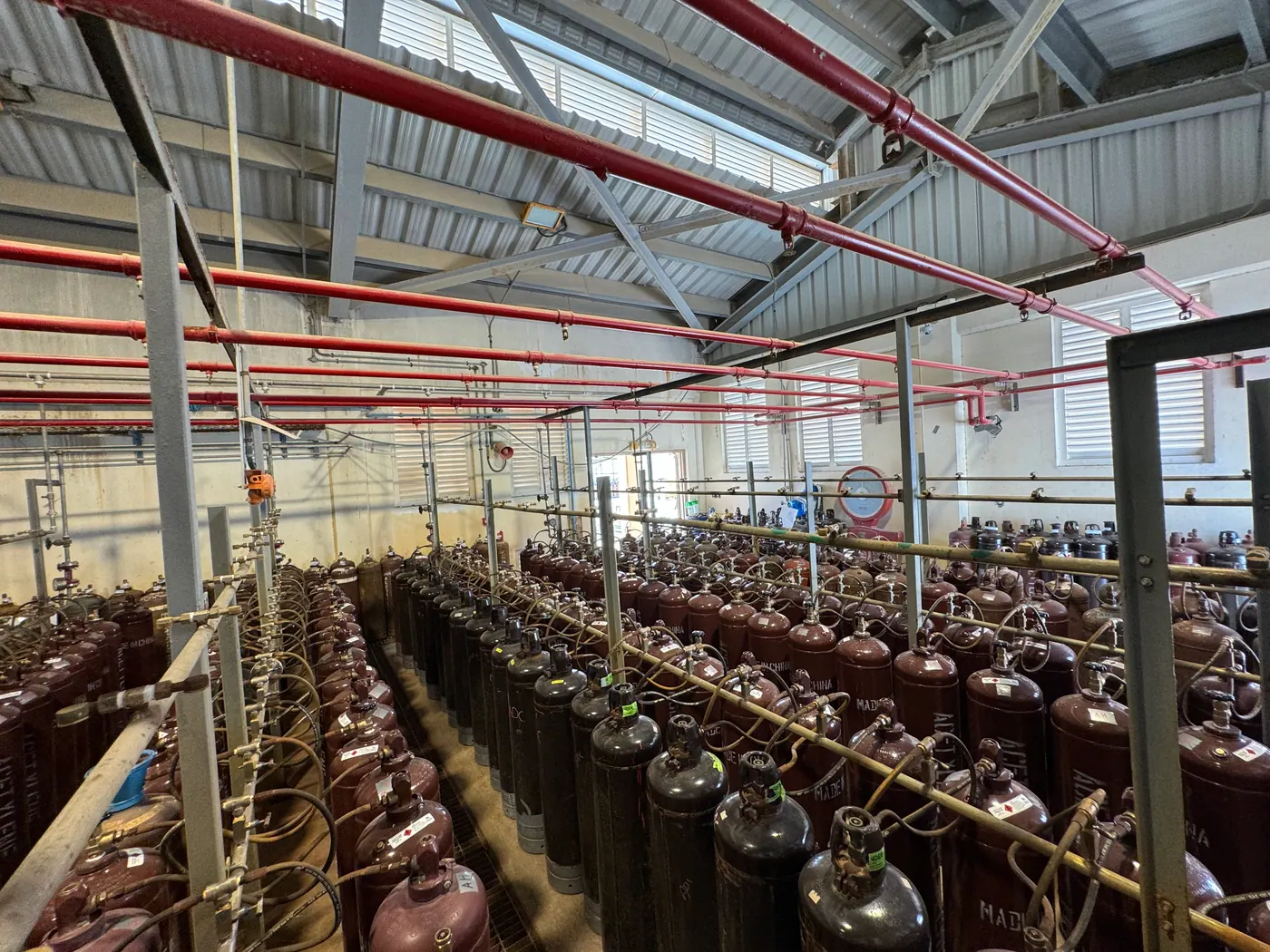
IS 16271:2014 requires every dissolved acetylene cylinder to be inspected before, during and after each filling. The filler confirms identity, inspection date and condition, empties it below 7 bar to measure solvent against the stamped tare, replenishes any acetone loss, leak-tests valve and fusible plugs, and verifies by weighing that maximum acetylene is not exceeded.
- Scope
- Every single cylinder
- Residual pressure for the solvent check
- Below 7 bar for cylinders of 17 bar working pressure or higher; below 4 bar otherwise; emptied at about 1/8 of maximum content per hour
- Thermal equilibrium
- Special care if the cylinder has seen a significant temperature change in the preceding 3 hours
- Visual examination at every charge
- Thorough visual examination to IS 8433 whenever a cylinder is charged; valve out and neck checked if none in the previous 2 years
- Post-fill diagnosis
- Pressure too high at correct weight = solvent deficiency
Every time a dissolved acetylene cylinder comes back to the filling station it has to be proved fit before it is charged again. IS 16271:2014, drawn from ISO 11372:2011, sets out the minimum inspection for single cylinders in three stages, before, during and after filling, and its central task is the one that cannot be done by eye: confirming that the right amount of solvent is in the cylinder so that the right amount of acetylene can go in. Rule 39 of the Gas Cylinders Rules 2016 adds a thorough visual examination to IS 8433 at every charge.
Why filling inspection matters more for acetylene
For an oxygen cylinder, filling inspection is about the shell and the valve. For a DA cylinder it is also about the contents system. The porous mass and the acetone are what stop a decomposition propagating, as set out on inside a dissolved acetylene cylinder, and the acetone is consumed a little at every use. The Explanation to Rule 37 of the Gas Cylinders Rules 2016 puts the stakes in one sentence: excess solvent can make a cylinder hydraulically full and a shortage makes it less resistant to decomposition from flashback, so solvent replenishment before refilling is essential.
Two published investigations show what happens when it is not done. The SAHTECH investigation of a September 2005 fire at a filling plant in Taiwan, presented at the AIGA acetylene safety seminar in 2009, found excessive settling of the porous mass and acetone not topped up, with poor residual-gas measurement hiding the shortage; about 90 cylinders were fire-affected and 8 exploded. The HSE investigation of the January 2010 explosion in Great Britain (Hooker, Hodges, Geary and Wakefield, IChemE Hazards 26, 2016) concluded that too little acetone and/or too much acetylene, with an undetected void in the mass, were the most likely causes, and identified manual acetone dosing, thermometers mounted away from the cylinders, gauge charts in 5 °C steps and chalk marking on racks of about 110 cylinders as weaknesses. Both point at the filling stage.
Rules that matter
IS 16271 cl 3.2.1 requires verification of stamping and documentation: that the cylinder is permitted to be filled at the station; that it has not passed its due date for periodic inspection; that the porous material is fit for further service with no current history of problems; and that stamp marking, label and colour coding comply. The following must be available for each cylinder: the porous material identity, the solvent type, the specified solvent content, the tare, and the total weight and/or maximum acetylene charge. Rule 38 of the Gas Cylinders Rules 2016 forbids charging any cylinder whose full particulars and history the filler does not hold.
The physical checks follow:
Before filling
- Condition (cl 3.2.2) Clean, free of foreign material, arc burns, severe corrosion, heat or fire damage and other significant mechanical damage. Fusible plugs inspected. Unserviceable cylinders identified, segregated and not filled.
- Attachments (cl 3.2.3) Neck ring or threaded boss fit for use and not loose; permanent valve guard in good condition and attached; footring checked. Exchanging a permanent guard may change the tare.
- Valve (cl 3.2.4) Suitable for acetylene, outlet undamaged, easy to operate, free of contaminants, fusible plug undamaged, and the filling connector attaches securely. The valve page gives the IS 3224 requirements.
A suspected blocked valve is tested by introducing inert gas at up to 5 bar and checking that it discharges (Annex A); IS 16271 Fig. 1 shows a simple obstructed-valve detector made of 8 mm bore rubber tube on a 3 mm bore steel tube.
Determining the solvent
This is the step that IS 16271 added beyond a visual check. Clause 3.3.1 requires:
| Condition | Requirement |
|---|---|
| Temperature | Special care if the cylinder has had a significant temperature change in the preceding 3 hours; it must be at room temperature |
| Residual pressure, working pressure ≥ 17 bar | Below 7 bar |
| Residual pressure, working pressure < 17 bar | Below 4 bar |
| Emptying rate | Slow; typically 1/8 of the maximum acetylene content per hour |
| Weight after deducting residual gas below tare | Replenish the solvent loss |
| Weight above tare | Examine and find the reason before further handling |
| Solvent type | Never changed for a given cylinder |
| Replenishment pressure (cl 3.3.2) | Only a few bar above the emptying pressure, so the porous mass is not damaged |
Annex B gives the method. The actual acetylene-to-solvent ratio F is obtained from the cylinder's residual pressure in bar and its temperature in °C through a vapour-pressure-type equation for acetone, and the solvent content then follows from the measured weight, the stamped tare, the specified solvent content and the saturation acetylene. The tare definition matters here: IS 16271 cl 2.14 makes the tare include the solvent and the acetylene that saturates it at atmospheric pressure and 15 °C, so a cylinder below tare after deducting residual gas has lost acetone. The user-side version of this arithmetic is on checking contents by weight.
The slow emptying rate and the 3-hour wait exist because desorption cools the cylinder. AIGA 022/26 records that rapid blow-down gives a false empty reading and that acetone carry-over is greatest during rapid blow-down. AIGA 037/16 sets scale tolerances for this measurement at ±20 g up to 6 litres water capacity, ±50 g to 20 litres and ±100 g above, with scales checked daily and calibrated annually.
During filling
Clause 3.4.1 requires the filler to verify that the valve is not blocked, for example by checking surface temperature, since a charging cylinder warms from the heat of solution, and that the valve and fusible plugs do not leak externally. On any suspicion the leak check extends to the valve gland nut, and filling stops and recommences only after rectification. Clause 3.4.2 requires cylinders filled simultaneously to have the same solvent type unless backflow is prevented by a technical device, with special care where porous materials differ or residual gas is high.
The charging rack itself carries one flashback arrestor per rack between compressor and rack and a non-return device at each charging station, as recorded in the C.P.I.'s Safety in the Production and Use of Acetylene (Paris 1968); the non-return valve page covers why both are needed.
After filling
Clause 3.5.1 requires leak tests with a leak-detection fluid at three places: the valve outlet seat, the valve-to-cylinder interface, and each fusible plug including its interface with the cylinder or valve. Clause 3.5.2 requires verification by weighing that the maximum acetylene content is not exceeded. Its Note gives the diagnostic that makes pressure useful once weight is known: at ambient temperature and correct total weight, a pressure that is too high indicates a solvent deficiency, solvent contaminated with water, or a high concentration of insoluble gases; a pressure that is too low indicates excess solvent. Clause 3.5.3 checks the valve protection. The pressure-and-contents page explains why pressure is otherwise misleading.
Rule 41 of the Gas Cylinders Rules 2016 requires a record of each charge: date, empty weight without gas, weight of solvent charged before gas charging, full weight, dates solvent was added and the results of Rule 39 examinations. Rule 42 puts the date of last filling, the weight of gas filled and the full cylinder weight on the label.
The case for a holding period
A freshly charged cylinder is not uniform inside. Strizhevskii (Zhur. Prikl. Khim., 1963, 36, 2320) reported that a DA cylinder behaves like a gas–liquid chromatography column: air, being poorly soluble in acetone, concentrated at the bottom, where it was 14.5 % by volume on the acetylene against 0.7 % at the top, with rack gas of 0.5–1 % air; equilibrium by diffusion took 10 to 14 days, and phosphine in unpurified gas distributed itself the same way. IS 16271 sets no holding period, and nor does any other standard KIGL has reviewed. A settling period before despatch is nonetheless a reasonable practice for consistent delivered gas, and the cylinder must in any case settle thermally before its pressure means anything.
Rules that matter
Rules to apply at the filling shed
- No history, no fill: hold the cylinder's particulars and check its inspection date first.
- Measure solvent on a cold, slowly emptied cylinder with a calibrated scale; make up any loss with the same solvent.
- Use temperature measured at the cylinder, not at the wall, and gauge charts fine enough to resolve it.
- Leak-test valve seat, valve joint and every plug after filling; a leaking cylinder is not issued.
- Weigh every cylinder after filling and record it under Rule 41.
The same checks apply to every refill of dissolved acetylene cylinders in India; the statutory side is summarised on Gas Cylinders Rules 2016 for fillers and users.
Inspecting — frequently asked questions
What checks are done before an acetylene cylinder is filled?
Under IS 16271:2014 cl 3.2 the filler confirms the cylinder may be filled at that station, that its periodic inspection is not overdue, that the porous mass has no history of problems, and that stamping, label and colour comply. It checks the shell for arc burns, corrosion and fire damage, the neck ring, guard and footring, the fusible plugs, and that the valve is suitable, operable and uncontaminated.
Why is the cylinder emptied before it is filled?
To measure the solvent. IS 16271 cl 3.3.1 requires the residual gas to be brought below 7 bar for cylinders with a working pressure of 17 bar or more, slowly at about 1/8 of the maximum content per hour, so that pressure, temperature and weight give a reliable solvent figure. Annex B then gives the acetylene-to-solvent ratio from pressure and temperature.
What if the cylinder weighs less than its tare?
After deducting the residual gas, a weight below the stamped tare means acetone has been lost, and IS 16271 cl 3.3.1 requires it to be replenished with the same solvent type before filling. A weight above the tare means the cylinder is examined and the reason found before any further handling. The solvent type of a given cylinder is never changed.
What leak tests are done after filling?
IS 16271 cl 3.5.1 requires leak testing with a suitable leak-detection fluid at the valve outlet seat for internal tightness, at the valve-to-cylinder joint, and at each fusible plug including its interface with the cylinder or valve. During filling the valve gland nut is watched as well; on any suspicion, filling stops until the leak is rectified.
How does the filler know the cylinder is not overfilled?
By weighing. Cl 3.5.2 requires verification after filling that the maximum acetylene content or maximum charge is not exceeded. Pressure need not be checked for every cylinder once weight and solvent content are verified, but an abnormal pressure at ambient temperature is the signal of a solvent problem or of insoluble gas.
Why should a freshly filled cylinder be held before despatch?
Strizhevskii reported in 1963 that a freshly charged cylinder behaves like a chromatography column: air in the gas was 14.5 % by volume on the acetylene at the bottom and 0.7 % at the top, equilibrating by diffusion over 10–14 days, and phosphine distributed itself the same way. A holding or settling period before despatch lets the contents homogenise. IS 16271 does not set a period.
Can cylinders with different solvents be filled on the same rack?
Only if backflow between them is prevented by a technical device. IS 16271 cl 3.4.2 requires cylinders filled simultaneously to have the same solvent type, and AIGA 022/26 forbids blowing down acetone and DMF cylinders together on one rack. Mixing solvents in a cylinder breaks its type-approved charge.
References
- Asia Industrial Gases Association. (2016). Permissible Charge / Filling Conditions for Acetylene Cylinders (AIGA 037/16).
- Asia Industrial Gases Association. (2026). Code of Practice: Acetylene (AIGA 022/26).
- Bureau of Indian Standards. (2014). Dissolved Acetylene Gas Cylinders — Inspection at Time of Filling — Code of Practice (IS 16271:2014).
- Government of India. (2016). Gas Cylinders Rules, 2016 (G.S.R. 1081(E)). Petroleum and Explosives Safety Organisation.
- Hooker, Hodges, Geary and Wakefield (HSE), Investigation of an Acetylene Cylinder Explosion Incident, IChemE Hazards 26, 2016 https://www.icheme.org/media/11834/hazards-26-paper-06-investigation-of-an-acetylene-cylinder-explosion-incident.pdf
Enquiries
Request a quotation
State the gas or equipment, the quantity or capacity, and your location. KIGL will confirm the grade, the cylinder or plant size, and whether the location can be served from Noonmati, or through the agent network.