
Guide
The one-seventh rule: how fast you can draw acetylene from a cylinder and why
The withdrawal limit for a dissolved acetylene cylinder is a rate: the benchmark is one-fifth (20 %) of the available gas per hour, and KIGL specifies one-seventh (about 14 %). Faster draw chills the cylinder, since desorption absorbs about 700 kJ per kg, collapses pressure and carries acetone out.
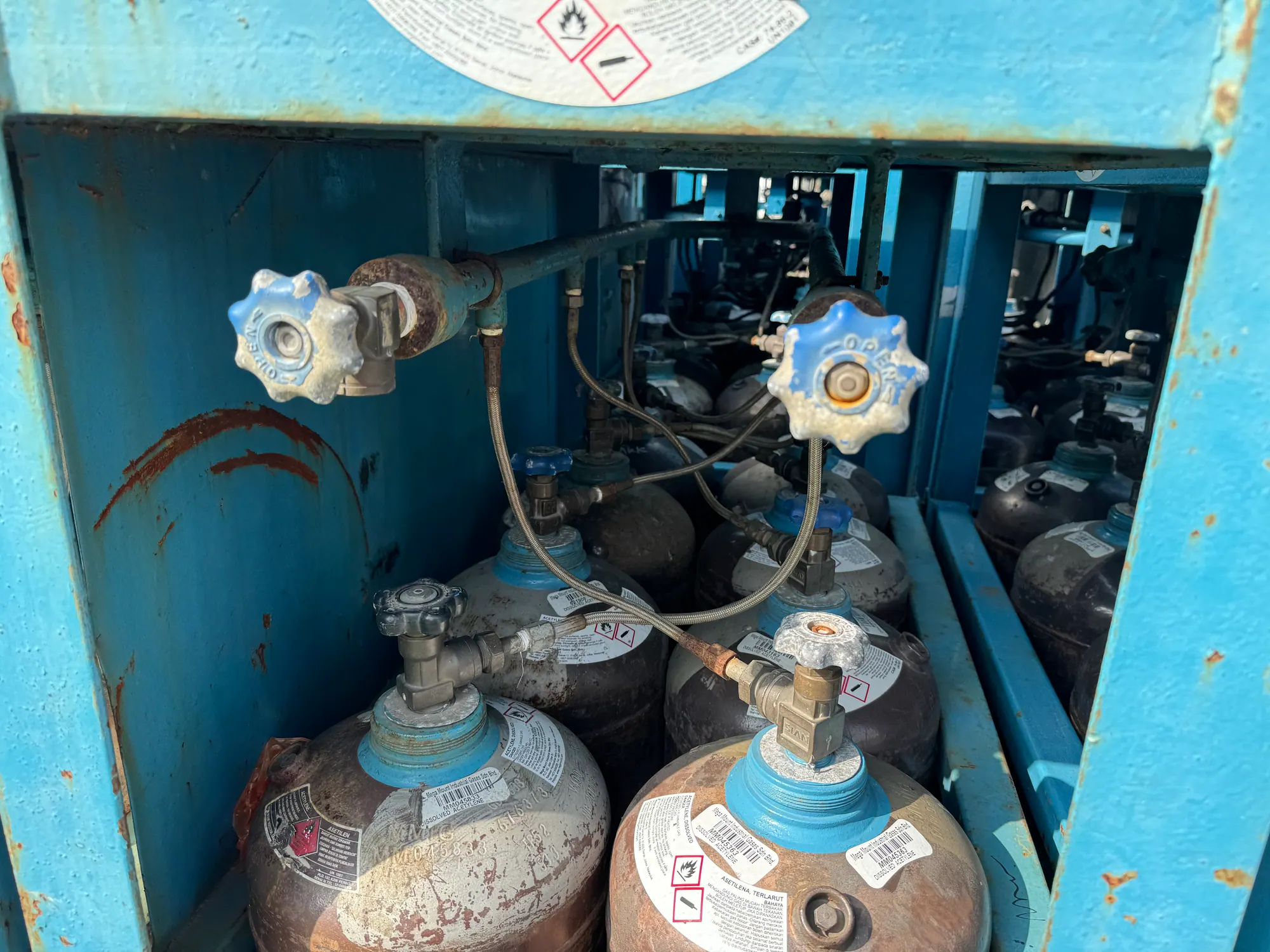
- Benchmark withdrawal rate
- One-fifth
- KIGL rule
- One-seventh of cylinder contents per hour
- Heat of solution
- 4.25
- Sustained-rate capacity
- Even at 20 %/h in a 15 °C water bath
- Dilation of the solvent
- Each gram of acetylene dissolved adds about 1.6 ml; at 15 °C and 15 atm the acetone swells by 84 %
Acetylene suppliers give a withdrawal limit for their cylinders, and almost none of them say why. The limit is a rate: the long-standing benchmark is one-fifth of the available gas per hour, and KIGL specifies one-seventh. Behind it sit two separate pieces of physics, both quantified in the solubility literature, and both of them turn the rule from an inconvenience into a safety measure.
Where the number comes from
As compiled by S. A. Miller (1965), the standard way to assess how well a cylinder gives up its gas was to hold it in a water bath at 15 °C and see how long it could maintain a discharge rate of one-fifth of its available acetylene per hour. The extent varied from 60 % to 90 % of the total available gas according to the quality of the porous mass. The same figure appears as a legal limit in the Dutch Factory Inspector's instruction leaflet on dissolved acetylene (1950), which forbade withdrawal at more than 20 % of the rated capacity per hour. The benchmark and the regulation are the same number, and that is the origin of the rule the whole industry repeats.
| Source | Rate | As % of contents per hour |
|---|---|---|
| Miller's dischargeability benchmark (1965) | One-fifth per hour, water bath at 15 °C | 20 % |
| Dutch Factory Inspector leaflet (1950) | 20 % of rated capacity per hour | 20 % |
| CGA G-1 cl 6.2 | One-seventh of cylinder capacity per hour, welding and cutting | 14.3 % |
| KIGL specification | One-seventh per hour | 14.3 % |
| IS 16271:2014 cl 3.3.1 / AIGA 037/16 | 1/8 of maximum content per hour, for blow-down before solvent check | 12.5 % (filler's operation, not a user rate) |
The C.P.I., Safety in the Production and Use of Acetylene (Paris 1968), stated the problem without a figure: in cold weather the gas output slows because the solubility of acetylene in the solvent rises as temperature falls, and heating the container with a flame is forbidden. No Indian Standard sets a customer withdrawal rate. CGA G-1 cl 6.2 does: one-seventh of cylinder capacity per hour for welding and cutting, one-tenth for solvent-sensitive intermittent use and one-fifteenth for continuous use.
Rules that matter
Dissolving acetylene in acetone releases heat; taking it out again absorbs the same amount. Miller's compiled heat of solution is 4.25–4.70 kcal/mol, which is 684–757 kJ per kg of acetylene. The C.P.I. (1968) gave about 160 calories per gram under normal filling conditions, which is 670 kJ/kg, within 5 % of the same figure. Taking 700 kJ/kg as a round value:
Reason one: desorption is endothermic and the cylinder refrigerates itself
- Drawing 1 m³ per hour (1.17 kg at 0 °C and 1 atm) removes about 820 kJ per hour from the cylinder contents.
- The thermal mass of a charged 41-litre cylinder is roughly 42 kJ per kelvin: about 13 kg of acetone at 2.16 kJ/kg·K, around 30 kg of steel at 0.46 kJ/kg·K, and the porous mass.
- If no heat leaked in, the contents would cool at close to 20 °C per hour at that draw.
Ambient heat does leak in, so the real temperature drop is smaller, but it is of the right order to matter. At two or three times the rated rate the shell frosts, the equilibrium pressure falls, delivery pressure collapses and the regulator starts to starve. The operator reads "empty" on a cylinder that still holds most of its charge. Miller framed this as porous-mass requirement (vi): rapid discharge demands permeability and the capacity to absorb the heat of solution from the surroundings. The mass must conduct heat inward as fast as desorption consumes it. The same effect makes delivery in cold weather a problem long before the cylinder is empty.
Reason two: a fast draw froths the acetone out
The second mechanism is why the rule is about rate rather than pressure. Hölemann and Hasselmann's solubility isotherms for acetylene in acetone (Forschungsberichte des Landes Nordrhein-Westfalen, 1952–1959), as compiled by Miller, give the dissolved load at 20 °C as 689 g per kg of acetone at 20 atm total, 472 g at 15 atm and 295 g at 10 atm. A fast draw takes the cylinder down that curve faster than the gas can diffuse out of the bulk liquid. The liquid supersaturates and releases gas as bubbles throughout its volume rather than at the surface.
That liquid is already swollen. Each gram of acetylene dissolved adds about 1.6 ml to the solution volume, so at 15 °C and 15 atm the loaded acetone occupies 1.84 times its original volume. The foam reaches the valve and acetone leaves the cylinder as liquid droplets, not vapour. Miller's porous-mass requirement (vii), that the mass should discharge its acetylene without entraining solvent in liquid form, is a statement that acetone retention is a property of the mass, and that it is a property that fails first under a fast draw.
Both mechanisms, chilling and frothing, act together: a cold, frothing cylinder delivers low pressure and loses solvent in the same event.
Why this is a safety limit and not only a performance limit
Most sources present the withdrawal rule as a matter of delivery pressure. Miller's data make it a safety rule as well, and this is the point worth stating plainly. Every gram of acetone that leaves the cylinder as liquid shifts the acetylene-to-solvent ratio in the direction that makes the cylinder more sensitive to a backfire. The Gas Cylinders Rules 2016 put it in the Explanation to Rule 37: a shortage of solvent makes the cylinder less resistant to decomposition from flashback. Over many cycles a cylinder that is habitually over-drawn arrives at the filling station with a persistent solvent deficiency, and the two published cylinder-fire investigations cited on this site, in Great Britain in 2010 and Taiwan in 2005, both found too little acetone together with a defective porous mass, although neither attributed the shortfall to over-drawing by users. Solvent make-up at filling, covered under inspection at filling, exists to reverse exactly this drift.
Worked example
Take an illustrative cylinder with a nominal content of 7 m³ (about 8 kg) of acetylene:
| Rule | Permitted draw from a full cylinder |
|---|---|
| One-fifth per hour (benchmark) | 1.4 m³/h |
| One-seventh per hour (KIGL) | 1.0 m³/h |
| Same cylinder half full, one-seventh rule | 0.5 m³/h |
Because the rule is a fraction of the contents, the permitted rate falls as the cylinder empties. A large cutting torch or a multi-burner heating job that needs 2–3 m³/h therefore needs three or more cylinders on a manifold, each drawing within its own limit, with a non-return valve per cylinder and a flashback arrestor after the regulator. The manifold guide covers the arrangement.
Why KIGL chose one-seventh
KIGL's figure is 28.6 % below the benchmark. Three considerations support the margin. Miller's own observation is that at 20 % per hour even a good mass sustains the rate for only 60–90 % of the charge; a lower rate stays sustainable for more of it. Indian ambient temperatures swing widely, and in the cold season there is less heat available in the surroundings to replace what desorption removes. And a lower draw keeps the frothing mechanism further away, which protects both the solvent inventory and the weld or cut, since liquid acetone at the torch disturbs the flame. The companion page on acetone carry-over shows that the vapour component of solvent loss is governed by pressure and temperature, whereas the liquid component is governed by rate; the withdrawal limit addresses the second.
What this is not
IS 16271:2014 cl 3.3.1 gives a typical emptying rate of one-eighth of the maximum acetylene content per hour, and AIGA 037/16 gives one-eighth to one-tenth. These are controlled blow-down rates used by the filler when emptying a cylinder before measuring its solvent content, so that the measurement is not distorted by cooling or by acetone carry-over. They are not customer withdrawal rates, although they are limited by the same physics. AIGA 022/26 notes that a large full cylinder takes 8 to 10 hours to blow down at that rate.
Rules that matter
Rules to apply
- Size the job to the cylinder: for welding and cutting, stay within one-seventh of the current contents per hour; for continuous service CGA G-1 gives one-fifteenth.
- Manifold cylinders rather than over-drawing one; fit a non-return valve to each and an arrestor downstream of the regulator.
- If a cylinder frosts or its pressure collapses under load, stop, let it warm naturally for about 3 hours and weigh it before deciding it is empty. Never apply a flame or a radiant heater.
- Treat liquid acetone at the regulator or torch as a sign of over-drawing or a cylinder lying down, and report it to the filler; the solvent must be made up before the next fill.
- Keep a cylinder at or above its minimum return pressure; the last few atmospheres are where acetone vapour loss is highest, as the carry-over table shows.
Ask the supplier of your dissolved acetylene for the withdrawal limit of the cylinder size you use; the full handling rules are on handling acetylene cylinders and the safety data sheet at /sds/acetylene.
— frequently asked questions
What is the maximum flow rate from a single acetylene cylinder?
The usual benchmark is one-fifth of the available gas per hour, and KIGL specifies one-seventh. For a cylinder holding 7 m³ that is roughly 1 000 litres per hour under the one-seventh rule. The limit is a rate, so it falls as the cylinder empties; a half-full cylinder should be drawn at about half the figure.
Why does an acetylene cylinder get cold and frosty when I draw gas fast?
Releasing acetylene from acetone is endothermic. Miller's compiled heat of solution is 684–757 kJ per kg of acetylene, so drawing 1 m³ (1.17 kg) per hour removes about 820 kJ per hour from the cylinder. Against a thermal mass of roughly 42 kJ/K for a 41-litre cylinder that is an adiabatic cooling rate near 20 °C per hour; ambient heat leaking in slows it, but at two or three times the rated draw the shell frosts.
Does a cold cylinder mean it is empty?
Often not. Solubility rises as temperature falls, so a chilled cylinder holds its gas more tightly and its pressure collapses while a large charge remains. Let it warm to room temperature (AIGA 037/16 allows 3 hours for thermal equilibration before a solvent check), and weigh it. Never warm it with a flame; the C.P.I. (1968) forbade flame heating outright.
Why does fast withdrawal carry acetone out of the cylinder?
A fast draw takes the solution down the solubility curve faster than gas can leave the bulk liquid, so it supersaturates and froths. The loaded acetone is already swollen by about 84 %, the foam reaches the valve and acetone leaves as liquid. Solvent carry-over at high draw rates is a frothing effect, which is why the rule is about rate, not pressure.
What should I do if I need more acetylene than one cylinder can give?
Manifold several cylinders so that each supplies its share within the limit, with a non-return valve on each cylinder and a flashback arrestor downstream of the regulator. Three cylinders on a manifold deliver three times the permitted rate of one. See the manifold guide for sizing and the arrestor requirements.
Is the one-seventh rule a legal requirement in India?
No. No Indian Standard sets a customer withdrawal rate. CGA G-1 cl 6.2 does: one-seventh of cylinder capacity per hour for welding and cutting, one-tenth for solvent-sensitive intermittent use and one-fifteenth for continuous use. The older codified figure Miller recorded was the Dutch 20 % per hour rule. IS 16271:2014 gives 1/8 per hour, but that is a controlled blow-down rate for emptying a cylinder before solvent measurement.
Why is KIGL's figure lower than the 20 % benchmark?
As compiled by S. A. Miller (1965), even at 20 % per hour a cylinder sustains the rate for only 60–90 % of its contents, after which pressure falls away. A one-seventh rate stays inside the sustainable range for more of the charge, keeps acetone losses lower and leaves a margin for Indian ambient temperatures, where the cylinder has less heat to draw on during the cold season.
References
- Asia Industrial Gases Association. (2016). Permissible Charge / Filling Conditions for Acetylene Cylinders (AIGA 037/16).
- Bureau of Indian Standards. (2014). Dissolved Acetylene Gas Cylinders — Inspection at Time of Filling (IS 16271:2014).
- Bureau of Indian Standards. (2023). Acetylene — Code of Safety (IS 14814:2023, First Revision).
- Linstrom, P. J., & Mallard, W. G. (Eds.). (n.d.). NIST Chemistry WebBook (NIST Standard Reference Database 69). National Institute of Standards and Technology. [acetylene thermophysical data] https://webbook.nist.gov/cgi/cbook.cgi?ID=C74862
Enquiries
Request a quotation
State the gas or equipment, the quantity or capacity, and your location. KIGL will confirm the grade, the cylinder or plant size, and whether the location can be served from Noonmati, or through the agent network.