
Equipment
Acetylene driers — the two drying stages, low pressure and high pressure
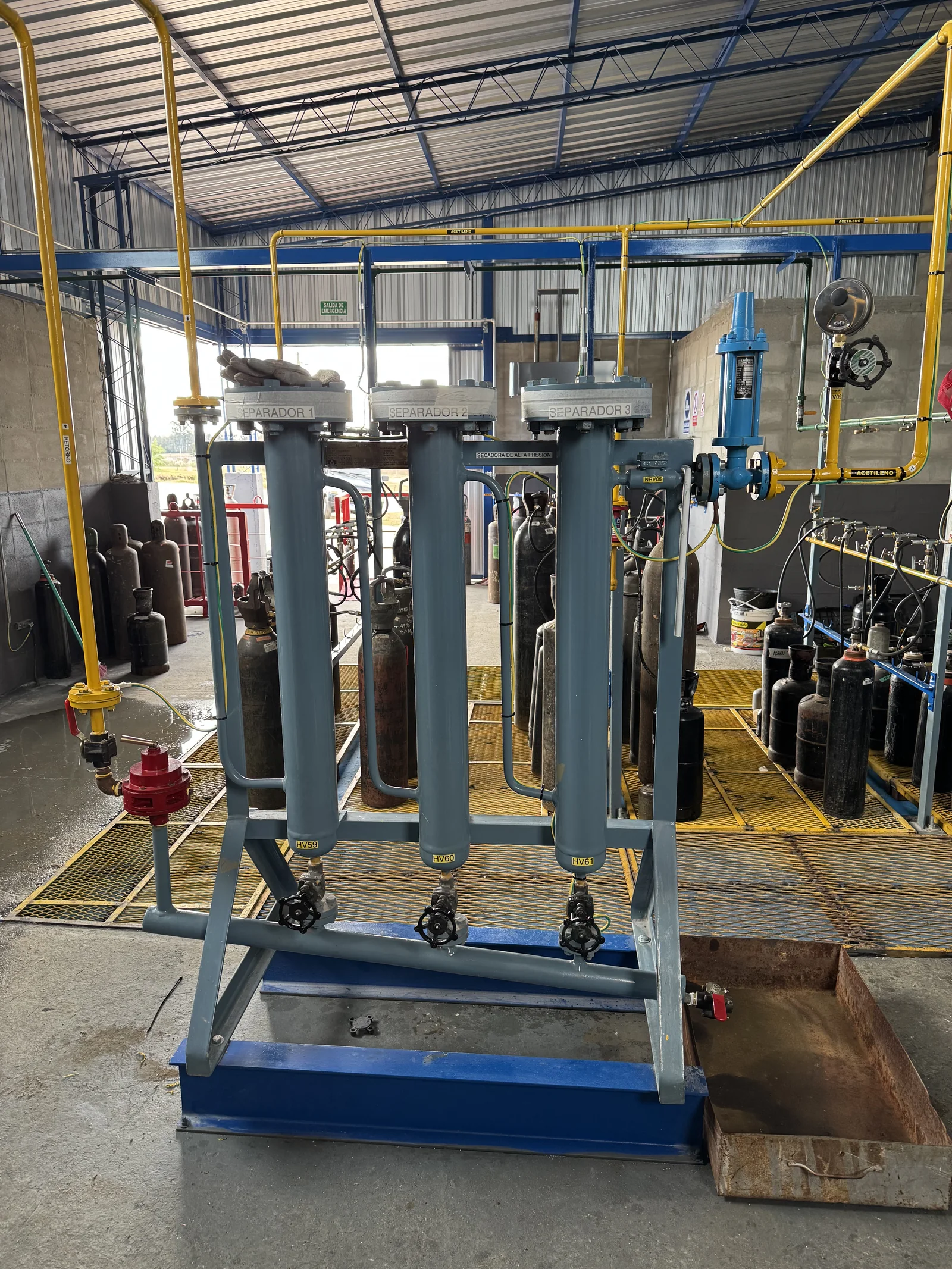
An acetylene plant dries its gas twice. The low-pressure drier takes bulk moisture out of generator gas before the purifier, and the high-pressure drier polishes it after compression, downstream of a back-pressure regulator holding 14 to 17 kg/cm²g. Both stages use calcium chloride, and both have drains that must be worked.
Written and checked by KIGL technical staff · Reviewed by Devendra Kumar Garg, Founder and Chairman
- Two
- Drying stages
- Calcium chloride
- Drying medium
- 14 to 17 kg/cm² gauge
- HP drier inlet pressure
- Wet acetylene is safer to compress than dry
- Why the gas is wet at the generator
- Never to a sewer
- Liquor disposal
On this page 9 sections
Two stages, not one #
An acetylene plant dries its gas twice, and the two driers are not interchangeable.
The low-pressure drier sits between the cooler-condenser and the chemical purifier. Its job is bulk moisture removal, and its real purpose is to protect the purifier: a flooded purifier was one of the commonest reasons plants were found running with the purifier bypassed altogether.
The high-pressure drier sits after the compressor. The gas arriving there has the same water in it, but the gas volume has shrunk by a factor of more than twenty, so the moisture is proportionally far more concentrated. Whatever this stage misses goes into the cylinder.
| Low-pressure drier | High-pressure drier | |
|---|---|---|
| Position | Before the purifier | After compression |
| Pressure | Generator side, under 1 kg/cm²g | 14 to 17 kg/cm²g |
| Job | Bulk moisture; protect the purifier | Final polish before filling |
| Medium | Calcium chloride | Calcium chloride |
| Attention needed | Drain and charge | Drain, charge, and liquor disposal |
Why the gas is wet in the first place #
It would be simpler to generate dry gas. Acetylene plants do the opposite deliberately, because wet acetylene is safer to compress than dry. Moisture raises the energy needed to start a decomposition in the gas, so the generator is run saturated on purpose and the plant accepts the condensate that follows.
That decision is why there are traps on the compressor suction and on the first and second stages, why they are drained hourly through the shift and all of them at shutdown, and why grey oil in the crankcase is read as a drainage failure rather than an oil fault.
The back-pressure regulator #
IS 15190 (Part 2):2002 cl 5.3.1 requires a back-pressure regulator after the high-pressure drier, holding 14 to 17 kg/cm² gauge. Without it the drier pressure follows whichever cylinder is being filled, and the drying duty changes through every fill.
This is also the figure to check against the compressor's own settings. The compressor's high-pressure switch is set at 24 kg/cm²g and its low at 3 kg/cm²g; the regulator band sits between them, and a plant where the two disagree has had one of them adjusted.
Acetylene driers, filled and despatched from KIGL's own works.
Guwahati works · agent network
Liquor, and the one rule about sewers #
Calcium chloride in these driers is a deliquescent. It takes up water, turns to liquor, and the liquor is drained off. That liquor still holds dissolved acetylene.
Open the outlet valve slowly, and take the solution and gas to a place or container where the gas cannot ignite or form explosive mixtures with air.
Never discharge high-pressure drier liquor into a sewer. The acetylene comes out of solution in the sewer and forms an explosive acetylene-air mixture in a confined space nobody is watching. The prohibition is old — it is in the C.P.I.'s 1968 code — and it has not been relaxed since.
What goes wrong #
| Symptom | Cause | Where to look |
|---|---|---|
| Grey oil in the compressor crankcase | Traps or drier drains not worked | Compressor troubleshooting |
| Purifier flooding | LP drier charge spent or drain blocked | Purifier regeneration and bed life |
| Water reaching cylinders | HP drier charge spent | Drying and condensate |
| Drier pressure wandering with each fill | Back-pressure regulator missing or misset | IS 15190 (Part 2) cl 5.3.1 |
| Oil level rising half an inch with no oil added | Water entering the crankcase | Compressor operation and oil |
Where the driers sit #
The driers are two of the nine stages between carbide and cylinder. The chemical cleaning — the purifier that takes out phosphine and hydrogen sulphide, and the scrubber that takes out ammonia — is covered on acetylene purification systems and cooler and scrubber. The whole train is on acetylene gas plants.
Supply, spares and commissioning #
KIGL builds both drier stages as part of a complete KIGL-DA plant, and also supplies either stage on its own for plants of other makes. A drier bought separately is sized from the drawings of the existing plant rather than from a catalogue, because it has to match the gas volume at its own working pressure. The low-pressure drier sees generator gas at around 0.92 kg/cm²g, and the high-pressure drier sees the same gas compressed, with a back-pressure regulator holding 14 to 17 kg/cm²g ahead of the manifold.
To quote for a drier alone, KIGL needs the plant's rated output in Nm³/h and which stage is being replaced. It also needs the process flow drawing or schematic, the inlet and outlet connection sizes, and the pressure the stage actually works at as the plant is piped today. The two details most often wrong on existing plant are the back-pressure regulator setting and the drain arrangement, so both are checked before a vessel is quoted.
A drier sits inside the licensed envelope of the plant, so swapping one is not the small job it looks like. The amended drawing is approved by PESO before the new vessel is commissioned, and KIGL will not commission a drier against a licence that still describes the old one. Allow for that in the programme, not after it. Which forms are filed, and in what order, is set out in the PESO licence guide.
Erection and commissioning are supervised rather than taken over: KIGL supervises and trains the operators on the plant itself, while the civil work, the utilities and the labour stay with the buyer.
Specification
Acetylene driers — full specification
| Property | Value | Basis |
|---|---|---|
| Drying stages | Two, low pressure before the purifier and high pressure after compression | KIGL-DA series operating manual |
| Drying medium | Calcium chloride, used as a deliquescent in both stages | KIGL-DA series operating manual |
| HP drier inlet pressure | 14 to 17 kg/cm² gauge, held by a back-pressure regulator | IS 15190 (Part 2):2002, cl 5.3.1 |
| Why the gas is wet at the generator | Wet acetylene is safer to compress than dry | KIGL-DA series operating manual |
| Liquor disposal | Never to a sewer, because acetylene comes out of solution there | C.P.I., Safety in the Production and Use of Acetylene, 1968 |
| Drain schedule | Suction, first- and second-stage traps hourly, all at shutdown | KIGL acetylene compressor operation manual |
| High-pressure drier inlet pressure | 14 to 17 kg/cm2 gauge, held by a back-pressure regulator | IS 15190 (Part 2):2002, cl 5.3.1 |
| Drain interval | Suction, first- and second-stage traps hourly, and all of them at shutdown | KIGL acetylene compressor operation manual |
| Built for plant sizes | KIGL-DA-25, DA-50 and DA-100, and other makes sized from drawings | KIGL plant range |
Questions
Acetylene driers — frequently asked questions
Why does an acetylene plant need two driers?
Because they do different jobs at different pressures. The low-pressure drier takes bulk moisture out of generator gas so the chemical purifier is not flooded. The high-pressure drier works after compression, where the same water content is a far higher proportion of a much smaller gas volume, and removes what would otherwise go into the cylinder with the acetylene.
Why is the gas deliberately wet leaving the generator?
Because wet acetylene is safer to compress than dry. Moisture raises the energy needed to start a decomposition in the gas, so the generator is run saturated on purpose. The consequence is condensate through every compression stage, which is why the traps are drained hourly. The [wet versus dry](/guides/wet-acetylene-is-safer-than-dry) guide sets out the reasoning.
What pressure does the high-pressure drier work at?
14 to 17 kg/cm² gauge. IS 15190 (Part 2):2002 cl 5.3.1 requires a back-pressure regulator after the high-pressure drier to hold that band, which is what keeps the drier at a steady working pressure rather than following the cylinder being filled.
What drying medium is used?
Calcium chloride, in both stages. It is used as a deliquescent rather than a regenerable desiccant: it takes up water and turns to liquor, and the liquor is drained and the charge replaced. That is a different maintenance habit from a regenerated bed, and it is why the drain matters more than the charge.
How is drier liquor disposed of?
The outlet valve is opened slowly, and the solution and gas are taken to a place or container where the gas cannot ignite or form an explosive mixture with air. It must never go into a sewer. Dissolved acetylene comes out of the liquor in the sewer and forms an explosive acetylene-air mixture there.
What happens if the drier drain is not worked?
Water carries forward. On the high-pressure side it reaches the cylinder; on the compressor it reaches the crankcase, and grey oil is the result. Grey oil means the whole charge is drained and replaced rather than topped up, and then the source is found. A running drier whose drain has never been opened was a recurring audit finding.
How long before the solvent in a cylinder picks up water?
Longer than people assume, if the driers are working. With rack gas at an average of about 11 atm gauge and 15 °C, the water vapour after compression is about 0.15 % of the free gas. If that were the only source, the solvent would take over fifty years to reach the point where the gas discharged carried out as much water as went in.
Can KIGL supply driers for a plant it did not build?
Yes, sized from drawings, as with generators, purifiers and compressors. The back-pressure regulator setting and the drain arrangement are the two details to get right, because both are commonly missing or wrongly set on existing plant.
References
Bureau of Indian Standards.
- IS 15190:2002Acetylene pipelines (2002)
- The Kamrup Industrial Gases Limited. (2026). Company information and manufacturer's data [Company statement].
Read next
Enquiries
Request a quotation for acetylene driers
State the gas or equipment, the quantity or capacity, and your location. KIGL will confirm the grade, the cylinder or plant size, and whether the location can be served from Noonmati, or through the agent network.