
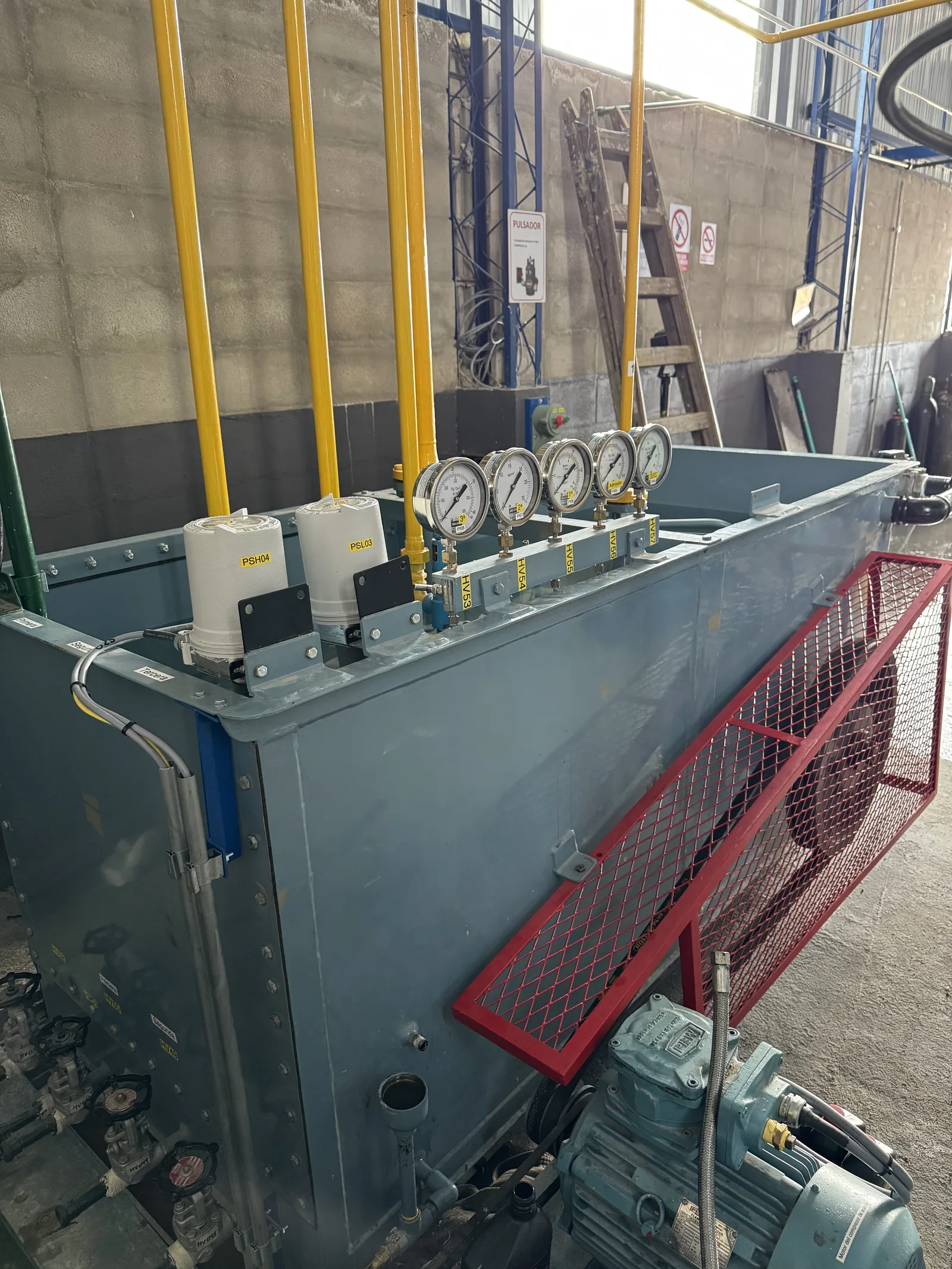
Equipment
KIGL-DA-COMP acetylene compressors — three-stage, 15 to 75 m³/hr
The KIGL-DA-COMP is a three-stage W-type acetylene compressor built in India in four sizes — 15, 30, 50 and 75 m³/hr — with bores of 5½, 3 and 1⅝ inches on a 4-inch stroke. Suction runs 0.4–0.9 kg/cm²g and discharge is 24 kg/cm² maximum. Vee-belt driven by a 5 to 15 HP motor.
Written and checked by KIGL technical staff
- KIGL-DA-COMP
- Model range
- W-type
- Configuration
- 5½ in
- Bores and stroke
- 0.4–0.9 kg/cm²g
- Suction pressure
- 24 kg/cm²g
- Maximum discharge
On this page 16 sections
What an acetylene compressor has to survive #
An acetylene compressor is built for a gas that decomposes rather than simply compresses. The KIGL-DA-COMP takes the gas up in three cooled stages, with its cylinders immersed in water, at a suction pressure of 0.4 to 0.9 kg/cm²g. Every other gas on a filling plant is simply compressed. Acetylene is not: raise its temperature and pressure together and it will decompose on its own — an exothermic reaction needing no oxygen and no spark, and once it has started inside a machine it does not stop because the drive was switched off.
That single fact decides the design. It is why the gas is taken up in three stages instead of one, each with its own cooling and its own condensate trap. It is why the cylinders sit immersed in a water tank rather than relying on air cooling. And it is why gas temperature at the compressor is a logged parameter, recorded by hand every hour of every shift.
An air compressor converted to acetylene service meets none of those conditions. It is the cheapest decision available on an acetylene plant and the one most likely to be the last.
The KIGL-DA-COMP range #
A W-type, vertical surface, three-stage machine, vee-belt driven, with bores of 5½, 3 and 1⅝ inches on a 4-inch stroke. The same frame across the range; capacity comes from speed.
| Model capacity | Compressor speed | Drive | Motor |
|---|---|---|---|
| 15 m³/hr | 140 rpm | 5 HP | 1440 rpm |
| 30 m³/hr | 280 rpm | 7.5 HP | 1440 rpm |
| 50 m³/hr | 445 rpm | 10 HP | 1440 rpm |
| 75 m³/hr | 650 rpm | 15 HP | 1440 rpm |
Suction 0.4–0.9 kg/cm²g. Maximum discharge 24 kg/cm². Cooling water 1.5 m³/hr at 2 kg/cm²g. Overall 2200 × 900 × 1000 mm. Two lubricant grades are approved, and either may be used.
Those are the figures a buyer compares, and they are published here because KIGL holds the datasheet they are taken from.
How it is run on a filling plant #
-
Suction comes off the generator
KIGL plants generate between 0.2 and 0.92 kg/cm²g. The normal pressure drop between generator and compressor is 0.21 kg/cm²g; when that drop grows, the arrestor check valve or the pipe is filling with sludge, and the gauge is the first place it shows.
-
Discharge is governed by the final-stage back pressure valve
It is set to 14 kg/cm²g at the start of cylinder charging. Manifold valves open only once the machine has reached that pressure, gradually, holding the back pressure as cylinders take gas. The manifold is never taken above 24 kg/cm²g. The manifold itself, its arrestors and the weighing that checks each fill are on acetylene cylinder filling plants.
-
The low-pressure switch is set to 0.1–0.2 kg/cm²g
Its job is the one most easily overlooked: it must stop the compressor before suction falls far enough to pull a vacuum on the generator. A vacuum on an acetylene generator admits air to a space full of fuel gas. KIGL's own procedure requires that switch to be tested at the end of every shift — not annually, not at service. Every shift.
KIGL-DA-COMP acetylene compressors, filled and despatched from KIGL's own works.
Guwahati works · agent network
The water tank is a safety device, not a cooling convenience #
It does two jobs. As a heat sink it holds the cylinder walls near water temperature, which is what keeps three stages of compression inside the machine's temperature limit. As a body of water surrounding the cylinders, it also stands between a decomposition event and the people on the filling floor.
So it is instrumented like a safety device, not a utility. The overflow is checked hourly: at or below 35 °C, and not more than 5 °C above inlet temperature. Above either figure, flow goes up before production continues. Annually the tank is drained, flushed and refilled, the piping inspected for corrosion, and the two magnesium anodes replaced once worn to the core wire.
Key points
Oil, condensate and the three traps #
Two lubricant grades are approved, and either may be used. What is not optional is the kind of oil, or the condition it is kept in.
- T-30, an SAE 30 non-detergent oil Its density is 0.876 at 15 °C, its viscosity 93.41 at 40 °C and its flash point 230 °C closed cup.
- An ISO VG 68 turbine or hydraulic grade Turbinol 68, Hydrol 68 and Turbo System 150 are all accepted under this grade.
- Detergent additives do not belong in acetylene service The flash point is part of the margin the machine runs on, and the two approved grades are not to be mixed in one charge.
- Water destroys the oil, not hours run Acetylene arrives from the generator wet, and condensate works past the rings into the crankcase.
Two symptoms matter, both on the maintenance schedule: oil gone grey or homogenised, and an oil level that has risen by half an inch. Either means the crankcase is collecting water, and the answer is a change, not a top-up.
Ahead of the crankcase, three traps take water out of the gas: suction, first stage and second stage, drained hourly through the shift and all three drained at shutdown. The four condensate valves are soap-tested on the monthly round. On a plant running properly this is the most repeated task in the shift log, for a simple reason: every litre drained at a trap is a litre that never reaches the oil.
Reading the stage pressures: the rule that finds a bad valve #
A three-stage compressor tells you which of its valves has failed, if you know how to read the gauges. One rule does most of the work, and it is in the operating manual in a single line:
Pressure too high in any of the three stages means a valve on the next higher stage is not functioning properly.
Work it through and the whole diagnostic falls out. First-stage pressure above its band is the second stage's valves leaking. Second-stage pressure high is the third stage. And the remedy is the same each time: remove that cylinder head, clean or replace the valve, then check the pressure in every stage again rather than only the one that complained.
The safety valves carry the same logic one step further, because a safety valve lifting is a symptom with an address:
| What lifts or reads wrong | What it is telling you |
|---|---|
| First-stage safety valve lifts | Second-stage valves leaking — remove the second-stage head |
| Second-stage safety valve lifts | Third-stage valves leaking — remove the third-stage head |
| Third-stage safety valve discharges rapidly | The compressor outlet valve is shut. The high-pressure switch should have stopped the machine first — check it, and check that no valve sits between the pressure switch connection and the compressor |
| First-stage pressure below its band | First-stage valves leaking |
| Machine not pumping to capacity | First-stage valves — clean them, and if capacity does not return, lap them with fine grinding compound |
The pressure switches have settings, and they drift. High at 24 kg/cm²g, low at 3 kg/cm²g. If the machine stops before charging pressure is reached and the manifold gauges disagree with the switch, the switch calibration has gone, not the compressor.
And if suction keeps falling until the low-pressure switch stops the machine, the fault is upstream, not here. Reduce to 3 kg/cm²g, restart, and watch the suction gauge: then work back through the purifier, the low-pressure drier, the generator flash back arrestor and the generator tank to find where the flow is restricted. The compressor is reporting a blockage somewhere else in the line — which is the single most useful thing it does.
Clearances, torques and the numbers an overhaul is held to #
| Valve bolt torque | 25 ft·lb (3.5 kg·m) |
| Ring gap clearance | not to exceed 0.13 mm at any point |
| Piston ring end gap | 0.005–0.015 in |
| Rated capacity, 50 Nm³/h machine | 50 Nm³/h, 55 Nm³/h maximum |
| Maximum speed | 445 rpm |
| Brake horsepower / drive horsepower | 7.5 / 10 |
| Piston displacement | 53.4 cfm |
| Bores × stroke | 5½ × 3 × 1⅝ in × 4 in (139.7 × 76.2 × 41.3 × 101.6 mm) |
The gap between brake horsepower and drive horsepower is deliberate: 7.5 against a 10 HP motor is the margin that keeps the machine off its limit on a hot day with a warm cooling tank, which is when an acetylene compressor is least forgiving.
When it knocks, it is a bush #
A knocking acetylene compressor on this type of frame sends most mechanics to the main bearings. They are usually sound.
The knock comes from a bush — the gudgeon pin bush, the connecting-rod bush, or the crankpin bush. That is the order worth checking, and checking it first saves stripping a crankshaft that was never the fault. Two measurements settle most of the rest: piston ring end gap against 0.005–0.015 in, and valve head torque, tightened to the lower limit rather than the upper.
A crankcase leak is confirmed, not guessed: pressurise to 5 psig or more and look for bubbles. A machine that cannot hold 2 psig through a shutdown has a leak to find.
The maintenance schedule KIGL runs its own plants on #
From the operating manual KIGL runs its own plants on, not from a brochure.
| Interval | Task |
|---|---|
| Hourly | Record suction, three stage pressures, manifold and oil pressure; drain suction, first- and second-stage traps; check cooling tank overflow and temperature |
| Every shift | Test the low-pressure switch — it must stop the machine before suction falls below 0.1 kg/cm²g |
| At shutdown | Drain all three traps; run until the low-pressure switch stops the machine; close outlet valves slowly; close the cooling tank water valve |
| Weekly | Drain water from the oil; check and correct oil level |
| Monthly | Check oil for moisture and change if grey; check anode wear; soap-test the four condensate valves |
| Annually | Drain, flush and refill the cooling tank; inspect drive belts and the oil pump gear belt; clean and lap suction and discharge valves |
| Every 5 years at 8 h/day | Regrease the motor until clean grease shows at the vent |
What to hold in spares, and in what order #
A compressor that stops for want of a gasket has cost more than the gasket. KIGL's parts schedule for the crankcase assembly carries a three-tier spares recommendation, and the tiers are a maintenance philosophy rather than a price list.
-
Tier one — hold these always
These are the items that fail without warning and stop the machine. They are the oil filler O-ring, the frame-end cover gasket, the shaft-end cover gasket, and a crankshaft assembly complete with its bearings.
-
Tier two — hold these if the plant runs continuously
These are the parts that wear rather than fail suddenly: both connecting rods, the thrust pin assembly, the viton oil seal and the pilot valve.
-
Tier three — the overhaul set
This holds everything in tiers one and two at higher quantities, and adds the centrifugal unloader spring.
Two things in that schedule are worth drawing out, because they confirm how the machine is meant to be maintained.
The crankpin bush is a listed, serviceable part, and the crankshaft is not. The crankshaft comes as an assembly complete with bearings, key and nut — you replace it, you do not rebuild it. The crankpin cap, crankpin body and crankpin bush are separate items you can change. That is the parts list agreeing with the diagnosis: when this machine knocks, the bush is the serviceable thing and the mains are not what you strip first.
There is a centrifugal unloader — pin, weight, plunger and spring — which unloads the machine so it starts against no load. On an acetylene compressor that is not a convenience. A machine that has to start against full suction pressure is a machine someone will be tempted to start against a closed valve.
A low oil level switch is listed as optional equipment, with a baffle to go with it. On a plant where oil condition is the thing that destroys the machine — water carried over from the generator gas, not hours run — that is the one option worth specifying every time.
Part numbers are not published here. Send the machine's serial number with an enquiry and KIGL will quote against the schedule, including for frames of other makes in acetylene service.
Spares and overhaul, including machines KIGL did not build #
KIGL runs acetylene compressors every day on its own filling plants, which is a different kind of knowledge from selling them. Valve cleaning and lapping, bush replacement, ring sets, cooling-tank anodes, condensate valves and drive belts are routine work.
That extends to machines of other makes, including the Ingersoll-Rand frames common in Indian acetylene service. A plant running thirty years is usually not a candidate for replacement; it is a candidate for a set of bushes, a valve overhaul and an honest look at the cooling tank.
Specifying a compressor: the six things KIGL needs to quote #
A buyer who sends these six things gets a machine selected against them, rather than a questionnaire back. They are gathered here so that nothing has to be hunted for elsewhere on the page.
-
Capacity, stated as cylinders per shift
That is what capacity means on a filling floor, and it is the figure that picks the frame. The range is 15, 30, 50 and 75 m³/hr: the same W-type three-stage machine run at 140, 280, 445 and 650 rpm. If the plant's hourly output in Nm³/h is known, send that too.
-
The suction pressure available
The machine takes suction from the generator, and the KIGL-DA-COMP is rated for 0.4 to 0.9 kg/cm²g at suction. KIGL plants generate between 0.2 and 0.92 kg/cm²g, and the normal pressure drop between generator and compressor is 0.21 kg/cm²g, so the pressure at the machine is lower than the pressure at the generator. Send the generator's operating band rather than its nameplate rating.
-
The discharge pressure required at the cylinder manifold
Maximum discharge is 24 kg/cm², and KIGL filling practice charges against a final-stage back pressure valve set to 14 kg/cm²g, with the manifold never taken above 24 kg/cm²g. Say whether that back pressure valve is to be inside the supply. It is not fitted at the works on every frame in acetylene service, and a machine that arrives without one cannot charge cylinders under control.
-
The power supply
Drive is by vee belt from a 1440 rpm motor, rated 5 HP at 15 m³/hr and rising to 15 HP at 75 m³/hr. State the voltage, phase and frequency at the site, and say whether the motor and starter are to be in KIGL's scope or the buyer's.
-
Cooling water, and the space for the tank
The machine runs immersed and needs 1.5 m³/hr of cooling water at 2 kg/cm²g, continuously, with the overflow at or below 35 °C and within 5 °C of inlet. The compressor itself is 2200 × 900 × 1000 mm; the water tank and the room to lift a cylinder head sit around that.
-
Whether the plant is KIGL-built
On a KIGL-DA plant the suction pressure, the arrestor arrangement and the manifold are already known, and the machine drops into a defined place. On a plant of another make, send the generator's operating pressure, the manifold pressure and the existing drive arrangement, and the interface is worked out against those.
For spares and an overhaul, send the nameplate #
Part numbers are not published on this page, because the schedule is in the original manufacturer's numbering. What KIGL quotes against is the machine in front of the buyer, so send the nameplate: make, model, serial number, rated capacity, speed and drive rating. Where the nameplate has gone, the bores and stroke and a photograph of the crankcase identify most frames in Indian acetylene service.
That applies to machines KIGL did not build, including the Ingersoll-Rand frames common in Indian acetylene service, as set out above. With the nameplate details, a quotation can be built against the three spares tiers rather than against a guess at what has worn.
Why KIGL
Why buy an acetylene compressor from KIGL
KIGL has been manufacturing since 1947 and runs acetylene compressors every day on its own filling plants. That is where the figures on this page come from: the hourly log limits, the shift test of the low-pressure switch, the stage-pressure rule that finds a failed valve, and the three-tier spares list. The machine is supplied on its own, or inside a complete acetylene gas plant with the generator, purification train, flash back arrestors and filling manifold. On the KIGL-DA-50 it is the component the whole plant is built around.
Specification
KIGL-DA-COMP acetylene compressors — full specification
| Property | Value | Basis |
|---|---|---|
| Model range | KIGL-DA-COMP, four sizes: 15, 30, 50 and 75 m³/hr | KIGL-DA-COMP technical datasheet |
| Configuration | W-type, vertical surface, three-stage, vee-belt driven | KIGL-DA-COMP technical datasheet |
| Bores and stroke | 5½ in, 3 in and 1⅝ in bores on a 4 in stroke | KIGL-DA-COMP technical datasheet |
| Suction pressure | 0.4–0.9 kg/cm²g | KIGL-DA-COMP technical datasheet |
| Maximum discharge | 24 kg/cm²g | KIGL-DA-COMP technical datasheet |
| Charging back pressure | 14 kg/cm²g, set at the final stage | KIGL-DA plant operating manual §1.10 |
| Cooling water | 1.5 m³/hr at 2 kg/cm²g | KIGL-DA-COMP technical datasheet |
| Lubricant | T-30 (SAE 30 non-detergent) or an ISO VG 68 turbine grade — both approved | KIGL-DA plant operating manual and compressor operating manual |
| Model | KIGL-DA-COMP | KIGL-DA-COMP technical datasheet |
| Type | W-type, vertical surface, three-stage, vee-belt | KIGL-DA-COMP technical datasheet |
| Bores × stroke | 5½ in & 3 in & 1⅝ in × 4 in | KIGL-DA-COMP technical datasheet |
| Capacities | 15, 30, 50 and 75 m³/hr | KIGL-DA-COMP technical datasheet |
| Drive power | 5, 7.5, 10 and 15 HP by capacity, 1440 rpm motors | KIGL-DA-COMP technical datasheet |
| Compressor speed | 140, 280, 445 and 650 rpm by capacity | KIGL-DA-COMP technical datasheet |
| Lubricating oil | T-30 / SAE 30 non-detergent, or ISO VG 68 (Turbinol 68, Hydrol 68, Turbo System 150) | Both approved; plant operating manual and compressor operating manual |
| Overall dimensions | 2200 × 900 × 1000 mm | KIGL-DA-COMP technical datasheet |
| Low-pressure cut-out | 0.1–0.2 kg/cm²g | KIGL-DA plant operating manual §1.10 |
| Oil pressure | 0.2–0.8 kg/cm² above suction | Plant shift log limits |
| Cooling tank temperature | At or below 35 °C, and not more than 5 °C above inlet | Plant shift log limits |
| Piston ring end gap | 0.005–0.015 in | Compressor technical reference |
Questions
KIGL-DA-COMP acetylene compressors — frequently asked questions
What capacities does KIGL build acetylene compressors in?
Four: 15, 30, 50 and 75 m³/hr. They are the same W-type three-stage machine run at different speeds — 140, 280, 445 and 650 rpm — driven by 5, 7.5, 10 and 15 HP motors at 1440 rpm. Bores and stroke do not change across the range: 5½, 3 and 1⅝ inches on a 4-inch stroke.
Why does acetylene need a special compressor at all?
Because acetylene decomposes rather than simply compresses. Heat and pressure together can start an exothermic decomposition that needs no oxygen and no spark. That is why the gas is taken up in three stages rather than one, why the cylinders sit immersed in water, and why the temperature limit at the compressor is written on the hourly shift log. An air compressor in acetylene service is not a cheaper machine; it is the wrong machine.
What pressure does it deliver?
Maximum discharge is 24 kg/cm². In KIGL filling practice the final stage charges against a back pressure valve set to 14 kg/cm²g, and the cylinder manifold is never taken above 24 kg/cm²g. Suction comes off the generator between 0.4 and 0.9 kg/cm²g.
Why is the compressor sitting in a tank of water?
The tank is a heat sink and a containment measure at once. It holds the cylinder walls near water temperature through three stages of compression. It takes 1.5 m³/hr of cooling water at 2 kg/cm²g, and the overflow is checked every hour: at or below 35 °C, and no more than 5 °C above the inlet temperature. If the tank runs warm, flow goes up before the machine runs on.
Which oil goes in an acetylene compressor?
Either T-30, an SAE 30 non-detergent, or an ISO VG 68 turbine grade such as Turbinol 68, Hydrol 68 or Turbo System 150. Both are approved; do not mix them in one charge. What is not optional is the kind of oil — detergent additives do not belong in acetylene service. Water in the oil is the condition to watch. If the oil turns grey or homogenised, or the level rises by half an inch, it is carrying condensate from the generator gas and needs changing rather than topping up.
My acetylene compressor is knocking. What fails first?
On this frame a knock is almost always a bush — the gudgeon pin bush, the connecting-rod bush or the crankpin bush — not the main bearings. Mechanics commonly strip the mains first and find them sound. Check the bushes, then the piston ring end gap against 0.005–0.015 in, and the valve head torque, before going deeper into the machine.
Do you supply spares and overhauls for compressors you did not build?
Yes. KIGL runs acetylene compressors daily on its own filling plants and works on machines of other makes, including the Ingersoll-Rand frames common in Indian acetylene service. Valve cleaning and lapping, bush replacement, ring sets, cooling-tank anodes, condensate valves and drive belts are routine work rather than special orders.
Can a compressor be bought on its own, and what does KIGL need to quote one?
Yes, the KIGL-DA-COMP is supplied as a standalone machine as well as inside a complete KIGL-DA plant. Six things select it: cylinders per shift, the generator pressure it takes suction from, the discharge pressure required at the manifold, the site power supply, the cooling water available, and whether the plant is KIGL-built. For spares, send the nameplate details instead.
References
- The Kamrup Industrial Gases Limited. (2026). Company information and manufacturer's data [Company statement].
Read next
Enquiries
Request a quotation for KIGL-DA-COMP acetylene compressors
State the gas or equipment, the quantity or capacity, and your location. KIGL will confirm the grade, the cylinder or plant size, and whether the location can be served from Noonmati, or through the agent network.