
Guide
Why wet acetylene is safer than dry acetylene and where the hazard rises in a DA plant
Wet acetylene is safer than dry because water vapour dilutes it, and the dilution grows with temperature. Rimarski's measurements, reported by the C.P.I. in 1968, put the propagation limit of dry acetylene at 0.40 kg/cm² at 80 °C but 1.4 kg/cm² for water-saturated gas. The hazard therefore rises downstream of the driers.
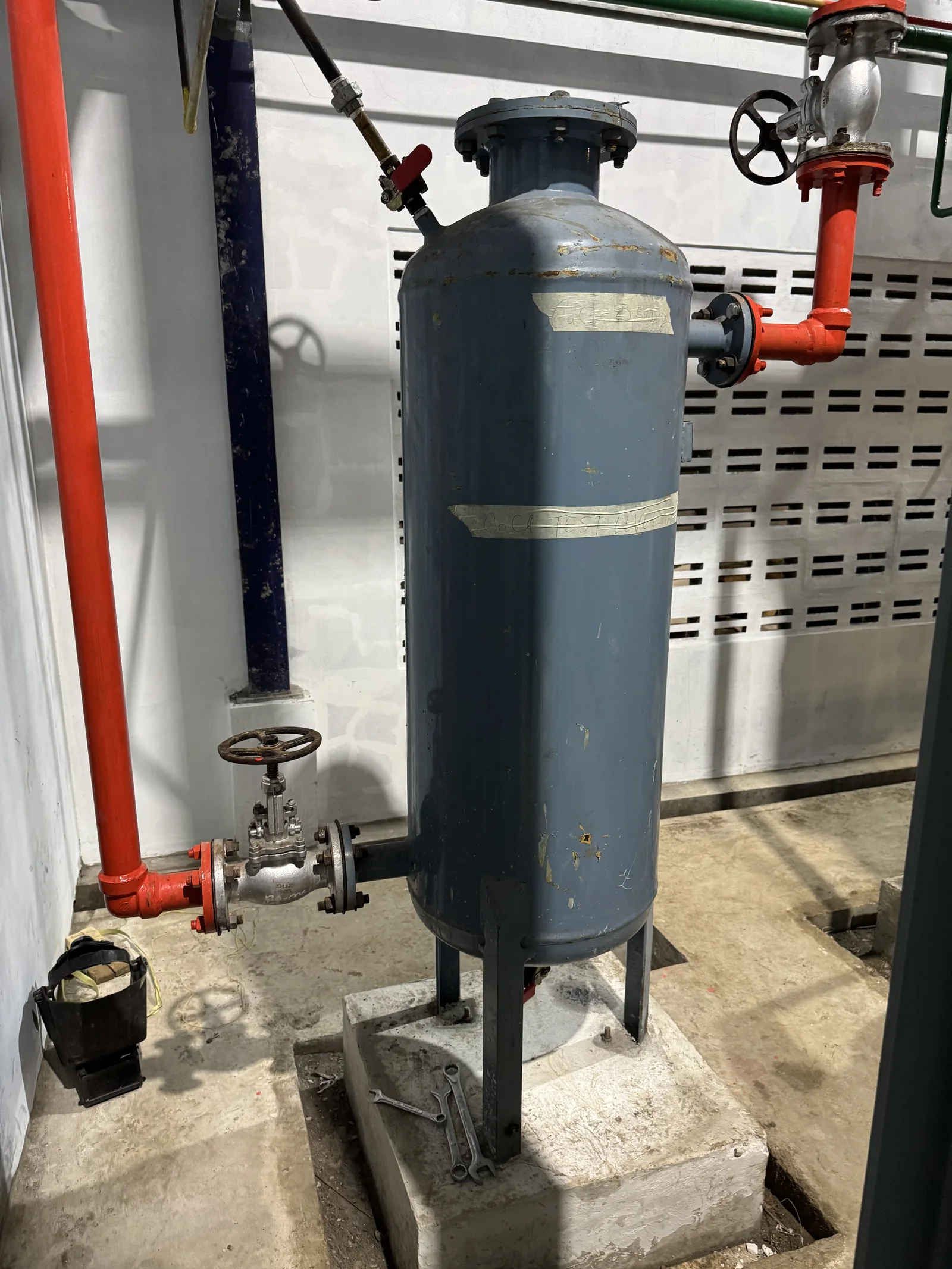
- Dry acetylene limit falls with temperature
- 0.60 kg/cm² at 10 °C
- Water-saturated acetylene limit
- 0.7 kg/cm² at 50 °C
- Wet-gas limit as total absolute pressure
- About 1.74 atm absolute at 50 °C and 2.63 atm absolute at 80 °C
- Effect of pipe size on wet and dry gas
- At 250
- Modern dryness target before the cylinders
- High pressure drier outlet at or below 100 ppmv moisture
Acetylene saturated with water vapour is harder to decompose than dry acetylene at the same pressure, and the advantage grows as the gas gets hotter. That is one of the few favourable physical facts about acetylene, and it shapes how a carbide-based dissolved acetylene (DA) plant is laid out: the gas is kept wet for as long as the process allows, and the section after the driers is treated as the most demanding part of the plant.
What the measurements show
The classic data are Rimarski's, measured on pure acetylene in identical 20-litre vessels with ignition by an incandescent platinum wire, and reported by the C.P.I. (Safety in the Production and Use of Acetylene, Paris 1968). The figure measured is the lowest effective pressure at which a decomposition, once started, spreads through the whole vessel.
| Temperature | Dry acetylene limit (kg/cm² effective) | Water-saturated limit (kg/cm² effective) | Water vapour in saturated gas |
|---|---|---|---|
| 10 °C | 0.60 | — | — |
| 50 °C | 0.48 | 0.7 | 7.1 % |
| 80 °C | 0.40 | 1.4 | 19.4 % |
| 100 °C | 0.33 | — | — |
| 140 °C | 0.10 | — | — |
Two things stand out. The dry limit falls steadily with temperature, from 0.60 kg/cm² at 10 °C to 0.10 kg/cm² at 140 °C. And at 80 °C, saturation lifts the limit from 0.40 to 1.4 kg/cm², three and a half times higher in effective pressure. In absolute terms that is a rise from about 1.39 to about 2.36 atm, roughly 1.7 times, which is still a substantial margin.
The water contents are physically consistent. Water's saturation vapour pressure is about 12 kPa at 50 °C and about 47 kPa at 80 °C (NIST steam data), and those figures divided by the limiting total pressures give very nearly the 7.1 % and 19.4 % that Rimarski recorded.
The compilation by S. A. Miller (1965) presents the same physics as two graphs that run in opposite directions. For dry acetylene, the lines of Rimarski and Boesler fall from about 1.6 to about 1.15 atm absolute between 0 and 200 °C. For water-saturated acetylene the limiting total pressure, water included, rises with temperature: about 1.74 atm absolute at 50 °C and 2.63 atm absolute at 80 °C.
Why does water vapour help?
The decomposition of acetylene to carbon and hydrogen is self-sustaining only above a critical pressure, because the carbon-laden flame loses heat by radiation. Any inert gas in the mixture absorbs part of the heat released without adding any, so the flame needs more acetylene per unit volume, and therefore a higher pressure, to survive. That mechanism is covered in detail on the acetylene decomposition page.
Water vapour is a particularly useful diluent in a carbide plant for one reason: its share of saturated gas rises much faster with temperature than the acetylene limit falls. A hotter generator makes dry gas more dangerous but makes saturated gas safer. The C.P.I. records the same point qualitatively, describing water vapour as playing "a highly moderating role" at high temperatures. This also explains why incandescent carbide inside a generator is a smaller decomposition risk than might be feared: the gas around it is always steam-laden. The same moderating effect is one reason generator temperature control works.
The C.P.I. lists the conditions that increase decomposition risk as higher pressure, a larger container, purer acetylene and drier acetylene. Purity and dryness are quality virtues for the customer; for decomposition they are aggravating factors.
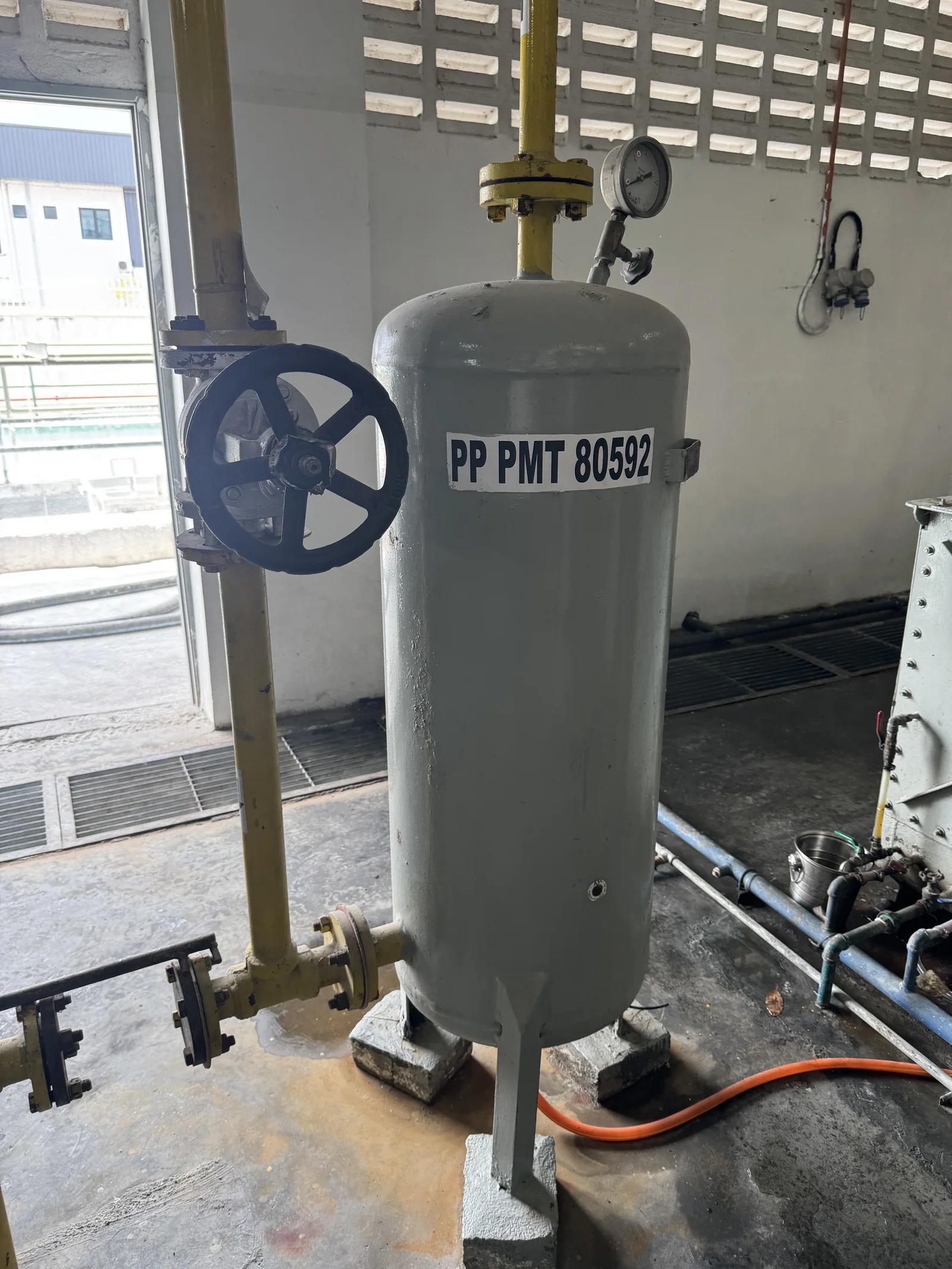
Wet gas and pipe size
Moisture also helps in wide pipe, but by less. The compilation by S. A. Miller (1965) gathers the results of Rimarski, Boesler and Jones on limiting pressure against vessel diameter: about 2.2–2.4 atm absolute at 50 mm, falling by 250–300 mm bore to roughly 1.8 atm absolute for wet gas and 1.4 atm absolute for dry. The sources disagree on how strong the diameter effect is: Sargent's long-pipeline data show a much steeper fall with diameter than these curves, and Ivanov and Kogarko's closed-tube work agrees with Sargent. Ivanov and Kogarko also showed that an arrangement simulating an open tube gives less favourable results than closed-tube tests, so the wide-pipe figures above should not be relied on as a margin. The diameter effect itself is the subject of pipe diameter and detonation.
Rules that matter
A carbide generator produces gas that is saturated at the reaction temperature. Following the KIGL plant operation manual, the gas then passes through:
Where does the hazard rise in a DA plant?
- a cooler condenser, which brings the gas close to cooling-water temperature, condenses most of the water and removes ammonia and lime particles;
- a calcium chloride low pressure drier, which steadies the moisture content entering the purifier;
- the purifiers, which remove phosphine and hydrogen sulphide;
- a water scrubber, which removes dust carried over from the purifier and re-saturates the gas before compression;
- the compressor, which raises the pressure in stages with water cooling;
- the high pressure driers, which remove moisture before the cylinder filling manifold.
The design logic is simple. Gas is compressed wet, because that is when the pressure is rising fastest and the moisture is most useful. It is dried only at the end, because moisture carried into the cylinders accumulates in the acetone and reduces the cylinder's capacity to absorb acetylene. EIGA Doc 241 sets the modern target for the high pressure drier outlet at or below 100 ppmv. The drier page covers condensate handling and drier filling.
The consequence is that the section from the high pressure driers to the cylinders holds acetylene that is at its highest pressure, dry, and often warm from compression. Every factor that lowers the propagation limit is present at the same time. That section is therefore built and run to the strictest rules: small-bore pipe (IS 15190 (Part 2):2002 clause 6.4 asks that DN 25 not be exceeded where possible and DN 40 never), three flame arrestors with non-return valves in series on each charging or discharging manifold (clause 8.6), and cooling of the cylinders and manifold during filling (clause 8.10).
Historical regulation reached the same conclusion. The Italian rules compiled by S. A. Miller (1965) required the gas to be kept saturated with moisture wherever possible, and scaled the design pressure of plant items by how close they ran to the dissociation pressure for the actual temperature and composition.
Rules that matter
Wet gas is not a licence to relax anything else.
What moisture does not do
- It does not remove the limit After the Hüls pipeline event of 1954, decomposition was propagated through 97–98 % wet acetylene (relative humidity 60–80 %, so not fully saturated) at down to 1.0 atm absolute in 30 cm pipe, when a strong initiation was spread across the full bore. The full sequence is on the 1.5 bar rule page.
- It does not change flammability in air Water vapour moderates self-decomposition; an air–acetylene mixture remains flammable across a very wide range.
- It brings its own hazards The C.P.I. warns that moist acetylene, above all with ammonia present, can form acetylide on copper itself, which is why the wet low pressure end of a plant is where copper alloys are most dangerous (copper and acetylene). Water in cold high pressure lines can also form solid hydrates.
- It limits the choice of arrestor The C.P.I. notes that dry packed arrestors whose packing is affected by steam should not be used on generator gas unless it is completely dry. Generator outlets therefore use hydraulic arrestors, described on the wet flashback arrestor page.
Rules that matter
Rules to apply
- Keep generator, purifier and compressor-suction gas saturated where the process allows. Do not add drying steps on the low pressure side that the process does not need.
- Keep the scrubber in service and at its correct water level. Its job of re-wetting the gas before compression is a safety function, not a quality step.
- Treat the gas downstream of the high pressure driers as the most demanding part of the plant: smallest practicable bore, arrestors with non-return valves at every manifold, cylinder cooling during filling, and no dead legs (dead legs and predetonation distance).
- Control temperature as well as pressure. For dry gas the limit falls as temperature rises, so compressor discharge cooling and the generator temperature ceiling (70 °C in the KIGL plant operation manual) both act on the variable that moves the limit.
- Do not treat moisture as a substitute for arrestors, earthing, purity or the exclusion of ignition sources. It widens the margin; it does not create one on its own.
The KIGL acetylene gas plant page describes how the generator, scrubber and drier train are arranged on KIGL's own equipment.
Why wet acetylene is safer than dry acetylene — frequently asked questions
Is wet acetylene less explosive than dry acetylene?
For self-decomposition, yes. Water vapour is an inert diluent, so saturated gas needs a higher pressure before a decomposition flame can travel through it. Rimarski's measurements give 0.40 kg/cm² for dry gas at 80 °C and 1.4 kg/cm² for saturated gas at the same temperature. Moisture does not change the flammable range of acetylene in air, which stays wide.
Why does hot dry acetylene decompose more easily?
A hotter gas needs less energy from the reaction to reach the temperature at which the decomposition flame sustains itself, so the limiting pressure falls as temperature rises. For dry acetylene Rimarski found the limit fell from 0.60 kg/cm² at 10 °C to 0.10 kg/cm² at 140 °C. That is why generator and compressor temperature ceilings matter.
Why does wet acetylene get safer as it gets hotter?
Because the water vapour content of saturated gas rises steeply with temperature. At 50 °C the saturated gas held 7.1 % water vapour in Rimarski's tests; at 80 °C it held 19.4 %. The growing share of inert vapour outruns the fall in the acetylene limit, so the total pressure needed for propagation goes up rather than down.
If wet acetylene is safer, why is acetylene dried before filling cylinders?
Moisture carried into a dissolved acetylene cylinder accumulates in the acetone and reduces the cylinder's absorption capacity, and water in high pressure lines can form hydrates. So the gas is kept wet through generation, scrubbing and compression, and dried only on the high pressure side, to about 100 ppmv under EIGA Doc 241, just before the filling manifold.
Where is the decomposition hazard highest in a DA plant?
Downstream of the high pressure driers. There the gas is at its highest pressure, it is dry, and it is often warm from compression. Every factor that lowers the propagation limit is present at once, which is why that section carries small-bore pipe, flashback arrestors with non-return valves on every manifold and the strictest temperature control.
Does moisture make acetylene safe at any pressure?
No. Water vapour raises the limit; it does not remove it. After the 1954 Hüls pipeline event, decomposition was propagated through 97–98 % wet acetylene (relative humidity 60–80 %) at down to 1.0 atm absolute in 30 cm pipe when initiation was strong and spread across the full bore. Wet gas still needs every other barrier.
References
- Bureau of Indian Standards. (2002). Acetylene Pipelines — Code of Practice, 155 to 2550 kPa(g) (IS 15190 (Part 2):2002).
- European Industrial Gases Association. (2022). Code of Practice: Acetylene (EIGA Doc 123/22). https://www.eiga.eu/uploads/documents/DOC123.pdf
- European Industrial Gases Association. (n.d.). Acetylene compressors and high pressure driers — European Industrial Gases Association documents list (EIGA Doc 241).
- Saturation vapour pressure of water — NIST Chemistry WebBook https://webbook.nist.gov/cgi/cbook.cgi?ID=C7732185
- Webster et al., The Explosive Decomposition of Acetylene in Pipelines, IChemE Symposium Series No. 33 (1972) https://www.icheme.org/media/10611/iv-paper-08.pdf
Enquiries
Request a quotation
State the gas or equipment, the quantity or capacity, and your location. KIGL will confirm the grade, the cylinder or plant size, and whether the location can be served from Noonmati, or through the agent network.