
Guide
Drying acetylene for cylinder filling: calcium chloride driers condensate drains and the empty-space rule
Acetylene for cylinders is dried in three stages: a low pressure calcium chloride drier, water knocked out in the compressor, and high pressure driers of 95 to 99 % CaCl₂. High pressure driers are kept full, drained slowly every hour, and their liquor never goes to a sewer.
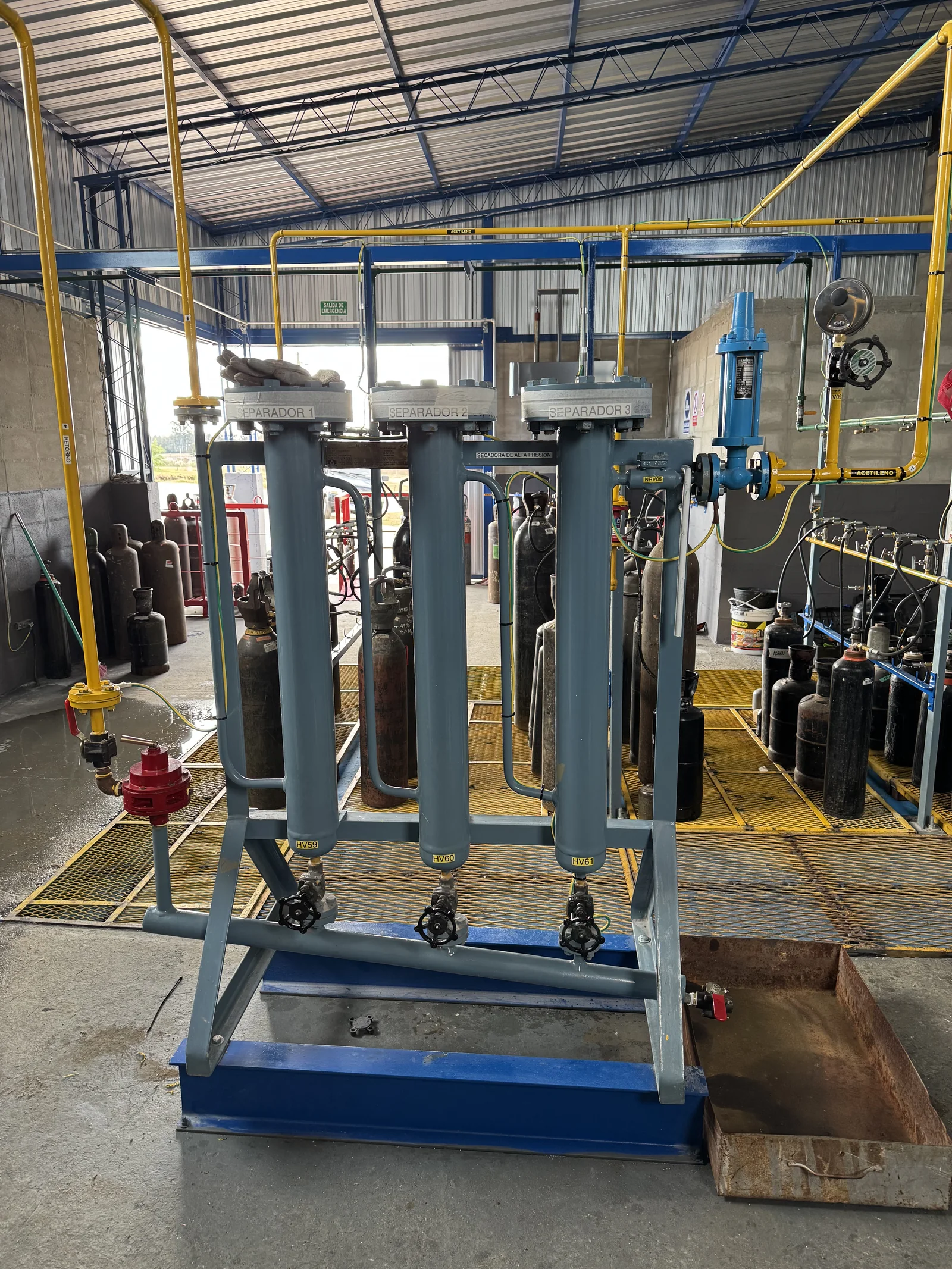
- Three-stage drying
- Low pressure drier of 75 to 85 % CaCl₂; water separated in the compressor as an oil emulsion; high pressure gas through 95 to 99 % CaCl₂
- Drier performance
- High pressure drier outlet at or below 100 ppmv moisture; desiccant void no more than 10 % or 3 litres
- Empty space
- High pressure driers designed and operated to reduce the empty space to a minimum; outlet valves opened slowly; liquor never discharged to a sewer
- KIGL drain routine
- Hourly: open the drier valve slowly until the manifold gauge reaches 0.9 kg/cm²g
- Hydrate formation
- Wet acetylene forms a solid hydrate above about 7 atm at 0 °C and above about 20 atm at 10 °C
Acetylene for dissolved-acetylene cylinders leaves the generator saturated with water, and it is kept that way through the scrubber because wet gas is safer to compress. It must then be dried before it reaches the cylinders. The driers that do it are simple vessels of calcium chloride, but the high pressure ones hold compressed acetylene at up to 24 kg/cm²g and are treated with the same respect as any other part of the high pressure system.
Why dry at all?
For fuel gas used straight from a generator, drying is usually unnecessary: cooled to ambient, the gas carries too little moisture to affect the flame. For cylinder filling it matters because water fed into a cylinder accumulates in the acetone. As compiled by S. A. Miller (1965), with rack gas at an average of about 11 atm gauge and 15 °C, the water vapour after compression would be about 0.15 % of the free gas, and if that were the only source it would take over fifty years for the solvent to reach the water content at which the discharged gas carried as much water as went in. The effect is slow, but it is a continuous, irreversible loss of dissolving power and a source of internal rust. IS 308:2024 limits moisture in dissolved acetylene to 0.25 % by mass, and acetone itself is water-sensitive: a few per cent of water measurably reduces its capacity, which the solvent guide quantifies.
The three stages
Dissolved-acetylene stations dry in three steps, an arrangement the 1965 literature, as compiled by S. A. Miller, described as virtually universal:
- A low pressure calcium chloride drier, with 75 to 85 % CaCl₂, removes the bulk of the water before the purifier.
- More water separates in the compressor, removed from the traps and crankcase as an emulsion with the oil.
- The high pressure gas passes through 95 to 99 % CaCl₂, capable of taking moisture below about 0.5 mm vapour pressure, an average of under 0.07 % on the free gas.
EIGA Doc 241 sets the modern target: high pressure drier outlet at or below 100 ppmv, with the desiccant void no more than 10 % or 3 litres.
| Stage | Pressure | Medium | Routine on KIGL plants |
|---|---|---|---|
| Low pressure drier | Generator side, below 1 kg/cm²g | Anhydrous calcium chloride, fused lump | Drain hourly; refill weekly; never taken out of service while running |
| Compressor traps | Each stage | Condensate as oil emulsion | Drain hourly, slowly; stop as gas appears |
| Oil separator | Discharge | Compacted chain | Drain hourly; flange cleaned yearly |
| High pressure driers | Up to 24 kg/cm²g, 14 by back-pressure valve | Anhydrous calcium chloride | Drain hourly in steps; refill daily; flush after 200,000 m³ |
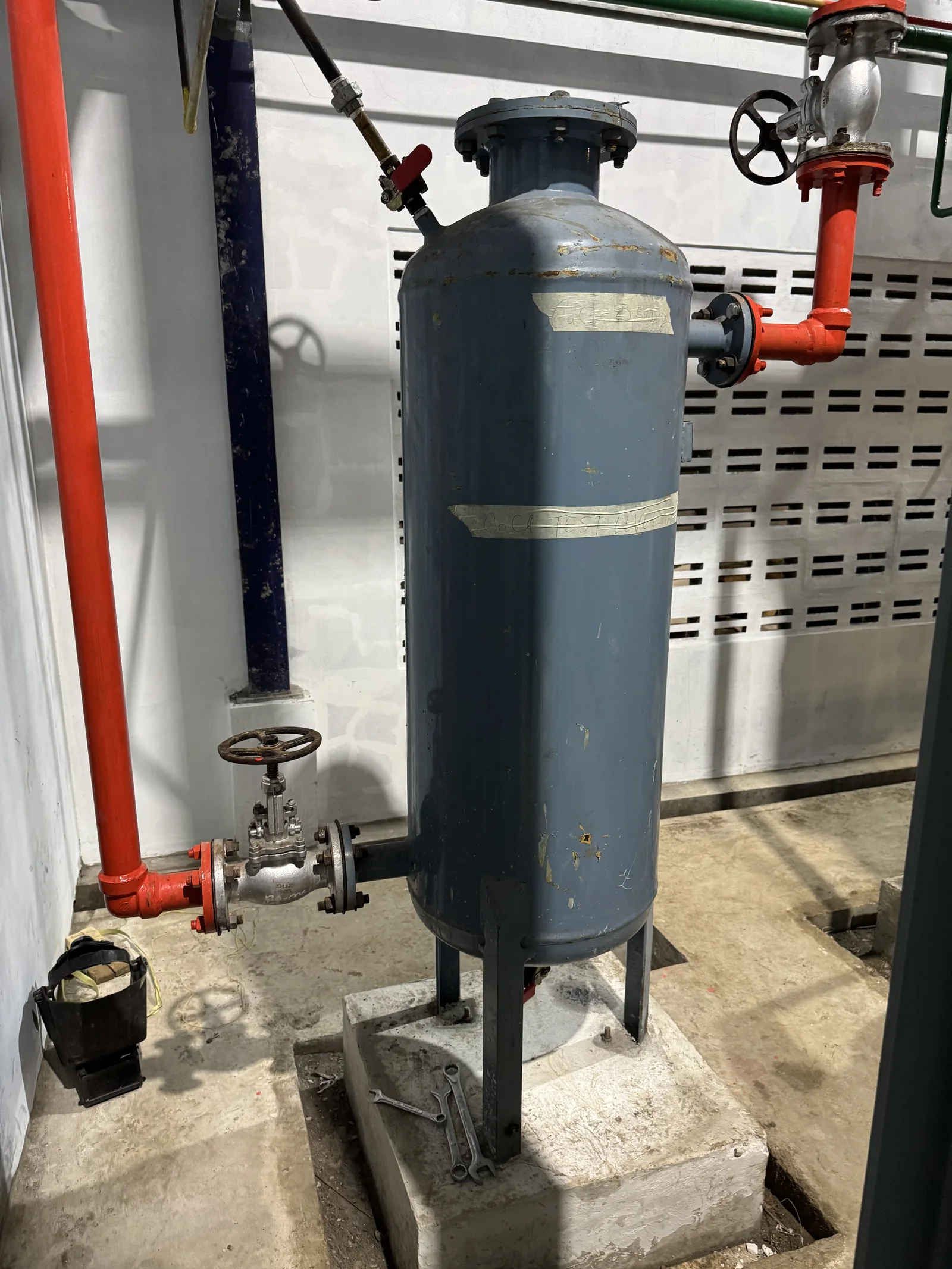
How a calcium chloride bed works
The gas passes upward. Most of the moisture is absorbed at the bottom of the bed, where the solid gradually dissolves into a liquor that is drained off from time to time while fresh solid is added at the top. The gas leaves after its last contact with dry solid, so drying efficiency is unaffected by hydrated solid or even liquor at the bottom. A bed with liquor below is a bed working correctly; operators who replace the whole charge whenever liquor appears waste calcium chloride, and operators who never drain it flood the bed.
Two practical points come from audits of plants of several makes. Fine calcium chloride smaller than the support mesh falls through and chokes the drain, so fused anhydrous lump of the correct grade is used. And a bed fed with gas that is too wet, or contaminated with ammonia, can crust over into a layer that is mechanically intact but chemically non-functional, so the medium is inspected, not only weighed.
The purifier sits before the high pressure drier for a reason. A ferric chloride purifier re-wets the gas, so drying ahead of it would be undone.
High pressure driers: the empty-space rule
KIGL's high pressure train is an oil separator packed with compacted chain followed by calcium chloride driers, with a back-pressure valve holding 14 kg/cm²g during the early part of charging so that water is squeezed out more effectively at the higher pressure. The manual's warning is unambiguous: the high pressure driers must be kept filled with anhydrous calcium chloride, because a void could result in an explosion, and moisture carried to the manifolds is deposited in cylinders and slowly destroys their absorption capacity. They are refilled daily before start-up.
The 1968 C.P.I. code gave the same rule its reason: driers must be designed and operated to reduce the empty space to a minimum. An empty volume of compressed acetylene is the space a decomposition has to run in.
Rules that matter
Each hour, on KIGL plants:
Draining the high pressure driers
- Open the first drier's drain valve slowly until the gauge at the drain manifold safety valve reaches 0.9 kg/cm²g, then close it.
- Wait about 15 to 30 seconds.
- Open the manifold condensate drain slowly and let the liquor out.
- Repeat for each drier in turn.
The C.P.I. code required the outlet valve to be opened slowly and the solution and gas to be taken to a place or container where the gas cannot ignite or form explosive mixtures with air, and it forbade discharging high pressure drier liquor into a sewer, because an explosive acetylene-air mixture forms in the sewer. Brass valves are not used on calcium chloride drains.
A drain valve that is open but delivers nothing is clogged. The plant is stopped, the compressor isolated, the drier vented and the valve removed and cleaned; if it clogs repeatedly, more water is used to flush the drier bottom. Audits of other makes found high pressure driers with no terminal drain valve, so that every hourly purge released water and compressed gas into the room, and inclined drain lines missing altogether; both are fitted before such a plant restarts.
Hydrate: the cold-weather trap
Wet acetylene under pressure forms a solid hydrate, a clathrate of acetylene and water first reported by Villard in 1895 and 1897 and given its structure by von Stackelberg. It forms above about 7 atm at 0 °C and above about 20 atm at 10 °C, so it can plug a cold discharge line, intercooler or neglected drier on a winter night at a temperature well above freezing. The hydrate guide covers it in detail; on the drier side the protection is to keep the low pressure drier and compressor traps working so that wet gas never reaches high pressure.
Other drying methods
Refrigeration is limited by liquefaction: acetylene at 20 atm gauge boils at about −8 °C, and cooling it to 0 °C leaves about 0.23 mg/l of water in the free gas. Alumina and silica gel dry more deeply than calcium chloride, to about 0.002 mg/l (as compiled by S. A. Miller, 1965), but adsorb acetylene, 1.8 % and 3.7 % respectively, and the C.P.I. code required special precautions so that silica gel in a high pressure circuit could never rise in temperature or hold an air-acetylene mixture. The same compilation judges the extra dryness of little value because the cylinder solvent mass is not that dry either. Calcium carbide as a drier fails because the lumps break down into fine lime that blocks the gas.
Rules that matter
Periodic maintenance
- Daily: refill high pressure driers with anhydrous calcium chloride.
- Weekly: refill the low pressure drier; soap-test drier drain valves.
- Yearly: remove, clean and lubricate the oil separator flange with a new gasket so it does not seize.
- After 200,000 m³ of acetylene, or if dirty: flush the oil separator with kerosene or fuel oil and then water, re-oil the chain rings, empty and flush the calcium chloride driers and recharge; purge all air at the next start-up.
Rules that matter
Rules to apply
- Keep the high pressure driers full; no void.
- Drain every drier hourly, slowly, in steps, to a vented container, never a sewer.
- Use lump anhydrous calcium chloride and steel drain valves.
- Treat liquor at the bottom as normal and an empty top as a fault.
- Purify before the high pressure drier, and keep wet gas off the high pressure side.
The KIGL acetylene plant is supplied with its driers sized for the plant's rating; the compressor guide covers the traps that feed them.
Drying acetylene — frequently asked questions
Why does acetylene have to be dried before filling cylinders?
Because water carried into a cylinder stays there. It accumulates in the acetone, slowly reducing its power to dissolve acetylene, and can rust the steel shell from inside. The effect is slow, decades rather than months on the rack gas alone, which is why drying is a cylinder-life control rather than an acute hazard, but the damage is irreversible.
Is liquid in the bottom of a calcium chloride drier a fault?
No. The gas flows upward; most of the moisture is taken up at the bottom, where the calcium chloride dissolves into a liquor that is drained off, while fresh solid is added at the top. The gas leaves after contact with dry solid, so drying is unaffected by liquor below. The fault is liquor that is not drained, or a bed allowed to run down so that a void forms.
Why must high pressure driers be kept full?
Empty space in a high pressure drier is a volume of compressed acetylene available to decompose. The C.P.I. code required driers designed and operated to reduce empty space to a minimum, and KIGL's manual warns that an unfilled drier could permit a void that results in an explosion, as well as letting moisture reach the cylinders. EIGA Doc 241 limits the void to 10 % or 3 litres.
How should a high pressure drier be drained?
Slowly, in steps, and to a safe place. On KIGL plants the first drier valve is cracked until the gauge at the drain manifold reaches 0.9 kg/cm²g, closed, then after 15 to 30 seconds the manifold drain is opened slowly; the routine is repeated for each drier every hour. The liquor and gas go to a vented container in the open, never to a sewer.
What is acetylene hydrate and why does it matter in driers?
A solid, ice-like compound of acetylene and water that forms under pressure at temperatures above freezing: above about 7 atm at 0 °C and about 20 atm at 10 °C, from work by Villard in the 1890s. In a cold discharge line or a wet high pressure drier on a winter night it can plug the line. Keeping the gas dry before compression and the driers drained is the protection.
Can silica gel be used to dry acetylene?
It can, and it dries more deeply than calcium chloride, but it adsorbs acetylene and warms as it does so. The C.P.I. code required special precautions so that silica gel in high pressure service could never rise in temperature and so that no air-acetylene mixture could form in the drier. Calcium chloride remains the near-universal choice for cylinder filling.
Why are brass valves not used on drier drains?
KIGL's manual forbids brass valves on the condensate drains of calcium chloride driers. The drain liquor is a concentrated chloride solution carrying dissolved acetylene, a combination that attacks copper alloys and favours acetylide formation. Steel valves are used, and IS 14814:2023 discourages copper alloys anywhere in acetylene service.
References
- Bureau of Indian Standards. (2023). Acetylene — Code of Safety (IS 14814:2023, First Revision).
- Bureau of Indian Standards. (2024). Dissolved Acetylene (Gas) — Specification (moisture 0.25 % by mass max) (IS 308:2024, Fourth Revision).
- Compressed Gas Association. (n.d.). Acetylene (CGA G-1).
- European Industrial Gases Association. (n.d.). Acetylene Plant Design and Operation (EIGA Doc 241).
Enquiries
Request a quotation
State the gas or equipment, the quantity or capacity, and your location. KIGL will confirm the grade, the cylinder or plant size, and whether the location can be served from Noonmati, or through the agent network.