
Guide
Running an acetylene compressor: suction limits stage pressures, cooling, and why the oil turns grey
An acetylene compressor is run wet, cool and never under vacuum. On KIGL plants the low-pressure switch stops the machine before suction falls below 0.1 kg/cm²g, it discharges against a 14 kg/cm²g back-pressure valve into a manifold of up to 24 kg/cm²g, and it runs on SAE 30 non-detergent oil. Grey oil means water.
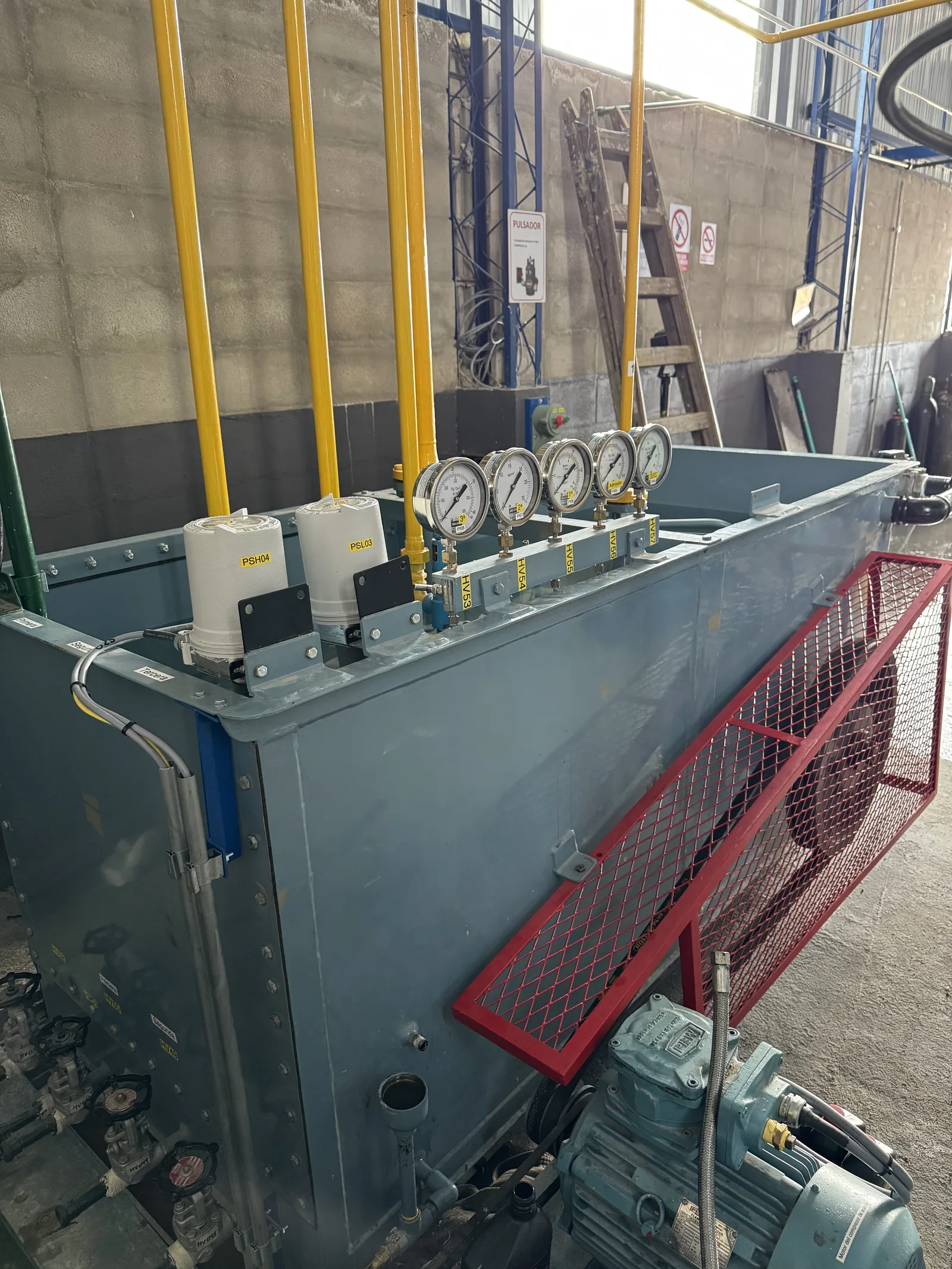
- Low-pressure switch
- Set 0.1 to 0.2 kg/cm²g; stops the machine before inlet falls below 0.1 kg/cm²g and prevents a start until it is back above 0.2
- Why never sub-atmospheric
- A slight excess pressure of more than 25 mm water must be kept on the low-pressure side; the compressor must stop automatically when intake falls to 25 mm water
- Stage pressures
- With 0.4 kg/cm²g suction
- Back pressure and manifold
- Back-pressure valve set at 14 kg/cm²g; cylinder manifold anything up to 24 kg/cm²g; check progress at 21 kg/cm²g
- Lubrication
- SAE 30 non-detergent oil
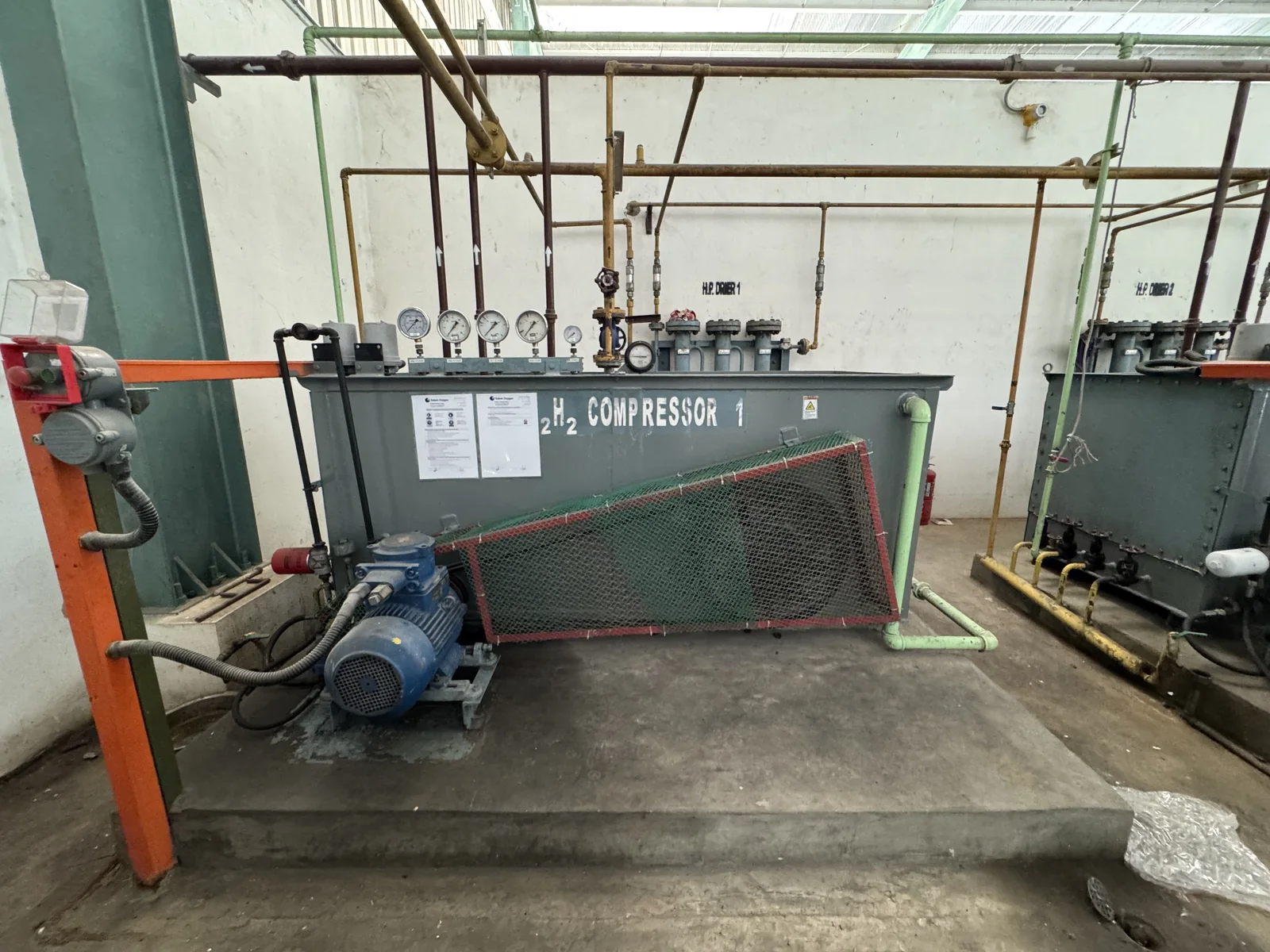
An acetylene compressor does something that no other reciprocating compressor is asked to do: it takes a gas that can decompose with no oxygen present, raises it from under 1 kg/cm²g to 24 kg/cm²g, and must do so without a single hot surface, a single pocket of air, or a single copper fitting in the gas path. Everything odd about the machine follows from that. It sits in a tank of water, it runs on plain oil, it stops itself when suction gets low, and it is cleaned out hourly.
Why the machine is built the way it is
KIGL compressors are water-immersed reciprocating machines with the interstage gas cooled by coils in the same tank. Immersion keeps every external surface at water temperature and removes the heat of compression continuously rather than at an aftercooler. Lubrication is by a belt-driven force-feed oil pump. The drive belts are static-conducting, the motor is flameproof, and no part of the gas path contains copper or brass above the 70 % copper limit that the KIGL plant operation manual sets for acetylene piping.
The hazard the design manages is heat. Acetylene can be initiated by a surface at about 425 °C and, where powdered material is present, by one at 280 °C, which is why acetylene plant is never heated by flame or electricity and why a compressor bearing running dry is treated as an ignition source. EIGA Doc 241 quotes a theoretical adiabatic discharge figure of 140 °C for oil-lubricated machines, which is why the interstage coils and the water tank exist. KIGL's own guidance keeps gas temperature at the compressor below 70 °C.
Suction: the one number that must never fall
The 1968 C.P.I. code put the principle in a sentence: there should always be a slight excess pressure of more than 25 mm water in the low-pressure part of the works, and the compressor must be stopped automatically when the pressure in its intake drops to 25 mm water. The purpose is to make it impossible for air to be passed into the acetylene on its way through the compressor, which would add greatly to the risk of ignition on the high-pressure side.
KIGL's implementation is a low-pressure switch set at 0.1 to 0.2 kg/cm²g: the compressor stops if inlet pressure falls to 0.1 and cannot start until it has risen to 0.2 or above. Suction is fed from a generator whose own maximum is 0.92 kg/cm²g. The pressure drop from generator to compressor through the arrestors, cooler, drier, purifier and scrubber is about 0.21 kg/cm²g; a drop much larger than that means sludge in the arrestor line or a choked drier, and the suction gauge is the first place it shows.
At shutdown the rule is explicit: turn off the hopper switches, drain the condensate traps, and let the compressor run until its low-pressure switch stops it. If it does not stop, switch it off by hand to avoid pulling a vacuum on the generator, then find and repair the cause. The switch is tested at the end of every shift, because the interlock is the only thing standing between a routine shutdown and an air-filled generator.
Stage pressures: what normal looks like
| Suction, kg/cm²g | First stage, kg/cm²g | Second stage, kg/cm²g | Final stage |
|---|---|---|---|
| 0.4 | 3 to 3.8 | 11 to 12.6 | 14 by back-pressure valve, then cylinder pressure up to 24 |
| 0.6 | 3.5 to 4.5 | 12 to 15 | 14 by back-pressure valve, then cylinder pressure up to 24 |
The table is read as a diagnostic as much as a specification. A first-stage pressure above normal means the second-stage valves are leaking slowly; a first-stage pressure below normal means the first-stage valves are leaking. A stage safety valve that discharges rapidly points at the valves of the next stage up, or dirt under them. The final-stage safety valve blowing means the manifold isolation valve is shut, a manifold non-return valve or the pressure controller is stuck, or the high-pressure driers are clogged, and in every such case the high-pressure switch should already have stopped the machine. The manual's one absolute rule here is that no valve may be fitted between the pressure switch connection and the compressor.
The back-pressure valve is set at 14 kg/cm²g, and the compressor builds up to that pressure before the manifold is opened. The cylinder manifold is then brought on gradually so that 14 is maintained; once the cylinders rise above 14, they govern the final stage. Charging progress is checked as the manifold reaches 21 kg/cm²g, and the manifold works at anything up to 24 kg/cm²g. When a filled bank is changed over, the manual has the compressor stopped and its pressure reduced to about 3 kg/cm²g through the high-pressure drier drain before it is restarted.
Oil: SAE 30, non-detergent, and nothing else
The lubricant is SAE 30 non-detergent compressor oil with a density of about 0.876 at 15 °C, a viscosity of about 93 cSt at 40 °C and a flash point of 230 °C. Oil pressure must stay within the band set by the compressor maker, which KIGL's manuals give as 0.2 to 0.8 kg/cm²g above suction pressure. Low oil pressure is a fault, and the causes in order are a broken oil-pump belt, low oil level, suction near zero, a clogged pump suction, or a defective pump. The oil-pump belt is a cogged belt that is meant to run slack; it drives by its teeth, not by tension, and it is fitted by loosening the sheave from the hub, never by stretching it over the flange.
Grey oil is water. The gas enters the compressor saturated on purpose, because wet acetylene is safer to compress than dry, and the moisture that condenses in the stages collects in the traps and finds its way into the crankcase. A non-detergent oil lets the water settle so it can be drained; a detergent oil holds it as a grey emulsion that carries no film. The daily routine is to drain water condensate from the crankcase before start-up and to check the level; the weekly routine is to check the oil for moisture and change it if it is cloudy. A rise of half an inch in the level without oil being added means water, and the whole charge is drained and replaced. If the level keeps rising, the oil-pump suction tube inside the water tank is pressure-tested for bubbles at 5 psig or more; a crankcase that will not hold 2 psig during a shutdown has a leak of its own.
A compressor with no working force-feed oil pump is not run. On one plant that KIGL audited, no compressor had a force-feed oil pump fitted at all, and the finding was classed as stop-now: bearings, rods and pistons running effectively dry generate friction heat with no upper limit, and a hot internal surface in pressurised acetylene is a recognised ignition route.
Condensate: hourly, slowly, and never into a drain
Each condensate trap on the machine is drained hourly, the valve opened very slowly and closed the moment acetylene appears, both to avoid wasting gas and to avoid a jet. Draining is finished at shutdown as well. One audited plant had bypassed the glass-ball condensate trap that gives the moisture surface area and velocity damping to settle; moisture then passed straight into the stages. The high-pressure driers downstream have their own hourly routine, and the liquor from any of them goes to a vented container in the open air, never to a sewer, because the C.P.I. code forbids it on the grounds that an explosive acetylene-air mixture forms in the sewer.
Wet compressed acetylene has one further trick. Above about 7 atm at 0 °C, or 20 atm at 10 °C, acetylene and water form a solid hydrate (Villard, 1895 and 1897; von Stackelberg's clathrate work), which can plug a cold discharge line or drier like ice at a temperature well above freezing. A compressor discharging at 24 kg/cm²g on a cold night with its driers neglected is inside that region.
Cooling water and the magnesium anodes
The tank overflow is checked hourly. If tank water exceeds 35 °C, or is more than 5 °C above the inlet water, whichever is higher, the flow is increased. Each month the tank is drained and cleaned and the piping is inspected for corrosion. Two magnesium anodes screwed into brackets in the tank protect the submerged steel; they are checked weekly and replaced when they have wasted to the core wire or the thickness of a pencil. Three of five plants KIGL has audited had no anode at all, and the corroded compressor bodies and oil lines found at those plants threaten the containment of 24 kg/cm²g acetylene.
Historical practice worth knowing
The C.P.I. code of 1968 required a list of permitted maximum compression pressures to be posted near the compressor by ambient temperature: 25 kg/cm² at +4 °C and above, 20 at 0 °C, 17 at −5 °C and 14.5 at −10 °C, because acetylene liquefies at 20.7 kg/cm² absolute at −10 °C. These are not Indian law and the temperatures are rarely relevant to Indian plants, but the principle, that discharge pressure is capped by ambient temperature so that liquid acetylene can never form in a line, is the physics behind the cylinder filling-pressure table a filling station works to. The Indian pressure limits are in IS 14814:2023.
Field findings, anonymised
The compressor is where operator workarounds cluster. At three of five plants KIGL audited, an oil-level check line had been tapped off the crankcase in plastic tube; at two, lines had been added to top up oil directly. The complaint behind every one was oil pressure or oil level, which the troubleshooting section already answers, and the real fault on investigation was worn rings, a missing oil pump or an overdue overhaul. A crankcase contains traces of acetylene, and a plastic tube on it that ruptures releases pressurised gas into the compressor room. Other recurring findings: daily oil changes masking blow-by past worn rings, murky oil nobody had traced, no interstage pressures recorded at all, safety valves with their pop-up heads missing, a copper pipe in a vent line, and a machine idled for most of the day because gas went straight to a pipeline, which separates the oil, dries the rings and sticks the valve plates. KIGL's recommendation for an idle machine is to run it at least once per shift, and for a rebuilt one to flush and refill the oil after the first 30 days.
Rules that matter
Rules to apply
- Never start with air in the machine: start with all drains open, close the stage separators in sequence, purge at the high-pressure drier drains, then close the vents.
- Suction always positive; the low-pressure switch stops the machine before 0.1 kg/cm²g and is tested every shift.
- Oil 0.2 to 0.8 kg/cm²g above suction; SAE 30 non-detergent; grey oil is drained, not topped up.
- Cooling tank at or below 35 °C and within 5 °C of inlet; anodes checked weekly.
- Drain every trap hourly, slowly; never to a sewer.
- Stop on knocking, on any safety valve lifting, on low oil pressure or on the smell of gas, and log every stage pressure every hour in the shift log.
Running an acetylene compressor — frequently asked questions
Why must an acetylene compressor never pull a vacuum on the generator?
Because the one thing worse than acetylene at pressure is acetylene mixed with air at pressure. If suction falls below atmospheric, air is drawn in through any leak and compressed with the gas into the high-pressure side. The 1968 C.P.I. code required a positive pressure of more than 25 mm water everywhere on the low-pressure side and an automatic stop when intake reached that figure. KIGL's switch stops the machine before inlet drops below 0.1 kg/cm²g.
What should the interstage pressures be?
They follow suction. KIGL's manual gives first stage 3 to 3.8 kg/cm²g and second stage 11 to 12.6 at 0.4 kg/cm²g suction, rising to 3.5 to 4.5 and 12 to 15 at 0.6 suction. The final stage is set by the 14 kg/cm²g back-pressure valve until the cylinders rise above that, after which cylinder pressure governs, up to 24 kg/cm²g. A stage reading high points to a leaking valve on the next stage up.
Why has the compressor oil turned grey?
Water has emulsified into it. The four causes in order of likelihood are condensate traps not drained on schedule, an oil change overdue, a detergent oil used by mistake, and a leaking trap drain valve. Drain the whole charge and refill with non-detergent SAE 30. If the level rises without oil being added, look for water left in the crankcase after a shutdown or a leaking oil-pump suction tube inside the water tank.
Why non-detergent oil?
A detergent oil holds water in suspension as a grey emulsion instead of letting it settle out to be drained. In an acetylene compressor water arrives continuously, because the gas is deliberately kept saturated through the scrubber for safe compression and the moisture separates in the cylinders and traps. Non-detergent oil lets it separate; a daily condensate drain from the crankcase removes it.
What temperature should the cooling water be?
The machine sits in a water tank with its interstage coils, and the rule is that if the tank water goes above 35 °C, or more than 5 °C above the inlet water, whichever is the higher, the flow must be increased. The tank is checked hourly, drained and cleaned monthly, and carries two magnesium sacrificial anodes that are replaced when worn to pencil thickness.
How is the back-pressure valve used at the start of filling?
Start the compressor with its drain valves open, close the stage separators in turn, and let pressure build to 14 kg/cm²g on the back-pressure valve before opening the manifold valves, gradually, so that 14 kg/cm²g is maintained. The higher final pressure squeezes more water out of the gas in the high-pressure drier and cools the gas as it expands past the valve into a manifold still below 14.
What are the warning signs that need an immediate stop?
Knocking from the crankcase, which in KIGL's experience means a worn piston head, connecting rod or gudgeon pin; oil pressure below the compressor maker's band; any stage safety valve discharging; a stage temperature too hot to touch; and the smell of acetylene at the machine. A compressor with no working force-feed oil pump is not run at all, because a dry bearing in pressurised acetylene is an ignition source.
References
- Bureau of Indian Standards. (2023). Acetylene — Code of Safety (IS 14814:2023, First Revision).
- Compressed Gas Association. (n.d.). Acetylene (CGA G-1).
- European Industrial Gases Association. (n.d.). Acetylene Plant Design and Operation (EIGA Doc 241).
- Occupational Safety and Health Administration. (n.d.). Oxygen-fuel gas welding and cutting (29 CFR 1910.253).
Enquiries
Request a quotation
State the gas or equipment, the quantity or capacity, and your location. KIGL will confirm the grade, the cylinder or plant size, and whether the location can be served from Noonmati, or through the agent network.