
Guide
How to get a PESO licence for an acetylene plant in India the Form C, E and F sequence explained
An acetylene plant in India is licensed by the Chief Controller of Explosives, PESO Nagpur, under the Gas Cylinders Rules 2016: Form C plan approval, a Form E filling licence and a Form F storage licence, which needs CCE approval of the generator. Licences run to 30 September, for up to 10 years.
- Licensing authority
- Chief Controller of Explosives
- Generator gate
- A Form F acetylene storage licence requires a copy of the CCE approval for the acetylene generator
- Safety distances
- 15 m to boundary and buildings; 30 m to an oxygen plant; 90 m to an air-compressor intake; 9 m from lime-sludge pits
- Validity
- Forms E and F run until 30 September of the year granted
- Own-use exemption
- No licence is needed to possess up to 25 dissolved acetylene cylinders at a time for own use
An acetylene plant in India cannot fill a single cylinder until the Chief Controller of Explosives (CCE) at PESO Nagpur has approved the site, the generator and the filling premises under the Gas Cylinders Rules 2016. The route is three forms in sequence — Form C for prior approval of the plans, Form E to fill dissolved acetylene, Form F to store it — plus a generator approval without which the storage licence cannot be issued. This page sets out the sequence as PESO's own procedural guidelines describe it, with the distances, documents, fees and validity periods that apply, so that a plant buyer knows what the regulator will ask for before the first drawing is made.
Who licenses what
Acetylene is a flammable gas, and under PESO's published procedure every Form E, Form F and Form G application for toxic and flammable gases is decided by the Chief Controller of Explosives in Nagpur rather than by a circle office. The CCE also grants manufacturing approvals for cylinders, valves and regulators, approves acetylene generators, and approves conversions. Circle offices approve testing stations and handle filling permissions for individual cylinders, and sub-circle offices inspect and report. The practical consequence is that an acetylene filler's entire regulatory relationship is centralised in one office, and a plant builder such as KIGL deals with the same office for generator approval.
| Matter | Authority |
|---|---|
| Form E, F, G for flammable or toxic gases (acetylene) | Chief Controller of Explosives, Nagpur |
| Form E, F, G for non-flammable, non-toxic gases | PESO circle offices |
| Manufacturing approval — cylinders, valves, regulators | CCE, Nagpur |
| Acetylene generator approval | CCE, Nagpur |
| Testing-station recognition | Circle offices approve; sub-circles inspect |
| Cylinder-specific filling permission | Circle and sub-circle offices |
Step 1 — Form C: prior approval of the site and plans
Nothing is built until the layout is approved. The Form C file, as PESO's guidelines list it, contains the application itself, a layout plan to scale, details of the surrounding area within 100 m (Rule 47(1)(a)(iii) requires the plan to show everything within 100 m of the edge of the facilities), the Schedule V fee, proof of legal possession of the land, a description of the process and its maintenance schedule, a fire-fighting adequacy check, and a piping and instrumentation flow sheet.
The layout is judged against the safety distances in Form E Part B of the Rules, which are the distances an Indian acetylene plant is actually licensed against:
| From the acetylene plant to | Minimum distance |
|---|---|
| Factory boundary wall, buildings, adjacent property, offices | 15 m |
| Pressure vessels holding cryogenic liquid | 15 m |
| Oxygen manufacturing plant | 30 m |
| Air-compressor air-intake point | 90 m |
| Non-flameproof electrical fittings | 15 m |
| Lime-sludge drying pits to boundary wall and generation unit | 9 m |
Two of these have no counterpart in EIGA Doc 123 Table 6, which is the European reference: the 30 m to an oxygen plant and the 90 m to an air-compressor intake are Indian cross-contamination rules, and they are stricter than the European code on that axis. EIGA, for its part, asks for 200 m to public buildings, which the Indian table does not state. A site that satisfies PESO is therefore not automatically a site that satisfies a multinational customer's audit. The full comparison is on the layout and safety distances page, and the capacity side of the decision on sizing an acetylene plant.
Step 2 — generator approval
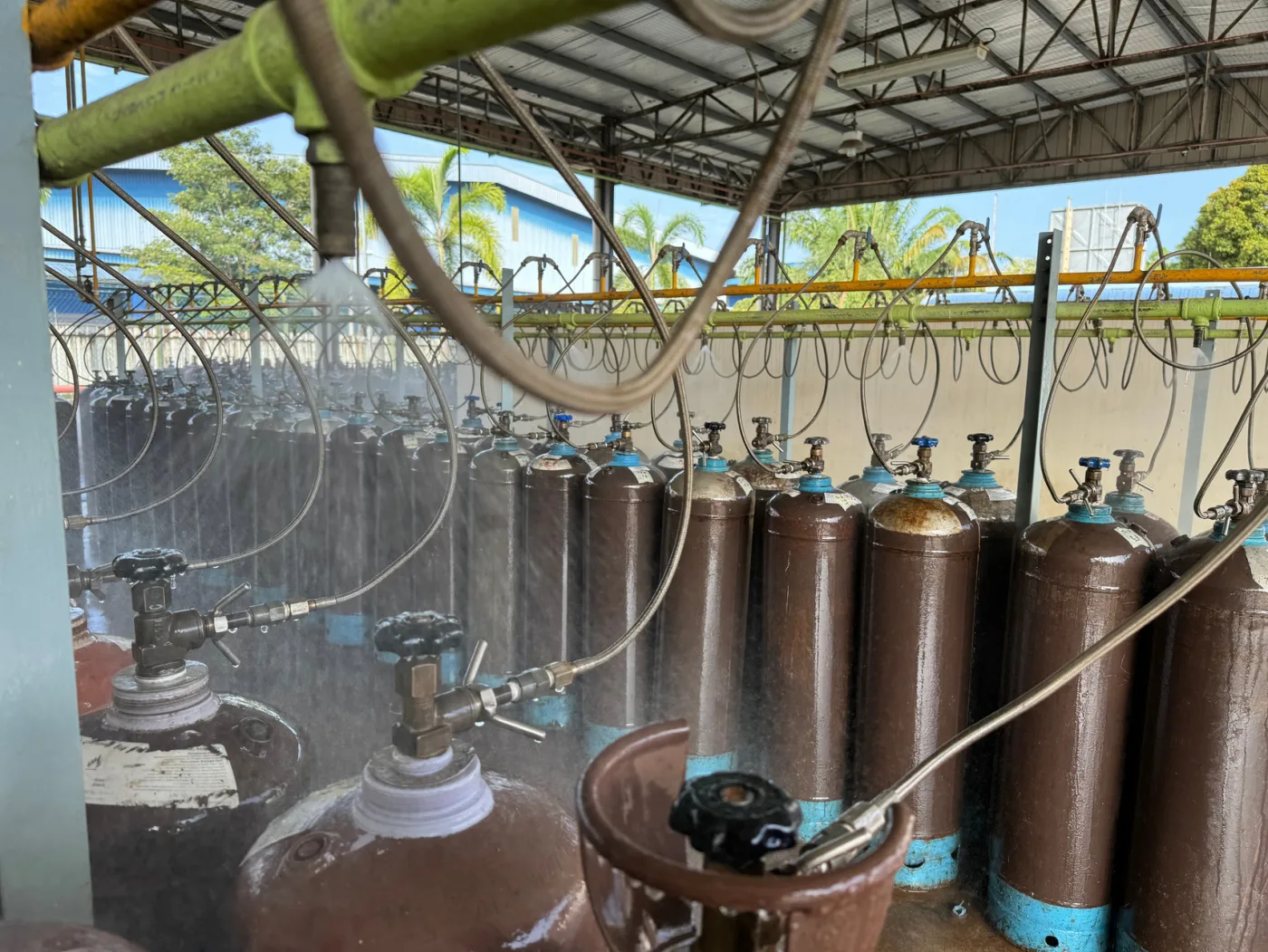
The acetylene generator is approved by the CCE separately from the premises. PESO's guidelines state expressly that a Form F licence for acetylene requires a copy of the CCE approval for the acetylene generator, so the generator's paperwork gates the storage licence. For a plant buyer this is the single most useful thing to know before ordering: a generator model that already holds a current CCE approval shortens the whole programme, and one that does not cannot be licensed into service until it does.
The technical basis for a generator in India is IS 8471:2003 (including Amendment 1 of February 2024, which updated the permitted steel grades to IS 2002, IS 2062 and IS 2041). The standard classifies generators as low pressure (maximum working pressure 14.71 kPa g) or medium pressure (138 kPa g), requires a test pressure of 200 % of design pressure, and in clause 12.8 requires the flashback arrestor on the generator to conform to IS 11006. What IS 8471 asks of a generator is set out on the IS 8471 explained page. Manufacturing approvals for pressure components run through a Third Party Inspection Agency (TPIA): design drawings endorsed by the TPIA, a TPIA-certified test certificate, a prototype inspection and a joint inspection report. The Indian first-time fee shown in PESO's table is Rs 10,000; a foreign manufacturer pays Rs 6,50,000 and must show ten years of track record, product liability insurance and ten years of supply records.
Rules that matter
Form E is the production licence. Rule 40 puts it as a prohibition: acetylene may only be compressed into cylinders at premises licensed by the Chief Controller or a Controller. The fee is charged per type of gas, and dissolved acetylene is its own category, separate from other flammable gases.
Form E carries licence conditions specific to dissolved acetylene plants (Part B), which the plant must be built to:
Step 3 — Form E: the licence to fill
- safety devices to keep pressure, temperature and flow within limits, and equipment designed to prevent air or oxygen entering and to purge air–acetylene mixtures safely;
- regulators to ISO 7291 and high-pressure hoses to ISO 14113, with hoses for high-pressure acetylene having a burst pressure of not less than 1,000 bar;
- flame arrestors or shut-off devices at all strategic locations, arresting both ignition and gas flow;
- manifolds designed with acetylene decomposition and detonation resistance in mind even though filling pressure may be 25 bar;
- a fire-protection and deluge system and an emergency response system, with written emergency procedures for carbide storage and transport, carbide fires, lime spillage and hot cylinders;
- dry chemical powder extinguishers at strategic points, with carbon dioxide extinguishers not to be used on flammable-gas fires because of static generation;
- no cylinder filling between sunset and sunrise unless specially endorsed (clause 8), and all electrical equipment of flameproof construction (clause 9); for acetylene, a Group IIC gas, specify IIC-certified equipment.
The licence-grant file adds ownership proof, the fee for the validity period, an as-built drawing verified against the approved drawing, clearances from the State Pollution Control Board, the fire service and the local body, the Rule 48 no-objection certificate where cylinders are stored for sale, a written SOP, and HAZOP, QRA or disaster-management reports where the MSIHC Rules 1989 apply. Endorsement follows an online inspection by a PESO officer.
Step 4 — Form F: the licence to store
Form F covers storage of filled cylinders in sheds, attached to or separate from the filling premises. For acetylene the shed must have at least 3 m clear distance all round with industrial fencing not less than 2 m high (Form F clause 5(b)), flammable-gas cylinders separated from oxidising-gas cylinders by at least 1 m or a fire-resisting partition (clause 4), and at least two portable foam or chemical extinguishers of 10 kg each (clause 16). The Rules also require flameproof, earthed electrical fittings in premises storing flammable gas and ban smoking and naked flames near flammable-gas cylinders. The storage rules for users are covered on handling acetylene cylinders.
Validity, renewal and the calendar trap
Rule 51(2) fixes the term: Forms E, F and G remain in force until 30 September of the year up to which they are granted or renewed, subject to a maximum of ten years. The renewal date is a calendar point, not the anniversary of grant. Rule 55(7) charges twice the ordinary fee for renewal within three months of expiry, and one year's fee for each further three months or part; Rule 55(8) refuses renewal altogether after one year. A renewal file needs a covering letter, Form C, the fee, land possession documents and an undertaking that no court cases are pending. Suspension under Rule 57 cannot exceed three months, and an appeal against a CCE order must be filed within sixty days (Rule 59).
Who does not need a licence
Rule 44(b)(iv) exempts possession of up to 25 dissolved acetylene cylinders at a time for own use — not for sale or trading. A fabrication shop drawing acetylene from a few cylinders therefore needs no PESO licence. Above 25 cylinders, or for any trading, a Form F licence is required, and Rule 48(1) requires a trader to obtain a District Authority no-objection certificate first. The parallel thresholds are 25 cylinders or 200 kg for other flammable non-toxic gases, 200 cylinders for non-flammable non-toxic gases and 5 for toxic gases.
Fees — the cost is in the engineering, not the stamp
PESO's procedural guidelines reproduce Schedule V. The headline figures are small: Rs 5,000 for Form E per gas type; Rs 2,000 for Form F storage of up to 200 dissolved acetylene cylinders plus Rs 2,000 per additional 200; Rs 1,000 for plan approval, amendment, duplicate copy or appeal; Rs 10,000 for a first Indian manufacturing approval and Rs 2,000 for its annual renewal. PESO's own document warns that some table values are garbled and must be confirmed against the Gazette. The real cost of compliance is the land to meet the 15/30/90 m distances, the generator approval, the pollution and fire clearances and the time.
Rules that matter
Rules to apply
- Start with the layout plan and the 100 m survey; the distances decide whether the site is licensable at all.
- Confirm the generator's CCE approval before committing to it; the storage licence cannot be issued without it.
- Build the plant to the Form E Part B conditions and IS 8471, and keep the as-built drawing identical to the approved one — PESO verifies it.
- Diarise 30 September, not the grant date.
- Keep the filling records required by Rule 41 from the first fill; they are inspected at renewal and after any accident, which Rule 67 requires to be notified within twelve hours.
A plant supplier should be able to show how its design meets these conditions; the acetylene safety standards page lists the Indian Standards the regulator reads alongside the Rules.
How — frequently asked questions
Which PESO office licenses an acetylene plant?
The Chief Controller of Explosives at PESO headquarters in Nagpur. Under PESO's own procedure, Form E and Form F applications for toxic and flammable gases go to the CCE, not to the circle office, and acetylene is a flammable gas. Manufacturing approvals for cylinders and valves and the approval of an acetylene generator also sit with the CCE. Circle and sub-circle offices handle only the non-flammable gases and some inspection work.
What is the difference between Form E and Form F for acetylene?
Form E is the licence to fill compressed gas into cylinders — the production licence, with dissolved acetylene listed as its own fee category. Form F is the licence to store filled cylinders in a shed, whether attached to the filling premises or separate. A filler normally needs both. A trader who only stores and sells needs Form F, and must first get a no-objection certificate from the District Authority under Rule 48.
Why does the storage licence depend on the generator?
PESO's procedure states that a Form F licence for acetylene requires a copy of the CCE approval for the acetylene generator. The regulator treats the source of the gas as part of the safety case for storing it. In practice this means a plant buyer should confirm that the generator model offered already holds a current CCE approval before signing, because without it the storage licence cannot be issued.
What goes into the Form C prior-approval file?
A Form C application, a layout plan to scale, details of the surrounding area within 100 m, the Schedule V fee, proof of legal possession of the land, a description of the process and the maintenance schedule, a fire-fighting adequacy check, and a P and ID flow sheet. The 100 m radius comes from Rule 47(1)(a)(iii) of the Gas Cylinders Rules 2016.
How long does an acetylene filling licence last?
Under Rule 51(2) Forms E, F and G remain in force until 30 September of the year up to which they are granted or renewed, subject to a maximum of ten years. The renewal date is a fixed calendar point, not the anniversary of grant. Late renewal within three months costs twice the normal fee; after one year a licence cannot be renewed at all (Rules 55(7) and 55(8)).
Does a welding shop need a PESO licence for its acetylene cylinders?
Not if it holds no more than 25 dissolved acetylene cylinders at a time for its own use. Rule 44(b)(iv) exempts possession up to that number. Above 25 cylinders, or if the cylinders are held for sale or trading, a Form F storage licence is required, with a District Authority no-objection certificate for trading premises.
How much is the PESO licence fee for an acetylene plant?
Very little compared with the engineering. The Schedule V figures shown in PESO's own procedure are Rs 5,000 for Form E per gas type, with dissolved acetylene a category of its own, and Rs 2,000 for Form F storage of up to 200 dissolved acetylene cylinders, plus Rs 2,000 per further 200. PESO warns that some values in its SOP table are garbled, so confirm against the Gazette before paying.
What other clearances does PESO ask for at the licence-grant stage?
Ownership proof, the fee for the validity period, an as-built drawing verified against the approved drawing, clearances from the State Pollution Control Board, the fire service and the panchayat or local body, the Rule 48 NOC, a written SOP, and HAZOP or QRA or disaster management reports where the MSIHC Rules apply. Endorsement follows an online inspection by a PESO officer.
References
- Bureau of Indian Standards. (2003). Acetylene generators — Requirements (incl. Amendment 1, 2024) (IS 8471:2003, First Revision).
- European Industrial Gases Association. (n.d.). Code of Practice — Acetylene (EIGA Doc 123).
- Government of India. (2016). Gas Cylinders Rules, 2016 (G.S.R. 1081(E)). Petroleum and Explosives Safety Organisation. [22 November 2016]
- Petroleum and Explosives Safety Organisation. (n.d.). , Guidelines for issuing licences under the Gas Cylinders Rules. Government of India.
Enquiries
Request a quotation
State the gas or equipment, the quantity or capacity, and your location. KIGL will confirm the grade, the cylinder or plant size, and whether the location can be served from Noonmati, or through the agent network.