
Guide
Regenerating an acetylene purifier: the 72-hour air cycle the 45 °C stop and when a bed is finished
An acetylene purifier bed is regenerated in place by blowing air through it for about 72 hours at low pressure, stopping the fan if the outlet air reaches 45 °C. The bed comes out of service on a silver nitrate breakthrough, never later than 3 weeks, and is repacked after roughly 10 regenerations.
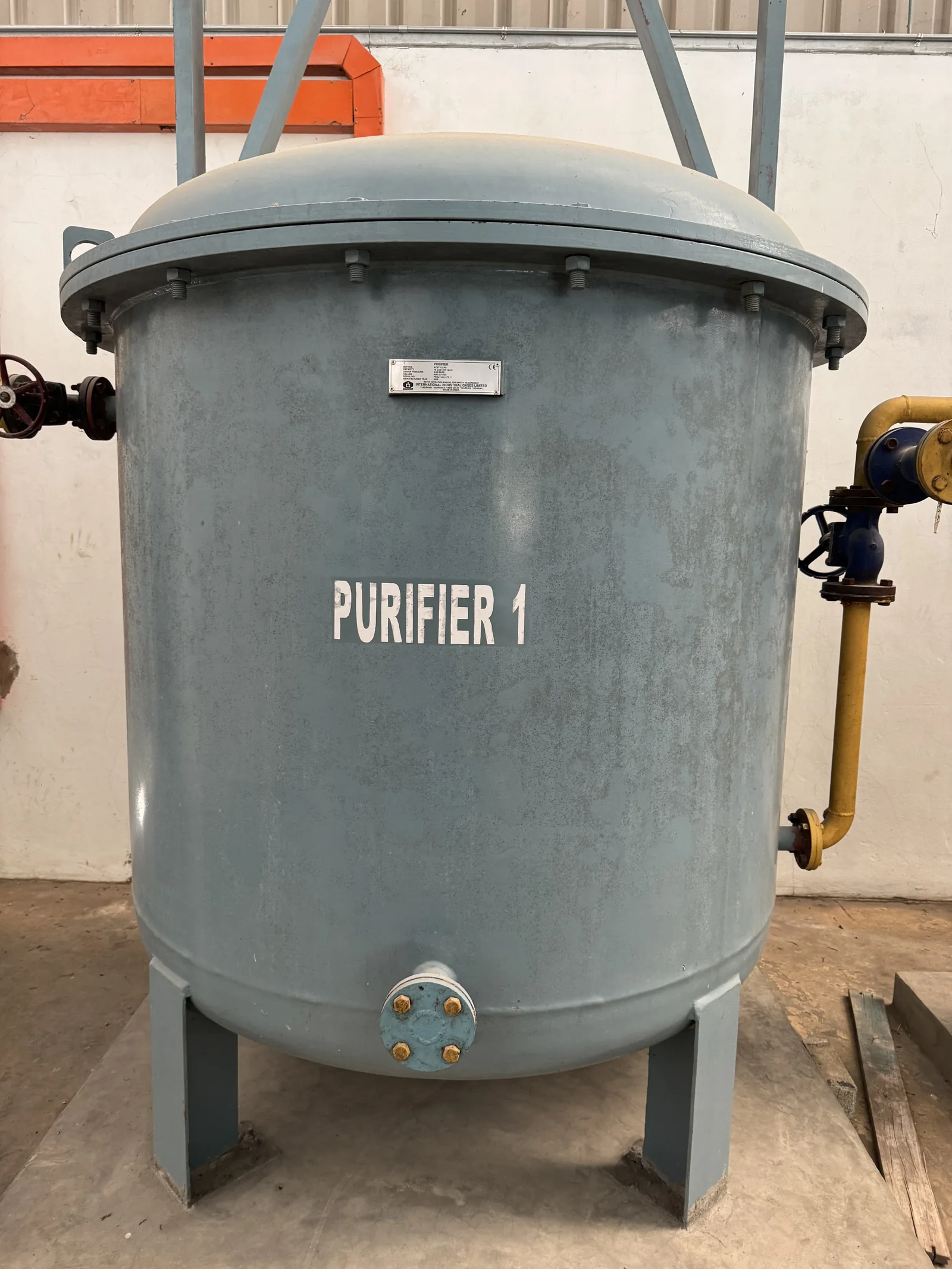
- Regeneration cycle
- Air blown through the isolated bed for 72 hours; fan pressure at least 15 cm WG
- Temperature stop
- If outlet air reaches 45 °C
- Air space velocity
- About 11 bed volumes per hour for regeneration against about 50 per hour in service; roughly 10 cycles before discard
- Service limit
- Never more than 3 weeks between regenerations; drain bottoms every 8 hours; silver nitrate test every shift
- Indian phosphine load
- 800 to 1
A dry acetylene purifier is a chemical bed, and like any chemical bed it is consumed. The ferric chloride mass that strips phosphine and hydrogen sulphide from the gas is re-oxidised with air, roughly ten times over its life, and each cycle restores a little less. Knowing how to run the 72-hour regeneration, when to trigger it and when to stop pretending the bed can be revived is most of what separates a plant that fills clean cylinders from one that does not.
What the purifier removes and why
Gas from a carbide-to-water generator is already 99 to 99.5 % acetylene on a dry basis; the main contaminant is air entrained with the feedwater. Purification in the trade sense means removing the non-metallic hydrides, mainly phosphine and hydrogen sulphide, with arsine and ammonia alongside. Phosphine comes from calcium phosphate in the lime and coke reduced to phosphide in the carbide furnace; hydrogen sulphide from calcium sulphide. The lime slurry in a wet generator holds back most of the sulphur, so hydrogen sulphide in crude gas is usually below 10 vpm, but phosphine passes almost entirely into the gas.
For dissolved acetylene IS 308:2024 sets 0.01 % by volume for phosphorus compounds as PH₃ and 0.02 % for sulphur compounds as H₂S. A ferric chloride bed of the Regenetal type can bring phosphine down to about 0.1 vpm and hydrogen sulphide to about 1 vpm at a working space velocity of about 50 bed volumes per hour, as compiled by S. A. Miller (1965) from British practice. That margin is why the silver nitrate paper, which responds to 5 vpm instantly, is such a good breakthrough detector.
The real reason to purify is the cylinder, not the weld. Phosphine and divinyl sulphide are retained by the porous mass and acetone; of the phosphorus charged with gas at about 0.06 % PH₃, only 55 to 79 % came back out over 14 days depending on temperature (Hölemann and Hasselmann, Forschungsberichte des Landes Nordrhein-Westfalen No. 739, 1959). What stays accumulates for the life of the cylinder.
Indian carbide and the phosphine load
A British Oxygen Company survey, run by the BS 642:1951 method on carbide offered for sale in Britain over ten years and reported by Miller, found phosphine from 19 manufacturers in 12 countries all within 150 to 310 vpm, with Indian carbide at 800 to 1,000 vpm, the highest in the table. The figures date from the 1950s and 1960s and say nothing about any present supplier, but they explain a design fact: an Indian purifier bed does three to six times the phosphine duty of a European one per cubic metre of gas. The bed is also the plant's effective lime-dust filter, taking entrained lime from about 21 mg/m³ down to about 1 mg/m³ in the first hour after start-up (Hölemann, Forschungsberichte des Landes Nordrhein-Westfalen No. 888). Stop-start plants load it faster still. Both facts argue against a calendar interval and for a breakthrough-triggered one.
How the bed is built
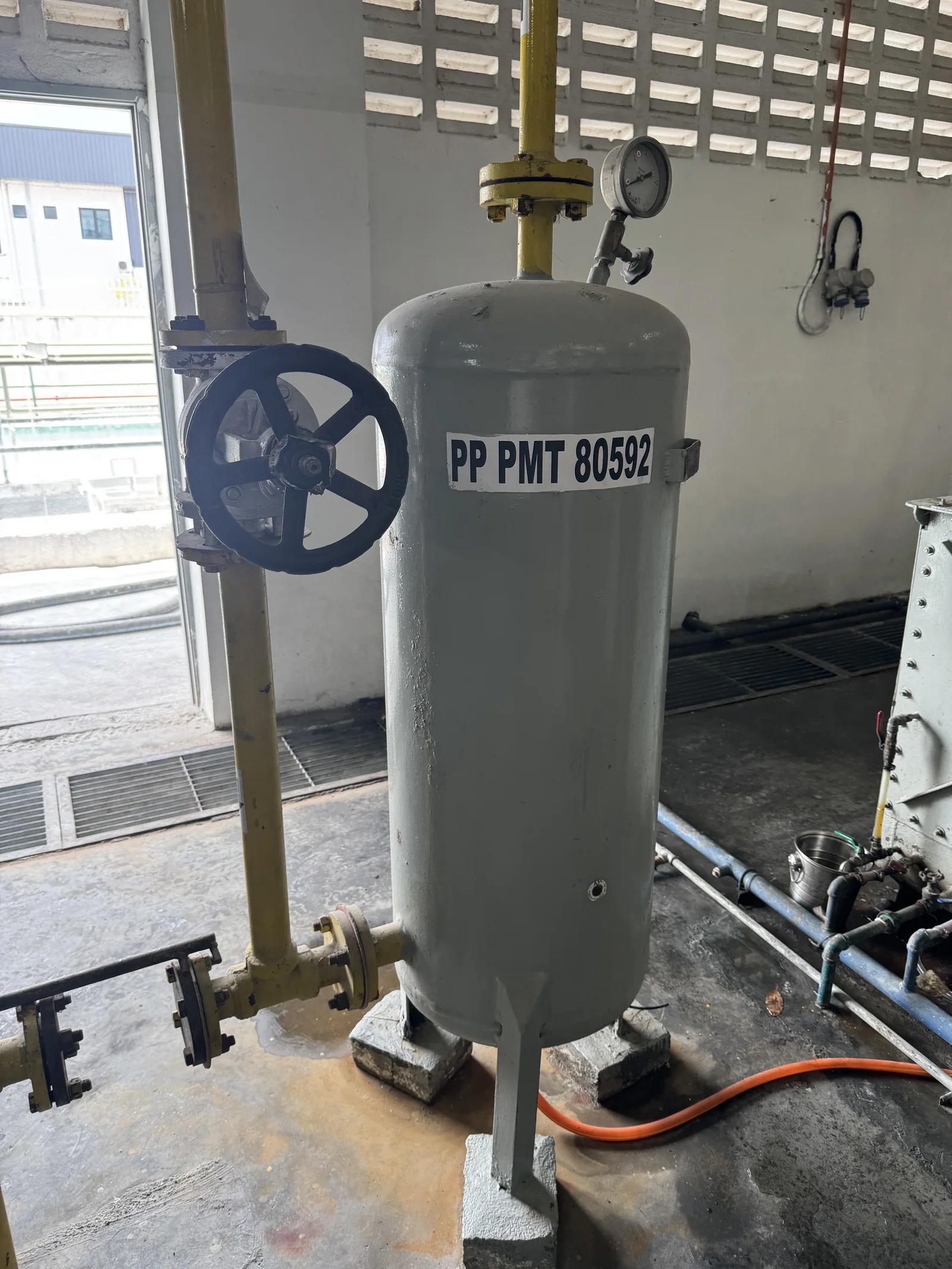
KIGL purifiers of the non-regeneration type take a charge of 250 kg on the DA-25 and 400 kg on the DA-45. The material is sieved through an 8 to 10 mesh screen and laid in three layers, each on its own stainless steel wire mesh: a first layer of about 400 mm, a second of 400 mm, and a top layer of about 200 mm of lime-kieselguhr mixture. The mass is spread with a light wooden rake and the edges pressed with a wooden reamer; the vessel interior is protected with zinc chromate primer and two coats of anti-acid paint.
The top layer deserves a word, because operators routinely misunderstand it. The lime is an HCl guard bed. Ferric chloride masses originally introduced traces of dichloroethylene and hydrogen chloride into the gas; the dichloroethylene was eliminated by cutting the mercury and copper chloride content to the minimum needed, and a layer of lime on top of the bed holds back any trace of HCl. It is not a filter, not a drier, and not an active purifying layer.
Before acetylene is admitted to a fresh or regenerated bed the vessel is purged with dry nitrogen for 2 to 3 minutes and the cover joint soap-tested. The purifier then runs at 0.1 to 1.3 kg/cm²g and within about 15 °C of ambient temperature, with its bottom drained every 8 hours and the drain valve never left open.
When to take a bed out of service
| Trigger | Action |
|---|---|
| Silver nitrate paper stains on gas leaving the top tray | Withdraw immediately; switch to the standby purifier |
| 3 weeks in service since the last regeneration | Withdraw and regenerate regardless of test result |
| Regeneration no longer restores a practical interval | Repack with fresh mass |
| Water found inside the bed | Withdraw; find the moisture source before repacking |
| Rising pressure drop across the bed | Investigate for blinding by lime dust or wet, clumped mass |
The rotation is run with progressively shortened intervals, so the record of each purifier's service dates is what tells the plant when repacking is due. The records the manual requires are not optional: date of repacking and quantity used, date out of service, date returned, hours on the fan and maximum air temperature, every purity test result, and any fault. They are open to inspection at any time, and they are the only evidence a plant has that its gas met IS 308 on a given day.
The 72-hour regeneration procedure
- Isolate the purifier by closing its gas inlet and outlet valves slowly, then purge it with nitrogen so that no acetylene-air mixture can form inside.
- Connect the regeneration blower. The fan must deliver at least 15 cm WG and the blower at least 18 cm WG; the air pressure in the vessel is kept low, within the limit set in the plant's own operating manual, because a purifier tank blown hard enough can get hot enough to start a fire.
- Run the air for 72 hours.
- Record the outlet air temperature every hour for the first 4 hours and every 2 hours thereafter until it stops rising.
- If the outlet air reaches 45 °C, stop the fan at once and let the bed cool for one hour, or cool it with nitrogen at less than 0.4 kg/cm²g, before restarting the air.
- For the first 4 hours after the bed returns to service, feel the vessel by hand for warm spots; if any are found, keep nitrogen on at less than 0.4 kg/cm²g until cool, then open the vessel and replace any discoloured material.
- Drain the regeneration pipeline near the exhaust fan at the same 8-hour interval as the purifier bottoms.
The 72 hours is not a KIGL invention. British dissolved-acetylene practice regenerated ferric chloride masses in place with an air current at a space velocity of about 11 bed volumes per hour for 72 hours, against about 50 per hour in gas service. The air is deliberately four to five times slower than the gas because re-oxidising ferrous to ferric iron is exothermic; the 45 °C stop and the low air-pressure limit are the same control expressed as a temperature and a pressure rather than a flow. A blower sized on the gas rate will run the bed hot.
Why capacity falls every cycle
Air restores the oxidant. It does not remove the products. The phosphate, phosphite and sulphate formed in service stay on the kieselguhr, progressively occupying surface and blocking pores, and the lime dust the bed has filtered out of the gas stays with them. That is why a ferric chloride mass can be regenerated about ten times before it is cheaper to discard, with a somewhat shortened run after each regeneration. The two signs that a bed is approaching the end are a purity test that fails sooner each cycle and a pressure drop that no longer recovers.
Spent mass is a mercury-bearing, acidic solid: mercury as chloride, phosphide and sulphide, iron and copper chlorides, calcium phosphate and sulphate, and the HCl-laden lime from the top layer. It is removed with the lid and lining treated carefully. The manual's sequence is to purge the acetylene out with nitrogen (older KIGL manuals say air or nitrogen; nitrogen is the only purge gas for acetylene plant), run the fan for not less than 12 hours, blank all regeneration lines, mark the lid-to-tank alignment, hoist the lid, remove the top screen one half at a time and never scratch the lining. Rubber gloves, and a dust mask if the mass is dry, are mandatory. The disposal route is a hazardous-waste question that the plant's own licence conditions must answer.
Rules that matter
KIGL audits carbide-to-water plants of several makes, and the purifier is the component most often found defeated. Across five audited plants, the purifier was bypassed, never used or improperly regenerated at every one. The consistent reasons were throughput and the labour of regeneration, never a technical judgement that the gas was clean. Three specific failures recur:
Lessons from the field
- Running one purifier where the design is two in series. Each unit has a rated flow; feeding a plant's full duty through one unit over-commits it on the impurity that matters most, and KIGL estimates the loss of purification efficiency at up to 60 %.
- Water inside the bed. A wet ferric chloride mass clumps into blocks, the gas channels past the active material and the bed loses capability while looking intact. At one plant the moisture was traced to a missing check valve ahead of the scrubber, which allowed back-pressure to push water out of the wet arrestor into the gas line. A water separation pot ahead of the purifier is cheap insurance.
- No purity test at all, or random untested intervals with no logbook. Contamination accumulating in customers' cylinders is invisible until a cylinder fails.
In KIGL's own recommissioning work the regeneration technique has also been found wanting at several sites, and KIGL audit reports recommend what they call the diagonal regeneration method together with strict rotation. The method is described in KIGL's audit reports; ask KIGL for the procedure before applying it to another purifier.
Rules that matter
Rules to apply
- Test with silver nitrate every shift on gas leaving the purifier; a stain withdraws the unit immediately.
- Never exceed 3 weeks in service; expect much less on high-phosphorus carbide.
- Regenerate for 72 hours at low air pressure, logging outlet temperature, and stop at 45 °C.
- Drain purifier bottoms every 8 hours; investigate any water in the bed rather than repacking around it.
- Keep every purifier record; it is the plant's evidence of gas quality.
- Never bypass the purifier. The KIGL purification system is designed for two units in rotation so that one is always clean.
Regenerating an acetylene purifier — frequently asked questions
How often should an acetylene purifier be regenerated?
Regenerate on evidence, not on the calendar. KIGL's manual sets 3 weeks as the maximum time in service between regenerations and requires a silver nitrate test on the gas leaving the top tray every shift; a stain means the purifier comes out of service at once. On Indian carbide, which carries several times the phosphine of European grades, breakthrough often arrives well inside 3 weeks, so the rotation is run with progressively shorter intervals.
What does regeneration actually do to the purifying mass?
The mass is ferric chloride with small amounts of copper and mercury salts on kieselguhr. In service the mercury captures phosphine and hydrogen sulphide as insoluble phosphide and sulphide, and ferric iron oxidises them to phosphate and sulphate, becoming ferrous iron. Air regeneration re-oxidises the iron, with copper as catalyst. It does not remove the phosphate and sulphate, which is why capacity falls a little every cycle.
Why must the fan be stopped at 45 °C?
Re-oxidising ferrous to ferric iron with air is exothermic. If air is blown too fast the bed heats, and a hot purifier with acetylene residues and mercury salts in it is a fire risk. KIGL's manual limits regeneration air pressure, checks outlet air temperature every hour for the first 4 hours and every 2 hours after that, and stops the fan for an hour of cooling if 45 °C is reached. The published British practice of 11 bed volumes per hour is the same control expressed as a flow.
How many times can a purifier bed be regenerated before repacking?
About 10 times is the figure for ferric chloride masses in British dissolved-acetylene practice, with a somewhat shorter run after each cycle. KIGL's rule is practical rather than numerical: repack when regeneration no longer restores a useful interval, that is when the purity test forces regeneration more often than the rotation can accommodate.
What is the lime layer on top of the purifier for?
It is a guard bed for hydrochloric acid, not a filter and not a drier. A ferric chloride mass can release traces of HCl into the gas; a layer of lime on top holds it back. KIGL beds are built as two 400 mm layers of purifying mass with a 200 mm lime-kieselguhr layer on top, each on its own stainless steel mesh, sieved through 8 to 10 mesh and levelled with a wooden rake.
Why does Indian carbide need more purifier duty?
Phosphine comes from phosphate in the lime and coke used to make the carbide, and it leaves the generator almost entirely as PH₃. A British survey covering 19 manufacturers in 12 countries found 150 to 310 vpm from normal carbide and 800 to 1,000 vpm from Indian carbide. Per cubic metre of gas, a bed on Indian carbide does 3 to 6 times the work, so a bed that would last 3 weeks on carbide in the normal range may last only a third to a sixth as long.
Can the purifier be bypassed when gas goes to a pipeline rather than cylinders?
No. Across five plants KIGL has audited, the purifier was bypassed or under-used at every one. Phosphine and hydrogen sulphide corrode wet steel, attack cylinder shells from inside and clog the porous mass, and the damage persists after refilling with clean gas. Bypass is prohibited during cylinder filling and is not sanctioned for pipeline supply either.
Does the phosphine in the gas make the purifier an explosion risk?
Not at the concentrations found in practice. Ignition-temperature measurements on impure acetylene-air mixtures (Ershov, Lyadski and Ragnueva, 1961) show the minimum ignition temperature still 300 to 310 °C at 0.17 % PH₃, and the authors concluded that 0.2 % adds no generation hazard. Phosphine is a product-quality, corrosion and toxicity problem, and that is the honest reason to purify.
References
- Bureau of Indian Standards. (2024). Dissolved Acetylene (Gas) — Specification (IS 308:2024, Fourth Revision).
- Compressed Gas Association. (n.d.). Acetylene (CGA G-1).
- European Industrial Gases Association. (n.d.). Acetylene Plant Design and Operation (EIGA Doc 241).
- Granjon, British Patent 19,838 (1912); Booer, British Patent 181,571 (1921) — origin of ferric chloride purifying masses on kieselguhr https://www.gov.uk/government/organisations/intellectual-property-office
Enquiries
Request a quotation
State the gas or equipment, the quantity or capacity, and your location. KIGL will confirm the grade, the cylinder or plant size, and whether the location can be served from Noonmati, or through the agent network.