
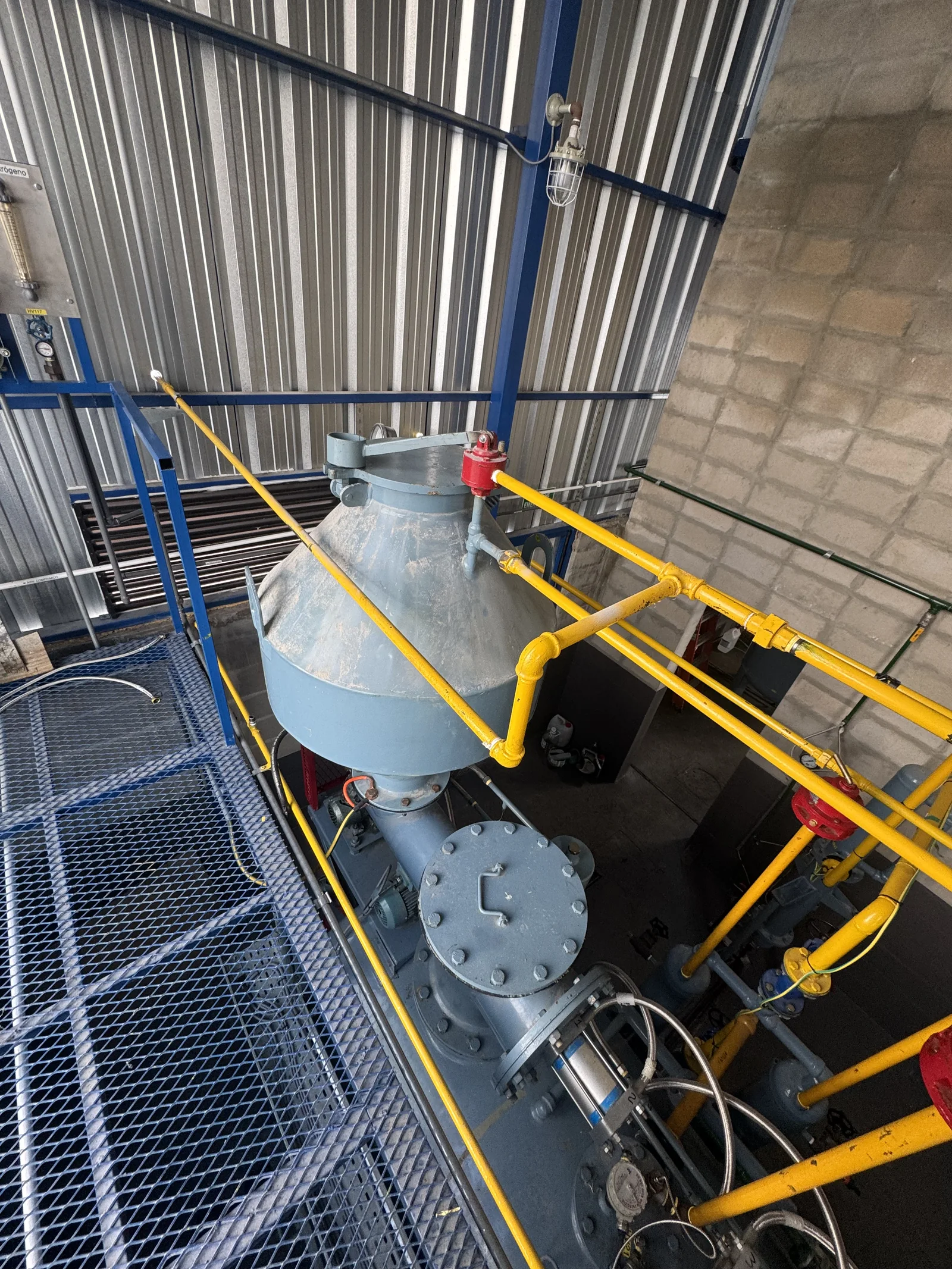
Equipment
Acetylene generators — the carbide-to-water vessel at the head of every plant
An acetylene generator reacts calcium carbide with water to make acetylene. KIGL builds the carbide-to-water type to IS 8471:2003, feeding carbide by screw into a water tank held below 70 °C at 6 to 8 litres per kg, and delivering gas at 0.92 kg/cm²g. Capacities run from 25 to 100 Nm³/h.
Written and checked by KIGL technical staff · Reviewed by Devendra Kumar Garg, Founder and Chairman
- IS 8471 : 2003
- Governing standard
- Carbide-to-water
- Generator type
- 6 to 8 litres per kg of carbide
- Water to carbide ratio
- 0.92 kg/cm²g
- Normal operating pressure
- Below 70 °C
- Maximum tank temperature
On this page 11 sections
What an acetylene generator does #
Everything else in an acetylene plant exists to clean up and compress what the generator makes. The reaction itself is simple enough to write in one line:
CaC₂ + 2H₂O → C₂H₂ + Ca(OH)₂
Calcium carbide and water give acetylene and slaked lime. The difficulty is not the chemistry. It is that the reaction releases about 429 kcal for every kilogram of commercial carbide, and acetylene is a gas that decomposes when it gets hot or when pressure rises. A generator is therefore a heat-management vessel first and a reactor second.
KIGL builds the carbide-to-water type, in which a screw feed drops carbide into a large standing body of water. That water is the heat sink. The reaction consumes only about half a litre per kilogram of carbide, but the generator is charged at 6 to 8 litres per kilogram so that the heat has somewhere to go and the tank stays below 70 °C.
The operating envelope #
| Parameter | Normal value | Why it matters |
|---|---|---|
| Gas pressure | 0.92 kg/cm²g | Keeps generation well inside the 1.5 bar ceiling |
| Water to carbide | 6 to 8 litres per kg | Below 6, the tank temperature climbs |
| Tank temperature | Below 70 °C | Above it, polymerisation and discoloured gas begin |
| Gas recovery | ≥ 90 % of carbide yield | The IS 8471 cl 5.2 acceptance figure |
| Capacity fluctuation | Within 10 % | The IS 8471 cl 5.1 continuous-running figure |
Two of these limits are worth separating, because they are often confused. 0.92 kg/cm²g is the normal running band, not the maximum settable pressure. A set point raised above the maker's figure was one of the recurring findings in KIGL's own plant audits, and it was found identically on more than one generator at the same site — which makes it a decision somebody took, not a drift.
Why the pressure limit is low #
Acetylene is one of very few industrial gases that can propagate a flame with no oxidant present at all. Raise its pressure and a local ignition can run through the gas as a decomposition. The accepted generation ceiling is 1.5 bar gauge, and EIGA Doc 237/21 states plainly that generator pressure above it is not permitted, because generator vessels are designed for operating pressure rather than decomposition pressure.
That last clause is the important one. A generator is not built to survive a decomposition. It is built not to have one. The 1.5 bar rule sets out the measurements the limit rests on.
Acetylene generators, filled and despatched from KIGL's own works.
Guwahati works · agent network
Safe handling
Safety devices on the vessel #
Three things protect the generator, and IS 8471:2003 names all of them.
- The hydraulic back-pressure valve, which doubles as the generator's flash back arrestor. Clause 12.8 requires it to be designed, made and tested to IS 11006, and clause 12.2 sets its steel sheet at not less than 2.0 mm. How the water seal actually stops a flame is covered under wet flashback arrestors.
- Two automatic pressure reliefs on any generator holding 50 kg of carbide or more (clause 11.1) — one on the generating chamber, one on the back-pressure valve.
- Level and temperature alarms, high and low. A level transmitter scaled with lime reads low, and then the trips and the slurry valve are working from a false number. That was another audit finding, and it is why the calibration register exists.
A soot mark below an arrestor's water line is the one piece of evidence that cannot be argued with: it means the arrestor has been run dry, and that the weekly drain and refill is not being logged.
What goes wrong, and what it looks like #
| Symptom | Likely cause | Where to look |
|---|---|---|
| Tank temperature climbing | Water ratio below 6 l/kg, or feed rate too high | Overheating and polymerisation |
| Discoloured or smelly gas | Polymerisation at high tank temperature | Same |
| Gas yield below 270 l/kg | Carbide wet from store, or feed error | Carbide storage losses |
| Pressure not rising on charge | Screw feed slipping, or hopper not sealing | Daily and weekly tasks |
| Sludge setting hard in the tank | Agitator stopped overnight | Yearly clean-out procedure |
| Suction falling at the compressor | Restriction upstream, often the generator arrestor | Compressor troubleshooting |
Falling suction at the compressor deserves its own note, because the compressor is usually blamed for it. The compressor is reporting someone else's problem. Work backwards through the purifier, the low-pressure drier, the generator flash back arrestor and the generator tank until you find where the flow is being throttled.
Carbide: what the generator is fed #
A generator is only as good as its carbide, and carbide is graded by the gas it yields. Commercial material at 300 l/kg is roughly 82 % CaC₂ and 12 % CaO. Size matters as much as assay: the same consignment gives about 300 l/kg at 25–50 mm but around 280 l/kg at 7–25 mm, because the finer material reacts faster than the water can carry the heat away.
Carbide also degrades in store. An open drum loses to atmospheric moisture, and the loss is large enough to show up as a yield shortfall rather than as a weight change. The carbide quality tests guide gives the acceptance checks, and grades, sizes and gas yield gives the yield table.
Where the generator sits in the plant #
The generator is the first of nine stages. Gas leaves it at a fraction of a bar, saturated with water on purpose, because wet acetylene is safer to compress than dry. It then passes through the cooler-condenser, the low-pressure drier, the chemical purifier, the scrubber and the high-pressure drier before it ever reaches a cylinder.
The full train, with the figures for each stage, is on acetylene gas plants. The cleaning stages are on acetylene purification systems, and the machine that raises the pressure is on acetylene compressors.
Licensing #
A generator is licensed plant, not equipment you can simply buy and install. Carbide storage and acetylene generation fall under the Carbide of Calcium Rules, administered by PESO, with approvals issued by the Chief Controller of Explosives at Nagpur. Any change to approved plant needs the amended drawing back through PESO before commissioning. The PESO licence guide sets out the Form C and licence-grant files document by document.
Supply, spares and commissioning #
KIGL builds the generator as the first stage of a complete KIGL-DA plant, and also supplies it on its own for plants of other makes. A generator bought on its own is sized from the drawings of the plant it is going into rather than from a catalogue. The gas offtake, the cooling water and the pipe runs already exist on an operating plant, and the vessel has to suit them. KIGL builds 25, 50 and 100 Nm³/h plants, and a generator quoted separately is sized against the plant's rated output in the same way.
To quote for a generator alone, KIGL needs the plant's rated output in Nm³/h and the carbide size the plant runs. It also needs the process flow drawing or schematic, with the inlet and outlet connection sizes and their positions marked. The cooling water available at site and the PESO licence currently held both bear on the sizing. A recent gas analysis helps where one exists, because poor recovery is sometimes a carbide or feed-rate problem rather than a vessel problem.
Any change to approved plant is a licensing matter before it is an engineering one. The amended drawing goes back through PESO and is approved before the new vessel is commissioned. KIGL does not commission a replacement stage against an unamended licence. The PESO licence guide sets out which forms are filed and in what order.
Erection and commissioning are supervised rather than taken over. KIGL supervises the work and trains the operators on the plant itself, while the civil work, the utilities and the labour stay with the buyer.
Specification
Acetylene generators — full specification
| Property | Value | Basis |
|---|---|---|
| Governing standard | IS 8471 : 2003, medium pressure generators | Bureau of Indian Standards |
| Generator type | Carbide-to-water, screw-fed, continuous | KIGL-DA series operating manual |
| Water to carbide ratio | 6 to 8 litres per kg of carbide, never below 6 | KIGL-DA series operating manual |
| Normal operating pressure | 0.92 kg/cm2 gauge | KIGL-DA series operating manual |
| Maximum tank temperature | Below 70 degrees Celsius | KIGL-DA series operating manual |
| Minimum gas recovery | Not less than 90 per cent of the carbide gas yield | IS 8471 : 2003, cl 5.2 |
| Capacity range built | 25, 50 and 100 Nm³/h | KIGL plant range |
| Pressure relief | Two automatic reliefs above a 50 kg carbide charge | IS 8471 : 2003, cl 11.1 |
| Built for plant sizes | KIGL-DA-25, DA-50 and DA-100, and other makes sized from drawings | KIGL plant range |
Questions
Acetylene generators — frequently asked questions
What type of acetylene generator does KIGL build?
KIGL builds the carbide-to-water type, which is the design IS 8471:2003 is written around and the only one suited to continuous plant duty. Carbide is screw-fed into a large body of water, so the water absorbs the heat of reaction and the tank stays below 70 °C. The alternative water-to-carbide and dry designs cannot hold that temperature at 25 Nm³/h and above.
How much water does an acetylene generator need per kilogram of carbide?
Between 6 and 8 litres per kilogram, and never below 6. The water is not a reagent quantity but a heat sink: the reaction itself consumes only about 0.5 litre per kg. Running below the floor lets the tank climb towards 70 °C, at which point polymerisation and discoloured gas begin. The [water-to-carbide ratio](/guides/acetylene-generator-water-to-carbide-ratio) guide works the arithmetic.
What pressure does the generator deliver?
0.92 kg/cm²g in normal running. That figure is not arbitrary. Acetylene can decompose without any oxygen present once pressure rises, and 1.5 bar gauge is the accepted ceiling for generation worldwide. KIGL's 0.92 kg/cm²g band sits inside it with margin. The [1.5 bar rule](/guides/where-the-1-5-bar-acetylene-rule-comes-from) explains the measurements behind the limit.
How much gas should a generator recover from its carbide?
IS 8471:2003 cl 5.2 requires not less than 90 % of the carbide's rated gas yield. With commercial 300 l/kg carbide, that means at least 270 litres per kilogram reaching the plant. Recovery below that points at feed-rate error, carbide that has absorbed atmospheric moisture in store, or gas lost through a relief or a leaking joint.
What are the generator's safety devices?
A hydraulic back-pressure valve, which is also the generator's flash back arrestor, and automatic pressure relief. IS 8471:2003 cl 11.1 requires generators holding 50 kg of carbide or more to carry two automatic reliefs — one on the generating chamber and one on the hydraulic back-pressure valve. Clause 12.8 requires that arrestor to be made and tested to IS 11006.
Why does the agitator run 24 hours a day?
Because lime sludge sets if it stands. The agitator runs on an intermittent timer around the clock, and it is the one switch left on at plant shutdown. A tank whose agitator has been off overnight may need the sludge broken out by hand, and the only permitted tool is a wooden paddle.
How often is the generator tank cleaned out?
On the yearly schedule, and it is a full isolation job: drain, uncouple the agitator from its gearbox, isolate the control panel so nothing can start, open the manholes and flush. The [plant maintenance schedule](/guides/acetylene-plant-daily-weekly-monthly-yearly-tasks) gives the daily, weekly, monthly and yearly tasks in order.
Can KIGL supply a generator for an existing plant?
Yes. KIGL sizes generators from drawings for plants it did not build, and the same applies to purifiers and compressors. The constraint is the licence rather than the vessel: any change to approved plant needs the amended drawing back through PESO before it is commissioned.
References
Bureau of Indian Standards.
- IS 8471:2003, First RevisionAcetylene generators — Requirements (2003)
- IS 11006:2011, First RevisionFlash back arrestor (flame arrestor) — Specification (2011)
Linstrom, P. J., & Mallard, W. G. (Eds.).
- NIST Standard Reference Database 69NIST Chemistry WebBook (n.d.) National Institute of Standards and Technology.
- The Kamrup Industrial Gases Limited. (2026). Company information and manufacturer's data [Company statement].
Read next
Enquiries
Request a quotation for acetylene generators
State the gas or equipment, the quantity or capacity, and your location. KIGL will confirm the grade, the cylinder or plant size, and whether the location can be served from Noonmati, or through the agent network.