
Guide
Why acetylene cylinders must be used and stored upright and how long to wait after one has been lying down
An acetylene cylinder must stand upright because its acetone, swollen by about 84 % with dissolved gas, can reach the valve and leave as liquid if the cylinder lies down. IS 14814:2023 cl 7.3.1 requires upright use and storage, and about half an hour upright before use after lying down.
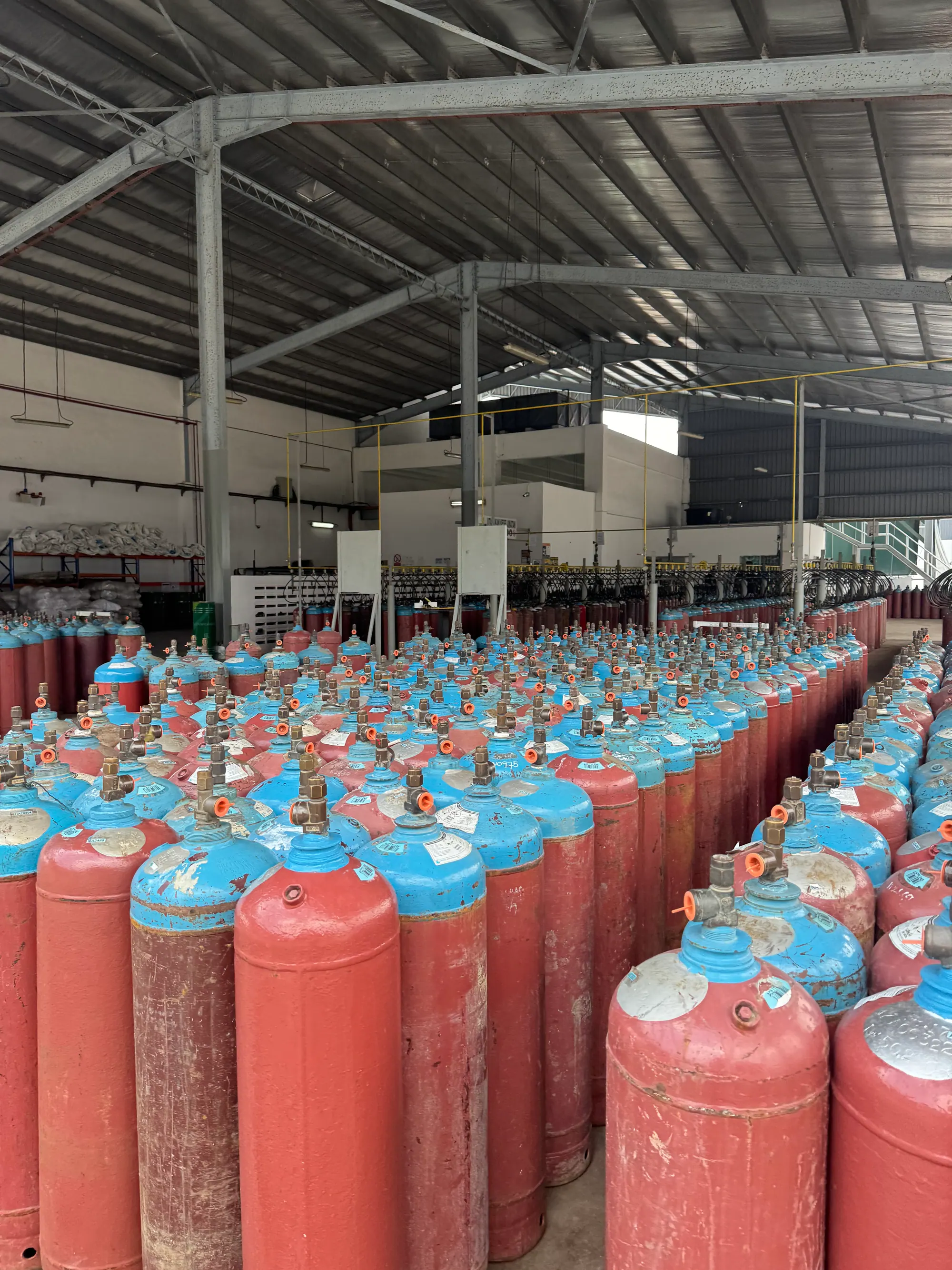
- Indian rule
- Use or store only upright to avoid acetone leaking; if not possible
- Solvent swelling
- Acetone dilates by about 84 % at 15 °C and 15 atm; each gram of acetylene dissolved adds about 1.6 ml
- Liquid level
- Radiography of fully charged cylinders detects a liquid level in probably all granular masses in use
- Acetone charge
- Up to 43.4 % of water capacity by volume at 90
- Older code
- The C.P.I. code of 1968 contained no upright-use rule at all
Acetylene cylinders are to be kept upright, and the reason is inside them. A dissolved acetylene cylinder holds several litres of liquid acetone, swollen by the gas dissolved in it, with only a small gas space above. Stood upright, the valve at the top draws gas from that space. Laid down, the liquid can reach the valve and leave as liquid. IS 14814:2023 makes upright use and storage the rule in India and sets a wait before a cylinder that has been lying down is used.
What the Indian code says
IS 14814:2023, the Indian acetylene code of safety, cl 7.3.1, states that acetylene cylinders should be used or stored only in an upright position to avoid the possibility of acetone leaking from the cylinder, and that where this is not possible the cylinder should be stood upright and left about half an hour before use. The same code requires opening the valve slowly and not more than one and a half turns, and forbids storing acetylene and oxygen cylinders together (cl 7.3.3). Note that IS 14814:2023 still refers to the Gas Cylinder Rules 1981 for storage and transport; the Gas Cylinders Rules 2016 now govern and should be read with it.
The older literature is silent. The C.P.I., Safety in the Production and Use of Acetylene (Paris 1968), the most detailed international code of its day, covered cylinder heat, impact and valve closure but contained no upright-use rule. The orientation rule is a product of later experience.
Why the liquid is so close to the valve
Three numbers explain it.
| Quantity | Figure | Source |
|---|---|---|
| Acetone charge at 90–92 % porosity, cylinder > 9 l | 43.4 % of water capacity by volume | IS 7312:1993 cl 19.3.2 (withdrawn edition) |
| Swelling of acetone at 15 °C and 15 atm | ×1.84 (546 g acetylene per kg acetone) | Hölemann and Hasselmann, as compiled by S. A. Miller (1965) |
| Volume added per gram of acetylene dissolved | about 1.6 ml | Same |
| Expansion of loaded solvent with temperature | about 0.23 % per °C | Same |
An acetone charge that occupies 43 % of the shell volume when it goes in occupies roughly 80 % of it once the cylinder is full of gas, against a pore volume of 90–92 %. A worked example from the dilation data for a 41-litre shell with a 92 % mass and 12.8 kg of acetone gives a charged solution of about 29.7 litres in 37.7 litres of void, filling 79 % of it; heating that cylinder from 15 °C to 45 °C takes the liquid to about 84 %. The gas space that separates the liquid from the valve is therefore a small fraction of the cylinder, and it shrinks as the cylinder warms.
As compiled by S. A. Miller (1965), the consequence has been observed directly: when acetylene dissolves the solution dilates and the liquid expands into the interstitial spaces of the mass, and radiography of fully charged cylinders detects a liquid level in probably all the granular masses then in use. A fine-pored monolithic mass holds liquid more firmly by capillarity, but the liquid is still there. The detail is on inside a dissolved acetylene cylinder.
Rules that matter
With the cylinder horizontal, the valve and the neck well are no longer at the top of the gas space. Liquid that has drained towards the neck, or that froths up under draw, can enter the valve and pass to the regulator as liquid. The effects follow in order:
What happens when a cylinder lies down
- At the torch Liquid acetone reaching the blowpipe gives an erratic, spitting flame and can flare; acetone is a flammable liquid with a closed-cup flash point well below room temperature.
- In the equipment Acetone attacks some elastomers. Published seal-compatibility data (Parker ORD 5700) rate nitrile and fluorocarbon rubbers unsatisfactory in acetone, which is why acetone-wetted components use EPDM or butyl. Regulator diaphragms and hose linings rated for acetylene gas are not meant to run full of liquid solvent.
- In the cylinder Every litre of acetone that leaves as liquid is solvent lost from the protection system. The Explanation to Rule 37 of the Gas Cylinders Rules 2016 states that a shortage of solvent makes the cylinder less resistant to decomposition from flashback. Liquid loss is of a different order from the vapour loss described on acetone carry-over; a cylinder used on its side can lose more solvent in one session than in many normal cycles.
The combination of lying down and fast withdrawal is the worst case, because a fast draw supersaturates the solvent and froths it, as the withdrawal-rate page explains.
Why the wait after lying down
A cylinder that has been lying down, in a vehicle or after being knocked over, has liquid sitting in or near the neck. Standing it upright lets that liquid drain back into the mass under gravity, but capillary drainage through a fine porous mass is slow. IS 14814:2023 puts the wait at about half an hour. If a supplier's label specifies a longer wait, the rule to apply is the longer of IS 14814's figure and the cylinder label. Do not shorten the wait by opening the valve to clear liquid; that is exactly the liquid release the wait exists to prevent.
Rules that matter
Rule-based storage and transport requirements arrive at the same position by a different route:
Storage and transport follow the same rule
- The Gas Cylinders Rules 2016 Schedule VI forbid transporting acetylene cylinders in a closed vehicle and thin-wall cylinders horizontally, require cylinders to be secured, blocked or braced, and require valve protection. The Rules allow up to 25 DA cylinders to travel with non-toxic, non-flammable gas cylinders with due precautions. See transporting acetylene cylinders.
- Form F storage conditions require flammable gas cylinders to be separated from oxidising gas cylinders by 1 metre or a fire-resisting wall. Upright storage, chained or in racks, keeps the valve at the top and the cylinder from falling, which IS 7312:2018's footring and the CGA C-13 footring criteria assume. See storage rules.
- A fallen cylinder can also have its porous mass disturbed. The C.P.I. (1968) required impacts to be avoided in handling, and the Dutch rules compiled by Miller forbade knocking, dropping or using cylinders as rollers. A cylinder that has fallen hard should be reported to the filler, who will examine it at the next fill.
Rules that matter
Rules to apply
- Use and store acetylene cylinders upright, secured against falling, with the valve at the top.
- After any period lying down, stand the cylinder upright and wait at least half an hour, or longer if the label says so, before opening the valve.
- If liquid appears at the regulator, close the cylinder valve, shut the torch, clear the equipment and do not relight until the cylinder has stood for the full wait.
- Liquid from an upright cylinder means a filling fault; stop and return it.
- Transport acetylene cylinders upright, always, and never in a closed vehicle. Never roll a cylinder on its side; for a short move it may be tilted and rolled on its base ring, and for anything longer use a trolley.
For dissolved acetylene supply, the general rules are on handling acetylene cylinders and the code is summarised on acetylene safety standards.
Why acetylene cylinders must be used — frequently asked questions
Why can't acetylene cylinders be laid on their side?
Because the cylinder holds a large volume of liquid acetone, swollen to about 1.8 times its original volume by the dissolved gas, with only a small gas space at the top. Upright, the valve draws from that gas space. On its side the liquid can reach the valve and leave as liquid acetone, which upsets the flame, damages regulators and hoses, and depletes the solvent that protects the cylinder.
How long should an acetylene cylinder stand upright before use?
IS 14814:2023 cl 7.3.1 says about half an hour. If the supplier's label gives a longer wait, follow the label; the safe choice is always the longer of the Indian figure and the supplier's instruction. The wait lets liquid drain back from the neck into the porous mass before the valve is opened.
Is it dangerous to use an acetylene cylinder lying down?
Yes. Liquid acetone at the regulator and hose can make the flame erratic and flare, can damage regulator diaphragms and hose linings, and is itself flammable liquid released at the torch. Each such use also removes solvent, pushing the cylinder towards the solvent shortage that the Gas Cylinders Rules 2016 Explanation to Rule 37 identifies as reducing resistance to flashback.
Can I transport acetylene cylinders lying down?
The Gas Cylinders Rules 2016 Schedule VI forbid transport of acetylene cylinders in closed vehicles and of thin-wall cylinders horizontally. Acetylene cylinders are always transported upright, secured, with valves protected and closed, in an open or well-ventilated vehicle. If cylinders have been carried lying down for any reason, stand them upright and wait before use.
Does a monolithic porous mass stop acetone moving when the cylinder lies down?
It reduces it, because a fine-pored monolithic mass holds liquid by capillarity better than a granular one, but it does not eliminate it. The data compiled by S. A. Miller (1965) show that dissolved gas swells the solvent into the interstitial spaces and that a liquid level forms in charged cylinders. The upright rule applies to every DA cylinder regardless of mass type.
What should I do if liquid comes out of an acetylene cylinder valve?
Close the valve at once, shut off the torch, and check that the cylinder is upright. Do not relight until the regulator and hose have been cleared and the cylinder has stood upright for at least the specified wait. If liquid appears on an upright cylinder, stop using it and return it to the filler; it may be overfilled with solvent.
Why did older acetylene codes not require cylinders to be upright?
The C.P.I. code of 1968 dealt with cylinders in terms of heat, impact and valve closure and contained no orientation rule. The upright requirement in IS 14814:2023 reflects later experience with solvent carry-over and is one of the clearest places where current Indian practice is ahead of the older literature.
References
- Asia Industrial Gases Association. (2026). Code of Practice: Acetylene (AIGA 022/26).
- Bureau of Indian Standards. (1993). Welded and Seamless Steel Dissolved Acetylene Gas Cylinders (public BIS mirror) (IS 7312:1993).
- Bureau of Indian Standards. (2023). Acetylene — Code of Safety (IS 14814:2023, First Revision).
- Government of India. (2016). Gas Cylinders Rules, 2016 (G.S.R. 1081(E)). Petroleum and Explosives Safety Organisation.
Enquiries
Request a quotation
State the gas or equipment, the quantity or capacity, and your location. KIGL will confirm the grade, the cylinder or plant size, and whether the location can be served from Noonmati, or through the agent network.