
Guide
Acetone carry-over: why an acetylene cylinder should never be run below 2 bar
Acetone vapour leaves an acetylene cylinder with the gas in proportion to its vapour pressure: about 1.2 % of the gas at 15 atm and 20 °C, 23 % at 1 atm, and 55 % at 1 atm and 40 °C. Returning cylinders at 2 bar or more keeps the solvent in the cylinder.
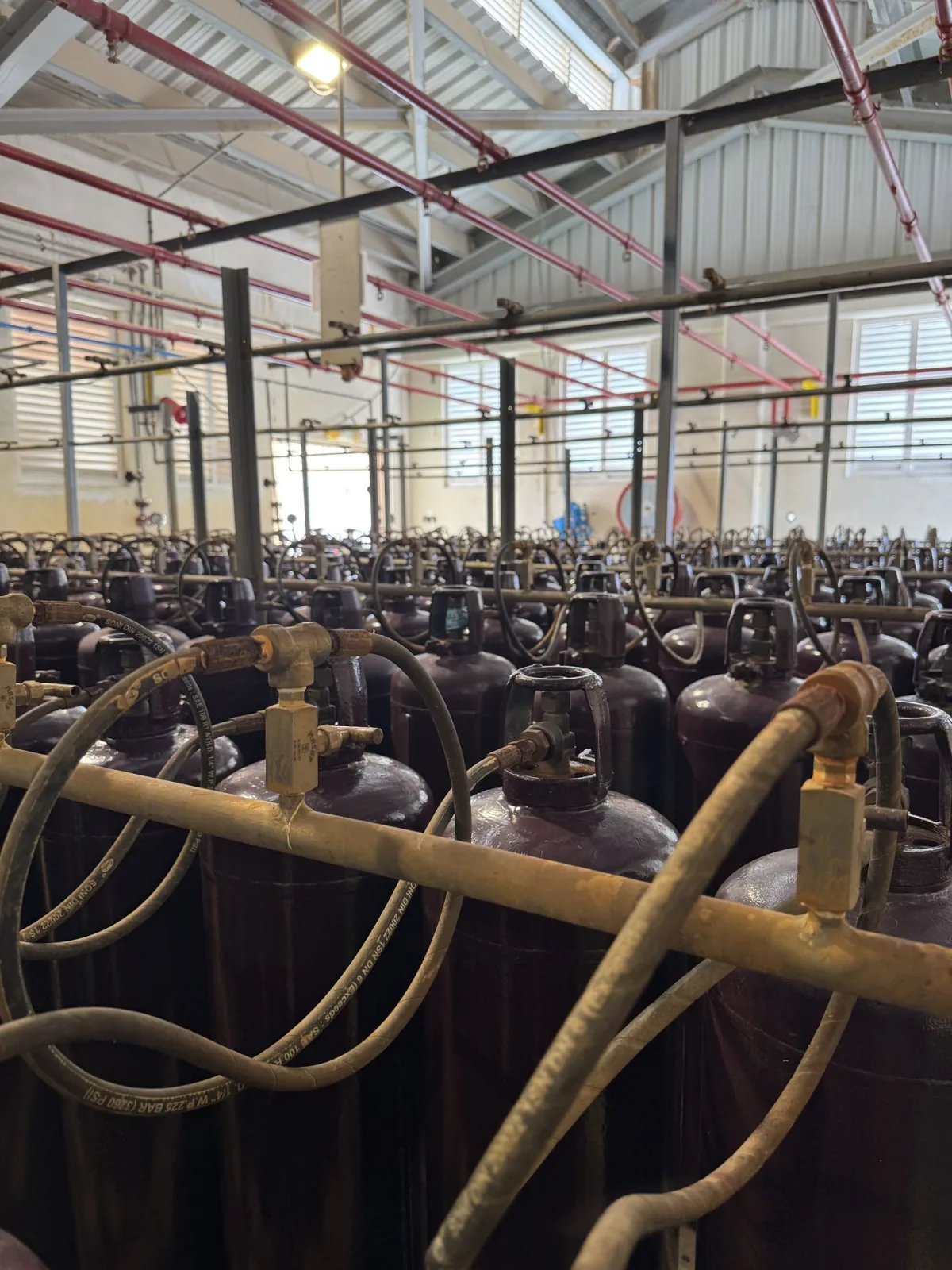
- Acetone vapour in withdrawn gas
- 1.2 % at 15 atm and 20 °C; 4.0 % at 5 atm; 23 % at 1 atm; 55 % at 1 atm and 40 °C
- Isothermal discharge at 15 °C
- Acetone vapour content rises from 0.9 % molar at full charge to 13.2 % at the end of discharge if the discharge were isothermal and down to 1 atm
- Acetone vs DMF vapour pressure
- About 30 kPa against 0.5 kPa at 25 °C
- Solvent loss per fill
- Average acetone loss 0.0075 kg per litre of water capacity per fill cycle against 0.00025 kg/l for DMF
- Fillings before replenishment
- Acetone bundles typically replenished after 6 fillings; DMF bundles after 100
Acetone leaves an acetylene cylinder with the gas, and it leaves fastest at the end of the charge and in hot weather. The mechanism is vapour pressure: whatever the acetone's vapour pressure is at the cylinder temperature, that is its share of the gas going out through the valve. At full pressure the share is small; at 1 atm it is nearly a quarter. The residual-pressure rule exists to keep the cylinder off the steep end of that curve, and the arithmetic behind it is worth seeing in full.
The carry-over table
Hölemann and Hasselmann measured the total pressure over acetylene–acetone solutions against the acetylene partial pressure (Forschungsberichte des Landes Nordrhein-Westfalen, 1952–1959). As compiled by S. A. Miller (1965, Table II.33), the gap between the two is the acetone's own vapour pressure, so the acetone fraction of the withdrawn gas is simply one minus the ratio of partial to total pressure. Computed from that data:
| Cylinder temperature | 1 atm total | 5 atm | 10 atm | 15 atm | 20 atm |
|---|---|---|---|---|---|
| 0 °C | 9.0 % | 1.4 % | 0.70 % | 0.40 % | 0.30 % |
| 10 °C | 15 % | 2.6 % | 1.2 % | 0.73 % | 0.50 % |
| 20 °C | 23 % | 4.0 % | 1.9 % | 1.2 % | 0.90 % |
| 30 °C | 34 % | 6.6 % | 3.2 % | 2.0 % | 1.45 % |
| 40 °C | 55 % | 10.2 % | 4.9 % | 3.1 % | 2.3 % |
| 50 °C | 78 % | 14.8 % | 7.3 % | 4.8 % | 3.6 % |
Three things follow directly.
Carry-over is a near-empty-cylinder effect
At 15 atm and 20 °C only 1.2 % of the gas leaving the valve is acetone vapour. At 1 atm, the last of the charge, it is 23 %. A cylinder run right down loses acetone at nineteen times the rate it did when full.
Carry-over is a hot-cylinder effect
At 1 atm, moving from 20 °C to 40 °C takes the acetone fraction from 23 % to 55 %. A cylinder standing in Indian summer sun and run to near-empty is venting roughly as much acetone vapour as acetylene.
The two effects multiply
Between 15 atm at 20 °C and 1 atm at 40 °C the acetone fraction differs by a factor of 46.
The same result for a single discharge was compiled by S. A. Miller (1965): if a cylinder were discharged isothermally at 15 °C down to 1 atm, the acetone vapour content of the gas would rise from 0.9 % molar at the start to 13.2 % at the end. In practice a discharge is rarely isothermal, because desorption cools the cylinder, and rarely goes to 1 atm, so the higher figures are not reached. That observation contains a counter-intuitive point: a slow discharge, which stays closer to isothermal, reaches higher acetone fractions than a fast self-cooling one. Slow draw does not reduce vapour carry-over. What slow draw prevents is liquid carry-over by frothing, which is the subject of the withdrawal-rate page.
Why the residual-pressure rule follows
Integrating the table over a typical discharge shows where the loss sits. Draw an illustrative 7 m³ cylinder at 20 °C from 15 atm down to 1.5 atm, weighting each pressure interval by the gas released in it: the acetone loss comes to roughly 0.09–0.12 kg per fill, about 1 % of a 13 kg charge, and almost all of it in the last 2 atm. Run the same cylinder down to 0.3 atm and the loss roughly triples; run it at 40 °C and it triples again.
Two independent trade figures confirm the practice. As compiled by S. A. Miller (1965), industrial users returned DA cylinders at about 3 atm absolute, and high solubility at low pressure was therefore a disadvantage in a solvent, since that gas is never delivered. Soviet cylinder practice specified a return pressure of 2 atm gauge (Strizhevskii and Gusev, Avtogennoe Delo, 1949). The modern rule of returning cylinders at not less than about 2 bar gauge (about 3 atm absolute) matches both. The gas left behind is not trivial: at 20 °C acetone still holds 94 g/kg at 3 atm against 472 g/kg at 15 atm, about 20 % of the charge, but that fraction cannot be recovered without the acetone going with it, as the pressure-and-contents page explains.
What it costs the filler
AIGA 037/16, which adopts EIGA's permissible-charge document and cites EN 12755 for the figures, gives the average solvent loss per fill cycle as 0.0075 kg per litre of water capacity for acetone and 0.00025 kg/l for DMF, a ratio of 30 to 1. For a 40-litre cylinder that is about 0.3 kg of acetone per cycle in normal service. The number of consecutive fillings before replenishment follows from the permitted solvent range divided by the loss rate, and AIGA 022/26 states the operational result: acetone bundles are typically replenished after 6 fillings and DMF bundles after 100. AIGA also records that solvent carry-over, especially acetone, occurs during rapid blow-down at the filling plant, and that a large full cylinder is blown down over 8 to 10 hours for that reason.
In India replenishment is required at every fill. IS 16271:2014 cl 3.3.1 requires the solvent content to be established from the cylinder weight after deduction of residual gas, with any loss below the stamped tare made up with the same solvent before filling; the filling inspection page gives the procedure. Rule 41 of the Gas Cylinders Rules 2016 requires the dates on which solvent was added to be recorded against each cylinder.
Why it matters for safety
The Explanation to Rule 37 of the Gas Cylinders Rules 2016 states both halves of the solvent problem: excess solvent can make a cylinder hydraulically full and develop extreme pressures on heating, while a shortage of solvent makes the cylinder less resistant to decomposition caused by flashback. Carry-over moves a cylinder steadily towards the second condition. The acetylene-to-solvent ratio fixed at type approval is the backfire line; every fill cycle without replenishment moves the cylinder closer to it. Two published investigations of acetylene cylinder fires at filling plants, in Taiwan in 2005 and Great Britain in 2010, both named a solvent shortfall among the causes (the British finding was too little acetone and/or too much acetylene); the British cylinder was a 75-year-old charcoal-mass design, so its read-across to a modern monolithic fleet is limited.
Acetone vapour at the torch is also the reason a run-down or hot cylinder gives a flame that behaves differently from a fresh one. Acetone burns, and its carbon and oxygen alter the flame chemistry; liquid acetone reaching the torch disturbs the flame visibly and can make it spit. Keeping the cylinder above residual pressure, upright and within its withdrawal rate keeps the delivered gas as the regulator setting assumes.
Why DMF carries over so much less
Acetone boils at 56 °C and has a vapour pressure of about 185 mm Hg (24 kPa) at 20 °C. N,N-dimethylformamide boils at 152 °C and has a vapour pressure of about 2.7 mm Hg at 20 °C; expressed at 25 °C the comparison is about 0.5 kPa against 30 kPa, roughly sixty times lower. Applying the same arithmetic as the table, the DMF fraction of withdrawn gas at 20 °C and 1 atm is of the order of 0.4 %, against acetone's 23 %. That, and not solubility, is the engineering case for DMF: on a per-kilogram basis at cylinder pressure acetone actually dissolves marginally more acetylene (472 g/kg against DMF's 452 g/kg at 20 °C and 15 atm, as compiled by S. A. Miller, 1965), and DMF's advantage in capacity comes only from its higher density. KIGL uses DMF for its ultra-high-purity acetylene, where solvent in the delivered gas would defeat the purpose; the full comparison is on acetone versus DMF. Even with DMF, the 1965 compilation cautions that solvent loss is not always vapour loss, since liquid entrainment can occur with some porous masses, and that replenishment is reduced, not eliminated.
Rules that matter
Rules to apply
- Change the cylinder at 2–3 kg/cm² gauge and return it with that residual pressure. The last atmospheres deliver little gas and most of the acetone loss.
- Keep cylinders in shade. At 40 °C the acetone fraction at any pressure is about two and a half times what it is at 20 °C.
- Stay within the withdrawal rate to avoid liquid carry-over, and keep the cylinder upright so the valve draws from the gas space.
- If the flame behaves oddly near the end of a cylinder, change the cylinder; do not open the regulator further.
- For analytical, instrument or electronics use, specify the DMF grade.
KIGL supplies industrial dissolved acetylene in acetone and ultra-high-purity acetylene in DMF; the grades are compared on acetylene grades explained.
Acetone carry-over — frequently asked questions
Why does acetone come out of an acetylene cylinder?
Because acetone has a vapour pressure of its own, about 185 mm Hg at 20 °C, and whatever gas leaves the cylinder carries acetone vapour at that partial pressure. When the cylinder is at 15 atm the acetone is a small fraction of the total; when the cylinder is nearly empty at 1 atm it is nearly a quarter of the gas. The fraction also rises steeply with temperature.
What is the minimum pressure to leave in an acetylene cylinder?
Practice is to return cylinders at not less than about 2 bar gauge. S. A. Miller (1965) recorded industrial users returning at about 3 atm absolute, and Soviet cylinder practice specified 2 atm gauge. Below 2 bar the acetone fraction of the withdrawn gas climbs from a few per cent to over 20 %, so the last of the charge is bought at the price of the solvent.
Does acetone in the gas affect welding and cutting?
Acetone vapour burns in the flame with the acetylene and alters the flame's character, and liquid acetone reaching the torch disturbs it visibly. A cylinder run down to low pressure, drawn too fast or used lying down delivers a solvent-rich gas. Keeping the cylinder upright, within its withdrawal rate and above its residual pressure keeps the flame as the regulator setting intends.
How much acetone is lost per cylinder fill?
AIGA 037/16 gives an average acetone loss of 0.0075 kg per litre of water capacity per fill cycle, about 0.3 kg for a 40-litre cylinder, against 0.00025 kg/l for DMF. That is why acetone cylinders in bundle service are replenished after about 6 fillings and DMF after about 100. Running a cylinder to zero or using it hot increases the loss several-fold.
Why is DMF used for high-purity acetylene?
Because its vapour pressure is roughly sixty times lower than acetone's, about 0.5 kPa against 30 kPa at 25 °C, so almost no solvent leaves with the gas and the delivered purity holds to low residual pressure. On solubility alone the two solvents are close; the case for DMF is carry-over. KIGL uses DMF for its ultra-high-purity grade.
Is acetone carry-over a safety issue or only a cost?
Both. Every gram of acetone that leaves shifts the acetylene-to-solvent ratio towards the backfire limit set at type approval, which the Gas Cylinders Rules 2016 Explanation to Rule 37 identifies as making the cylinder less resistant to flashback. The filler makes up the solvent before refilling, which is why solvent checks at filling exist.
Does drawing gas slowly reduce carry-over?
Not the vapour part. Vapour carry-over depends on pressure and temperature, and a slow discharge that stays close to isothermal reaches the higher acetone fractions that a fast, self-cooling discharge does not. Slow draw does avoid liquid carry-over by frothing. The practical rule is therefore not to run the cylinder below residual pressure and not to let it get hot.
References
- Asia Industrial Gases Association. (2016). Permissible Charge / Filling Conditions for Acetylene Cylinders, Bundles and Battery Vehicles (AIGA 037/16).
- Asia Industrial Gases Association. (2026). Code of Practice: Acetylene (AIGA 022/26).
- Bureau of Indian Standards. (2014). Dissolved Acetylene Gas Cylinders — Inspection at Time of Filling (IS 16271:2014).
- Linstrom, P. J., & Mallard, W. G. (Eds.). (n.d.). NIST Chemistry WebBook (NIST Standard Reference Database 69). National Institute of Standards and Technology. [acetone and acetylene vapour pressure data] https://webbook.nist.gov/chemistry/
Enquiries
Request a quotation
State the gas or equipment, the quantity or capacity, and your location. KIGL will confirm the grade, the cylinder or plant size, and whether the location can be served from Noonmati, or through the agent network.