
Guide
Handling and storing acetylene cylinders: the rules that matter
An acetylene cylinder must stand upright, run below 0.62 bar g line pressure, and give up no more than one-seventh of its contents an hour. Fit a flashback arrestor at every take-off, store it away from oxidisers, and stand a horizontal cylinder upright for an hour before use.
- Free acetylene at the point of use
- 0.62 bar g
- Maximum continuous draw-off
- One-seventh of cylinder contents per hour
- Storage position
- Upright
- Settling time after transport on its side
- At least 1 hour upright before use
- Cylinder colour
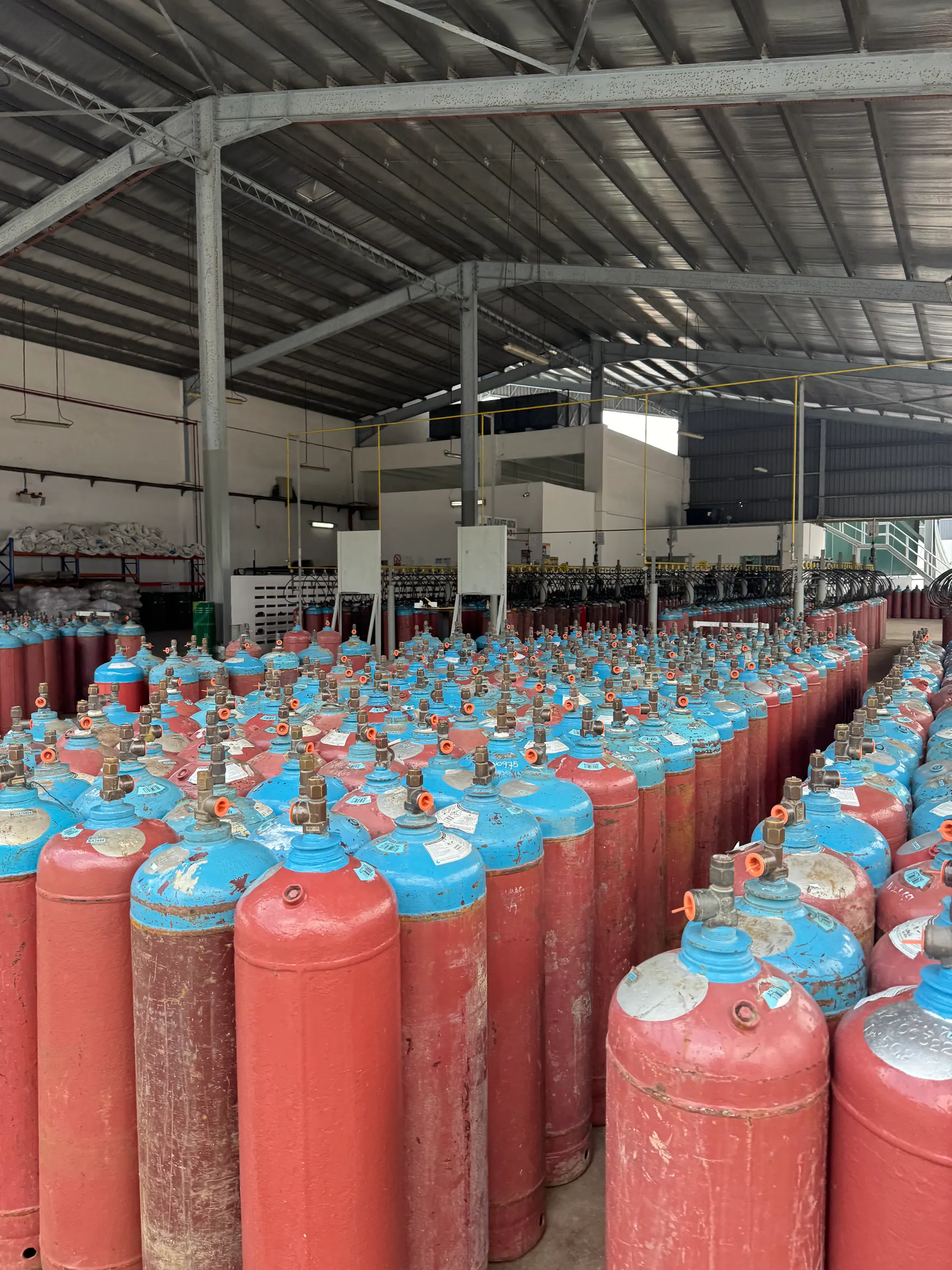
- Maroon
Acetylene is not a compressed gas, and that changes everything
Every other cylinder on your site holds a gas squeezed into a steel shell. An acetylene cylinder does not. It holds a porous mass soaked in acetone, with the acetylene dissolved into that acetone the way carbon dioxide dissolves into a soft drink.
That single fact is behind almost every rule below. The cylinder is heavy because most of what is inside it is not gas. It must stay upright because the solvent is a liquid. It cannot be filled or drawn like anything else on the rack. And it is retested every two years rather than five, because the mass and the solvent have to be assessed as well as the steel.
If you take one thing from this page: acetylene rules are not conservative versions of ordinary gas rules. They exist because the molecule is unstable under pressure on its own.
The three numbers
0.62 bar g
This is the limit for free acetylene at the point of use — regulator, hose and torch — under IS 14814 : 2023 cl 7.2.1, and 1.03 bar g is the absolute maximum even with clearance from the Chief Controller of Explosives. A fixed, engineered distribution pipeline is a different case, designed to IS 15190, which permits 155 kPa g. Never exceed the point-of-use figure on a hose. Free acetylene can decompose explosively with no oxidant present at all — it does not need to meet air to be dangerous. This is why acetylene regulators, hoses and fittings are rated the way they are.
One-seventh per hour
The most a single cylinder should give up in an hour of continuous use. Draw faster and you pull acetone out with the gas. The flame goes unstable, downstream equipment is contaminated, and the protection a flashback arrestor offers is reduced. If you need more flow, manifold cylinders into a cascade — that is what cascades are for, and we size them against measured draw-off rather than against total monthly consumption.
2.5 % to 82 %
The flammability range in air, and the widest of any common industrial gas. Almost any acetylene leak that mixes with air at all produces an ignitable atmosphere. Ventilation and leak testing therefore matter more here than for any other fuel gas on site.
Rules that matter
Storage
- Upright, always — in the store, on the trolley, on the truck and at the workface
- Secured against falling, by chain, strap or stillage
- Ventilated, at the top of the space as well as at floor level
- Away from oxidisers — oxygen cylinders segregated, not merely adjacent
- Away from heat and ignition sources, including direct sun on a summer afternoon
- Full and empty separated and clearly marked, so nobody hunts through the rack
A cylinder that has travelled lying down is not ready to use. Stand it upright and leave it for at least an hour so the acetone drains back into the mass.
Rules that matter
Use
- Fit a flashback arrestor at both the regulator and the torch
- Open the valve no more than 1.5 turns, so it can be shut quickly
- Use acetylene-rated equipment only — different thread form, different materials, and a left-hand thread because it is a fuel gas
- No copper or high-copper alloys anywhere in contact with the gas; acetylene forms explosive copper acetylides
- No oil or grease on fittings
- Leak-test with soap solution, never with a flame
Never force a fitting that will not start. The thread forms differ deliberately so that a fuel regulator cannot be married to an oxidising gas by someone working quickly at the end of a shift. If it will not go on, that is the system working.
Checking contents
Not from the gauge. The pressure you read is the vapour pressure of the acetone, which varies with temperature and tells you very little about how much acetylene is left.
Weigh the cylinder. Subtract the tare weight stamped on the shoulder. The difference is your remaining acetylene. This is the only reliable method, and it is the one your operators should be trained on.
If a cylinder gets hot
A cylinder warming up in use may be undergoing internal decomposition, and that is an emergency rather than a fault.
- Close the valve only if it is safe to reach
- Evacuate the area
- Raise the alarm, and call the fire service and your supplier
- Do not move the cylinder. Do not attempt to cool it yourself
Acetylene cylinders can require prolonged cooling well after any external flame has been put out, because the reaction inside is not being fed from outside. Treat the cylinder as live until the fire service says otherwise.
Where the standards sit
| Standard | What it governs |
|---|---|
| IS 308 | The gas itself — dissolved acetylene |
| IS 7312 | The cylinder, its porous mass and its solvent charge |
| IS 14814 | Code of safety for acetylene |
| IS 8433 | Two-yearly periodic inspection |
| IS 4379 | Maroon, the identifying colour |
| IS 11006 | Flashback arrestors |
Full hazard data is in the acetylene safety data sheet. If you want the reason behind the acetone rather than the rule, that is on why acetylene is dissolved in acetone.
Sources
Handling — specification
| Property | Value | Method / basis |
|---|---|---|
| Valve opening | No more than 1.5 turns, so it can be closed fast | KIGL practice |
| Contents check | By weight against the stamped tare, never by pressure gauge | KIGL practice |
| Leak testing | Soap solution only, never a flame | IS 14814 |
| Separation from oxidisers | Segregated storage, away from oxygen and heat sources | IS 14814 |
| Prohibited materials in contact | Copper and high-copper alloys — form explosive acetylides | IS 14814 |
Handling — frequently asked questions
Why must an acetylene cylinder always be kept upright?
Because the acetylene is dissolved in acetone held inside a porous mass, not compressed as a free gas. Lying the cylinder down lets liquid acetone reach the valve, so acetone is drawn off with the gas. That starves the porous mass, contaminates the flame and damages downstream equipment. If a cylinder has travelled on its side, stand it upright for at least an hour.
What is the one-seventh rule?
Draw no more than one-seventh of a cylinder's contents in any hour of continuous use. Pulling gas faster than that carries acetone out with it, which destabilises the flame and reduces the protection a flashback arrestor can give. Where a high continuous rate is needed, manifold several cylinders into a cascade rather than pushing one harder.
What is the maximum line pressure for acetylene?
IS 14814 : 2023 permits 0.612 atm — about 0.62 bar g — normally, and 1.021 atm (exactly 15 psig) only with statutory clearance. Free acetylene can decompose explosively on its own, with no oxygen present at all. This is a property of the molecule, not a reaction with air. It is the reason acetylene equipment is built and rated differently from every other fuel gas, and the reason the figure is a limit rather than a recommendation.
How do I tell how much gas is left?
Weigh it. The pressure gauge reads the vapour pressure of the acetone rather than the gas remaining, and it moves with temperature, so it is close to useless as a contents gauge. Subtract the tare weight stamped on the cylinder shoulder from the current weight, and the difference is the acetylene you have.
What should I do if a cylinder becomes hot in use?
Treat it as possible internal decomposition. Close the valve if it is safe to reach, evacuate the area, raise the alarm, and call the fire service and your supplier. Do not move the cylinder and do not try to cool it yourself. An acetylene cylinder can need prolonged cooling long after any external flame is out.
Can I use copper pipe or fittings on acetylene?
No. Acetylene attacks copper and high-copper alloys to form copper acetylide, which is explosive and shock-sensitive. Use only acetylene-rated equipment throughout, keep it free of oil and grease, and never fit an adaptor to make an acetylene connection meet a fitting intended for another gas.
How should cylinders be stored?
Upright, secured against falling, in a ventilated space away from heat and ignition sources, and segregated from oxygen and other oxidisers. Full and empty cylinders should be separated and marked. Ventilation matters more with acetylene than with any other fuel gas because it ignites across a 2.5 % to 82 % range in air — almost any leak that mixes with air will burn.
How often must an acetylene cylinder be retested?
On a two-year cycle in group practice, against five for ordinary compressed gases. Note where that interval comes from: IS 8433 sets the PROCEDURE for periodic inspection of acetylene cylinders, not the interval — it defers to the Gas Cylinders Rules. And the inspection is different in kind, not merely more frequent: because the porous mass fills the cylinder, IS 8433 states that neither a hydraulic nor a pneumatic pressure test, nor any visual inspection of the inside of the shell, can be carried out at all. The mass and the solvent are assessed instead.
Enquiries
Request a quotation
State the gas or equipment, the quantity or capacity, and your location. KIGL will confirm the grade, the cylinder or plant size, and whether the location can be served from Noonmati, or through our agent network.