
Guide
Which industrial gases are flammable which are oxidisers and which are inert: one table for 12 common gases
Of 12 common industrial gases, five are flammable: hydrogen (4–75 % in air), acetylene (2.5–82 %), methane (5–15 %), propane (2.1–9.5 %) and carbon monoxide (12.5–74 %). Oxygen and nitrous oxide do not burn but are oxidisers that make other things burn fiercely. Nitrogen, argon, helium, carbon dioxide and air are non-flammable.
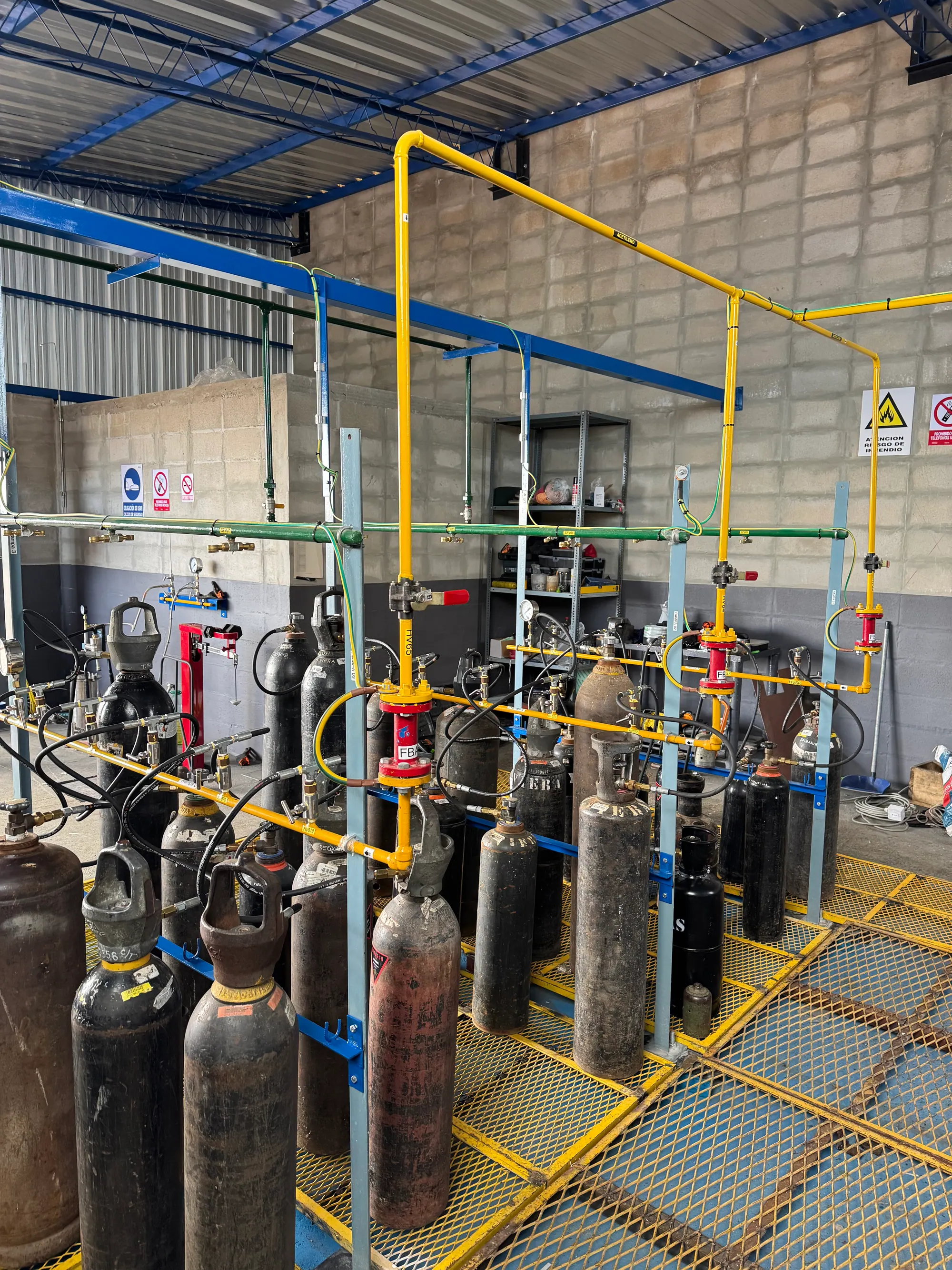
- Flammable gases in the set
- Hydrogen
- Widest flammable range
- Hydrogen 4
- Lowest lower limit
- Propane 2.1 % in air
- Indian legal definition
- A flammable gas forms a flammable mixture with air at 13 % or less
- Oxidisers
- Oxygen
Five of the twelve gases most used in Indian industry are flammable: hydrogen, acetylene, methane, propane (LPG) and carbon monoxide. Two more, oxygen and nitrous oxide, do not burn themselves but are oxidisers that turn a small fire into a violent one. The other five (nitrogen, argon, helium, carbon dioxide and compressed air) are non-flammable, and the hazard they carry is a different one: they displace oxygen without warning.
The table below gives each gas's category, its flammable range in air at normal temperature and pressure, its autoignition temperature where it has one, and its UN number and transport class. Every figure carries its source.
Which industrial gases are flammable: the master table
| Gas | Category | Flammable range in air, % v/v | Autoignition | UN number | UN class | Source of limits |
|---|---|---|---|---|---|---|
| Hydrogen, H₂ | Flammable | 4–75 | about 560–574 °C, by test method | 1049 | 2.1 | ICSC 0001; USCG CHRIS |
| Acetylene, C₂H₂ | Flammable; decomposes without air | 2.5–82 (effectively to 100) | 305 °C | 1001 | 2.1 | IS 14814:2023 cl 4.5 |
| Methane, CH₄ | Flammable | 5–15 | 537 °C | 1971 | 2.1 | ICSC 0291 |
| Propane, C₃H₈ (LPG) | Flammable | 2.1–9.5 | 450 °C | 1978 | 2.1 | NIOSH; ICSC 0319 |
| Carbon monoxide, CO | Flammable and toxic | 12.5–74 | 605 °C | 1016 | 2.3 (sub. 2.1) | NIOSH; ICSC 0023 |
| Oxygen, O₂ | Oxidiser | Does not burn | — | 1072 | 2.2 (sub. 5.1) | UN Model Regulations |
| Nitrous oxide, N₂O | Oxidiser | Does not burn | — | 1070 | 2.2 (sub. 5.1) | UN Model Regulations |
| Nitrogen, N₂ | Inert, asphyxiant | Does not burn | — | 1066 | 2.2 | UN Model Regulations |
| Argon, Ar | Inert, asphyxiant | Does not burn | — | 1006 | 2.2 | UN Model Regulations |
| Helium, He | Inert, asphyxiant | Does not burn | — | 1046 | 2.2 | UN Model Regulations |
| Carbon dioxide, CO₂ | Non-flammable; toxic at high concentration | Does not burn | — | 1013 | 2.2 | UN Model Regulations |
| Compressed air | Non-flammable; supports combustion | Does not burn | — | 1002 | 2.2 | UN Model Regulations |
Reference conditions: flammable limits are for mixtures with air at about 20–25 °C and 1 atm, upward propagation, as reported by the named source. Limits widen as temperature and pressure rise, and they differ between test apparatus by up to a percentage point. UN numbers are for the compressed gas; the refrigerated liquids carry their own numbers (for example 1073 oxygen, 1977 nitrogen, 1951 argon).
How Indian law decides that a gas is flammable
The Gas Cylinders Rules 2016 do not list flammable gases; they define them. Under Rule 2(xxvi) a gas is flammable if a mixture of 13 % or less by volume with air will burn, or if its flammable range with air is wider than 12 percentage points regardless of where it starts.
Every gas in the flammable rows above passes the first test. Carbon monoxide only just passes it, at 12.5 %, and it also passes the second, with a range of 61.5 points. Ammonia shows why the second test exists. The NIOSH Pocket Guide gives it 15–28 %, so it fails the 13 % test, but its range is 13 points wide, so Indian law treats it as flammable. NIOSH reaches the same practical conclusion: ammonia does not meet the US transport definition of a flammable gas but should be treated as one.
The definition matters because it decides, among other things, the left-hand valve outlet thread for flammable gases not listed in IS 3224 (Rule 4(3)) and the storage separation from oxidising gases.
Rules that matter
The lower flammable limit (LEL) is the leanest mixture that will carry a flame; the upper limit (UEL) is the richest. Outside the range, a spark does nothing. Inside it, the mixture burns or explodes.
What the lower and upper limits mean
- A low LEL means a small leak becomes dangerous quickly. Propane at 2.1 % and acetylene at 2.5 % are the two to watch in a workshop.
- A wide range means the mixture stays flammable over a wide spread of dilution. Hydrogen and carbon monoxide are both above 60 points wide.
- A UEL is not a safety margin. Acetylene's upper limit is effectively 100 % because the pure gas can decompose without any air, which is covered in acetylene flammability limits and ignition temperature.
Gas detectors are normally set to alarm at 10–20 % of the LEL, so a propane alarm sounds well below 0.5 % propane in air.
Gas by gas: the direct answers
Is hydrogen flammable?
Yes, extremely. Hydrogen burns from 4 % to 75 % in air and needs a spark of only about 0.02 mJ, the same as acetylene; its flame is nearly invisible in daylight. It rises fast, relative density 0.07, and collects under roofs. Details are on hydrogen safety data explained.
Is acetylene flammable?
Yes, and it is the most demanding of the five. Its range in air is 2.5–82 % per IS 14814:2023, it autoignites at 305 °C, and it can decompose with no air at all, which is why cylinder acetylene is dissolved in acetone inside a porous mass. See acetylene flammability limits.
Is methane or natural gas flammable?
Yes, between about 5 % and 15 % in air, autoigniting at 537 °C (ICSC 0291). Methane is lighter than air (relative density 0.55) and disperses upward. Its minimum ignition energy is about 15 times that of acetylene (Fenn, Ind. Eng. Chem. 1951).
Is propane or LPG flammable?
Yes, from 2.1 % to 9.5 % in air (NIOSH), with an autoignition temperature of 450 °C. Propane vapour is about 1.55 times as dense as air, so a leak runs along the floor into drains and pits. The fuel-gas comparison is in acetylene vs LPG cutting.
Is carbon monoxide flammable?
Yes, from 12.5 % to 74 % (NIOSH), autoigniting at 605 °C. It is classed first as a toxic gas, Class 2.3, because it poisons long before it burns. It is found in calibration mixtures; see calibration gas vs welding mixtures.
Is oxygen flammable?
No. Oxygen is an oxidiser. Above 23.5 % oxygen an atmosphere is enriched and materials ignite more easily and burn hotter; oil and grease can ignite spontaneously in high-pressure oxygen. See oxygen safety data explained.
Is nitrous oxide flammable?
No, but it is an oxidiser and can decompose exothermically on its own once heated, releasing a mixture that is one-third oxygen. Fuels burn in it readily, which is why the nitrous oxide–acetylene flame is used in atomic absorption spectrometry. See nitrous oxide safety data explained.
Is nitrogen flammable?
No. Nitrogen is inert and is used to purge flammable gas out of pipelines and vessels. It kills by displacing oxygen, with no smell and no warning; see nitrogen safety and asphyxiation.
Is argon flammable?
No. Argon is a noble gas and will not burn or react. It is 1.38 times as dense as air and collects in pits, tanks and the bottom of vessels being welded. See argon safety data explained.
Is helium flammable?
No. Helium is the most inert element and will not burn, which is why it replaced hydrogen in balloons and airships. It rises and collects at ceiling level. See helium safety data explained.
Is carbon dioxide flammable?
No. Carbon dioxide does not burn and is used to extinguish fires. It is not simply an asphyxiant: NIOSH sets its IDLH at 4 %, with normal oxygen present. See carbon dioxide safety data explained.
Is compressed air flammable?
No. It carries the normal 20.9 % oxygen and supports combustion, so it is never a purge gas for fuel lines. Quality classes are on compressed air quality classes.
Inert does not mean harmless
The non-flammable gases kill in industry because they give no warning. Oxygen below 19.5 % by volume is the entry limit without breathing apparatus (OSHA 29 CFR 1910.146), and at about 10 % a person can faint without any prior warning (EIGA Doc 44, Hazards of Inert Gases). Releasing nitrogen equal to only 7 % of a room's volume takes the oxygen from 20.9 % to 19.5 %. Carbon dioxide adds toxicity on top: NIOSH puts its IDLH at 4 % (40,000 ppm), even with normal oxygen present.
Oxidisers are the other hidden half. Oxygen and nitrous oxide sit in Class 2.2 like nitrogen, but they carry the 5.1 oxidiser label because they make every fuel burn faster. The Gas Cylinders Rules 2016 require oxidising and flammable gas cylinders in a store to be separated by 1 m of clear space or a fire-resisting partition (Form F condition 4), and IS 14814:2023 cl 7.3.3 forbids storing acetylene and oxygen cylinders together.
Rules that matter
Rules to apply
- Identify the gas by the cylinder label and the IS 4379 colour, then check this table for its category before you decide on ventilation, detection or storage.
- For the five flammable gases: left-hand valve threads, flashback arrestors on fuel lines, no ignition sources, and detection set below 20 % of the LEL.
- For oxygen and nitrous oxide: no oil or grease, oxygen-clean fittings, and separation from fuel gases.
- For nitrogen, argon, helium and carbon dioxide: an oxygen monitor where gas can accumulate, and no entry into a space that has not been tested.
- For a leak, follow the per-gas actions in gas cylinder leak: what to do. The full physical-property comparison is in the industrial gas properties table.
Which industrial gases are flammable — frequently asked questions
Which industrial gases are not flammable?
Nitrogen, argon, helium, carbon dioxide and compressed air will not burn at any concentration, and neither will oxygen or nitrous oxide. The difference is that oxygen and nitrous oxide are oxidisers: they make fuels, oil, clothing and even steel burn much more fiercely. Nitrogen, argon, helium and carbon dioxide are inert in a fire but can kill by displacing the oxygen in a room.
Is carbon monoxide flammable?
Yes. Carbon monoxide burns in air between 12.5 % and 74 % by volume (NIOSH Pocket Guide) and autoignites at 605 °C (ICSC 0023). It is also toxic, with an IDLH of 1,200 ppm, so it is carried as UN 1016, Class 2.3 toxic gas with a subsidiary 2.1 flammable risk. A leak will poison people at concentrations about a hundred times below the level at which it would burn.
Is propane (LPG) more flammable than acetylene?
Propane starts to burn at a leaner mixture, 2.1 % in air against 2.5 % for acetylene, but its range is narrow, ending at 9.5 %. Acetylene burns up to 82 % in air and can decompose with no air at all, ignites at 305 °C against 450 °C for propane, and needs roughly one-fifteenth of the spark energy of methane. Acetylene is the more hazardous gas; propane is heavier than air and pools.
What makes a gas flammable under the Gas Cylinders Rules 2016?
Rule 2(xxvi) uses two tests. A gas is flammable if a mixture of 13 % or less by volume with air is flammable, or if its flammable range in air is wider than 12 percentage points, whatever the lower limit. Ammonia, at 15–28 % (NIOSH), fails the first test but passes the second, because its range is 13 points wide, so it counts as flammable.
Is compressed air flammable?
No. Compressed air is UN 1002, Class 2.2 non-flammable, and it contains the normal 20.9 % oxygen. It will not burn, but it still supports combustion, so it must never be used to purge a fuel-gas line or to blow down clothing. Air that has been enriched with oxygen, or a breathing-air system contaminated with oil, is a fire risk at high pressure.
Which gases are oxidisers rather than fuels?
Of the common industrial gases, oxygen and nitrous oxide. Both are Class 2.2 with a subsidiary 5.1 oxidiser label and GHS Oxidising Gas Category 1 (H270). Neither burns, but both feed a fire: the C.P.I. code of 1968 notes that clothing ignites readily once the atmosphere reaches 25–30 % oxygen, and nitrous oxide decomposes to a mixture that is one-third oxygen. Keep them apart from fuel-gas cylinders and free of oil.
Is methane flammable at any concentration?
No, only between about 5 % and 15 % by volume in air (ICSC 0291). Below 5 % the mixture is too lean to propagate a flame and above 15 % it is too rich, although a rich cloud becomes flammable again as it mixes with surrounding air. Methane is lighter than air (relative density 0.55) and rises; it autoignites at 537 °C.
Can an inert gas such as nitrogen or argon cause an explosion?
Not a combustion explosion. The physical hazards are different: a cylinder can burst if it is overheated or over-pressurised, and a cryogenic liquid sealed in a pipe or container expands several hundred times as it boils (about 694 times for liquid nitrogen, measured as gas at 21 °C) and can rupture it. The commonest fatal hazard of an inert gas is asphyxiation, because it gives no warning by smell.
References
- Bureau of Indian Standards. (2023). Acetylene — Code of Safety (IS 14814:2023, First Revision).
- European Industrial Gases Association. (n.d.). Hazards of Inert Gases and Oxygen Depletion (EIGA Doc 44).
- Government of India. (2016). Gas Cylinders Rules, 2016 (G.S.R. 1081(E)). Petroleum and Explosives Safety Organisation.
- ILO/WHO International Chemical Safety Card 0001, Hydrogen (also 0291 methane, 0319 propane, 0023 carbon monoxide) https://chemicalsafety.ilo.org/dyn/icsc/showcard.display?p_card_id=0001&p_lang=en&p_version=2
- Linstrom, P. J., & Mallard, W. G. (Eds.). (n.d.). NIST Chemistry WebBook (NIST Standard Reference Database 69). National Institute of Standards and Technology. [Thermophysical Properties of Fluid Systems] https://webbook.nist.gov/chemistry/fluid/
- NIOSH Pocket Guide to Chemical Hazards — propane, carbon monoxide, ammonia entries https://www.cdc.gov/niosh/npg/
Enquiries
Request a quotation
State the gas or equipment, the quantity or capacity, and your location. KIGL will confirm the grade, the cylinder or plant size, and whether the location can be served from Noonmati, or through the agent network.