
Guide
Oxygen safety data explained: why an oxidiser that does not burn is the gas that starts fires
Oxygen is not flammable: UN 1072 (compressed) and UN 1073 (refrigerated liquid) are classed as an oxidising gas and a gas under pressure. Air holds 20.9 % oxygen; EIGA treats anything above 23.5 % as enriched, and at 25 to 30 % clothing ignites readily. Keep oil, grease and heat away and open valves slowly.
- Transport identity
- UN 1072
- Enrichment threshold
- Above 23.5 % oxygen by volume the atmosphere is enriched; normal air is 20.9 %
- Clothing ignition
- Combustible materials
- Boiling point and expansion
- Liquid oxygen boils at −183 °C; one volume of liquid gives roughly 860 volumes of gas at 21 °C
- Indian cylinder colour
- Industrial oxygen: Graphite Black RAL 9011 throughout
Oxygen is the gas every welding shop handles most casually and the one responsible for the most burns. Its safety data sheet classifies it as an oxidising gas and a gas under pressure, never as flammable, and that distinction is the whole story: oxygen does not burn, but it makes everything else burn hotter, faster and at a lower temperature than it would in air. This page explains the numbers behind that classification so that the full sheet at /sds/oxygen makes sense when you read it.
What the SDS classification means
| Item | Value | Source |
|---|---|---|
| UN number | 1072 (compressed gas); 1073 (refrigerated liquid) | UN Model Regulations; IS 4379:2021 Table 1 |
| Transport class | 2.2 non-flammable gas, subsidiary risk 5.1 oxidiser | UN Model Regulations |
| GHS classification | Oxidising Gas Category 1 (H270); Gas under pressure, compressed (H280) or refrigerated liquefied (H281) | UN GHS |
| Pictograms | GHS03 flame over circle; GHS04 gas cylinder | UN GHS |
| CAS number | 7782-44-7 | NIST Chemistry WebBook |
| Molar mass | 31.999 g/mol | NIST Chemistry WebBook |
| Boiling point | −183.0 °C at 1 atm | NIST Chemistry WebBook |
| Critical temperature and pressure | −118.6 °C; 50.4 bar | NIST Chemistry WebBook |
| Gas density | 1.429 kg/m³ at 0 °C and 1 atm; relative density 1.105 (air = 1) | NIST Chemistry WebBook |
| Liquid density at boiling point | about 1,141 kg/m³; roughly 860 volumes of gas per volume of liquid at 21 °C | NIST Chemistry WebBook |
| Oxygen in normal air | 20.9 % by volume | EIGA Doc 04 |
Two of those figures do more work than the rest. The relative density of 1.105 means oxygen is slightly heavier than air, so a leak in a pit, a tank or a closed cabin does not float away; it pools. And the 860-fold expansion means that a spill of 10 litres of liquid oxygen produces about 8.6 m³ of pure oxygen, enough to push a 50 m³ room from 20.9 % to over 30 %.
Rules that matter
The enrichment threshold that EIGA uses in Doc 04, Fire hazards of oxygen and oxygen-enriched atmospheres, and that OSHA writes into its confined-space rule 29 CFR 1910.146, is 23.5 % oxygen by volume. That is only 2.6 percentage points above normal air, and the reason the margin is so thin is that fire behaviour does not scale gently with oxygen content. Three things change at once as the fraction rises:
Why 23.5 % is the line
- The ignition temperature of common materials falls, so sources that would never light cotton in air, such as a hot bearing or a cigarette ember, do.
- The burning rate rises steeply. Materials that smoulder in air flame in enriched air.
- Materials that are not considered combustible in air, including carbon steel, aluminium and stainless steel, will burn in oxygen once ignited, which is why oxygen pipework fires consume the pipe.
The 1968 C.P.I. code, Safety in the Production and Use of Acetylene, Paris, recorded the practical consequence for oxy-fuel workshops long before the modern threshold was set: ignition of combustible substances, including workmen's clothes and cleaning products, occurs even with an oxygen content of 25 to 30 %. A welder whose overalls have soaked up oxygen from a leaking hose connection is wearing an accelerant, and the usual ignition source is the spark shower from their own torch.
A worked example shows how little gas it takes. A 50 m³ workshop contains 10.45 m³ of oxygen. Adding 1.7 m³ of pure oxygen, which a cutting nozzle can pass in well under an hour, brings the room to 23.5 %. The companion guide on oxygen enrichment and deficiency in the workplace works through the monitoring and ventilation response.
Oil, grease and the oil-free rule
The second hazard on the sheet is chemical rather than atmospheric. Hydrocarbon oils and greases, and many ordinary polymers, react violently with oxygen at pressure. A film of lubricant on a regulator seat, a smear of grease on a cylinder thread or a hydrocarbon-based thread sealant can ignite from the heat generated when the valve is opened, and the fire then propagates into brass and steel.
Indian law states the rule bluntly. Rule 15(2) of the Gas Cylinders Rules, 2016 forbids any oil or similar lubricant on valves or fittings, and the warning that Rule 9 requires on every cylinder label repeats it as item (iv). IS 309:2023 backs the rule from the product side: industrial oxygen to Grade 2 (N2.5), the grade KIGL supplies as industrial oxygen, is limited to 20 ppm hydrocarbons and 2.0 ppm water vapour, so the gas itself brings no fuel into the system. The engineering discipline that keeps it that way, from degreasing to the velocity limits that stop particle impact ignition, is covered under oxygen pipeline cleanliness.
Adiabatic compression: the valve you snap open
When an oxygen cylinder valve or a manifold isolation valve is opened quickly into a dead-ended regulator or pipe, the gas already in that space is compressed almost instantaneously, and gas compressed fast enough has no time to lose heat. The temperature rise follows the isentropic relation T₂ = T₁ × (P₂/P₁)^((γ−1)/γ). For oxygen (γ = 1.40) starting at 20 °C:
| Compression | Ideal-gas temperature reached |
|---|---|
| 1 bar to 50 bar | about 620 °C |
| 1 bar to 150 bar | about 950 °C |
| 1 bar to 200 bar | about 1,060 °C |
Real systems do not reach these ideal figures because the compression is not perfectly adiabatic, but they do not need to. Polymer valve seats, PTFE tape, particles of rust or dust and any trace of lubricant all have ignition temperatures in oxygen of a few hundred degrees, well below even half of the calculated peak. This is the mechanism behind regulator fires, and the defence is procedural: crack the cylinder valve slowly with the regulator adjusting screw backed out, stand to one side, and never use adaptors or quick-fit couplings not rated for oxygen.
Cylinders, colours and grades in India
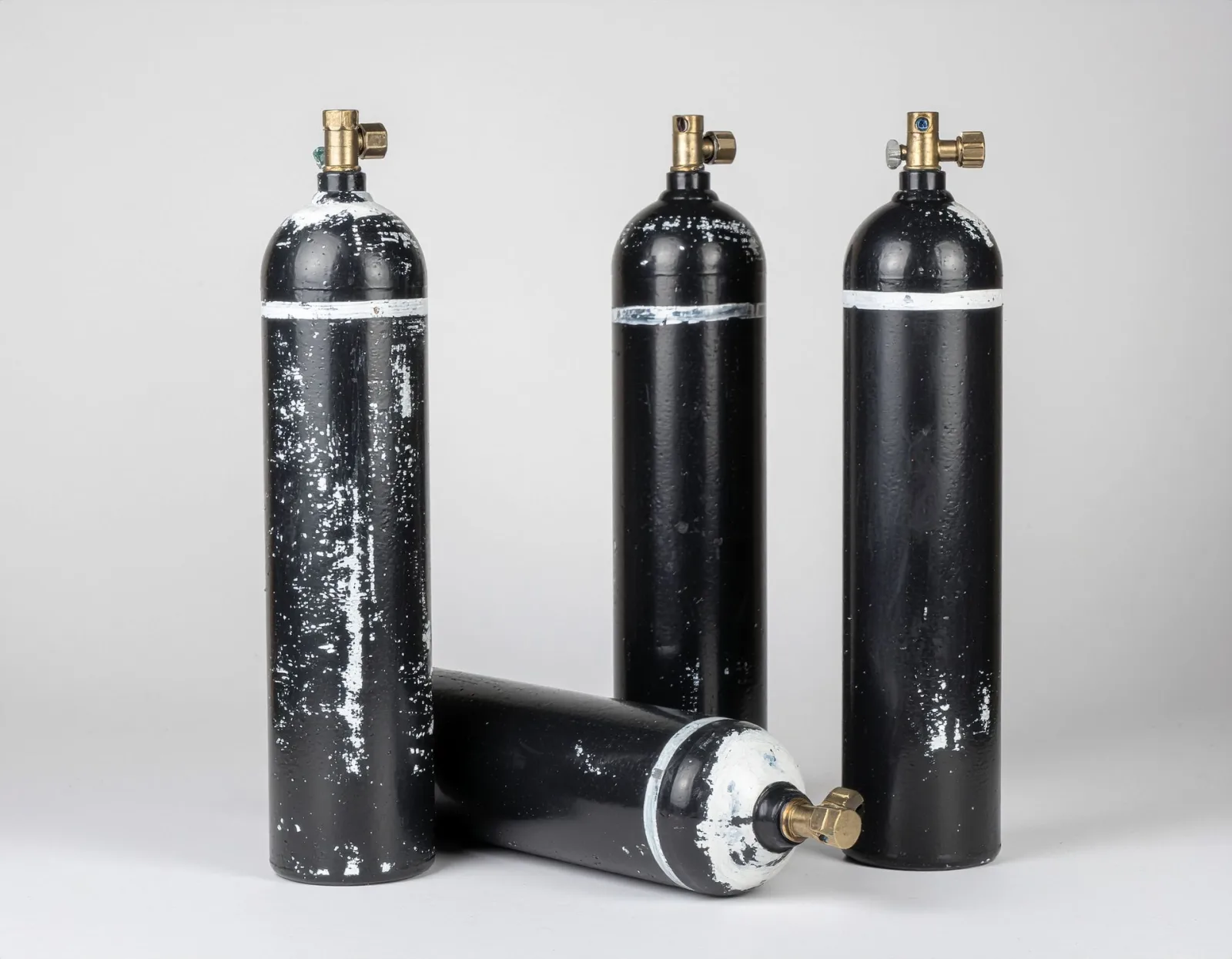
An oxygen cylinder in India is identified by colour before anything else, and the two colour standards differ deliberately. IS 4379:2021 Table 7 gives industrial oxygen a Graphite Black RAL 9011 body with the shoulder in the ground colour and no band. IS 3933:2021 Table 1 gives medical oxygen a Graphite Black body with a White RAL 9003 shoulder. A black cylinder with a white shoulder is medical; a wholly black cylinder is industrial. The two must never be swapped, and the detail is laid out on the cylinder colour codes page.
The gas inside is specified by IS 309:2023, which since its fifth revision carries three grades: Grade 1 (N3.5, ≥ 99.95 %), Grade 2 (N2.5, ≥ 99.5 %) and Grade 3 (N2.0, ≥ 99.0 %). IS 309 expressly excludes medical oxygen, which is governed by the Indian Pharmacopoeia monograph, and the difference between the two products is explained under industrial versus medical oxygen.
Oxygen is a permanent gas in the sense of IS 8775:1978 (critical temperature below 0 °C), so the cylinder is filled to a pressure referred to 15 °C, with the pressure it develops at 65 °C, the Indian maximum design temperature, checked against the cylinder rating. Unlike dissolved acetylene or carbon dioxide, the gauge pressure on an oxygen cylinder is a fair measure of its contents.
Storage and separation rules
| Requirement | Figure | Source |
|---|---|---|
| Separation of oxidising from flammable gas cylinders in a storage shed | 1 m clear space, or a fire-resisting partition wall | Gas Cylinders Rules, 2016, Form F condition 4 |
| Acetylene and oxygen cylinders | Not to be stored together | IS 14814:2023 cl 7.3.3 |
| Oxygen-to-acetylene separation, international comparison | 6.1 m (20 ft) or a 1.5 m high partition with 1-hour fire rating | CGA G-1 cl 5.2 (not Indian law) |
| Own-use possession without licence | Up to 200 non-flammable non-toxic cylinders | Gas Cylinders Rules, 2016, Rule 44(b)(ii) |
| Storage in sun or near heat | Prohibited | Gas Cylinders Rules, 2016, Rule 15(3) |
| Oil or lubricant on valves | Prohibited | Gas Cylinders Rules, 2016, Rule 15(2) |
Cylinders stand upright, with valve caps on when not connected, secured against falling, away from combustibles, in a ventilated shed with no smoking and no naked flames. Oxygen that leaks in a closed store does not disperse upward; it settles and lingers, which is why a store that smells of nothing can still be enriched.
Liquid oxygen adds two hazards
Where oxygen is delivered as a cryogenic liquid, the SDS adds the H281 statement and a second set of precautions. The liquid is at −183 °C and causes immediate cold burns on skin and brittle fracture in carbon steel. Its boil-off continuously enriches the surrounding air, so tank compounds and vaporiser bays must be open to the sky and kept clear of combustible storage. Liquid oxygen soaked into asphalt, oily rags or wooden pallets forms an impact-sensitive mixture; tank pads are concrete for this reason.
Rules that matter
Rules to apply
- Treat 23.5 % as the alarm level on any oxygen monitor and 19.5 % as the deficiency alarm; keep both alarms on the same instrument.
- Never use oxygen to ventilate, to cool, to blow dust off clothing or to start an engine.
- Keep every oxygen fitting free of oil and grease; use only oxygen-rated regulators, sealants and hoses.
- Open cylinder valves slowly, stand clear of the regulator face, and close the valve when work stops, not just the torch.
- Store oxygen at least 1 m or a fire wall away from acetylene and LPG, upright, shaded and secured.
- Read the SDS sections that matter for a gas (2, 7, 9, 10 and 14) before the first delivery; the guide on how to read an industrial gas SDS explains each.
The full KIGL sheet at /sds/oxygen carries the first-aid, fire-fighting and transport sections that this explainer deliberately leaves to the SDS.
Oxygen safety data explained — frequently asked questions
Is oxygen flammable or explosive?
No. Oxygen does not burn; it is the oxidiser that lets other things burn. That is why its SDS carries the flame-over-circle pictogram (GHS03) and hazard statement H270, "may cause or intensify fire", rather than the flammable-gas statement H220. The practical consequence is that an oxygen leak is harmless until it meets a fuel and a spark, and then everything nearby becomes the fuel.
What oxygen concentration counts as enriched?
EIGA Doc 04 and OSHA both use 23.5 % by volume as the enrichment boundary, against 20.9 % in normal air. That is only 2.6 percentage points, and a single cutting torch left on overnight in a closed workshop can reach it. The 1968 C.P.I. acetylene safety code records that clothing and cleaning products ignite readily once the oxygen content reaches 25 to 30 %.
Why must oxygen fittings be free of oil and grease?
Hydrocarbon oil or grease in contact with high-pressure oxygen can ignite from the heat of compression alone, and once alight it burns with great intensity. The Gas Cylinders Rules, 2016 (Rule 15(2)) prohibit any oil or lubricant on valves and fittings, and the warning label every Indian cylinder must carry under Rule 9 repeats the prohibition. Use only oxygen-compatible thread sealants and regulators marked for oxygen.
What is adiabatic compression and why does it matter for oxygen?
When a valve is snapped open, the gas rushing into a closed downstream space is compressed almost instantaneously and heats up. An ideal-gas estimate for oxygen compressed from 1 bar to 150 bar gives a temperature near 950 °C, far above the ignition temperature of any polymer seat, lubricant or particle in the line. Open oxygen valves slowly, and never stand in front of the regulator while doing so.
How far must oxygen cylinders be kept from acetylene or LPG?
Under the Gas Cylinders Rules, 2016 Form F conditions, flammable gas cylinders in a storage shed must be separated from oxidising gas cylinders by at least 1 m of clear space or by a fire-resisting partition, and IS 14814:2023 does not permit acetylene and oxygen cylinders to be stored together. The US CGA G-1 figure for comparison is 6.1 m (20 ft) or a 1.5 m partition with a 1-hour fire rating.
Do I need a PESO licence to keep oxygen cylinders?
Oxygen is a non-flammable, non-toxic gas for licensing purposes. Rule 44(b)(ii) of the Gas Cylinders Rules, 2016 allows up to 200 such cylinders to be possessed for own use without a licence. Above that, or for sale, a Form F storage licence from the PESO circle office is required. The 25-cylinder exemption that applies to dissolved acetylene does not apply here.
Is breathing oxygen-enriched air dangerous in itself?
At atmospheric pressure, short exposure to enriched air is not acutely harmful; the danger is the fire hazard on your clothing and surroundings. Prolonged breathing of high oxygen fractions can irritate the lungs, which is why medical oxygen is prescribed and dosed. Oxygen deficiency below 19.5 % is the opposite and far more immediate risk; see the companion guide on enrichment and deficiency.
What should I check on the oxygen SDS before using the gas?
Section 2 for the oxidiser classification, Section 7 for the oil-free and slow-opening rules, Section 9 for the 1.105 relative density (oxygen settles, it does not rise), Section 10 for the incompatible materials list and Section 14 for UN 1072 and the transport class. KIGL publishes a full sheet at /sds/oxygen; this page is the explainer, not the SDS.
References
- Bureau of Indian Standards. (2021). Identification of contents of industrial gas cylinders (IS 4379:2021, Second Revision).
- Bureau of Indian Standards. (2023). Oxygen, compressed gas and liquid (IS 309:2023, Fifth Revision).
- Compressed Gas Association. (n.d.). Acetylene (storage separation from oxygen) (CGA G-1).
- European Industrial Gases Association. (n.d.). — Fire hazards of oxygen and oxygen-enriched atmospheres (EIGA Doc 04).
- Government of India. (2016). Gas Cylinders Rules, 2016 (G.S.R. 1081(E)). Petroleum and Explosives Safety Organisation.
- Linstrom, P. J., & Mallard, W. G. (Eds.). (n.d.). NIST Chemistry WebBook (NIST Standard Reference Database 69). National Institute of Standards and Technology. [Oxygen thermophysical properties] https://webbook.nist.gov/cgi/cbook.cgi?ID=C7782447
- Occupational Safety and Health Administration. (n.d.). Permit-required confined spaces (definitions of oxygen-enriched and oxygen-deficient) (29 CFR 1910.146).
Enquiries
Request a quotation
State the gas or equipment, the quantity or capacity, and your location. KIGL will confirm the grade, the cylinder or plant size, and whether the location can be served from Noonmati, or through the agent network.