
Guide
Calibration standards and welding mixtures: not the same product
A welding mixture is blended to a working tolerance and classified under EN ISO 14175, because the arc cannot detect a small deviation. A calibration standard is analysed against a reference and certified with a stated uncertainty. Buying the wrong one wastes money or invalidates every reading.
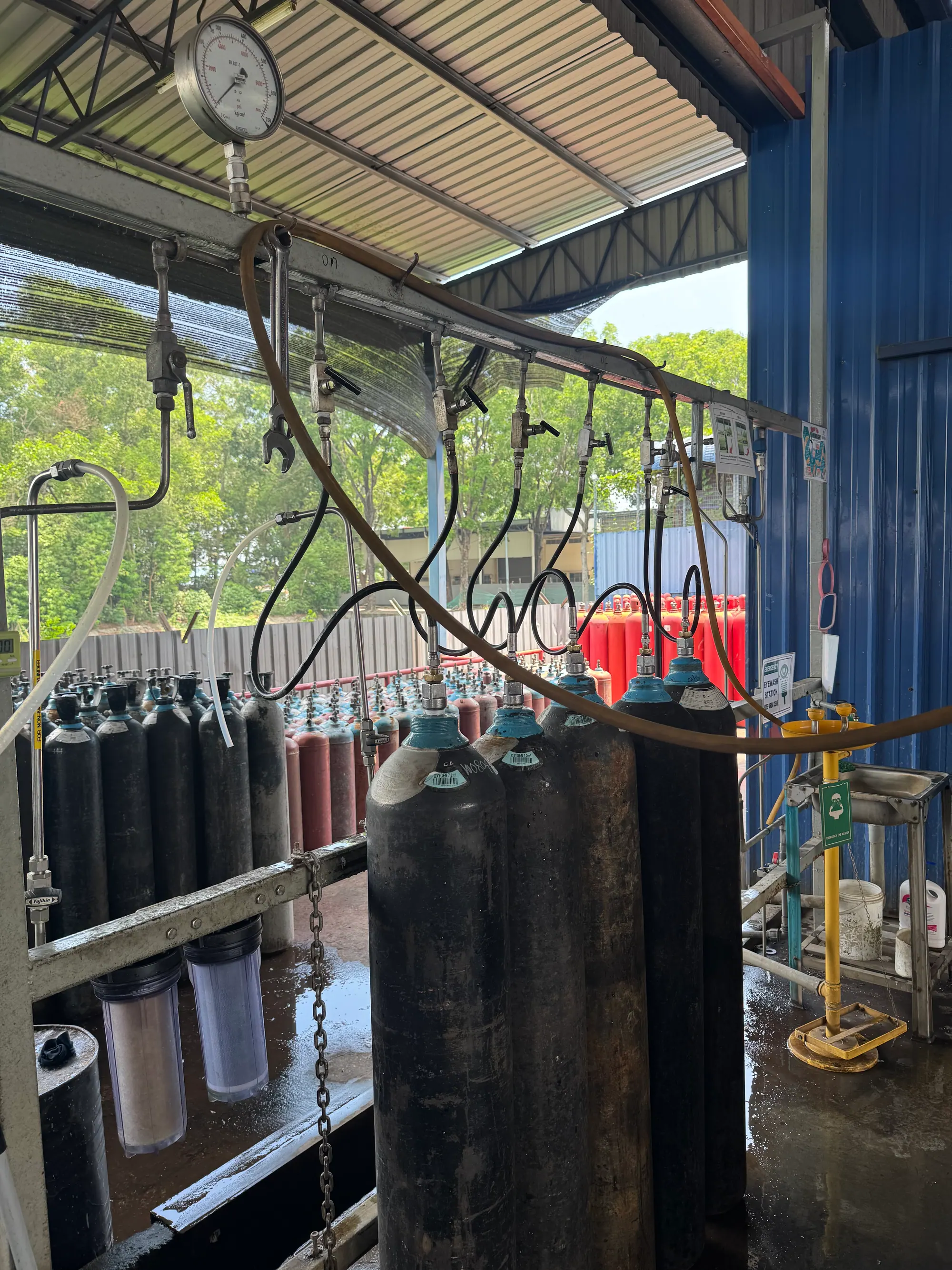
- Welding mixture basis
- Blended to a working tolerance
- Welding mixture classification
- EN ISO 14175
- Calibration standard basis
- Blended
- What the certificate carries
- Analysed value and stated uncertainty
- Common error
- Buying a certified standard for a bump test
Both are mixtures. That is where the similarity ends.
Ask for "a gas mixture" and you could be asking for either of two products that differ in price by a factor of several, and in purpose completely.
The welding mixture
Blended to a working tolerance, because the arc cannot detect a small deviation. If a mixture arrives a little either side of specification, the weld is unaffected, because the difference sits far below what the process responds to. These are classified under EN ISO 14175.
What matters here is consistency between cylinders, so a welder who set the machine up on Monday is not fighting it on Thursday. You are buying a reliable blend, and that is all the job needs.
Which mixture is a separate question, answered on choosing a shielding gas.
The calibration standard
Blended, then analysed against a reference, and supplied with a certificate stating the analysed value and the uncertainty on that value.
The distinction is not that it was blended more carefully. It is that it has been measured, and that the measurement traces back through reference materials to a recognised standard, so the number means the same thing in your laboratory as in anybody else's.
You are buying evidence. The gas is almost incidental.
The gap is not workmanship. A welding mixture and a calibration standard can be blended on the same rig, to the same care, and still be different products, because one of them has then been measured against a reference and had that measurement written down. You are not paying for a better blend. You are paying for the evidence that the blend is what the label says.
Which do you actually need?
| Use | What to buy |
|---|---|
| Welding, any process | Welding mixture to a working tolerance |
| Bump test — does the detector respond at all? | Working-tolerance mixture |
| Calibration — setting the instrument's response | Certified standard |
| Anything an auditor or regulator will examine | Certified standard, traceable |
| Process control where the reading drives a decision | Certified standard |
The common and expensive error is buying a certified standard for bump testing. A bump test asks one question: does the detector see gas? A working-tolerance mixture answers it perfectly for a fraction of the money.
The dangerous error is the reverse: calibrating an instrument against an uncertified mixture and then trusting the readings. The instrument will be confidently, invisibly wrong.
Why the low-concentration ones are the fragile ones
The counter-intuitive part of calibration gas is that the more dilute the component, the harder it is to keep honest.
A few parts per million of a reactive species in a cylinder is a very small number of molecules against a very large internal surface. Some of them adsorb onto the wall. Some react with each other or with traces of moisture. Neither process announces itself, and both move the concentration in one direction — down — so the standard reads low, the instrument is set high to compensate, and the instrument then under-reports in service. That is the wrong direction for a gas detector to be wrong in.
This is why cylinders for low-concentration standards are specially prepared, why the shelf life is shorter than people expect, and why the certificate carries an uncertainty rather than a single number. The uncertainty is not hedging; it is the honest statement of how well the value is known.
Rules that matter
A calibration standard carries a shelf life, and it is real.
Expiry is not a formality
- Components adsorb onto cylinder walls, particularly at low concentration
- Some react slowly with each other or with residual moisture
- Reactive species at low concentration drift fastest — exactly where accuracy mattered most
An expired standard does not fail loudly. It quietly shifts, and every instrument calibrated against it inherits the shift.
There is one more question worth asking, and it separates suppliers quickly: what is the balance gas, and does it matter to your instrument? Many detectors respond differently to the same target concentration in nitrogen and in air, because the balance affects thermal conductivity, oxygen availability at a sensor, or both. A standard blended in the wrong balance is accurate and useless at the same time.
What to tell us when you order
For welding: parent metal, thickness, transfer mode. Three facts and the gas can be specified.
For calibration: exact components and concentrations, balance gas, the instrument being calibrated, whether you need traceability and to what, cylinder size and connection.
The second list is longer because the product is defined by its evidence rather than its contents. Tell us which you are actually buying and we will say honestly which you need, and it is frequently the cheaper one.
Calibration standards — frequently asked questions
What is the actual difference?
Tolerance and evidence. A welding mixture is made to a working tolerance because the arc cannot detect a small deviation. A calibration standard is made and then measured, and arrives with a certificate stating the analysed value and the uncertainty on it. You are paying for the measurement and its traceability, not for a more careful blend.
Do I need a certified standard for a bump test?
Usually not. A bump test asks whether a detector responds to gas at all, and a working-tolerance mixture answers that perfectly at a fraction of the cost. A certified standard is for calibration — setting the instrument's response — and for any measurement that must stand up to an audit or a regulator.
What does traceability mean on a gas certificate?
That the analysis behind the stated value can be followed back through reference materials to a recognised standard, so the number means the same thing in your laboratory as in anyone else's. Without traceability, a certificate is the supplier's opinion of their own product.
How long does a calibration standard last?
It carries an expiry, and that expiry is real. Components adsorb onto cylinder walls, react slowly with each other or with residual moisture, and drift. Reactive components at low concentration drift fastest — exactly the case where accuracy mattered most. An instrument calibrated against an expired standard is confidently wrong.
Can any supplier make a calibration standard?
Blending is straightforward; certifying is not. It needs analytical capability, reference materials, and the discipline to report what was measured rather than what was intended. Ask what the certificate is traceable to, and be careful of one that simply restates the composition you ordered.
What should I tell a supplier when ordering?
For welding: parent metal, thickness and transfer mode. For calibration: exact components and concentrations, the balance gas, the instrument being calibrated, whether you need traceability and to what, plus cylinder size and connection. The second list is longer because the product is defined by its evidence.
Enquiries
Request a quotation
State the gas or equipment, the quantity or capacity, and your location. KIGL will confirm the grade, the cylinder or plant size, and whether the location can be served from Noonmati, or through our agent network.