
Guide
Argon safety data explained: an inert gas 1.38 times heavier than air that collects where welders work
Argon is not flammable and not toxic. Argon (UN 1006) is an inert simple asphyxiant 1.38 times denser than air, so it sinks into pits, trenches, tank bottoms and the lower half of a vessel being welded. Oxygen below 19.5 % at floor level is the warning; argon gives none. Ventilate and monitor low.
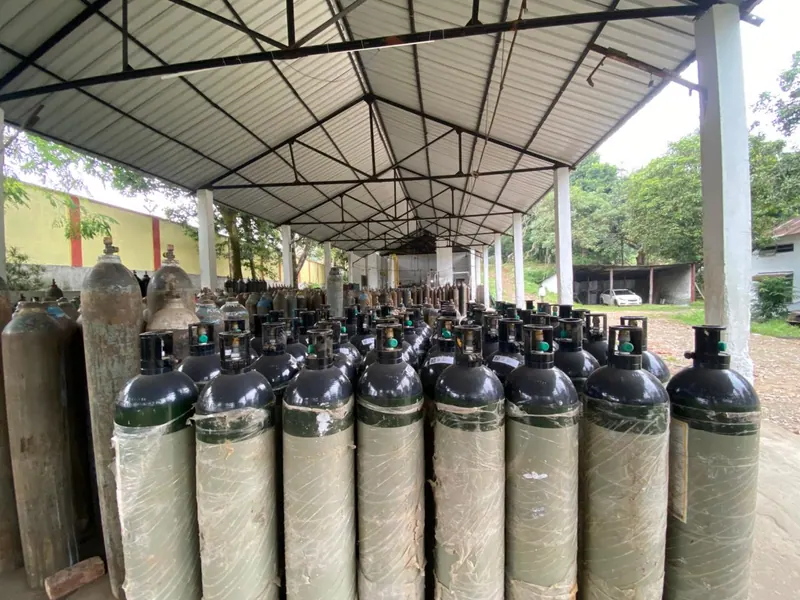
- Transport identity
- UN 1006
- Relative density
- 1.784 kg/m³ at 0 °C and 1 atm
- Boiling point and expansion
- Liquid argon boils at −185.8 °C; one litre of liquid yields about 840 litres of gas at 20 °C
- Oxygen-deficient limit
- Below 19.5 % oxygen by volume; argon displaces oxygen with no smell
- Argon in air
- 0.93 % by volume
Argon is the gas of the welding bay: it shields every TIG arc and most MIG arcs, it is inert, and it is sold by KIGL as a routine industrial product. Its safety data sheet is one of the shortest in the range, because argon reacts with nothing, and that brevity hides the one figure that matters. Argon is 1.38 times denser than air. It sinks, it stays down, and it collects exactly where a welder inside a vessel or a fitter in a pit is breathing. This page explains the numbers behind the sheet at /sds/argon.
What the SDS classification means
| Item | Value | Source |
|---|---|---|
| UN number | 1006 (compressed gas); 1951 (refrigerated liquid) | UN Model Regulations; IS 4379:2021 Table 1 |
| Transport class | 2.2 non-flammable, non-toxic gas | UN Model Regulations |
| GHS classification | Gas under pressure: compressed (H280) or refrigerated liquefied (H281); no health classification | UN GHS |
| Pictogram | GHS04 gas cylinder only | UN GHS |
| CAS number | 7440-37-1 | NIST Chemistry WebBook |
| Molar mass | 39.948 g/mol | NIST Chemistry WebBook |
| Boiling point | −185.8 °C at 1 atm | NIST Chemistry WebBook |
| Critical temperature and pressure | −122.46 °C; 48.63 bar | NIST Chemistry WebBook |
| Gas density | 1.784 kg/m³ at 0 °C and 1 atm; relative density 1.38 (air = 1) | NIST Chemistry WebBook |
| Liquid density at boiling point | about 1,395 kg/m³; roughly 840 volumes of gas per volume of liquid at 20 °C | NIST Chemistry WebBook |
| Argon in normal air | 0.93 % by volume | Standard atmosphere |
Section 10 of the argon SDS, stability and reactivity, is essentially empty: no incompatible materials, no hazardous decomposition products, no polymerisation. Argon is a noble gas with a full outer electron shell and takes part in no reaction at any temperature met in industry, which is precisely why it is used to shield an arc. Everything on the sheet that can hurt you is in Sections 2, 7 and 9, and it is physical: pressure, cold and displacement of oxygen.
Rules that matter
Nitrogen, the other common inert gas, has a relative density of 0.967 and mixes with air almost indifferently. Argon at 1.38 does not. Released at low level it flows along the floor and collects in any depression, and released into a vessel it fills the vessel from the bottom up like water filling a tank. The practical consequences:
Why density is the whole story
- An oxygen monitor clipped to a collar can read 20.9 % while the air at the wearer's knees is at 15 %.
- A pit, trench, sump, tank bottom or inspection chamber downhill of an argon leak becomes an unbreathable space with no visible change.
- Roof ventilation, which clears light gases such as helium and hydrogen, does almost nothing for argon. Extraction must draw from the lowest point.
- Cold argon vapour from a liquid spill or a tank vent is denser still while it is cold, and spreads along the ground for metres before it warms and disperses.
The asphyxiation mechanism is the same as for nitrogen and is described in detail under nitrogen safety and asphyxiation: the body's breathing drive responds to carbon dioxide, not to oxygen, so an argon atmosphere produces no sensation of suffocation before unconsciousness. The thresholds are the same too. OSHA 29 CFR 1910.146 defines an atmosphere below 19.5 % oxygen as oxygen-deficient; below about 10 % a person can collapse within a few breaths; below 6 % death follows in minutes.
The welding bay: how much argon a torch puts out
The hazard in day-to-day use is not the cylinder bursting; it is the slow, silent accumulation from ordinary shielding-gas flow in a space that cannot clear it.
| Process | Typical shielding flow | Argon released per hour | Volume of air taken below 19.5 % O₂ if unmixed at the bottom |
|---|---|---|---|
| TIG, small torch | 8 L/min | 0.48 m³ | about 7 m³ |
| TIG, large torch | 15 L/min | 0.9 m³ | about 13 m³ |
| MIG, argon-rich mixture | 20 L/min | 1.2 m³ | about 17 m³ |
| Purge gas for a pipe root | 5 to 10 L/min, often left running | 0.3 to 0.6 m³ | 4 to 8 m³ |
The last column uses the same volume balance as the nitrogen page: nitrogen or argon equal to about 7 % of a sealed space's volume takes it to 19.5 % if fully mixed. Argon is worse than that figure suggests because it is not fully mixed; it is concentrated in the bottom layer where the work is. A welder inside a 10 m³ tank running a large TIG torch for an hour has released enough argon to make the whole tank deficient, and the layer he is lying in has reached that point much sooner. Purge gas is the forgotten contributor: a root purge left flowing overnight into a closed vessel or a pipe with a blanked end fills it completely.
Argon-based mixtures carry the same hazard. Argon with carbon dioxide, the commonest MIG mixture and the one IS 4379:2021 Table 12 identifies with a Light Brunswick Green band on a Peacock blue cylinder, is heavier than air on both counts, and the carbon dioxide fraction adds a toxic effect on top of displacement; see carbon dioxide safety data explained. The choice between mixtures for a given job is covered under choosing a shielding gas.
Rules that matter
Ventilation and monitoring rules for argon
- Extract from the lowest point of the work area; argon cannot be removed from the ceiling.
- For work inside a vessel, below floor level or in a pit, treat the job as a confined-space entry: permit, forced air supply to the work position, extraction from the bottom, continuous oxygen monitoring at the work position, an attendant outside, and a non-entry rescue plan. The procedure is set out under inert gas confined-space entry.
- Wear the oxygen monitor low, at belt height or on the chest, alarmed at 19.5 %.
- Shut the shielding gas at the cylinder, not just at the torch, during every break. A torch valve passing a few litres a minute all night fills the vessel by morning.
- Never purge a pipe or vessel with argon and then enter it, or allow a colleague to, without an air purge and a documented gas test at top, middle and bottom.
- Site liquid argon tanks and vaporisers in the open with no pits, basements, drains or cable ducts within the spill path.
Liquid argon
Where argon is delivered as a cryogenic liquid, the SDS adds H281. Liquid argon at −185.8 °C causes instant cold burns, embrittles carbon steel, rubber and most plastics on contact, and expands about 840-fold on boiling, so a 50 litre dewar holds about 42 m³ of gas. Cold vapour from an argon vent or spill is much denser than air and hugs the ground until it warms.
Indian specification and colour
Industrial argon cylinders in India are identified under IS 4379:2021 Table 7 by a Peacock blue (103) body with the shoulder in the ground colour and no band. The Indian product specification is IS 5760, Argon, compressed and liquid, which the BIS catalogue shows in a third revision published in 2026; KIGL's argon grades are stated as company specifications, and the standards position is set out on the argon standards page. For licensing, argon is a non-flammable non-toxic gas and Rule 44(b)(ii) of the Gas Cylinders Rules, 2016 permits up to 200 cylinders for own use without a licence.
Because argon is a permanent gas (critical temperature −122.46 °C, well below the 0 °C limit in IS 8775:1978), the cylinder is filled to a pressure referred to 15 °C (IS 8775:1978 cl 2.1–2.2) and the gauge pressure is a fair indication of contents, unlike a liquefied gas such as pure carbon dioxide.
Rules that matter
Rules to apply
- Think of argon as a liquid that you cannot see: it flows downhill and fills from the bottom.
- Monitor at the level where people breathe, which inside a vessel is the floor.
- Ventilate low, extract low, and never rely on roof vents or an open door.
- Treat every vessel, pit and pipe that has seen argon as a permit space until a gas test proves otherwise.
- Close the gas at the cylinder at every break and at the end of every shift.
- Read Sections 2, 7, 9 and 14 of the SDS before the first delivery; the guide on how to read an industrial gas SDS explains what each section is for.
The full sheet at /sds/argon carries the first-aid, fire-fighting and transport sections that this explainer leaves to the SDS.
Argon safety data explained — frequently asked questions
Is argon flammable, toxic or poisonous?
None of these. Argon is a noble gas and takes part in no reaction at any temperature met in industry, which is why it shields arcs and molten metal. Its SDS Section 10 lists no incompatible materials. The only physical hazards are pressure in the cylinder, cold burns and embrittlement from the liquid at −186 °C, and asphyxiation.
Is argon dangerous to breathe?
Argon has no toxic effect and no smell, but it is a simple asphyxiant: it displaces the oxygen in the air you breathe. Because it is 1.38 times heavier than air, it concentrates at low level, which is where a welder sitting inside a tank or a fitter kneeling in a pit is breathing. The effect is identical to nitrogen asphyxiation, with no warning before unconsciousness.
Why is argon more dangerous than nitrogen in a welding bay?
Nitrogen has almost the same density as air and mixes; argon is 38 % heavier and settles. A TIG or MIG torch feeding 10 to 15 litres per minute of argon into the bottom of a vessel builds a layer of oxygen-deficient gas from the floor upward, while the air at head height still reads normal. The monitor must be worn low on the body, not clipped to a collar.
How much argon does a welding torch release?
Typical shielding-gas flow for TIG is 8 to 15 litres per minute and for MIG 12 to 20 litres per minute. At 15 litres per minute a torch passes 0.9 m³ in an hour. In a 10 m³ tank with a welder inside, an hour of shielding gas is enough to take the mixed oxygen level below 19.5 %, and the argon will not be mixed; it will be concentrated at the bottom where the welder is.
What ventilation does a welding bay need for argon?
Extraction at low level, because that is where argon goes. General roof ventilation is almost useless against a heavy gas. For work inside a vessel or below floor level, forced air supply to the work position plus extraction from the lowest point, a continuous oxygen monitor at the work position and an attendant outside are the minimum, and a permit is required.
Is liquid argon dangerous?
Yes: cold burns on contact at −185.8 °C, brittle fracture of ordinary steel and plastics, and expansion of about 840 to 1 as it boils. Cold argon vapour is far denser than air and spreads along the ground from a spill or a vent, so liquid argon tanks are sited in the open with no pits, basements or drains nearby.
Do argon cylinders need a PESO licence?
Argon is a non-flammable non-toxic gas, so Rule 44(b)(ii) of the Gas Cylinders Rules, 2016 allows up to 200 cylinders to be held for own use without a licence. Industrial argon cylinders are Peacock blue (103) under IS 4379:2021, and the Indian argon specification is IS 5760, which was revised in 2026.
What should I look for on the argon SDS?
Section 2 for the gas-under-pressure classification and the simple-asphyxiant note, Section 7 for the low-level ventilation and confined-space rules, Section 9 for the relative density of 1.38 that drives everything else, and Section 14 for UN 1006 and Class 2.2. KIGL's full sheet is at /sds/argon; this page explains it.
References
- Bureau of Indian Standards. (2021). Identification of contents of industrial gas cylinders (IS 4379:2021, Second Revision).
- Compressed Gas Association. (n.d.). — Oxygen-deficient atmospheres (CGA SB-2).
- European Industrial Gases Association. (n.d.). — Hazards of inert gases and oxygen depletion (EIGA Doc 44).
- IS 5760 Argon, compressed and liquid, Bureau of Indian Standards
- Linstrom, P. J., & Mallard, W. G. (Eds.). (n.d.). NIST Chemistry WebBook (NIST Standard Reference Database 69). National Institute of Standards and Technology. [Argon thermophysical properties] https://webbook.nist.gov/cgi/cbook.cgi?ID=C7440371
- Occupational Safety and Health Administration. (n.d.). Permit-required confined spaces (29 CFR 1910.146).
Enquiries
Request a quotation
State the gas or equipment, the quantity or capacity, and your location. KIGL will confirm the grade, the cylinder or plant size, and whether the location can be served from Noonmati, or through the agent network.