
Guide
Acetylene flammability limits and ignition temperature: 2.5–82 % in air 305 °C, and why the upper limit is really 100 %
Acetylene is flammable in air from 2.5 % to 82 % by volume (IS 14814:2023) and in oxygen from about 2.0 % to 93 %. It auto-ignites at 305 °C and needs only about 0.02 mJ to ignite. Because it decomposes without air, the true upper limit is 100 %.
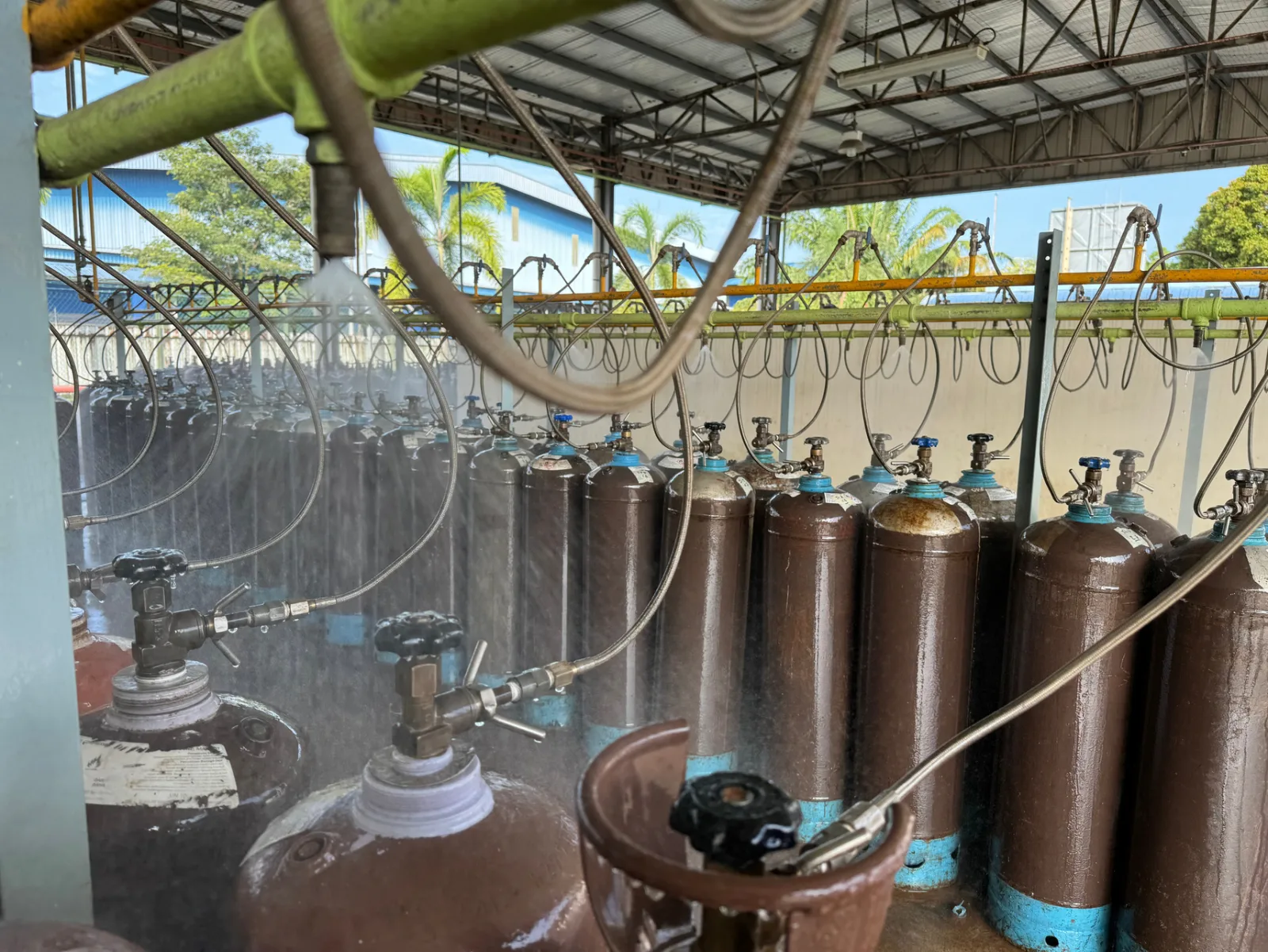
- Flammable range in air
- 2.5
- Flammable range in oxygen
- 2.0
- Ignition temperatures
- auto-ignition 305 °C; ignition temperature 325 °C; flash point −17.7 °C closed cup
- Kindling point by mixture
- 335 °C at 45 % acetylene in air
- Minimum ignition energy
- 2 × 10⁻⁵ J
Acetylene is flammable in air between 2.5 % and 82 % by volume, auto-ignites at 305 °C and can be lit by a spark of about two hundred-thousandths of a joule. Those are the figures IS 14814:2023 and the primary measurements support, and each carries a condition that the bare number hides. This page gives the limits in air and oxygen, the ignition temperatures by mixture, the ignition energy and the inerting limits, and explains the one fact that makes acetylene different from every other fuel gas: its upper flammability limit is not really 82 %, it is 100 %.
The reason is the heat of formation, +226.9 kJ/mol. Acetylene carries its own energy and does not need an oxidant to release it, so a mixture that is "too rich to burn" can still decompose. That is covered in depth in acetylene decomposition; here it sets the boundary on everything else.
The limits in air
| Source | Lower limit, % v/v | Upper limit, % v/v | Note |
|---|---|---|---|
| IS 14814:2023 cl 4.5.3 | 2.5 | 82 | the Indian code of safety |
| Jones and Kennedy, USBM RI 3337 (1937) | 2.50 | — | upward propagation, open 1.5 m × 5 cm tube; the accepted lower limit |
| Classical values (Le Chatelier 1891–95, Clowes 1896) | 3.0 | 82 | source of most handbook figures |
| C.P.I., Paris 1968 | 2.3 | 80 | most explosive mixture 7–13 % |
| Coward and Jones, USBM Bull. 503 (1952), 84-litre bomb | 2.4 | 80 | large closed vessel |
| Closed 5 cm tube, wet acetylene, 1 atm | — | 78 | as compiled by S. A. Miller (1965) |
| Same tube, 1.5 atm | — | 100 | decomposition takes over |
Two things stand out from the thirty-odd published determinations. The lower limit is robust: it lies between 2.3 and 3.5 % whatever the apparatus, clustering around 2.5 %, and only a tube narrower than the quenching diameter (0.8 mm, where the range collapses to 7.7–10 %) moves it. The upper limit is not a property of the gas at all. Across the published series it runs from 10 % to 100 % depending on tube diameter, direction of propagation, whether the tube is closed, the pressure and the ignition energy. Publishing 82 % or 85 % as a physical constant is a convention, not a measurement.
Temperature and pressure both widen the range. In one closed-tube series run in the same apparatus throughout, the limits were 2.90–55.0 % at 17 °C, 2.68–65.0 % at 100 °C, 2.39–81.0 % at 200 °C and a lower limit of 2.19 % at 400 °C. A hot pipe is a more dangerous pipe. Raising the pressure of a wet acetylene–air mixture in a closed 5 cm tube from 1 atm to 1.5 atm took the upper limit from 78 % to 100 %.
The limits in oxygen and enriched air
| Condition | Lower, % | Upper, % | Source |
|---|---|---|---|
| 2 cm³ vessel | 2.0 | 92.5 | László and Németh, 1962 — the origin of the usual "2.0–93 %" |
| 5 cm tube, upward, 3 mm spark | 2.3 | 94.5 | as compiled by S. A. Miller (1965) |
| Hempel pipette | 2.45 | 89.2 | same |
| Bunte burette, downward | 3.1 | — | same |
| C.P.I. 1968 | 2.3 | 93 | most explosive at about 30 % |
| Air enriched to 97 % oxygen, Bunte burette | little change | 89.7 | Terres |
The upper limit in oxygen is again really 100 % if the ignition is energetic enough. Oxygen enrichment barely moves the lower limit but pushes the upper limit out, which is one reason the C.P.I. forbids using oxygen for ventilation and warns that clothing ignites readily at 25–30 % oxygen.
Ignition temperature — one number or several?
IS 14814:2023 gives two figures: an ignition temperature of 325 °C (cl 4.5.1) and an auto-ignition temperature of 305 °C (cl 4.5.2), plus a closed-cup flash point of −17.7 °C (cl 4.5.4). These are the values to cite in any Indian document. The C.P.I. handbook of 1968 recorded something the Indian code does not: the kindling point depends strongly on the mixture.
| Mixture | Acetylene, % | Kindling point |
|---|---|---|
| Acetylene–air | 45 | 335 °C |
| Acetylene–air | 20 | 400 °C |
| Acetylene–air | 10 | 500 °C |
| Acetylene–oxygen | 80 | 352 °C |
| Acetylene–oxygen | 50 | 354 °C |
| Acetylene–oxygen | 30 | 386 °C |
In air, the leaner the mixture, the hotter the surface it needs; in oxygen the kindling point is nearly flat across 30–80 %. The 305 °C figure is therefore the conservative floor for a rich mixture, and it is the one to design to. Note also that pure acetylene under pressure is initiated by a clean steel surface at about 425 °C but at 280–300 °C when powdered rust, pipe scale or similar dust is present, and at about 170 °C with solid potassium hydroxide; that is the subject of rust, dust and acetylene ignition temperature, and it is why acetylene vessels are heated by hot fluids rather than by flame or electric elements.
Rules that matter
For the stoichiometric mixture (7.73 % acetylene in air) at 1 atm and 25 °C the minimum ignition energy is about 2 × 10⁻⁵ J (Fenn, Ind. Eng. Chem. 1951, 43, 2865). Methane in air needs about 2.8 × 10⁻⁴ J, roughly fifteen times more. Only hydrogen is as easy to ignite. The energy rises steeply as pressure falls, roughly with the inverse square of pressure; Fenn's sub-atmospheric values (about 5 × 10⁻⁵ J at 0.5 atm and 3.3 × 10⁻⁴ J at 0.25 atm) are partly reconstructed from a degraded scan and should be read as indicative only.
The practical ignition sources that follow from a 0.02 mJ threshold, all recorded in the combustion literature compiled in 1965:
Minimum ignition energy — the figure that drives the electrical rules
- a static discharge from a human finger;
- sparks from aluminium rubbed on rusty steel;
- friction sparks from unalloyed or low-alloy steel, which ignite acetylene–air mixtures of 3–40 %; steels with more than 6 % silicon or more than 18 % chromium did not produce incendive sparks;
- calcium carbide of 50–80 mm dropped more than 2.5 m, because of its ferrosilicon content, and 25–50 mm ferrosilicon dropped 4.5 m onto ordinary steel;
- the impact of shoe nails on steel plate, listed by the C.P.I. alongside naked lights, torch sparks, switches and grinding wheels.
Minimum igniting current for acetylene–air at 24 V is 0.34 of that for methane–air and 0.7–0.8 of that for hydrogen in circuits of similar inductance (Smith and Heathcote, ERA report). That ratio, and the very small maximum experimental safe gap, are why acetylene is gas group IIC. IS 14814:2023 cl 7.3.4 requires all electric meters, distribution boards, switches, fuses, plugs, sockets and lamps in filling and storage premises to be flameproof to IS/IEC 60079-1; the selection logic is in electrical equipment in acetylene areas, and the earthing and static rules in static electricity and minimum ignition energy.
Rules that matter
The flammable range closes as oxygen is removed. In the 84-litre bomb of Coward and Jones (US Bureau of Mines Bulletin 503, 1952):
Inerting and purging — the limiting oxygen concentration
- with progressive nitrogen dilution of the air the two limits met at 2.75 % acetylene when the oxygen concentration had fallen to 6.5 %;
- with carbon dioxide dilution they met at 3.75 % acetylene at 9 % oxygen, an atmosphere containing about 55 % CO₂;
- a stoichiometric acetylene–oxygen charge could not propagate once diluted below 18.7 % of the mixture in CO₂ or 13.0 % in nitrogen;
- no flammable mixture could be made in 46 % CO₂ / 11.3 % O₂ / 43 % N₂, nor in 13 % CO₂ / 79 % N₂ / 8 % O₂.
Carbon dioxide is the more effective diluent because of its higher heat capacity, though it is not used to purge acetylene plant because it generates static (EIGA Doc 237); methane is more effective still, and hydrogen mixtures follow Le Chatelier's mixing rule while methane mixtures do not. Two cautions attach. First, inerting removes the oxygen hazard but not the decomposition hazard; a vessel of pure acetylene above about 1 atm is still an explosive, as nitrogen dilution does not make acetylene safe explains. Second, the C.P.I. rule for bringing a generator or purifier into service is to scavenge with acetylene until the emergent gas contains at least 98 % acetylene, venting the scavenge outside the building, and to keep more than 25 mm water gauge of positive pressure on the low-pressure side so that air can never be drawn in. Purging is a measurement, never an assumption.
Rules that matter
Rules to apply
- Cite 2.5–82 % in air and 305 °C auto-ignition from IS 14814:2023 in any Indian document; cite the primary measurement when a figure is challenged.
- Design to the lower limit and never to the upper. Rich atmospheres of acetylene are decomposable, not safe.
- Treat every ignition source as adequate. At 0.02 mJ there is no such thing as a spark too small.
- Specify Group IIC, flameproof to IS/IEC 60079-1, with an appropriate temperature class, for anything electrical where acetylene can be present.
- Purge with nitrogen, never CO₂, to 2.5 % oxygen or less (IS 15190) and prove it with an analyser, then scavenge to at least 98 % acetylene before putting plant in service.
- Fit flashback protection on every oxy-fuel outlet; the physics of flame arrest is in how a flashback arrestor works, and KIGL's range is on the flashback arrestor page.
Acetylene flammability limits — frequently asked questions
What is the LEL and UEL of acetylene in air?
IS 14814:2023 gives a lower explosive limit of 2.5 % v/v and an upper limit of 82 %. The lower limit is robust: some 35 published determinations cluster between 2.3 and 3.5 %, and 2.50 % (Jones and Kennedy, 1937) is the accepted value. The upper limit depends on the apparatus and is physically 100 %, because pure acetylene decomposes without any air.
What is the auto-ignition temperature of acetylene?
305 °C according to IS 14814:2023, which also lists an ignition temperature of 325 °C. The older C.P.I. handbook (1968) gives kindling points that depend on the mixture: 335 °C at 45 % acetylene in air but 500 °C at 10 %. Lean mixtures need a hotter surface than rich ones, which is why a single figure is only a guide.
Why is the upper flammability limit of acetylene sometimes given as 100 %?
Because acetylene is endothermic and will decompose to carbon and hydrogen with no oxidant present if the ignition is energetic enough and the pressure is above about 1 atm. In a closed 5 cm tube at 1.5 atm the upper limit measured was 100 %. "Too rich to burn" is never a safe condition for acetylene; purges must be verified by measurement.
How much energy does it take to ignite acetylene?
About 2 × 10⁻⁵ joules for the most ignitable 7.73 % mixture in air at 1 atm and 25 °C (Fenn, 1951), the lowest measured for any combustible apart from hydrogen. Methane needs roughly 2.8 × 10⁻⁴ J. A static discharge from a fingertip, aluminium rubbed on rusty steel, or carbide lumps dropped 2.5 m can all exceed the acetylene figure.
What is the flammable range of acetylene in oxygen?
About 2.0 % to 93 %. The 2.0–92.5 % figure comes from a small 2 cm³ vessel (László and Németh, 1962); a 5 cm tube with upward propagation gave 2.3–94.5 %. Again the upper limit is really 100 % with a strong enough igniter. The C.P.I. (1968) gave 2.3–93 %, with the most violent mixture at about 30 % acetylene.
How much nitrogen or CO₂ is needed to inert acetylene?
From the 84-litre bomb tests of Coward and Jones (US Bureau of Mines, 1952), the limits in air meet when oxygen falls to 6.5 % with nitrogen dilution and 9 % with carbon dioxide dilution. Plant is nevertheless purged with nitrogen only, never CO₂ (EIGA Doc 237), to the IS 15190 end-point of 2.5 % oxygen or less, and the C.P.I. rule for bringing plant into service is to scavenge until the gas is at least 98 % acetylene.
Does temperature or pressure change the flammability limits?
Both widen the range. In one closed-tube series the limits moved from 2.90–55 % at 17 °C to 2.39–81 % at 200 °C. Raising the pressure of a wet mixture from 1 atm to 1.5 atm took the upper limit from 78 % to 100 %. A hot pipe or a pressurised vessel is more dangerous than the room-temperature figures suggest.
Is acetylene in explosion group IIC?
Yes. Acetylene is gas group IIC under IS/IEC 60079 (NEC Group A in the United States), alongside hydrogen, because of its very small maximum experimental safe gap. IS 14814:2023 cl 7.3.4 requires flameproof electrical equipment to IS/IEC 60079-1 in acetylene filling and storage premises. IS 15190 (Part 2):2002 cl 4.2.6 asks only for at least group IIB, but because acetylene is a IIC gas, equipment certified only for IIA or IIB should not be specified.
References
- Bureau of Indian Standards. (2023). Acetylene — Code of Safety (IS 14814:2023, First Revision).
- C.P.I. (1968). Safety in the production and use of acetylene. Paris.
- Fenn, J. B., Ind. Eng. Chem. 1951, 43, 2865 — minimum ignition energies
- IS/IEC 60079-1 Explosive atmospheres — flameproof enclosures 'd', Bureau of Indian Standards
- Jones and Kennedy, US Bureau of Mines Report of Investigations 3337 (1937); Coward and Jones, USBM Bulletin 503 (1952) — flammability limits
Enquiries
Request a quotation
State the gas or equipment, the quantity or capacity, and your location. KIGL will confirm the grade, the cylinder or plant size, and whether the location can be served from Noonmati, or through the agent network.