
Guide
Copper and acetylene: why the limit is 70 % why some standards say 65, and why IS 14814 bans brass outright
The 70 % copper limit for acetylene is a film-adhesion threshold. Below about 65–70 % copper an acetylide film stays thin and adherent and cannot spark; above it the film flakes, and a flake is a detonator. Britain, Germany and France legislated 70 %, CGA advises below 65 %, and IS 14814:2023 bans brass outright.
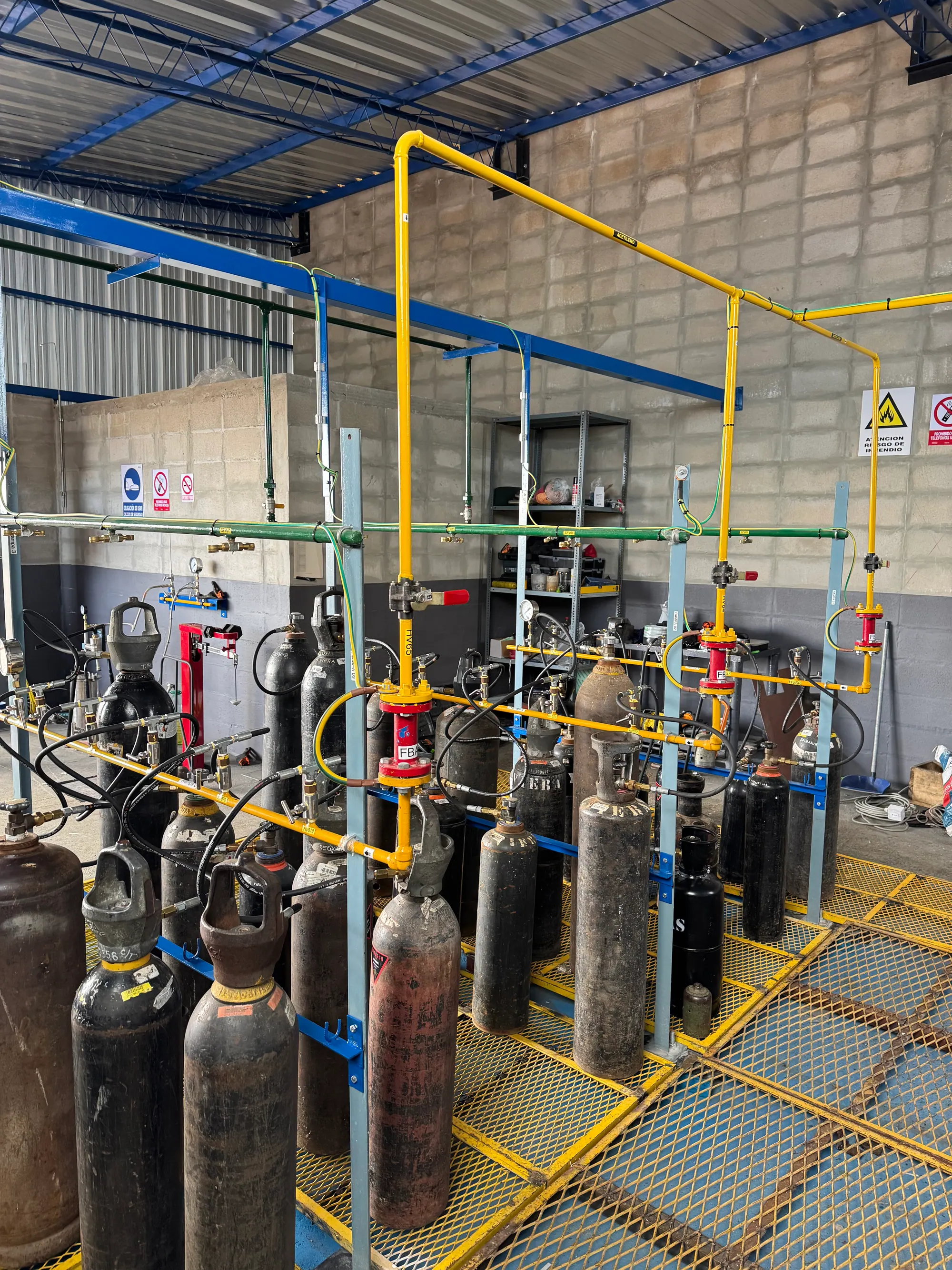
- The mechanism
- Below 65
- The demonstration
- A 6 mm steel ball dropped 30 cm onto a flake of dry copper acetylide set off acetylene at only 3 atm
- Indian valve rule
- Copper content of dissolved acetylene cylinder valves not more than 70 %
- Indian code of safety
- Containers
- Indian high-pressure piping
- Copper alloy with less than 65 % copper; brass mesh in ventilators not more than 65 %
Everyone in the gas trade knows that copper and acetylene do not mix, and almost everyone quotes a number — 70 %, or sometimes 65 — without being able to say why. The number is not arbitrary. It marks the composition at which the acetylide film on a copper alloy stops being thin and adherent and starts being thick enough to flake off, and a loose flake of copper acetylide inside pressurised acetylene is a detonator. This page sets out the mechanism from its 1947 source, the demonstration that made it vivid, and the different limits that seven Indian and international instruments actually impose.
What copper acetylide is, and what it is not
Acetylene's two hydrogen atoms can be replaced by metal atoms. With copper this happens readily when acetylene is passed into solutions of copper salts, and — the point that matters for plant — it also happens on metallic copper itself, particularly when the gas is moist, when ammonia is present, and when the surface has previously been corroded. Crude carbide acetylene is moist and carries ammonia from the calcium cyanamide in the carbide, so the wet, low-pressure part of a dissolved acetylene plant is exactly the environment in which films form.
The correct way to think about the hazard was stated as compiled by S. A. Miller (1965): the quantities of copper acetylide formed adventitiously in acetylene work are too small, and its explosive power too low, for the acetylide to be a serious hazard in itself. But if it explodes within a vessel containing acetylene under pressure, it reaches a temperature high enough to initiate decomposition of the acetylene. Copper acetylide is dangerous as a detonator, not as a charge. That framing explains why a thin film is tolerable and a loose flake is not, and why the limit is about the state of the film rather than the mere presence of copper.
Two further facts prevent misidentification. Cupric acetylide, from acetylene and slightly acidic cupric chloride solution, is black, flaky and highly sensitive; cuprous acetylide is usually red. Cuprene, which forms when acetylene meets copper at 220–260 °C and 14 atm (Teranishi, 1956), is a non-explosive polymer. A deposit on a copper part in acetylene service should be treated as suspect until identified.
The mechanism behind the 70 % figure
The key experiments are those of Brameld, Clark and Seyfang (J. Soc. Chem. Ind., 1947, 66, 346). They found that if the metal is not of high copper content — above about 65–70 % — then any acetylide film that forms remains thin and adherent to the metal, and cannot be made to spark by friction, by impact, or by contact with a wire at 150 °C. On pure copper, or on alloys of high copper content, the film may grow thicker and become detachable; once detached, it can be ignited by friction or by a wire at 150 °C.
So the limit is a film-adhesion threshold. Below it the acetylide is locked to the surface and cannot be rubbed, struck or heated into going off. Above it the film grows to a thickness at which it flakes, and the flake can be carried by the gas stream to wherever it may detonate. The same workers supplied the demonstration that makes the hazard concrete. A fragment of dry, black, flaky copper acetylide was placed on an anvil inside a tube, with a 6 mm steel ball held by an electromagnet only 30 cm above it. Acetylene was admitted at 3 atm. Dropping the ball caused an explosive decomposition of the acetylene. A 6 mm ball falling 30 cm is a trivial impact, and 3 atm is a modest pressure.
Because the transition is a band of roughly 65–70 % rather than a sharp line, different authorities have drawn their limit at different edges of it.
Seven instruments, by component and jurisdiction
| Instrument | Limit | Applies to |
|---|---|---|
| Gas Cylinders Rules, 2016, Rule 37(v) | not more than 70 % copper | dissolved acetylene cylinder valves |
| IS 8471:2003, clauses 6.2 and 7.2 | copper not used in acetylene-handling parts; copper alloys avoided in interior parts unless copper does not exceed 70 %; filler metal for sheet joints not above 70 % | acetylene generators |
| IS 15190 (Part 2):2002, clause 6.2 | copper alloy with less than 65 % copper | high-pressure acetylene piping and fittings, 155–2,550 kPa gauge |
| IS 15190 (Part 2):2002, clause 4.2.3 | brass mesh not more than 65 % copper | ventilator screens in filling buildings |
| IS 14814:2023, clause 7.3.4 | copper and copper alloys (brass, bronze) should not be used | containers, pipes, valves, fittings — a flat ban |
| EIGA Doc 123/22, Table 5 and clause 6.4 | above 70 % prohibited (Table 5); sensing elements steel or less than 70 % copper (clause 6.4) | general acetylene service; pressure instruments |
| CGA G-1 (2009), clause 7 | brass with less than 65 % copper generally acceptable | piping and fittings, advisory wording |
Three points about this table deserve emphasis. First, the historical figure of 70 % was legislated independently in Britain, Germany and France, as compiled by S. A. Miller (1965): Britain allowed licensing authorities to prohibit alloys with more than 70 % copper; Germany forbade copper alloys above 70 % from contact with acetylene; France forbade copper and alloys above 70 % in generators and in cylinders and their fittings. Three regulators arriving at the same number from the same physics is a stronger argument than "copper is banned".
Second, the CGA figure is advisory. CGA G-1 says it is generally accepted that brass containing less than 65 % copper is suitable under normal conditions, and expressly withdraws that where there is contact with highly caustic salts or solutions — a condition a carbide generator with lime slurry meets. It is not a specification of 65 %.
Third, the Indian position is the strictest of all, and it is internally layered. The Gas Cylinders Rules and IS 8471 allow up to 70 % for valves and generator parts; IS 15190 (Part 2) requires below 65 % for high-pressure piping; and IS 14814:2023, the code of safety that governs every acetylene installation, says copper alloys including brass and bronze should not be used in containers, pipes, valves or fittings at all. Where a KIGL guide gives operational advice it follows IS 14814, and the conservative reading is to specify steel, stainless steel or nickel alloys for anything in contact with acetylene, and to treat the percentage limits as the ceiling for the few components, such as valve bodies, where a copper alloy is unavoidable and specifically permitted. The IS 14814 explainer covers the clause in context.
Why the lower figure is the safer one
The most thoroughly documented dissolved acetylene cylinder explosion on public record — at a British filling plant on 7 January 2010, published by HSE staff as Hooker, Hodges, Geary and Wakefield in IChemE Hazards 26 — identified three candidate initiators: friction from a fractured valve spindle, compression of acetylene hydrate blockages, and explosive copper acetylide formed after dezincification of the copper–zinc valve. The spindle itself had failed by stress-corrosion cracking, with ammonia the most likely agent. The cylinder was 75 years old with a charcoal porous mass, so read-across to modern monolithic-mass cylinders is limited, but the valve chemistry is not specific to the mass. Dezincification selectively removes zinc from brass and leaves the surface richer in copper than the bulk alloy. A valve that was at 70 % copper when new can therefore be well above it locally after years of service in moist, ammonia-bearing gas.
That finding is the physical reason to prefer the lower edge of the band. Specifying below 65 % copper and a dezincification-resistant brass for any copper-alloy component in acetylene service is defensible on published evidence, and it satisfies every percentage limit in the table at once. It does not satisfy IS 14814:2023, which bans copper alloys outright, so in India the conservative course is steel, stainless steel or nickel alloys wherever the gas is in contact. It also bears on the one component where copper alloys have historically been most common: the cylinder valve, covered under acetylene cylinder valves and keys.
Bourdon tubes and gauges
Pressure gauges are the component most often overlooked. As compiled by S. A. Miller (1965), opening a cylinder valve quickly onto a gauge compresses the trapped gas adiabatically; the calculation from a standard charge at 16 atm absolute gives about 190 °C, and from a tropically heated cylinder at 29 atm absolute about 270 °C, neither of which will initiate acetylene. The real hazard is different: a Bourdon tube of pure copper or high-copper alloy, surface-corroded and in use for years, may contain a fragment of flaky copper acetylide, and that can initiate under the same shock. Feitknecht and Hugi-Carmes (Schweiz. Archiv, 1957, 23, 325) investigated copper acetylide found in Bourdon tubes.
The C.P.I. (Safety in the Production and Use of Acetylene, Paris 1968) therefore recommended manometer tubes of steel or stainless steel, a shock-absorbing device or capillary between pipe and gauge, and siting gauges so that a burst cannot reach another part of the high-pressure line. EIGA Doc 123/22 clause 6.4 makes the sensing element steel or below 70 % copper, requires a solid bulkhead with a blow-out back, and calls for a 0.5 mm restrictor or a flame arrestor at medium and high working pressure. IS 15190 (Part 1):2002 clause 7.7.2(b) requires a gauge vent with a bursting disc and a device on the inlet to limit leakage if the measuring element ruptures, giving an orifice of not more than 0.1 mm² as an example. Every one of these provisions follows from the same acetylide-as-detonator logic.
Where the physics sits in the hierarchy of materials
As compiled by S. A. Miller (1965), the engineering guidance on copper is a hierarchy rather than a single rule. Copper and high-copper alloys are to be avoided for vessels and pipes containing pressurised acetylene. Even low-copper alloys are best avoided for substantial items of plant, especially where there is any possibility of acidic corrosion — and a carbide generator with its hydrogen sulphide, phosphine oxidation products and acidic purifying media is such a place. Brass or bronze fittings external to plant items were regarded in 1965 as presenting little hazard provided they were kept clean, because any film there is not sensitive and is not located where it could initiate the pressurised gas.
Indian practice does not rely on that last concession. IS 14814:2023 bans brass and bronze fittings in acetylene service without qualification, and the conservative course for any plant in India is to follow it. Nickel is safe from acetylide formation: it forms no acetylide, and nor do steel, stainless steel and the other metals normally used in chemical plant. Nickel is not, however, inert in every sense — reduced nickel is the most active catalytic surface for acetylene condensation, with onset at 230 °C (Cullis and Nettleton, Trans. Faraday Soc., 1963, 59, 301), a different hazard discussed under rust, dust and ignition temperature. Silver and mercury, the other two acetylide-forming metals, are covered under silver solder and acetylene.
Rules that matter
Rules to apply
- Treat every copper-alloy component in acetylene service as a question, not a default. Steel, stainless steel and nickel alloys are the standard materials for acetylene pipelines, flashback arrestor bodies and generator internals.
- Where a copper alloy is permitted and unavoidable, specify below 65 % copper and dezincification-resistant brass. That satisfies GCR Rule 37(v), IS 8471, IS 15190 (Part 2), EIGA and CGA at once.
- Replace copper or high-copper Bourdon tubes with steel or stainless steel, and fit a restrictor and blow-out back as EIGA Doc 123 and IS 15190 (Part 1) require.
- Keep the wet, ammonia-bearing low-pressure section free of copper alloys altogether; it is where films form fastest.
- Audit old installations for brass unions, gauge tubes, valve trim and brazed joints. The audit of brazing, where silver is the sharper risk, is a separate task.
- Do not identify an unknown deposit by guesswork. A dry flaky deposit on copper in acetylene service is treated as acetylide and wetted before removal.
Copper — frequently asked questions
Why is copper not allowed with acetylene?
Acetylene reacts with copper, especially moist copper in the presence of ammonia, to form copper acetylide. The acetylide itself is a weak explosive in small quantities, but if a flake of it goes off inside a vessel of pressurised acetylene it reaches a temperature high enough to initiate decomposition of the gas around it. Copper acetylide is dangerous as a detonator, not as a charge.
What is the maximum copper content allowed in brass for acetylene?
It depends on the component and the jurisdiction. The Gas Cylinders Rules, 2016, Rule 37(v) allow up to 70 % copper in cylinder valves. IS 15190 (Part 2):2002 requires less than 65 % in high-pressure piping and fittings. CGA G-1 treats brass below 65 % as generally acceptable. IS 14814:2023 cl 7.3.4 says copper alloys including brass and bronze should not be used at all.
Why do some standards say 65 % and others 70 %?
The physical transition is a band, roughly 65–70 % copper, where the acetylide film changes from thin and adherent to thick and detachable (Brameld, Clark and Seyfang, 1947). Britain, Germany and France took the top of the band; CGA and IS 15190 (Part 2) take the bottom. The 2010 British cylinder explosion, where a brass valve dezincified, suggests the lower figure is the safer one.
Can I use a brass pressure gauge on acetylene?
Not with a copper or high-copper Bourdon tube. Copper acetylide has been found inside Bourdon tubes after years of service (Feitknecht and Hugi-Carmes, 1957), and the C.P.I. recommended steel or stainless steel manometer tubes in 1968. EIGA Doc 123/22 requires the sensing element to be steel or below 70 % copper, with a blow-out back and a 0.5 mm restrictor at medium and high pressure.
Is copper acetylide the same as the green deposit on copper fittings?
No. Ordinary green copper corrosion is carbonate or chloride. Copper acetylide from wet acidic conditions is black and flaky (cupric) or red (cuprous). Cuprene, formed when acetylene meets copper at 220–260 °C and 14 atm, is a non-explosive polymer. Any deposit on a copper part in acetylene service should be treated as suspect until identified.
Does the copper rule apply to tools used in an acetylene plant?
Yes in India. IS 14814:2023 requires hand tools to be of the non-sparking type and separately says copper alloys should not be used, so bronze or brass scraping tools inside a generator are not the answer. The C.P.I. 1968 text allowed wood or brass tools for scraping lime; that permission is superseded by IS 14814.
Is nickel safe with acetylene?
Nickel does not form an acetylide, nor do the other metals normally used in chemical plant. Steel, stainless steel and nickel alloys are the standard materials. Reduced nickel is, however, the most catalytically active surface for acetylene condensation, with onset at 230 °C (Cullis and Nettleton, 1963), so nickel is safe from acetylide and not from heat.
References
- Bureau of Indian Standards. (2002). Acetylene Pipelines — Code of Practice, 155 to 2550 kPa(g) (IS 15190 (Part 2):2002).
- Bureau of Indian Standards. (2023). Acetylene — Code of Safety (IS 14814:2023, First Revision).
- Compressed Gas Association. (2009). Acetylene, clause 7 (CGA G-1).
- European Industrial Gases Association. (2022). Code of Practice: Acetylene (Table 5 and clause 6.4) (EIGA Doc 123/22). https://www.eiga.eu/uploads/documents/DOC123.pdf
- Government of India. (2016). Gas Cylinders Rules, 2016 (G.S.R. 1081(E)). Petroleum and Explosives Safety Organisation. [Rule 37]
- Hooker, Hodges, Geary and Wakefield, Investigation of an acetylene cylinder explosion incident, IChemE Hazards 26 https://www.icheme.org/media/11834/hazards-26-paper-06-investigation-of-an-acetylene-cylinder-explosion-incident.pdf
Enquiries
Request a quotation
State the gas or equipment, the quantity or capacity, and your location. KIGL will confirm the grade, the cylinder or plant size, and whether the location can be served from Noonmati, or through the agent network.