
Guide
How a PSA oxygen plant makes oxygen out of air
A PSA oxygen plant pushes compressed air through a zeolite sieve that holds nitrogen and lets oxygen pass. It runs two vessels in alternation: one producing under pressure while the other depressurises and regenerates. The swing between pressures is the whole mechanism, and typical product purity is 93 %.
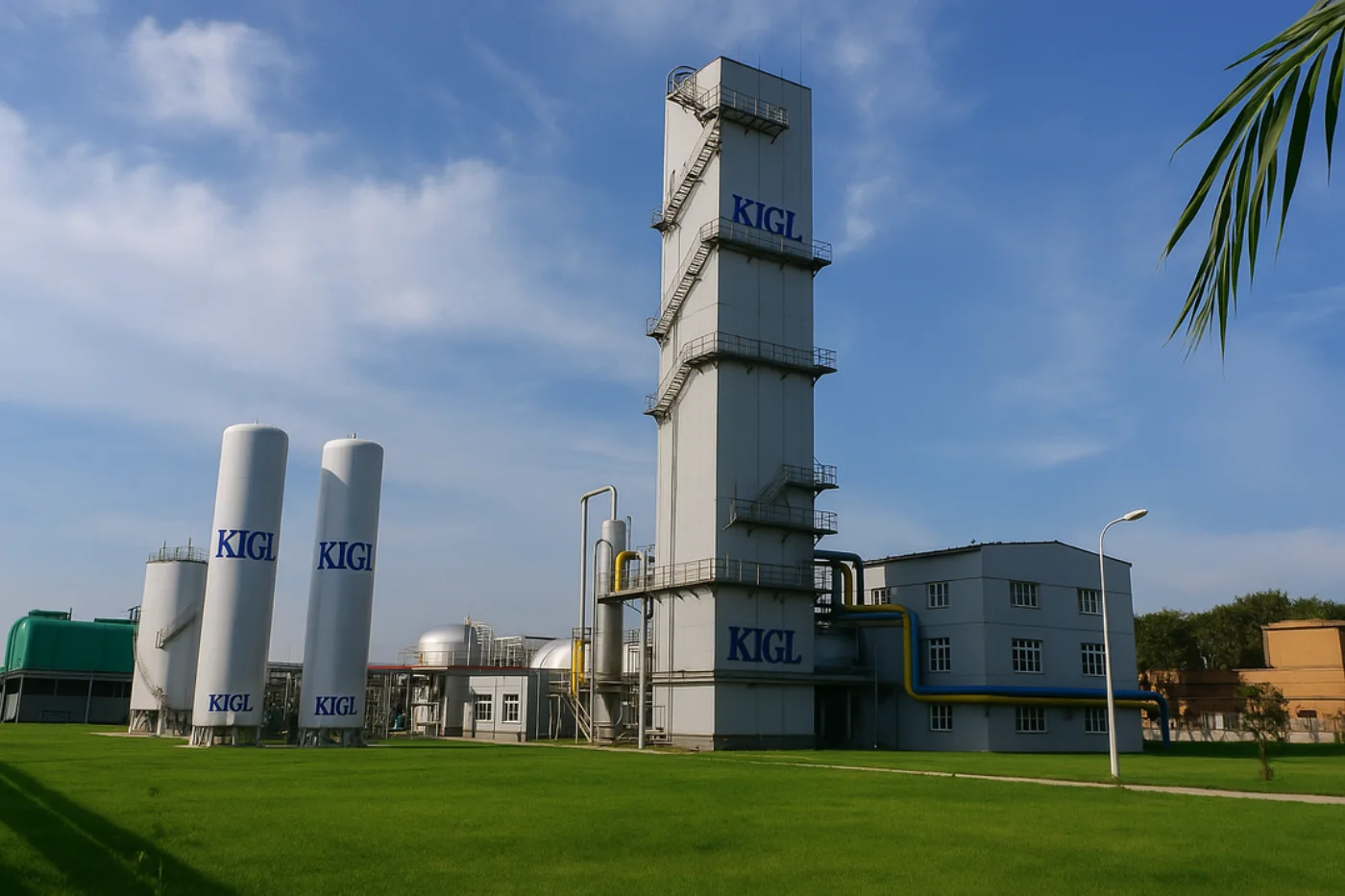
- Feedstock
- Compressed air
- Separating medium
- Zeolite molecular sieve
- Configuration
- Two vessels alternating
- Dominant running cost
- Electricity for the air compressor
- Feed air quality
- Oil and moisture shorten sieve life
Oxygen out of air, using pressure alone
A PSA plant makes oxygen from the air already around it. There is no feedstock to buy and nothing to deliver: the raw material is free, and what you pay for is the electricity to separate it.
PSA stands for pressure swing adsorption, and the name describes the mechanism exactly. It is worth understanding the mechanism rather than treating the plant as a black box, because every number in the business case — purity, output, running cost, sieve life — falls out of it directly.
The sieve
Air is roughly 78 % nitrogen and 21 % oxygen. Push it under pressure through a bed of zeolite molecular sieve and the nitrogen is preferentially adsorbed — held on the surface of the material — while the oxygen passes through.
What leaves the vessel is oxygen-enriched. What stays behind is nitrogen, accumulating in the bed.
Note what the sieve is not doing: it is not filtering by size in the way the word "sieve" suggests, and it is not chemically reacting. It is holding nitrogen on a surface, reversibly, because of how the molecule interacts with that surface. Everything that damages a sieve — oil, water, anything that coats or occupies that surface — damages it by taking away the surface area the whole process depends on. That is why feed air quality gets its own section below.
The swing
The sieve fills up. That is the constraint the whole plant is designed around.
Drop the pressure in the vessel and the trapped nitrogen releases to atmosphere, regenerating the bed. Adsorb at pressure, desorb at low pressure: that is the swing.
So the plant runs two vessels in alternation: one producing oxygen under pressure while the other is depressurised and regenerating. They change over continuously, which is how a batch process delivers a continuous output.
Two consequences follow, and both surprise people. First, the changeover is where a PSA plant makes its noise and where its valves do their work, and valve maintenance is a real line item, not an afterthought. Second, a PSA plant likes to run steadily. Cycling it up and down to follow an intermittent demand wastes the gas left in a vessel at each changeover and works the valves harder. Steady load is not just better economics; it is easier on the machine.
What limits the purity
PSA oxygen is high purity, but not the near-total purity cryogenic distillation achieves. The reason is argon.
Argon makes up 0.93 % of air, and on a zeolite sieve it behaves much like oxygen does, so it is not held back with the nitrogen. It travels through with the product. Since it cannot be separated by the same mechanism that is doing the separating, it accumulates in the output and sets a ceiling in the mid-nineties per cent that no amount of extra sieve or extra pressure will lift.
This is a property of the physics, not a limitation of a particular machine, and it is the single most useful thing to know when a supplier quotes you a PSA plant. A PSA oxygen plant offered at 99 %+ is not describing pressure swing adsorption. Reaching that purity means cryogenic separation, which is an entirely different plant at an entirely different scale, or cylinder supply.
For welding, cutting, furnace work, water treatment and hospital oxygen supply, mid-nineties is entirely sufficient. In the medical case it is more than sufficient, because "Oxygen 93 %" is a recognised pharmacopoeial grade in its own right, distinct from the higher-purity product and specified for exactly this kind of on-site generation.
What it costs to run
Electricity, overwhelmingly. The air compressor runs continuously and dominates the operating cost. After that:
- Sieve replacement — periodic, and not a small item
- Compressor maintenance — the largest mechanical cost
- Valve maintenance — the changeover valves work every cycle, all day
- Operator time
- Air treatment media — filters and dryers
The oxygen is free. You are buying the energy to separate it, which means a PSA business case is in large part an electricity tariff calculation. That has a consequence people miss: a plant that paid for itself at one tariff may stop doing so at another, and the calculation should be redone when the tariff moves rather than treated as settled at purchase. It also means the comparison against cylinders is not fixed: it moves with your electricity bill and with the delivered price of gas independently.
Feed air quality is part of the plant
Oil and moisture reaching the sieve degrade it, and the sieve is expensive.
Air treatment ahead of the vessels — filtration and drying — is part of the plant, not an accessory. Skimping there is one of the more costly false economies in this equipment, and the reason is the failure mode: the damage is invisible and cumulative. Nothing trips, nothing alarms. Output drifts down and purity drifts down with it, slowly enough that people adjust to it, and the diagnosis arrives when the bed is opened and the sieve has to be replaced early.
The practical defence is to record output and purity from commissioning and watch the trend rather than the reading. A number that has moved is information; a number that is merely within limits is not.
The classes involved are on compressed air quality classes.
Rules that matter
When demand is steady, continuous and large enough that cylinder delivery has become the dominant cost, and when you can genuinely run and maintain the plant. That last condition is not a formality: a PSA plant is a compressor, a set of cycling valves and a consumable bed, and it rewards an operator who logs it and punishes one who does not.
Three things point back toward cylinders, and any one of them is usually decisive:
When it pays
- Intermittent demand — the plant runs badly and the economics assume it runs steadily
- Modest volumes — the capital never gets paid back against a small delivered-gas bill
- Purity above the mid-nineties — the physics closes the door, whatever the flow
The full method for that decision is on cylinders or on-site generation.
How — frequently asked questions
What does the sieve actually do?
It adsorbs nitrogen preferentially. Air is roughly 78 % nitrogen and 21 % oxygen; pushed through a zeolite bed under pressure, the nitrogen is held on the sieve surface and the oxygen passes through. What comes out is oxygen-enriched, and the sieve is progressively filling with nitrogen as it does so.
What is the pressure swing?
The sieve fills up and must be cleared. Dropping the pressure releases the trapped nitrogen to atmosphere and regenerates the bed. That is the swing — adsorb at pressure, desorb at low pressure. Two vessels alternate so one is always producing while the other regenerates, which is how the output stays continuous.
What purity can PSA reach?
PSA oxygen is high but not the near-total purity of cryogenic separation, because argon behaves similarly to oxygen on the sieve and travels with it. For welding, cutting, furnaces, water treatment and medical oxygen supply this is entirely sufficient. For applications needing the very top of the purity range, cryogenic separation or cylinder supply is the route.
What determines the running cost?
Electricity, overwhelmingly, because the air compressor runs continuously. Sieve replacement, compressor maintenance and operator time follow. The oxygen itself is free — you are buying the energy to separate it, which is why a PSA business case is really an electricity tariff calculation.
Why does feed air quality matter?
Because oil and moisture reaching the sieve degrade it, and sieve replacement is not a small item. Air treatment ahead of the vessels is part of the plant rather than an accessory, and skimping on it is one of the more expensive false economies in this equipment.
When does a PSA plant make sense?
When you have a steady, continuous demand large enough that cylinder delivery becomes the dominant cost, and when you can run and maintain the plant. Intermittent demand, modest volumes, or very high purity requirements all point back towards cylinders. There is a method for that decision on the cylinders-or-generation guide.
Enquiries
Request a quotation
State the gas or equipment, the quantity or capacity, and your location. KIGL will confirm the grade, the cylinder or plant size, and whether the location can be served from Noonmati, or through our agent network.