
Standards · IS 4379:1981 · IS 3933 · IS 5:1978
IS 4379 gas cylinder colour codes in India gas by gas
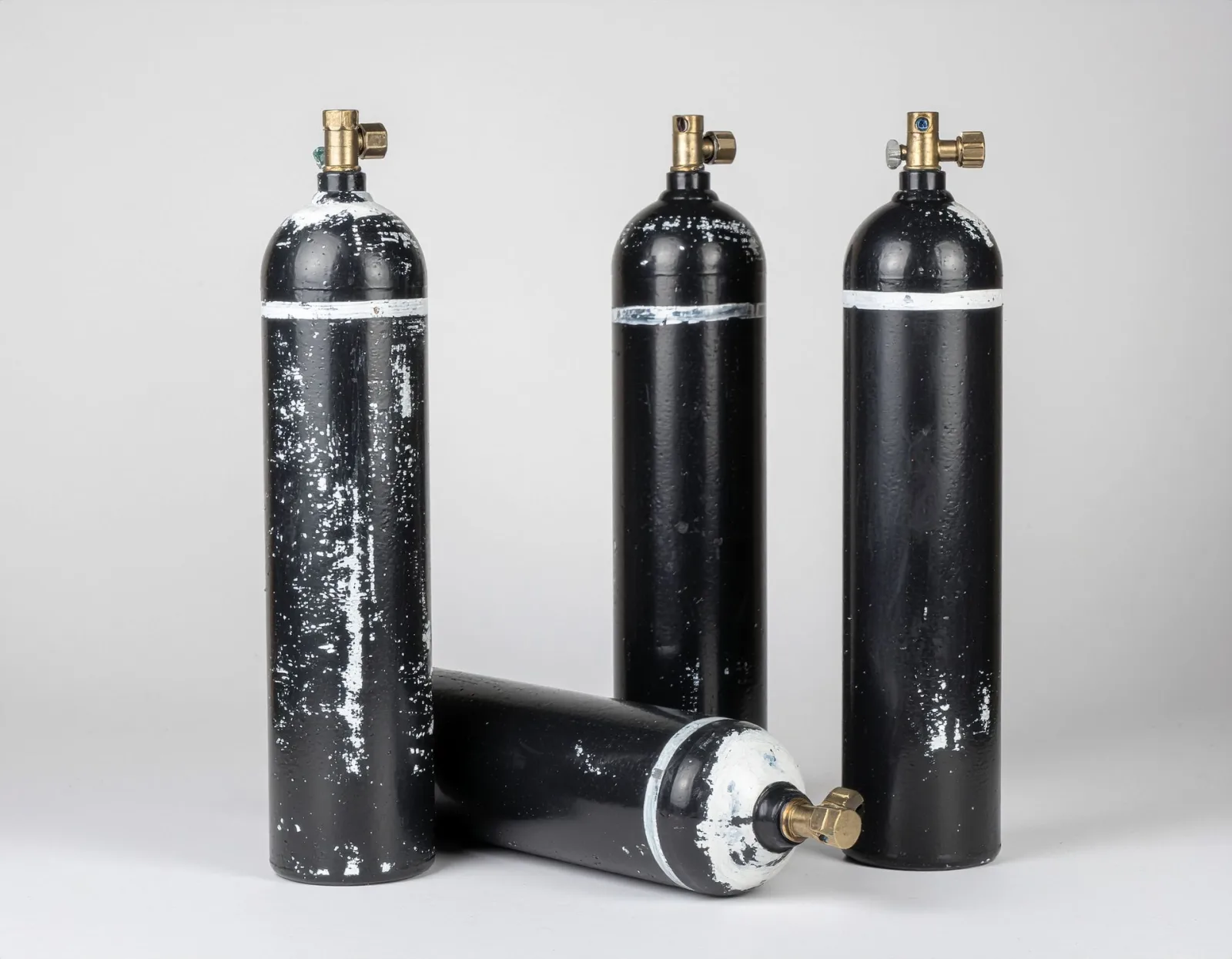
IS 4379:1981 sets the ground colour and neck band identifying the contents of industrial gas cylinders in India. Oxygen is black, dissolved acetylene maroon, hydrogen signal red, argon peacock blue. Medical cylinders follow IS 3933 instead. Colour is a secondary check only — the stamped marking is the authority.
- Governing standard (industrial)
- IS 4379:1981
- Governing standard (medical)
- IS 3933 : 2021
- Colour shade reference
- IS 5:1978 ready-mixed paint shades
- Minimum band width
- 0.25 × cylinder outside diameter
- Cylinders sharing a black body
- Oxygen and carbon dioxide
What IS 4379 actually does
IS 4379:1981, Identification of the Contents of Industrial Gas Cylinders, is the Indian Standard that tells you what is inside a cylinder by how it is painted. It is referenced by the Gas Cylinders Rules and it applies to industrial cylinders. Medical cylinders are outside its scope and follow IS 3933 instead — a distinction that catches out a surprising number of otherwise careful buyers.
The standard works on two elements:
- Ground colour — the body of the cylinder.
- Neck band — a band around the shoulder, used where the ground colour alone would be ambiguous.
Colour names in the standard are tied to shade numbers from IS 5:1978, the ready-mixed paint standard. That is what makes the scheme reproducible between paint suppliers. "Maroon" is an opinion; shade 541 is a specification.
The colour table
The ground colours and bands for the gases in normal industrial circulation in India:
| Gas | Ground colour | Neck band |
|---|---|---|
| Oxygen | Black | — |
| Dissolved acetylene | Maroon (541) | — |
| Hydrogen | Signal red (537) | — |
| Nitrogen | French grey (630) | Black |
| Carbon dioxide | Black | White or aluminium |
| Argon | Peacock blue (103) | — |
| Helium | Middle brown (411) | — |
| Compressed air | French grey (630) | — |
| Ammonia | Black | Signal red + golden yellow |
| LPG, methane, propane, butane | Signal red (537) | — |
Where a cylinder carries two bands, the order is fixed: the red or blue band sits nearest the valve, with yellow between. Any band must be at least a quarter of the cylinder’s outside diameter in width, so that it reads at a distance.
Medical cylinders follow a different standard
Medical gas cylinders are not covered by IS 4379. They follow IS 3933, and the difference is not cosmetic: it is what stops the wrong gas reaching a patient.
The distinction that matters most on a KIGL site, because both gases are ours:
Medical oxygen carries the same black body as industrial oxygen. What separates them is a white shoulder.
So on a hospital site, or anywhere both are handled, a black cylinder tells you almost nothing on its own; the shoulder does the work. Our medical oxygen is manufactured under drug licence to Indian Pharmacopoeia standard and finished to the medical scheme; our industrial oxygen to IS 309 is not, and the two must never be substituted for one another whatever the body colour suggests.
Medical nitrous oxide, the other medical gas we fill, is blue on both body and shoulder under the same standard.
Where a medical cylinder needs two colours to identify it, IS 3933 has them painted in quarters around the shoulder rather than as a band. If you are specifying or auditing a medical gas installation, work from the standard itself. We have not reproduced its tables here.
The black-cylinder problem
Look at the table again. Oxygen and carbon dioxide are both black. The only thing separating them on the paintwork is a white neck band on the CO₂ cylinder, a band that fades, gets overpainted during refurbishment, and disappears entirely under a coat of workshop grime.
This is the most consequential ambiguity in the Indian scheme, and it deserves to be treated as a live hazard rather than a curiosity:
- Carbon dioxide connected where oxygen was expected will not support combustion — a cutting set will not light, which is the harmless failure.
- The dangerous failure is the reverse, or a medical application, where the consequence is not a flame that will not light.
The practical rule in every plant we supply is the same: colour tells you where to look, the stamping tells you what it is. IS 4379 requires the cylinder to be marked with the gas name and chemical formula, and every cylinder carries stamped identification on the shoulder. Read it. Then read the label. Colour is the third check, not the first.
Why the international colours are different
If you have handled imported cylinders, or worked to ISO or EN practice, the table above will look wrong: under the ISO harmonised scheme oxygen is white, not black.
Both are correct in their own jurisdiction. India runs the IS 4379:1981 scheme, and the cylinders in circulation here — including ours — are painted to it. A later edition of IS 4379 moves toward the ISO colours, but the installed fleet across the country reflects the 1981 edition and will for years, because cylinders last decades and repainting a national fleet is not a thing that happens quickly.
Two consequences worth planning for:
- A mixed fleet is normal. If you buy from more than one supplier, or take in imported cylinders, you will eventually hold cylinders painted to two different conventions at the same time. Procedure must be written around the marking, not the paint.
- Do not repaint to "correct" a cylinder. Repainting a cylinder to the colour you think it ought to be is how a genuinely mislabelled cylinder gets created. Colour changes are the filler’s job, made at the same time as the markings.
Colour is not a specification
A last point, because it is the one that causes arguments on delivery.
Colour identifies the gas. It says nothing about the grade. An industrial oxygen cylinder and a higher-purity oxygen cylinder are painted identically. Dissolved acetylene at ≥98 % to IS 308 and ultra-high-purity acetylene at 99.99 % in DMF are both maroon. If your process is purity-sensitive — atomic absorption, analysis, medical use — the paint will never tell you what you need to know. The batch certificate will.
How KIGL applies it
Every cylinder we fill leaves painted to IS 4379, marked with the gas name and formula, and labelled with the grade and batch reference. Our cylinder tracking system holds the colour, the specification, the test date and the fill record against each individual cylinder’s serial number, which is how we can answer "what is actually in this one" without relying on what somebody painted on it years ago.
For the standards that govern how those cylinders are built, valved and tested, see the standards index.
IS 4379 gas cylinder colour codes — specification
| Property | Value | Method / basis |
|---|---|---|
| Oxygen | Black ground, no band | IS 4379:1981 |
| Dissolved acetylene | Maroon (shade 541), no band | IS 4379:1981 |
| Hydrogen | Signal red (shade 537), no band | IS 4379:1981 |
| Nitrogen | French grey (shade 630) + black neck band | IS 4379:1981 |
| Carbon dioxide | Black + white (or aluminium) neck band | IS 4379:1981 |
| Argon | Peacock blue (shade 103), no band | IS 4379:1981 |
| Helium | Middle brown (shade 411) | IS 4379:1981 |
| Compressed air | French grey (shade 630), no band | IS 4379:1981 |
| Nitrous oxide | Blue (medical — IS 3933) | IS 3933 |
| Ammonia | Black + signal red and golden yellow bands | IS 4379:1981 |
| LPG, methane, propane, butane | Signal red (shade 537) | IS 4379:1981 |
IS 4379 gas cylinder colour codes — frequently asked questions
Why are oxygen and carbon dioxide cylinders both black?
Because IS 4379 assigns black as the ground colour to both, and separates them by neck band — carbon dioxide carries a white or aluminium band, oxygen carries none. It is the single most dangerous ambiguity in the Indian colour scheme, and it is why colour must never be your only check. Read the stamped marking on the shoulder and the label before you connect anything. A CO₂ cylinder connected in place of oxygen will not support life and will not support combustion.
Is oxygen white or black in India?
Industrial oxygen under IS 4379:1981 is black, and that is what cylinders in service across India actually carry. White is the ISO 32 international colour for oxygen and is used in many other countries, and medical oxygen in India follows IS 3933 rather than IS 4379. If you have worked with imported or medical cylinders, expect the difference and check the marking rather than assuming.
Does the colour on the cylinder legally identify the gas?
No. IS 4379 itself requires cylinders to be marked with the gas name and chemical formula, and that marking — with the stamping on the cylinder shoulder — is the identification that counts. Paint fades, gets overpainted, and is repeated across gases. Treat colour as a distance cue that tells you where to look, never as the answer.
How wide does a neck band have to be?
At least a quarter of the cylinder’s outside diameter. Where a cylinder carries two bands, IS 4379 fixes the order: the red or blue band goes nearest the valve and the yellow band sits between. The ordering matters because it is what lets you read a two-band cylinder correctly from the top down.
What do the shade numbers like 541 and 630 mean?
They are shade references from IS 5:1978, the Indian Standard for ready-mixed paint colours. Quoting the shade number rather than a colour name is what makes the scheme reproducible — "maroon" is a matter of opinion, shade 541 is not. Specify the IS 5 number when you order cylinder paint.
Do medical cylinders follow this standard?
No. Medical gas cylinders in India follow IS 3933, and the colours differ from the industrial scheme in ways that matter — medical oxygen is not painted like industrial oxygen. Hospitals, nursing homes and ambulance services should work to IS 3933 and to their drug licence conditions, not to the table on this page.
Has IS 4379 changed since 1981?
A later edition exists that moves towards the ISO harmonised scheme, and under ISO the colours differ — oxygen becomes white. The overwhelming majority of cylinders in circulation in India today, including ours, follow the 1981 edition, which is why this page documents it. If you are specifying new cylinders or writing a procedure, confirm which edition your PESO licence and your customers work to before repainting anything.
Enquiries
Request a quotation
State the gas or equipment, the quantity or capacity, and your location. KIGL will confirm the grade, the cylinder or plant size, and whether the location can be served from Noonmati, or through our agent network.