
Guide
What are industrial gases? The four families the five ways they are supplied, and the Indian standard for each
Industrial gases are gases produced and sold in bulk for industry, healthcare and science: oxygen, nitrogen and argon separated from air, which is about 78 % nitrogen and 21 % oxygen; fuel gases such as acetylene and hydrogen; and specialty and medical gases. Each has its own Indian specification, such as IS 309:2023 for oxygen.
- Composition of dry air
- Nitrogen 78.08 %
- Legal meaning of compressed gas
- Any gas above 2.5 kgf/cm² absolute at 15 °C or 3 kgf/cm² absolute at 50 °C
- Classes by critical temperature
- Permanent gas below −10 °C; high-pressure liquefiable −10 °C to +70 °C; low-pressure liquefiable above +70 °C
- Legal meaning of flammable gas
- Forms a flammable mixture at 13 % or less in air
- Oxygen grades
- Three grades: 99.95 %
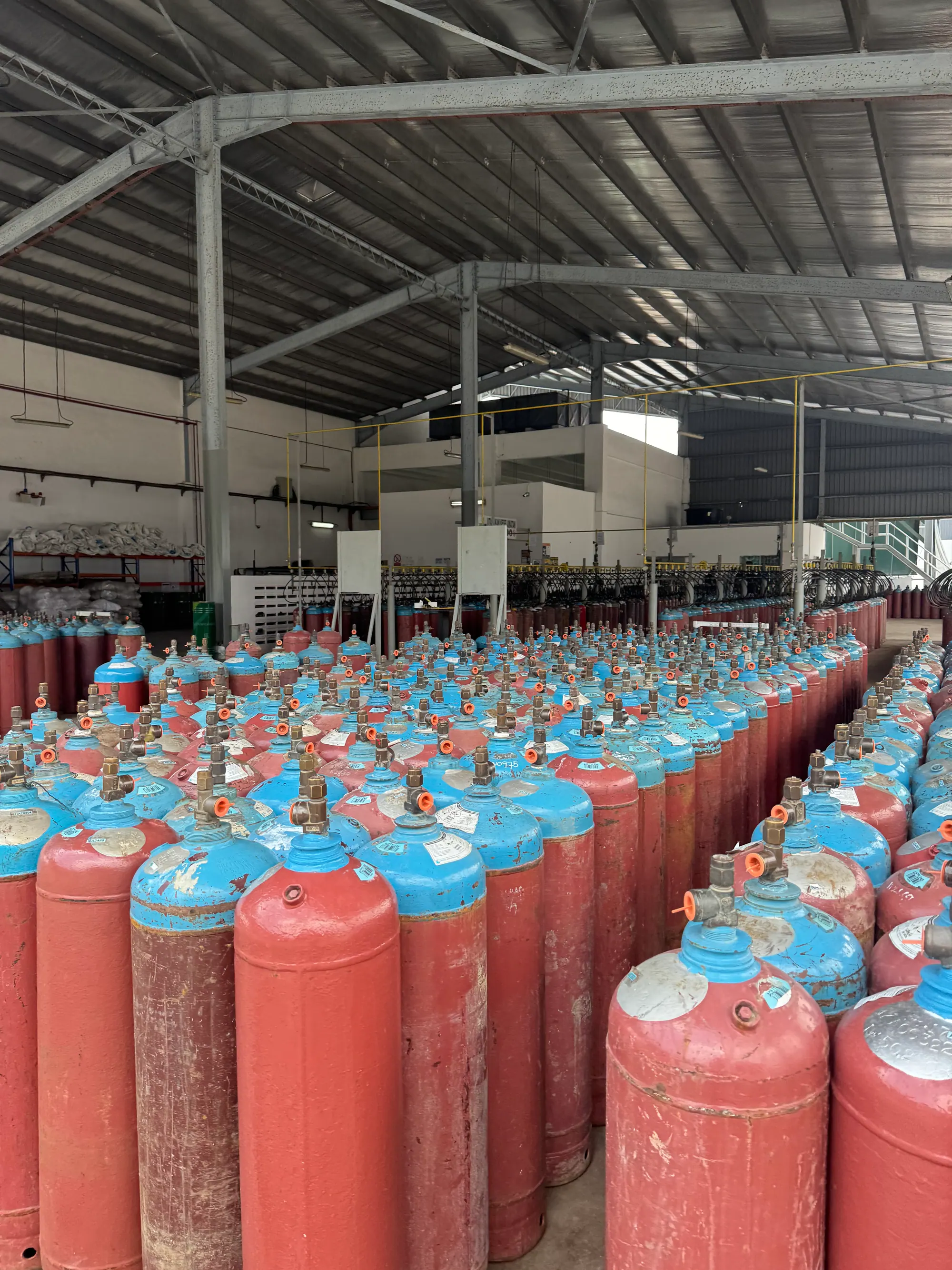
An industrial gas is a gas made in quantity and sold for what it does in a process: oxygen to burn hotter, nitrogen to keep air out, argon to shield a weld, acetylene to cut steel, carbon dioxide to carbonate a drink. Most are separated from air or recovered from another process, purified to a stated grade, and delivered in a cylinder, a tank, a pipe or a plant on the customer's own site. In India each major gas has its own Bureau of Indian Standards specification and its own cylinder colour.
What makes a gas an industrial gas?
Three things: it is produced in bulk rather than in a laboratory, it is sold to a purity specification, and it is delivered under pressure or as a cryogenic liquid. The Gas Cylinders Rules 2016 give the legal threshold. Rule 2(v) treats any gas exerting more than 2.5 kgf/cm² absolute at 15 °C, or more than 3 kgf/cm² absolute at 50 °C, as a compressed gas, and expressly includes cryogenic liquids. Once a gas crosses that line, its cylinder, valve, filling, storage and transport are regulated by PESO.
The Rules then sort gases by what they do in a cylinder, using critical temperature, the temperature above which a gas cannot be liquefied by pressure alone. A permanent gas has a critical temperature below −10 °C and stays gaseous in the cylinder at any pressure; oxygen, nitrogen, argon, hydrogen and helium are permanent gases. A high-pressure liquefiable gas has its critical temperature between −10 °C and +70 °C, which is where carbon dioxide and nitrous oxide sit. A low-pressure liquefiable gas, such as LPG or ammonia, has one above +70 °C. Acetylene is a fourth case, a dissolved gas held in acetone inside a porous mass, for reasons explained on why acetylene is dissolved in acetone.
The four families
| Family | Gases | Where they come from | Typical role |
|---|---|---|---|
| Atmospheric | Oxygen, nitrogen, argon; neon, krypton, xenon | Separated from air, cryogenically or by PSA | Oxidiser, inerting, shielding |
| Fuel | Acetylene, hydrogen, LPG | Calcium carbide, water electrolysis or reforming, petroleum refining | Heat, cutting, reduction |
| Process and specialty | Carbon dioxide, nitrous oxide, helium, calibration mixtures, ultra-high-purity gases | Recovered process gas, chemical synthesis, natural gas wells, blending | Carbonation, analysis, leak testing, laboratories |
| Medical | Medical oxygen, nitrous oxide, medical air, carbon dioxide | As above, made and handled as drugs | Therapy, anaesthesia, surgery |
The atmospheric gases dominate by volume because their raw material is free. The U.S. Standard Atmosphere 1976 gives dry air as 78.08 % nitrogen, 20.95 % oxygen and 0.93 % argon by volume, with every other component together under 0.05 %. Separating air is therefore the largest single activity in the industry; the routes are compared on types of industrial gas plants.
The Gas Cylinders Rules also define the hazard classes that decide how a gas is stored and moved. Rule 2(xxvi) calls a gas flammable if it forms a flammable mixture at 13 % or less in air, or if its flammable range is wider than 12 percentage points; acetylene, at 2.5 to 82 % in air under IS 14814:2023, qualifies on both counts. Rule 2(xlv) calls a gas toxic if its maximum allowable concentration for breathing does not exceed 100 mg/m³. The full hazard picture gas by gas is on which industrial gases are flammable.
How are industrial gases supplied?
| Supply mode | What the customer receives | Suits | Governing instrument |
|---|---|---|---|
| Cylinder | A metal container of more than 0.5 litre and, for most gases, not more than 1,000 litres water capacity | Small or irregular demand, many gases on one site | Gas Cylinders Rules 2016, Rule 2(xxviii); IS 3224 valves; IS 4379 colours |
| Bundle, cascade or manifold | Several cylinders coupled to one outlet | Higher flow without bulk storage | IS 16507:2017 for transportable cascades; IS 15190 (Part 2):2002 for acetylene manifolds |
| Liquid bulk | Cryogenic liquid in a vacuum-insulated tank, vaporised on site | Large steady demand for oxygen, nitrogen or argon | SMPV (Unfired) Rules 2016 for static tanks; IS 18719 (Parts 1 and 2):2024 for transportable vessels up to 1,000 litres |
| Pipeline | Gas piped from a central source to points of use | Factories, hospitals, filling plants | IS 15190 (Parts 1 and 2):2002 for acetylene; medical pipeline practice for hospitals |
| On-site generation | A plant that makes the gas at the point of use | Steady demand at a purity the plant can reach | IS 8471:2003 for acetylene generators; PESO approval |
One gap is worth knowing before a tender asks for it. The BIS committee that writes the gas specifications, CHD 06, publishes no standard for an air separation or PSA plant; it covers the product gases and, through the IS/ISO 8573 series, the purity classes of compressed air. A claim that a PSA plant is built "as per IS" therefore has no plant standard behind it. The trade-offs between cylinder supply and a plant are set out on cylinder supply or on-site generation.
The Indian standard for each gas
| Gas | Indian specification | Industrial cylinder colour (IS 4379:2021) | UN number |
|---|---|---|---|
| Dissolved acetylene | IS 308:2024 | Maroon, RAL 3009 | 1001 |
| Oxygen | IS 309:2023, three grades | Graphite black, RAL 9011, no band | 1072 |
| Medical oxygen | Indian Pharmacopoeia | Black body, white shoulder (IS 3933:2021) | 1072 |
| Nitrogen | IS 1747:2023, grades N 2.5 to N 5.5 | French grey, black shoulder, bottle green band | 1066 |
| Argon | IS 5760 (1998; third revision 2026) | Peacock blue | 1006 |
| Carbon dioxide | IS 307:2024 | Graphite black, white or aluminium shoulder, black band | 1013 |
| Hydrogen | IS 1090:2002 | Signal red, RAL 3001 | 1049 |
| Helium | IS 15583 (2005; first revision 2026) | Middle brown | 1046 |
| Nitrous oxide | Indian Pharmacopoeia for medical use | French blue (IS 3933:2021, medical) | 1070 |
| Compressed air | IS/ISO 8573-1:2010 purity classes | French grey | 1002 |
| Gas mixtures | IS 15578:2005 and IS 16142:2019 handling codes | IS 4379 Tables 12 and 13 | By composition |
Two cautions apply to that table. First, the specifications set limits that buyers often misquote. IS 308:2024 sets no minimum acetylene purity at all, only four impurity limits, including phosphorus compounds at 0.01 % v/v and sulphur compounds at 0.02 % v/v. IS 309:2023 now has three oxygen grades at 99.95, 99.5 and 99.0 % minimum, so "99.5 % to IS 309" names Grade 2 and should say so. IS 1747:2023 abolished the old "technical" and "pure" nitrogen grades. Second, the colours are law, not decoration: Rule 8(1) of the Gas Cylinders Rules 2016 applies IS 4379 to industrial cylinders and IS 3933 to medical ones, and the warning label that Rule 9 requires on every cylinder says that its colour must not be changed. The full scheme is on cylinder colour codes.
Uses by industry
| Industry | Gases | What they do |
|---|---|---|
| Steel fabrication and repair | Oxygen, acetylene, LPG, argon, CO₂ | Cutting, gas welding and brazing, MIG and TIG shielding |
| Healthcare | Medical oxygen, nitrous oxide, medical air | Therapy and anaesthesia, delivered by cylinder manifold and pipeline |
| Food and beverage | Carbon dioxide, nitrogen | Carbonation, chilling, modified-atmosphere packing, blanketing |
| Chemicals and pharmaceuticals | Nitrogen, hydrogen, oxygen | Inerting and purging, hydrogenation, oxidation |
| Laboratories and instrumentation | Ultra-high-purity acetylene, argon, helium, calibration mixtures | Atomic absorption, chromatography, analyser calibration, leak testing |
| Heat treatment and glass | Nitrogen, argon, hydrogen | Protective atmospheres, bright annealing |
| Pollution monitoring | Calibration mixtures | Zero and span gases for stack and ambient analysers |
The welding column is the one most buyers meet first; welding gases explained gives the gas for each process. The physical data behind every row, such as boiling point, density and flammable range, are collected on the industrial gas properties table.
Where KIGL fits
Kamrup Industrial Gases Limited, founded in 1947, fills dissolved acetylene, industrial and medical oxygen, nitrogen, argon, carbon dioxide, compressed air, calibration mixtures and ultra-high-purity acetylene in DMF at its own PESO-approved works at Noonmati, Guwahati and at Howrah, Kolkata. KIGL operates an air separation plant and supplies liquid oxygen and liquid nitrogen. Helium, hydrogen and nitrous oxide are supplied from licensed producers; helium is not produced in India at all. KIGL also builds acetylene plants, PSA oxygen and nitrogen plants, gas pipelines and medical gas pipeline systems.
Rules that matter
What this means for you
- Name the gas by its Indian standard and grade on every order: "oxygen to IS 309:2023 Grade 2", not "pure oxygen".
- Check the cylinder colour against IS 4379 or IS 3933 before connecting anything; colour is the first identification and the label the second.
- Treat medical gas as a drug, with its own pharmacopoeial specification, colours and pin-index valves.
- Choose the supply mode on steady demand and required purity, not on the price of a single cylinder.
- Expect your supplier to hold a PESO Form E licence for every gas it fills.
What are industrial gases? — frequently asked questions
What are the main industrial gases?
Oxygen, nitrogen and argon, which are separated from air; carbon dioxide, recovered from process gas streams; the fuel gases acetylene, hydrogen and LPG; helium; and nitrous oxide. Around these sit the specialty products: calibration mixtures, welding mixtures and ultra-high-purity gases. In India each major gas has its own Bureau of Indian Standards specification, for example IS 308:2024 for dissolved acetylene and IS 1747:2023 for nitrogen.
Which industrial gases are made from air?
Nitrogen, oxygen and argon, which together make up more than 99.9 % of dry air by volume according to the U.S. Standard Atmosphere 1976, plus the rare gases neon, krypton and xenon in much smaller amounts. A cryogenic air separation unit produces all of them, including liquids; a PSA plant produces gaseous oxygen or nitrogen only. Helium is present in air at only a few parts per million and is not recovered from it commercially.
Is LPG an industrial gas?
Yes, when it is used as a fuel gas for heating and cutting, although it is a petroleum product with its own valve, regulator and cylinder standards rather than a gas made by an industrial gas company. LPG is outside the scope of IS 3224:2021, the cylinder valve standard for other gases, and its cylinders are signal red under IS 4379:2021, the same colour as hydrogen. Acetylene, by contrast, is maroon.
What is a specialty gas?
A gas or mixture sold for its exact composition rather than its bulk properties: calibration mixtures for analysers, ultra-high-purity gases for laboratories and electronics, and certified blends. Purity is stated to parts per million and each cylinder carries a certificate. The Indian handling codes are IS 13490:2024 for specialty gases and IS 16142:2019 for calibration gases and mixtures, the latter identical to ISO 16664:2017.
How are industrial gases supplied?
Five ways: individual cylinders; cylinder bundles, cascades and manifolds; cryogenic liquid in vacuum-insulated tanks; pipelines from a central source; and on-site generation such as a PSA plant or an acetylene plant. The choice turns on steady consumption, the purity needed and whether the user can run plant. Cylinders suit small or variable demand; generation suits large, steady demand at modest purity.
Who regulates industrial gas cylinders in India?
The Petroleum and Explosives Safety Organisation under the Chief Controller of Explosives, Nagpur, through the Gas Cylinders Rules 2016 made under the Explosives Act 1884. Filling needs a Form E licence and storage a Form F licence. Bulk static and mobile vessels fall under the Static and Mobile Pressure Vessels (Unfired) Rules 2016 instead.
What is the difference between an industrial gas and a medical gas?
A medical gas is a drug. Medical oxygen is governed by the Indian Pharmacopoeia monograph, at not less than 99.0 % with limits of 300 ppm carbon dioxide and 5 ppm carbon monoxide, and IS 309:2023 expressly excludes it. Medical cylinders follow IS 3933:2021 colours, so medical oxygen is black with a white shoulder while industrial oxygen is plain black, and they use pin-index valves.
References
- Bureau of Indian Standards. (2021). Identification of the Contents of Industrial Gas Cylinders (IS 4379:2021, Second Revision).
- Bureau of Indian Standards. (2021). medical cylinders (IS 3933:2021).
- Bureau of Indian Standards. (2024). IS 309, IS 1747, IS 307 gas specifications (IS 308:2024, Fourth Revision).
- EIGA, European Industrial Gases Association, document library
- Government of India. (2016). Gas Cylinders Rules, 2016 (G.S.R. 1081(E)). Petroleum and Explosives Safety Organisation.
- U.S. Standard Atmosphere, 1976, NOAA/NASA/USAF
Enquiries
Request a quotation
State the gas or equipment, the quantity or capacity, and your location. KIGL will confirm the grade, the cylinder or plant size, and whether the location can be served from Noonmati, or through the agent network.